Blog
Why Do We Lack Visibility Into Deal Health?
Most sales organizations have more tools than ever. Call recorders. CRM platforms. Forecasting dashboards. Pipeline review cadences. And yet, when a leader asks
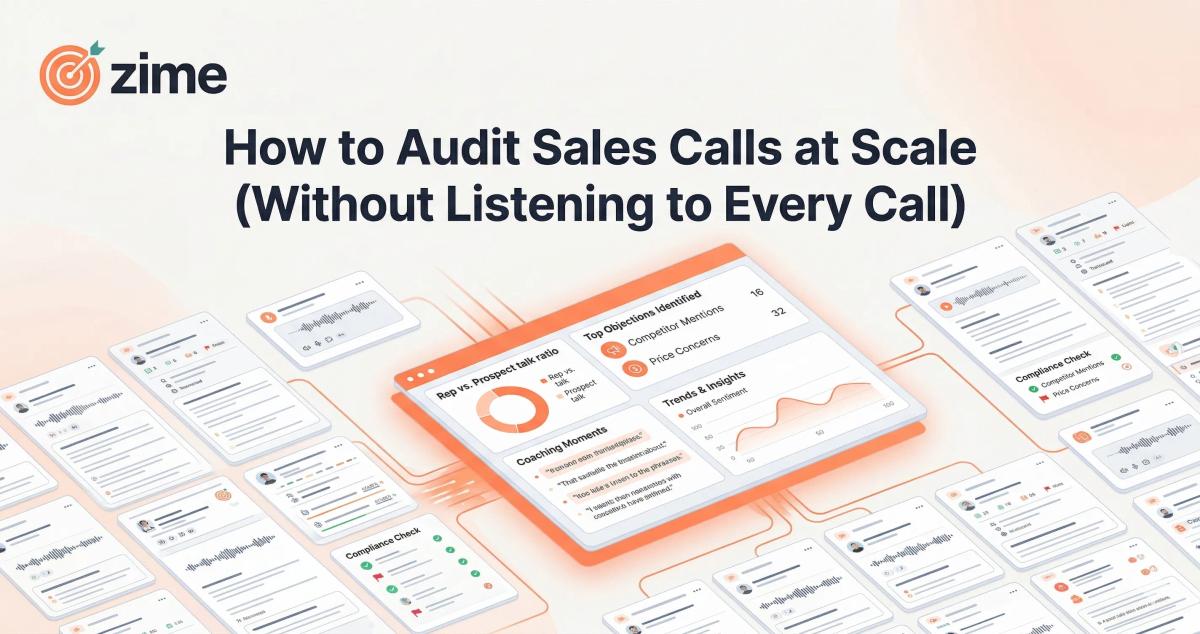
How do you audit sales calls at scale without listening to all of them? It is the right question, and most sales organizations are asking it years too late. Teams that have been running call recording for 18 months often find themselves with a growing library of conversations and no system to extract meaningful patterns from them.
The direct answer: you audit at scale by replacing manual spot-checking with behavioral scoring tied to your playbook, applied automatically across every call. Instead of sampling 1 to 2 percent of calls by chance, you score 100 percent of calls against defined criteria and surface only the gaps that require human attention. The goal is not to listen to everything. The goal is to know everything relevant without having to.
This is an execution problem, not a technology problem. The tools to do this exist. What most teams are missing is the operational model to use them.
The leaders asking this question typically manage 30 to 300 reps across multiple segments, product lines, or geographies. They have call recording in place, some form of CRM, and a playbook that exists somewhere in a shared drive or content management system.
What they do not have is a reliable way to close the loop between what reps are doing on actual calls and what the playbook says they should be doing. As a result, call data sits unused. Managers default to gut instinct or rep narratives during pipeline reviews. Coaching becomes reactive rather than systematic.
These are Revenue Operations leaders, VP Sales, Heads of Enablement, and CROs who know the data exists but cannot operationalize it fast enough to change rep behavior before the quarter ends.
The audit problem is really a signal problem. When a manager has 100 calls recorded in a week, three things typically happen. First, she reviews two or three at random, usually the ones flagged by reps or managers already aware of an issue. Second, those two or three calls confirm things she already suspected. Third, everything else goes unreviewed and un-coached.
Research by Avoma found that sales managers review less than 1 percent of all sales calls. For a team running 500 calls per week, that means fewer than 5 calls get reviewed. Worse, those 5 are not selected based on impact. They are selected by proximity, availability, or accident.
The operational consequence is that a rep can repeat the same mistake across 40 consecutive calls before anyone notices. The pattern never surfaces in a pipeline review because nobody has the data to see it. By the time it becomes visible, it has already affected deal outcomes.
Most call recording platforms store conversations and produce summaries. They do not assess whether a specific rep followed your qualification framework on a specific call. Generic AI analysis, applied uniformly across all calls, produces generic output. As one revenue leader described it: what Gong gives you is the same analysis whether you are a cybersecurity company or a construction firm. Somebody still has to listen to understand what actually happened.
The gap between what a playbook says and what a rep actually does is invisible without a scoring system. Playbooks live as documents. Calls live as recordings. Without a mechanism that applies the playbook to the recording automatically, both assets sit idle. One RevOps leader described the situation directly: "Your playbooks can never capture them. Your training in LMS will not drive adoption." The graveyard of unreviewed recordings is the predictable outcome.[
A typical manager with 8 to 12 direct reports who generates 3 to 5 calls per week cannot meaningfully review more than a fraction of those calls while also running pipeline reviews, forecast calls, and 1:1s. Gartner research confirms that 58 percent of sales reps need dedicated coaching sessions to improve, yet only 39 percent of reps report that their manager uses technology to coach them effectively. The math simply does not work without automation.
Even when managers do identify patterns, there is rarely a mechanism to feed those patterns back into the playbook and redistribute the insight to the full team. The learning stays in one manager's head or one coaching conversation. The same issues surface quarter after quarter.
The three most common approaches are variations of the same instinct: add more oversight.
Teams invest in call recording platforms and mandate recording compliance. They assign managers to review calls weekly as part of their development responsibilities. They build scorecards in spreadsheets and ask managers to manually fill them after reviews. Some teams implement smart trackers inside existing tools, attempting to flag when certain keywords appear on calls.
Each of these represents a reasonable step. Recording compliance creates the raw material. Manager review is the right concept. Scorecards provide structure. The problem is the operational mechanism connecting all three, which in most cases does not exist.
Manual review does not scale, and the math is not close. One manager reviewing one call per rep per week, with 10 reps each making 5 calls, means reviewing 10 out of 50 calls. That is 20 percent coverage, optimistically, on weeks when nothing else competes for the manager's time. In practice, it is closer to 5 percent or less, confirmed by research showing the industry average hovers under 1 percent.
Spreadsheet scorecards fail because they rely on a human completing them consistently, which is the same constraint the organization is trying to overcome. Smart trackers inside call tools fail because they match keywords, not behavioral intent. A rep can use all the right words while executing none of the right behaviors.
As one revenue leader noted, after teams in the Bay Area spent two years trying to fine-tune Gong and Clari for their specific nuances, the output still did not reflect what winning behaviors looked like for their specific sales motion. Generic intelligence is not the same as playbook-specific behavioral scoring.
The shift that makes call auditing scalable is separating the burden of auditing from the judgment of auditing.
Automated behavioral scoring handles the first part: every call gets analyzed against defined criteria drawn from your playbook, flagging gaps and surfacing the calls that need human attention. A manager who previously spent time deciding which 5 calls to review now spends that same time on the 5 calls the system has identified as highest priority for coaching.
The second part is feedback that reaches reps at the right moment. One insight that emerged across multiple conversations with revenue leaders is that real-time coaching during calls does not work, particularly on video. Reps are reading the customer. Notifications break focus. The right intervention is before the call, in the form of a prep note that surfaces what was left open on the previous conversation and what the playbook requires in the upcoming one.
When auditing produces behavioral scores, those scores create accountability. Managers arriving at 1:1s with specific behavioral data drive different conversations than managers arriving with general observations. The rep knows what the system sees. The conversation moves from "how is the deal going" to "here is what I need to do differently."
Across conversations with revenue leaders in enterprise and growth-stage SaaS organizations, the same frustrations surface when the topic is call auditing and coaching at scale.
Anant Saksena leads a sales team with approximately 55 field reps in the US. His organization uses Salesforce and Outreach, and at the time of the conversation had no call recording in place. He identified the fundamental visibility problem directly:
"When sellers go on review calls, the information they tell on why a deal is not closing is as good as what the seller is saying. We have no secondary insight or conversation intelligence to understand if what the seller is saying is right or not. There is no recording platform, no conversation intelligence in this case."
Anant Saksena, Sales Leader, B2B SaaS (India and US operations)
Navin Madhavan is VP Revenue at Amagi, a cloud broadcast and streaming technology company, heading up RevOps, sales enablement, and marketing operations. His team uses Clari for forecasting, Clari Copilot for call recording, Highspot for enablement, Salesforce as their CRM, and HubSpot for lead routing. Despite a mature tech stack, the audit gap remained:
"There is a play in Highspot where we are putting things down, and we are doing enablement calls. But we are not looking at calls to see if reps have hit the play or not. That is not something we're doing through call recording or otherwise."
Navin Madhavan, VP Revenue, Amagi
Vibhor Mishra is a C-suite revenue leader at Tavant, a product engineering and technology services company. In describing what he needed from a call intelligence system, he framed the audit problem in terms of scoring plus business outcomes:
"It is good to score reps on what they are doing in the call. But marrying that back to their targets, or how much they are booking quarter on quarter, is also something I do not see. That is why I wanted to ask how do we marry that data together."
Vibhor Mishra, C-Suite Revenue Leader, Tavant
Start by documenting 5 to 8 specific behavioral criteria tied to each pipeline stage. Not generic items like "listened well" but specific actions like "surfaced the cost of inaction," "confirmed budget authority," or "identified decision criteria." These criteria become the foundation of your scoring system and must be tied to your specific sales motion, not a generic framework.
Analyze 80 to 100 of your most recent closed-won deals. Identify the behavioral patterns that appear consistently in those calls but not in closed-lost ones. Use those patterns to validate and refine your criteria. A playbook built from real win data carries credibility with reps that a policy document does not.
Use behavioral scoring to flag every call against your criteria automatically. Set thresholds for what constitutes a coaching-necessary gap versus acceptable variance. The manager's job becomes reviewing flagged calls, not sampling calls. Coverage goes from under 5 percent to 100 percent without adding manager hours.
The highest-leverage moment for a coaching intervention is the 60 minutes before a rep's next call with the same buyer. Deliver a prep note to the rep in Slack or Teams that identifies what was left open in the previous conversation and what the playbook requires next. This turns audit data into just-in-time behavior change rather than post-mortem feedback.
Every quarter, review the patterns surfacing from your audit system. Which behavioral gaps are recurring across multiple reps? Which objections are appearing at high frequency without being handled well? Use this data to update criteria, add new playbook content, and redistribute winning behaviors from top performers to the full team.
Use these questions to identify where your call audit system is breaking down:
The question of how to audit sales calls at scale without listening to all of them has a clear answer: you stop auditing by listening and start auditing by scoring. The constraint is not human attention. It is the absence of a system that converts call behavior into structured, inspectable signals automatically.
Teams that close this gap do not just coach better. They make behavior visible across their entire pipeline, in real time, without adding manager hours. The result is that pattern recognition which previously required a manager to personally attend dozens of calls now surfaces automatically, enabling intervention at the right moment rather than the convenient one.
Auditing at scale is not a future capability. It is an operational model available now to any team willing to replace spot-checking with systematic behavioral scoring.
If you are ready to act
If your team is generating more call data than it can meaningfully review, it is worth seeing how behavioral scoring works in practice across a live pipeline. Book a Demo with Zime to see how we apply your playbook to every call automatically, surface coaching gaps by rep and deal stage, and delivers prep notes to reps before their next conversation.