Blog
Why Do We Lack Visibility Into Deal Health?
Most sales organizations have more tools than ever. Call recorders. CRM platforms. Forecasting dashboards. Pipeline review cadences. And yet, when a leader asks
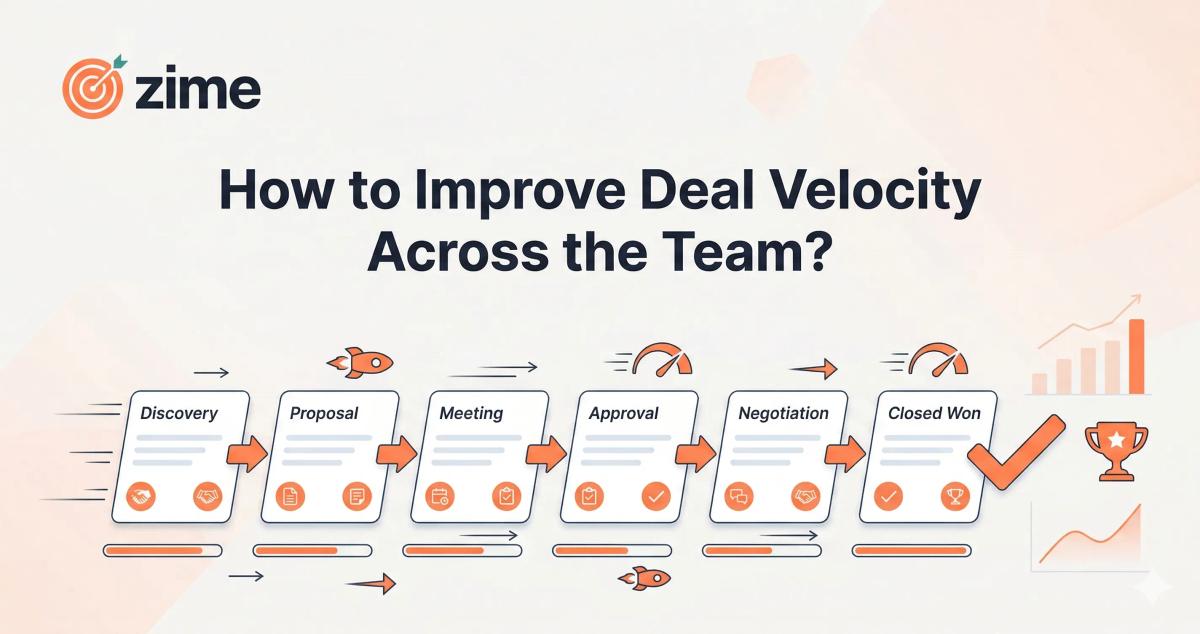
Deal velocity is the metric that separates revenue organizations that scale from those that survive quarter to quarter on heroics. When deals move slowly, forecast accuracy drops, pipeline reviews become fire drills, and the pressure on individual reps to compensate grows unsustainable.
The direct answer: improving deal velocity requires fixing three things in parallel. First, qualification discipline must be real, not self-reported. Second, managers need inspectable signals, not deal-by-deal interrogation in pipeline reviews. Third, reps need contextual coaching tied to their live deals, not periodic training events.
When all three break down together, which they frequently do in scaling SaaS organizations, the result is a pipeline full of deals labeled "progressing" that are actually stalling. Fixing the label does not move the deal. Fixing the execution does.
The leaders asking this question are not new to sales. They are VP Sales profiles managing teams of 10 to 50 reps, often across multiple segments with different sales motions. They are RevOps leaders who have instrumented their CRM, deployed a call recording tool, and still cannot explain why pipeline is not converting at the rate the top of funnel activity suggests it should.
They run weekly pipeline reviews that are too long, too deal-specific, and too dependent on rep self-reporting. They have tried methodology training, coaching certifications, and CRM hygiene initiatives. And they still see 60 to 70 percent of their pipeline sitting in an ambiguous "progressing" status that tells them almost nothing.
The pattern is consistent across B2B SaaS organizations: strong pipeline creation metrics, inadequate stage progression signals, and coaching that is reactive rather than proactive.
The visible symptom is simple. Deals sit in stages far longer than they should. Win rates are lower than they could be. Pipeline reviews consume manager time without generating actionable outputs. Forecasts are educated guesses.
Research from Selling Power confirms that 72 percent of all new B2B sales opportunities stall in the middle to late stages of the sales pipeline, defined as more than 60 days without customer action.
For enterprise deals, the problem intensifies. Analysis of deals exceeding $250,000 in value shows that 67 percent are stalled beyond their expected close dates, with 41 percent of those ultimately failing to close at all.
The operational reality underneath these numbers is that most pipeline reviews are structured around rep confidence levels rather than behavioral evidence. A rep marks a deal as qualified. A manager trusts the flag. The deal sits for another 45 days and eventually falls out of the forecast.
There are three structural causes that compound each other and are rarely addressed together.
Reps mark deals as qualified based on their intuition or on surface-level signals like a strong demo reaction or an interested champion. The underlying criteria, such as whether a timeline exists, whether a compelling reason to move has been established, or whether budget has been verified, are not systematically captured or inspected. Gartner research notes that only 53 percent of sales leaders can accurately forecast the progression of longer, more variable deal cycles.
Managers reviewing pipeline cannot see, from a dashboard, which deals meet exit criteria for the current stage and which do not. They cannot see whether a rep addressed the key objection surfaced in the last call, whether a timeline was established, or whether the customer expressed a compelling reason to move. Without this visibility, pipeline reviews default to rep interviews rather than behavioral audits.
When managers do coach, the input is typically directional. "Push for timeline." "Tighten your discovery." Without evidence from actual calls showing specifically what is missing in specific deals, the coaching does not change rep behavior on the next call. It creates awareness without action.
Revenue leaders facing velocity problems move through a familiar set of interventions:
Each of these is a reasonable response to a visible symptom. The problem is that none of them address the root cause. Better CRM fields do not change what reps say on calls. A more structured pipeline review does not help a manager identify which eight deals out of 47 most urgently need intervention. And call intelligence tools that surface generic insights do not tell a manager which specific behaviors are missing from specific deals in the current quarter.
The fundamental issue is that deal velocity depends on what happens inside sales conversations, not what gets logged in the CRM afterward.
When a rep does not establish a compelling reason to move, a budget conversation does not happen at the right moment, or an objection is acknowledged but not addressed, those gaps do not show up in CRM activity data. The deal shows calls logged, emails sent, and engagement tracked. It looks healthy from the outside. It is not moving because the conversation quality is insufficient.
Salesforce's State of Sales research shows that sales reps spend just 28 percent of their time actually selling. The rest goes to administrative tasks, CRM updates, and internal meetings. Every process-heavy intervention, whether it is a new CRM workflow, a new review format, or a new tool that requires manual configuration, adds to the administrative load without adding to the selling quality.
Additionally, Gartner's 2025 CSO research found that sales leaders who coach using comparative performance data are 4.3 times more likely to grow profits. The gap is not the intent to coach. It is the absence of the specific, deal-level data required to make coaching targeted and timely rather than directional and generic.
Improving deal velocity requires building a system that connects what happens in conversations to what appears in pipeline data. This is not a theoretical improvement. It produces measurable results when implemented with consistency.
Deals that meet clearly defined qualification criteria are two to three times more likely to close than poorly qualified opportunities, according to Forecastio analysis. Companies that tighten qualification consistently see a 20 to 40 percent increase in win rates, often while reducing pipeline volume and sales cycle length.
The critical shift is moving from rep-declared qualification to data-supported qualification, where the system can show whether a deal actually has a documented timeline, an established consequence of inaction, and a confirmed budget conversation, based on what happened in the calls, not what the rep reported afterward.
Pipeline reviews become significantly more productive when the manager enters the review knowing which deals need attention and why. Specifically, they need to know which deals are genuinely qualified and progressing, which are stuck despite engagement, and which are stuck because the rep has not addressed a critical objection. This transforms a 30-minute pipeline review from a deal-by-deal interview into a focused coaching conversation about the five deals that need intervention.
Pre-call prep notes that surface what was unresolved in the last conversation, what objection was raised but not answered, and what behavior from top reps is most relevant to the current situation change rep behavior more effectively than after-the-fact review. The guidance reaches the rep at the moment they can act on it.
Research from MySalesCoach and EBSTA confirms that reps receiving regular coaching on discovery and qualification are 30 percent more likely to hit quota, and reps with strong qualification skills show 23 percent higher win rates than their peers.
These patterns surface consistently in conversations with revenue leaders navigating deal velocity challenges at scaling technology companies.
"There is very little we can do to accelerate some of our longer enterprise cycles because the CTO simply doesn't think it is a pressing problem. Helping reps surface a compelling reason to move, at the right moment, for the right audience, is where we need to get better."
Navin Madhavan, Head of Revenue Operations, Amagi
"60 to 70 percent of the deals in our pipe will show as progressing. So I take a quick look. If something is really in the red, we talk about it. Otherwise I don't give it too much attention. The problem is I'm missing signals on the deals that look fine but are quietly stalling."
Suraj Ramesh, Sales Leader, Sprinto
"A lot of deals are stuck and you don't know how many of them even met qualification criteria, and how many of them met criteria but your reps are simply not engaging properly. That distinction matters enormously for how you coach and where you spend manager time."
Sanchit Garg, CEO & Co-founder, Zime
Use this five-step framework to diagnose and close the gap between pipeline creation and pipeline conversion.
Do not ask reps to self-report. Pull the last 30 closed-won deals and identify which qualifying behaviors, specifically which questions were asked, which customer responses were captured, and which objections were addressed, consistently appeared. These are your real qualification criteria, not the theoretical ones in your playbook.
Every deal in your pipeline falls into one of four practical buckets: qualified and progressing, qualified but rep is under-engaging, engaged but critical objections are unresolved, or marked qualified but qualification criteria were never actually met. Knowing which bucket each deal sits in changes where managers spend their time.
Not every deal deserves equal attention in a pipeline review. Deals that are genuinely qualified, have strong customer engagement, and have one or two resolvable objections represent the highest-return coaching investment. Give managers the view to find these deals quickly.
The most effective behavior change happens when the rep receives specific, deal-relevant guidance before the next conversation, not after. A pre-call note that says "this customer raised a pricing objection last time and you did not resolve it, here is how your top performers handle it" changes the quality of the next call in a way that a post-call debrief cannot.
If you are losing deals to a specific competitor in a specific stage, that information should reach reps within weeks, not after the next sales kickoff. Living playbooks that update based on ongoing win-loss patterns close the execution gap continuously instead of only at scheduled training events.
Use this diagnostic to identify where deal velocity is breaking down in your organization:
If you answered no to three or more of these questions, the velocity problem is structural. More activity will not solve it.
Improving deal velocity across the team is not primarily a process problem or a motivation problem. It is a visibility and execution problem. When managers cannot see which deals need intervention and why, coaching is generic. When reps lack deal-specific guidance before critical conversations, qualification and objection handling are inconsistent. When qualification criteria exist in documents but not in data, pipeline reviews are theater rather than strategy.
The organizations closing this gap are building systems that connect what happens in sales conversations to what appears in pipeline dashboards, that give managers inspectable signals rather than rep opinions, and that deliver rep guidance at the moment of each deal rather than in quarterly training events. That is the foundation on which deal velocity improves, and it is what allows average performers to close at a rate that begins to approach what your top reps have always done.
For revenue leaders ready to act
Book a Demo to explore how deal execution systems, built on behavioral signals from real sales conversations, can give your managers the pipeline visibility they need to coach with precision and move deals faster across every rep on the team.