Blog
Why Do We Lack Visibility Into Deal Health?
Most sales organizations have more tools than ever. Call recorders. CRM platforms. Forecasting dashboards. Pipeline review cadences. And yet, when a leader asks
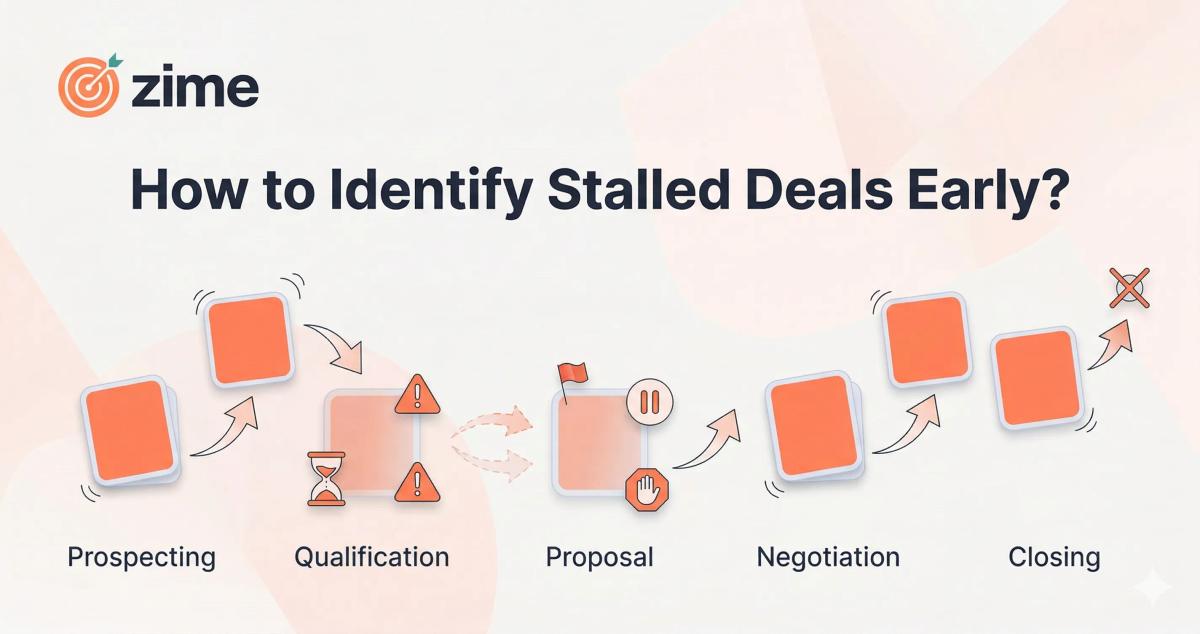
In multiple conversations with revenue leaders across B2B SaaS organizations, one question surfaces more consistently than almost any other: How do I know which deals are actually moving, and which ones have quietly died? The phrasing changes, but the frustration is identical. Pipeline reviews look busy. CRM stages appear active. Yet quarters close with shortfalls that nobody saw coming.
Identifying stalled deals early is not just a tactical advantage. It is the difference between a forecast you can defend and one that embarrasses you in front of the board. The answer lies in separating pipeline activity from pipeline progress, and building the operational muscle to act on that distinction before the quarter is over.
This challenge is not unique to one company or one market. It shows up across sales teams that are scaling, teams managing high-velocity SMB pipelines, and teams running long-cycle enterprise motions.
VP Sales leaders managing 10 to 50 reps face it acutely because they have limited time per rep. Pipeline reviews are compressed into 30-minute windows, and there is no realistic way to inspect every deal at depth. CROs at growth-stage SaaS companies face it as a forecasting problem: the board wants numbers, but the pipeline data feeding the forecast is structurally unreliable. Sales enablement leaders face it as a behavioral problem: reps update CRM stages without the underlying activity to justify it.
What connects all of them is the same structural gap. The information needed to identify stalled deals exists somewhere, typically scattered across call recordings, email threads, and CRM notes. But it has never been organized, scored, or surfaced in time to act on it.
The visible symptoms are well known to anyone who has run a pipeline review. Deals sit in the same stage for three, four, even six weeks. Close dates get pushed. "Strong" opportunities disappear from the forecast without a clear loss reason. Reps describe deals as "progressing" while no meaningful customer action has occurred in two months.
According to research from Selling Power, 72% of all new sales opportunities stall in the middle to late stages of the B2B sales pipeline, defined as no customer action for more than 60 days. Separate analysis found that 67% of enterprise deals exceeding $250,000 are stalled beyond their expected close dates, with 41% ultimately failing to close at all. Alongside these, industry estimates suggest 30 to 40% of B2B pipeline goes silent at some point, representing real revenue that was never formally lost, just quietly abandoned.
What makes this painful is that most of these deals were real opportunities at some point. They were not disqualified. They were neglected, mis-navigated, or left at a stage that no longer reflected reality. That distinction matters enormously for how you respond.
Stalled deals rarely happen because the market changed or the prospect lost interest overnight. They happen because of structural gaps in how sales teams track and respond to deal health in real time.
The first cause is shallow CRM data. Most reps update pipeline stages based on their own activity, not on what the customer has said or done. A rep sends a follow-up email and moves the deal to "proposal." But the customer has not responded, raised a concern, or confirmed any urgency. The stage now reflects rep behavior, not deal reality.
The second cause is forecast data that stays at surface level. Tools built on call transcripts often give leaders "step-one" data rather than deal-validated signals. A deal gets marked as qualified because a transcript flagged a pain point, but nobody confirmed urgency, timeline, or budget. The forecast inherits that optimism without the underlying substance.
The third cause is manager bandwidth. Research shows 93% of sales leaders are unable to forecast revenue within 5% accuracy even with two weeks left in a quarter. Part of that is because managers are working from secondhand information, relying on what reps tell them in compressed reviews with no independent signal to validate or challenge those assessments. Fewer than 20% of B2B sales organizations consistently forecast within 5% of actuals. \
The fourth cause is unaddressed objections. A deal looks healthy on the surface. Calls are happening, emails are going out. But the customer raised a concern in one of those calls that the rep either did not fully register or did not know how to handle. According to research from the JOLT Effect study, 40 to 60 percent of deals in the pipeline are lost not to a competitor, but to "no decision," driven by unresolved buyer indecision and unanswered concerns.
The most common response is to add more process. Teams roll out new CRM hygiene rules and mandate more fields. They introduce deal review templates and stage-exit criteria. Some invest in call recording platforms to capture more conversation data. Training programs get launched. New sales methodologies get adopted.
These efforts are not wrong, but they consistently underdeliver on the core problem. Call recording tools generate transcripts and generic summaries. CRM hygiene rules get followed for two weeks and then fade. Deal review templates become checkbox exercises that reps complete without real inspection. Pipeline reviews remain dependent on manager intuition and rep self-reporting.
The underlying problem does not change: nobody has a reliable, real-time signal for which specific deals are stalling and why. The data volume increases while the clarity does not.
The core issue with standard approaches is that they generate more data without generating more actionable context. A transcript-based system tells you what was said on a call. It does not tell you whether the exit criteria for that stage were met, whether the prospect's engagement is trending upward, or whether there is a fatal objection sitting unaddressed in the conversation history.
According to Gartner, fewer than 50% of sales leaders have high confidence in their forecasts, and poor data hygiene is cited as one of the leading reasons forecasts miss by more than 10%. The reason is not lack of data. It is the absence of contextual scoring: data that tells you not just what happened, but whether what happened was good enough for this deal at this stage.
Generic call recording also fails because it treats all conversations the same way. A discovery call for a high-velocity SMB deal requires different success criteria than a third-stage negotiation call for a $200K enterprise opportunity. Tools that score activity without understanding deal context produce noise, not signal. This is a pattern that shows up repeatedly in conversations with practitioners who have been through multiple enablement cycles.
Identifying stalled deals early requires three things working together: clear stage exit criteria based on customer behavior, multi-dimensional engagement scoring, and proactive surfacing of at-risk signals to the right person before the window to act closes.
Stage exit criteria means defining, in specific terms, what a customer must have said or done before a deal legitimately advances. Not what the rep did. Not what was discussed. What the customer confirmed. Did they articulate a clear pain point with a timeline? Did they express urgency? Did they identify a decision-maker and describe a budget process?
Engagement scoring means tracking two separate dimensions: rep engagement and prospect engagement. A high rep score with a low prospect score is a warning signal. The rep is active, but the right person on the buyer side is not responding. That is a stall in progress. A high prospect score with low rep engagement is equally dangerous: the buyer is showing interest, but the rep is not capitalizing on it.
Surfacing means that managers cannot wait for the weekly pipeline review to discover a problem. At-risk signals need to reach the manager before the damage is irreversible, enabling coaching conversations instead of loss postmortems.
During a recent series of revenue conversations, sales leaders at B2B SaaS companies described this problem with striking consistency.
During a deep-dive pipeline review session, Suraj Ramesh, Head of Revenue Operations at Sprinto, a compliance automation SaaS company based in Bangalore managing a high-velocity inside sales team targeting SMB and mid-market segments, described the practical constraint every frontline manager faces:
"I just have 30 minutes with each rep every week for a pipe review. In 30 minutes, it's impossible for me to go into such depth. What I need is: closing soon, progressing, and stuck. For the stuck bucket, I just need simple pointers. Was it properly qualified? Are there enough touchpoints? Are emails going out? Are follow-up calls being scheduled? That's it."
Aravind Chandrashekar, a senior sales leader working across multiple B2B SaaS revenue teams in India, articulated the question that sits at the center of every pipeline review:
"From a sales leadership, pipeline review angle, the fundamental baseline 101 question is: how do I know which deals I need to act on so that it moves fast? The combination of deal score and activity tells you where to fix the bug first, so the deal starts progressing."
On the specific mechanism that turns an unaddressed concern into a lost deal, Aravind described a pattern that recurs across sales teams of different sizes and verticals:
"The customer has very explicitly spoken about the concern. If the rep is not addressing the concern, there are only two outcomes. The deal is going to stall, or the deal is going to go to a competitor."
Navin Madhavan, a VP-level revenue leader at Amagi, a media technology company scaling enterprise and mid-market sales across India, North America, and APAC, described the intelligence gap that makes deal health invisible without conversation-level data:
"When sellers go on review calls, the information they give about why a deal is not closing is as good as what the seller is saying. There is no secondary insight or conversation intelligence to understand if the seller is right or not, because there's no recording platform, there's no conversation intelligence in this case."
Step 1: Define stage exit criteria based on customer behavior, not rep activity.For each pipeline stage, write out what the customer must have done or confirmed before the deal advances. Qualification requires expressed pain, clear timeline, and a known decision-maker. Late-stage requires budget confirmation, a known evaluation process, and no unresolved objections.
Step 2: Score deals on two axes: qualification quality and engagement recency.Qualification quality reflects how well the deal meets your stage-exit criteria. Engagement recency captures whether the customer has been responsive in the last 7 to 14 days. High qualification quality with low recent engagement is a stall warning. Low qualification quality with a rep-assigned "closing soon" status is a forecast risk.
Step 3: Separate rep engagement from prospect engagement in your pipeline review.Many CRM activity logs only track what reps do. Add signals for what the prospect has done: responded to follow-ups, scheduled the next meeting, introduced a new stakeholder. Deals where rep activity is high but prospect activity is flat are stalling regardless of what the stage label says.
Step 4: Triage weekly by deal category, not by deal list.Instead of reviewing 47 deals one by one, group them: closing soon, progressing actively, stalled-qualified, and stalled-unqualified. Focus manager coaching time on the stalled-qualified group. These are the deals with the highest recoverability and the highest cost of losing.
Step 5: Act within 72 hours of identifying a stall.When a stalled-qualified deal surfaces, the manager's job is to identify the specific objection or engagement gap and work with the rep on a targeted next action. That might mean an escalation email, bringing in a senior leader, or sending a relevant case study. The window to recover a stalled deal is narrow, and waiting for the next weekly review significantly reduces recovery odds.
Run through this diagnostic to understand where deal stalls are entering your pipeline:
If the honest answer to most of these is no, you are operating with a lagging indicator system. You are learning about stalled deals after they have already cost you the quarter.
Identifying stalled deals early is a structural discipline. It requires clear definitions of what "progress" actually means at each stage, multi-dimensional engagement signals that separate rep activity from prospect intent, and a cadence of proactive coaching before the deal window closes.
The data is consistent: the majority of B2B pipeline sits in various states of stall at any given time, and most of that pipeline is recoverable with earlier detection. The sales leaders who consistently outperform their forecasts are not the ones with the most optimistic pipelines. They are the ones who know the difference between a deal that is moving and one that just looks like it is.
For revenue leaders ready to act
If you want to see how Zime surfaces stalled deals, scores engagement by stage, and prioritizes your pipeline review in real time, book a live demo with a revenue expert.