Blog
How to Improve Sales Discovery with AI in 2026: A Practical Guide
AI improves sales discovery by automating conversation analysis, predictive scoring, and personalized outreach, helping teams qualify opportunities faster and m
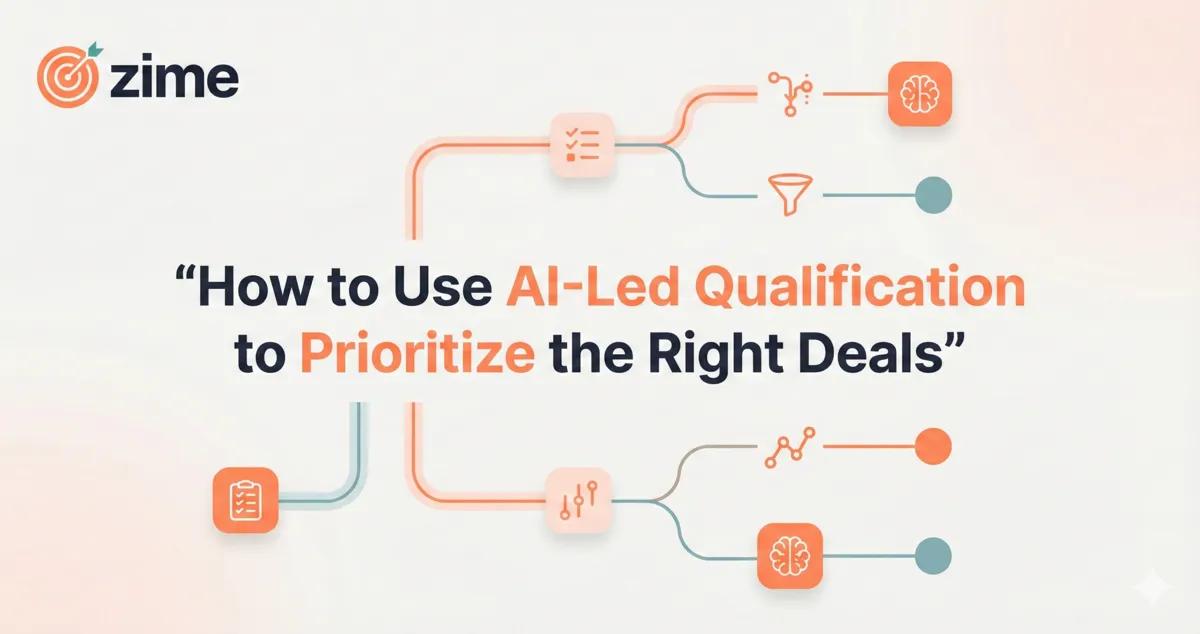
AI-led qualification uses machine learning to analyze behavioral signals, engagement patterns, and historical data to predict which leads are most likely to convert. Companies implementing AI-powered predictive scoring see 40-60% more accurate lead prioritization compared to rule-based systems, with teams reporting 20-30% higher conversion rates and 30-40% reduction in initial qualification time.
• AI lead qualification transforms manual scoring into a continuous, self-improving system that analyzes past interactions and purchase patterns to rank prospects by conversion likelihood
• Poor lead prioritization wastes 67% of sales reps' productivity, costing a 15-person team approximately $480,000 annually in salary alone
• Companies using AI-augmented qualification report 41% higher revenue per rep ($1.75M vs $1.24M) and 78% ICP targeting precision
• Effective implementation requires clean data, the right ML models (decision trees, logistic regression), and regular updates to keep scoring accurate
• Smart disqualification through AI automation reduces unproductive outreach by 45% and frees up 30+ rep hours monthly
AI lead qualification is no longer a competitive advantage; it is table stakes for B2B revenue teams aiming to hit quota consistently. The predictive lead scoring market is projected to reach $5.6 billion by 2025, growing at a 38% CAGR, and teams using AI predictive scoring see 40-60% more accurate lead prioritization compared to rule-based systems. Yet the real payoff is not just accuracy; companies that implement AI lead scoring report 20-30% higher conversion rates and reclaim the hours reps once lost chasing unqualified prospects.
This post provides a step-by-step playbook for building, deploying, and continuously improving an AI-led qualification engine that helps your team focus on deals most likely to close.
AI lead qualification refers to the use of artificial intelligence technologies to identify, attract, and nurture potential customers. Rather than relying on static rules or gut instinct, machine-learning models evaluate demographic fit, buying intent, and historical conversion patterns to flag the prospects most likely to close.
Lead qualification itself is the process of evaluating and scoring leads based on demographic, behavioral, and contextual data. It is not a one-time event but an ongoing, dynamic process that requires constant monitoring and adjustment. AI transforms this process from a manual, error-prone exercise into a continuous, self-improving system.
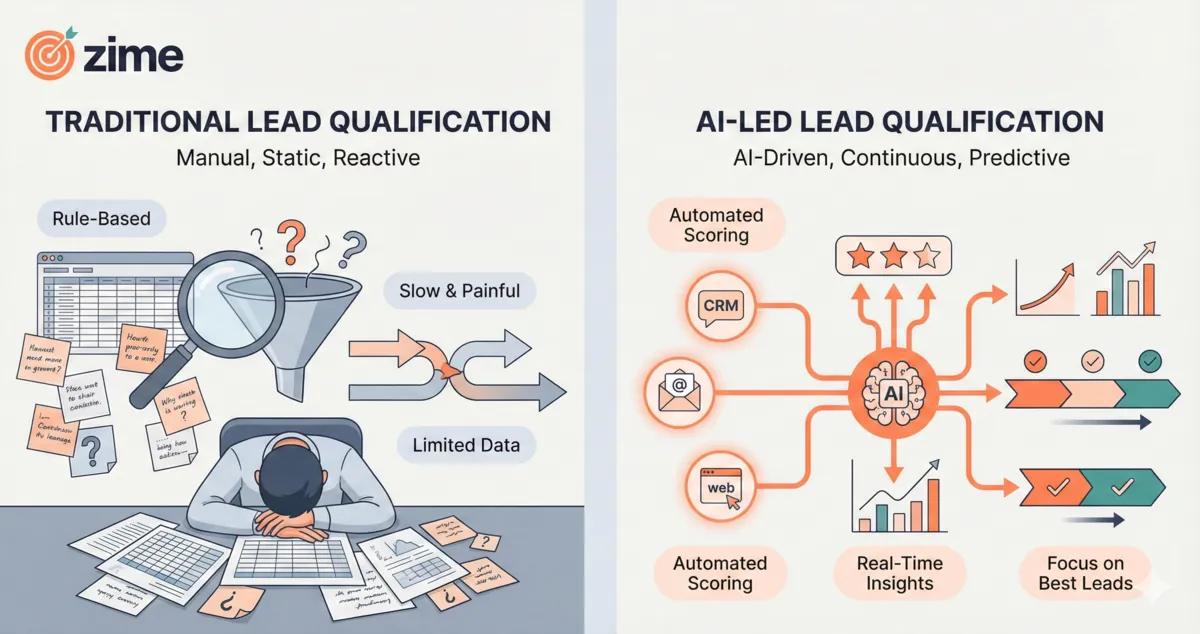
The business impact is substantial. Poor lead prioritization is the biggest productivity killer for 67% of sales reps. Meanwhile, AI scoring cuts initial qualification time by 30-40% because it flags the most promising prospects upfront. When reps spend less time researching and more time selling, pipeline velocity accelerates and forecast accuracy improves.
Manual and rules-based qualification frameworks carry costs that rarely appear on a balance sheet but erode revenue nonetheless. A 15-person sales team spending 20% of its time on bad leads wastes approximately $480,000 per year in salary costs alone. That figure ignores opportunity cost, morale drag, and the compounding effect of missed forecasts.
Gartner reports that the average B2B purchase decision involves six to ten stakeholders. Traditional frameworks like BANT, which rely on four criteria (Budget, Authority, Need, and Timing), often lack the depth to navigate these complex buyer journeys. Deals slip because a single champion is mistaken for full buying-committee support, or because static scoring fails to detect a shift in urgency.
Deals are not qualified just once; they need to be constantly tested and retested with the goal of exiting, either forward or out, as soon as possible. When sales leaders treat qualification as a one-time checkpoint, they allow zombie deals to linger in the pipeline, inflating forecasts and diverting resources from winnable opportunities.
Key takeaway: The true cost of traditional qualification is not the leads you chase; it is the deals you could have closed while chasing them.
Classic qualification frameworks remain valuable, but they gain new power when layered with predictive intelligence. An ideal customer profile (ICP) aligns sales and marketing to the highest-value accounts and focuses efforts on converting them into customers. BANT provides a quick, accessible checklist: Budget, Authority, Need, and Timeline. MEDDIC adds depth with Metrics, Economic Buyer, Decision Criteria, Decision Process, Identify Pain, and Champion.
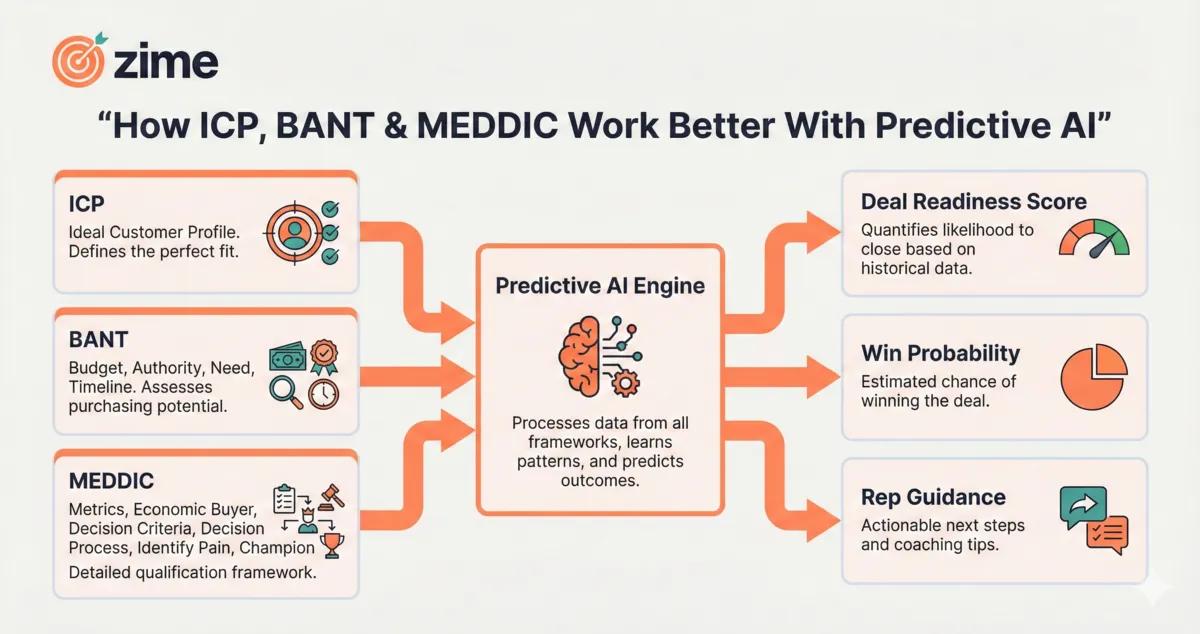
AI-powered lead scoring models can integrate BANT and MEDDIC parameters to rank prospects by readiness and fit. Machine learning models predict the likelihood of deal closure based on historical BANT and MEDDIC data patterns, while AI-driven coaching platforms analyze sales calls and CRM notes to provide reps with tailored advice on engaging economic buyers or uncovering pain points.
Companies using MEDDIC report up to a 25% increase in win rates due to better qualification and alignment with buyer needs. Predictive scoring amplifies those gains by surfacing patterns humans miss, such as subtle engagement declines or shifts in stakeholder sentiment, and translating them into actionable deal scores.
The goal of ICP development is simple: identify the accounts most likely to become high-value customers. Without a well-defined ICP, lead qualification becomes a guessing game.
Start by analyzing your most successful customers. Which accounts generate the highest revenue? Which have the lowest churn? Quantitative analysis of historical prospect and customer data helps identify common attributes of the most (and least) valuable accounts. Attributes may include industry, company size, budget, pain points, and SLA expectations.
According to Forbes, 81% of people prefer a company that offers a personalized experience. A data-driven ICP enables that personalization at scale, ensuring marketing campaigns resonate and sales outreach hits the mark.
AI lead scoring changes the game, helping teams prioritize the right prospects, shorten sales cycles, and boost conversions by up to 30%. Building that engine requires three ingredients: clean data, the right model, and a continuous improvement cadence.
Predictive lead scoring models are expected to replace traditional models as they positively impact sales performance. Classification algorithms, particularly decision trees and logistic regression, are the most commonly applied. Monitor and refine models regularly; regular updates and reviews keep scoring accurate and relevant.
Predictive lead scoring uses a machine-learning model to calculate a score for open leads based on historical data. In Dynamics 365 Sales, you need at least 40 qualified and 40 disqualified leads within a chosen timeframe to train the model.
Oracle Sales uses a built-in machine-learning model that recalculates the AI Lead Score every 12 hours based on updates salespeople have made. HubSpot allows you to create lead scores for contacts, companies, and deals, with engagement, fit, and combined scores calculated based on event and property rules.
The result is a single source of truth. Reps open their CRM and immediately see which leads warrant attention, eliminating the guesswork that slows pipeline velocity.
AI systems do not improve by accident; they improve when taught continuously. The AI Learning Loop is the discipline of reviewing results, refining prompts or models, and testing new approaches in a structured way.
AI feedback loop integration transforms static models into adaptive systems that improve through each user interaction, error correction, and performance measurement. Microsoft's AI Builder feedback loop feature helps automate this continuous process, though currently limited to custom document processing models.
Practical steps include:
A score without action is just a number. The real value of AI-led qualification emerges when scores drive in-flow guidance, disqualification decisions, and resource allocation.
Sales teams that disqualify 20% of leads see 19% higher conversion rates. Unqualified leads waste 33% of a sales rep's time, which equates to more than one full day per week. AI-powered platforms continuously analyze emails, calls, and meetings to flag subtle risk signals, such as missing next steps, disengaged stakeholders, or dropped urgency, as they happen rather than after deals stall.
One secure-network solutions provider implemented just-in-time Actions tailored to their sales strategy. "This resulted in a 20% increase in pipeline by reducing wastage of leads." Leaders reclaimed 50% of their time while deals progressed faster across stages.
By far, the most common class of red flags is based on prospects going dark. But silence is not the only signal. Common disqualification reasons include Not Interested, No Budget, Unable to Reach Prospect, In Selection Process with Competitive Solutions, Incorrect Data, and Wrong Contact.
Companies automating lead disqualification reduce unproductive outreach by 45%. AI-powered disqualification can free up 30+ rep hours per month. The discipline is not about rejection; it is about focusing on high-fit prospects to drive better sales outcomes. Notably, 18% of disqualified leads re-engage within six months when nurtured correctly, so smart disqualification feeds a healthy re-engagement pipeline.
Quantifying the ROI of AI-led qualification requires tracking the right metrics across the revenue cycle.
Metric
Definition
AI Impact
Pipeline Velocity
Speed at which deals move through stages and convert to revenue
High velocity signals efficient conversion to closed-won
Forecast Accuracy
Degree to which predicted sales match actual outcomes
Companies with accurate forecasts are 10% more likely to grow revenue YoY
Win Rate
Percentage of opportunities closed-won vs. total closed
AI-augmented reps achieve 41% higher revenue per rep ($1.75M vs $1.24M)
Sales Cycle Length
Days from opportunity creation to close
Shorter cycles correlate with higher win rates
Pipeline velocity is calculated as (Number of Opportunities × Average Deal Value × Win Rate %) / Sales Cycle Length. Accurate sales forecasts are essential for making key decisions about short-term spending and key account deals; their downstream effects are far-reaching.
ICP targeting precision improves from 52% to 78% with AI-powered scoring, reducing wasted effort on mismatched prospects by 48%. Automated time allocation reduces manual tasks by 32%, enabling reps to spend 80% of their time on customer-facing activities versus 48% in traditional models.
Technology alone does not guarantee results; adoption does. Only 25% of frontline employees say they receive sufficient guidance from leadership on how to use AI effectively. Meanwhile, 96% of surveyed leaders believe AI will transform their sales organization in the next one to two years, yet only 6% are confident their teams are well-equipped to use sales AI effectively.
Successful teams follow a playbook:
AI agent adoption accelerates when CROs and RevOps leaders set the vision, define success, and publicly support the rollout. The goal is not adoption for its own sake but measurable impact on pipeline quality, forecast accuracy, and revenue outcomes.
AI-led qualification is not a one-time implementation; it is a discipline. Bureau, a no-code identity decisioning platform, implemented AI-powered coaching and CRM automation. "Bureau realized a 30% increase in deal conversion from improved discovery." Reps saved an hour each day on CRM updates, and managers gained clear visibility into adoption and performance.
Unqualified leads waste 33% of a sales rep's time. Organizations that embrace AI-led qualification reclaim that time, convert more pipeline, and build a self-improving system that gets smarter with every closed-won and closed-lost outcome.
For revenue teams ready to move beyond static training and manual scoring, Zime offers Living AI Playbooks that continuously learn from real sales conversations and outcomes, delivering just-in-time guidance that helps every rep sell like the best.