Blog
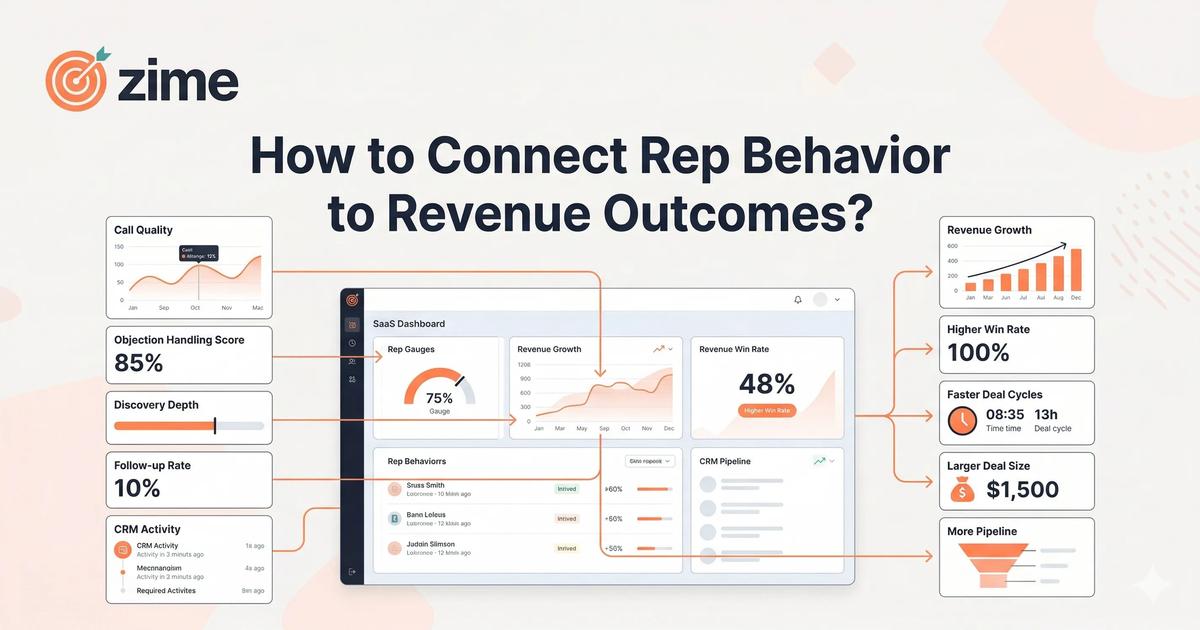
How to Connect Rep Behavior to Revenue Outcomes?
Connecting rep behavior to revenue outcomes is one of the most persistently unsolved problems in B2B sales leadership. Revenue teams have dashboards full of act


The calendar looked busy, but the conversations never produced the signals that correlate with decisions. If forecasting is supposed to be a probability-weighted view of revenue, the dataset should reflect how buyers actually move, not how sellers record their day.
Activity logs still matter for hygiene. They do not explain momentum. Buyers tip their hand in different ways, and those cues sit inside conversations, follow ups, mutual plans, stakeholder choreography, and the consistency of discovery. When those elements are explicit and measurable, pipeline reviews turn from theater into triage, and AI sales forecasting starts to look like a model of behavior rather than a count of tasks.
Modern benchmarks reinforce the gap. HubSpot's 2024 research reports an average win rate of 21 percent and an average close rate of 29 percent across more than 1,400 sales professionals, with a median deal size of four thousand dollars. The headline is not the number, it is the spread, since teams with comparable activity footprints produce very different outcomes. That is a clue. Similar calendars, different behaviors, different results.
A behavior first approach asks a simpler question. Which observable signals inside the sales motion increase the odds that a buyer will advance or sign. Multi threading is a clean example. Gong's published analysis shows that in deals over fifty thousand dollars, engaging multiple stakeholders boosts win rates by an average of one hundred thirty percent. It is not the email volume that moves the needle; it is the presence of the right people in the right sequence.
The same pattern holds for agentic AI, the class of systems designed to monitor, reason, and trigger next best actions in the flow of work. McKinsey frames the shift as a move from passive copilots to proactive teammates that watch pipelines, initiate follow ups, and enforce process logic aligned to a company's value creation levers. Forecasts improve when those agents operate on behaviors that matter to your motion rather than generic tasks that look busy.
Zime was built around that premise. Instead of treating the playbook as a PDF, Zime encodes your sales strategy as Living AI Playbooks that show up where reps already work, then observes conversations to turn those plays into measurable behaviors. Zime's Smart Call Summaries translate calls into structured signals, Zime's CRM Auto Update writes clean facts back into your system of record, and Zime's Pipeline Review brings those facts to the foreground so coaching centers on behavior rather than opinion. The outcome is AI sales forecasting based on deal qualification AI and predictive deal scoring that reflect real buyer movement, not a tally of completed tasks.
Customer results point in the same direction. Bureau reported a thirty percent increase in deal conversions after tightening discovery with checklists mapped to their motion and automating post call documentation. The lift did not come from more logged calls. It came from consistent discovery behaviors that revealed impact and qualified accurately.
Versa Networks cut coaching time in half while improving pipeline progress and increasing win rates. Their leadership highlights a shift from rehashing recordings to focused, behavior level coaching using signals captured from calls and reflected in CRM. That change freed managers for strategy and gave reps a self serve way to improve where it counts.
Internal interviews echo the same mechanism. Teams that position Zime as a source of truth for reps, not surveillance, see adoption because the product shows them missed opportunities that affect pay and advancement. The message is practical. Here is the stakeholder you have not touched in four months. Here is the discovery thread you keep skipping. Here is how a peer handles it to move deals forward. That is behavior, not activity.
Champions tend to be outcome focused CROs and sales leaders who own revenue predictability and are willing to sponsor adoption when they see a path to fewer revenue leakages. In markets where predictability has slipped, they want systems that tie behavior change to forecast quality, and they can mobilize enablement once the stakes are clear.
Start by defining the handful of buyer signals that separate wins from losses in your motion. For complex B2B cycles, include stakeholder coverage by persona, mutual plan milestones accepted by the customer, discovery depth on technical constraints, risk surfaced and resolved, and economic signoff steps observed in sequence. Treat these as fields the system infers from conversations and documents, not as manual checkboxes. Zime's Smart Call Summaries and CRM Auto Update handle that translation, while Living AI Playbooks make the expected behavior visible before each meeting.
Next, align coaching and review to those signals. Managers should read a pipeline through stakeholder maps and plan acceptance, not through the volume of logged tasks. Zime's Pipeline Review and AI Rep Coaching center those behaviors so feedback becomes concrete. Over time, Win Loss Analysis correlates the presence of signals with outcomes and tunes the playbook. This is how evolving playbooks in AI sales stay alive, and how predictive deal scoring learns from what your best sellers already do.
Finally, measure the shift. Compare forecast accuracy at the region or segment level before and after the change. Track movement on cycle time, slippage, and conversion at key handoffs. External research suggests why you will see a difference. Teams that consistently engage the right stakeholders and orchestrate complex deals outperform those that stay single threaded, and the lift is large enough to move a quarterly forecast.
Static training produces awareness, not adoption. AI sales enablement works when the system turns strategy into just in time guidance and captures the resulting behavior without friction. That is why agentic systems aligned to your process logic produce durable gains and why broad activity counters rarely do. McKinsey's recent work highlights the need to align agents with company specific data flows and decision logic to create impact that is difficult to copy. BCG's findings underline the same lesson at the enterprise level. Many firms still struggle to convert AI experimentation into scaled value. Behavior first design helps cross that gap because it connects AI to the few high leverage actions that change revenue.
Pick one motion where forecasting feels least trustworthy. For that motion, codify the discovery flow and proof sequence as a living playbook, define the small set of buyer signals that indicate movement, wire conversation understanding to update those signals in CRM, and run pipeline reviews against that evidence for two to four cycles. If, like Bureau and Versa, you see conversion, coaching time, and pipeline reliability improve, you will know your forecast finally reflects behavior and not a busy calendar.
Start your behavior-first forecasting pilot - no fees, no training till you see results.
No more activity-based forecasts that miss the real buyer signals!
In an era where sales forecasting accuracy determines revenue predictability, the shift from activity logs to behavior data represents a fundamental improvement. AI sales forecasting that captures real buyer signals like multi-threading, stakeholder engagement, and mutual plan acceptance outperforms traditional methods by connecting directly to what drives decisions. When powered by evolving playbooks and AI rep coaching, this approach transforms forecasting from guesswork into a reliable model of buyer movement.