Blog
Why Don't Sales Playbooks Drive Behavior Change?
Sales playbooks exist in nearly every B2B organization. Most of them collect dust. This is not a content problem. It is not a training problem. It is a behavior
Adopting new sales messaging frameworks requires systematically building buyer-aligned narratives, embedding guidance into rep workflows, and reinforcing with spaced learning. Teams using AI-powered coaching see 91% of reps meet or exceed goals, while those closing deals within 50 days achieve 47% win rates versus 20% after that threshold.
• 44% of go-to-market leaders are prioritizing changes to sales messaging and positioning as static pitches fail to connect with modern buyers
• Spaced learning beats one-time training - distributed training sessions show 0.32 standardized mean difference in knowledge retention over massed education
• AI coaching drives results - 91% of organizations using AI coaching see reps meet goals versus 69% with traditional methods, while cutting coaching time by 50%
• Speed matters for revenue - opportunities closed within 50 days have 47% win rates compared to 20% or lower after that threshold
• Zime's Living AI Playbooks continuously learn from real sales conversations and outcomes, automatically updating guidance to prevent repeated deal losses
• Bureau case study - achieved 30% increase in deal conversion after implementing Zime's pre-call checklists and personalized coaching actions
B2B revenue teams face relentless pressure to refresh their sales messaging framework and keep pace with rapidly shifting buyer behavior. Nearly half (44%) of go-to-market leaders now prioritize changes to sales messaging and positioning, signaling that static pitches no longer cut it. When reps wing conversations instead of following a buyer-relevant framework, deals stall, forecasts slip, and growth plateaus.
This guide walks through exactly how to build, roll out, and continuously improve a high-impact sales messaging framework, and shows how AI sales enablement tools like Living AI Playbooks can compress adoption timelines from quarters to weeks.
Sales performance is under pressure across every industry. Win rates are declining, fewer reps are hitting quota, and forecasts are harder to trust. The root cause often lies in inconsistent messaging that fails to connect with real buyer signals.
"Strong sales messaging frameworks give reps repeatable plays, so they stop winging it and start leading consistent, buyer-relevant conversations that drive more meetings, faster closes, and revenue growth," according to Highspot's modern messaging guide. When messaging is tied to real buyer signals and business outcomes, teams stop guessing and start scaling what works, closing go-to-market execution gaps and increasing revenue predictability.
The data reinforces the urgency. Opportunities closed within 50 days have a 47% win rate, compared to 20% or lower after that threshold. Every week a deal lingers without clear, relevant messaging erodes the probability of a close.
Key takeaway: Updated, buyer-centric messaging correlates directly with faster cycles and higher win rates, making framework modernization a revenue imperative, not a nice-to-have.
A sales messaging framework is a repeatable structure that links your product narrative to real buyer signals and prioritized business outcomes. Instead of one-off pitch decks, it provides reps with modular talking points, proof, and questions they can tailor in-call, driving consistent, buyer-relevant conversations.
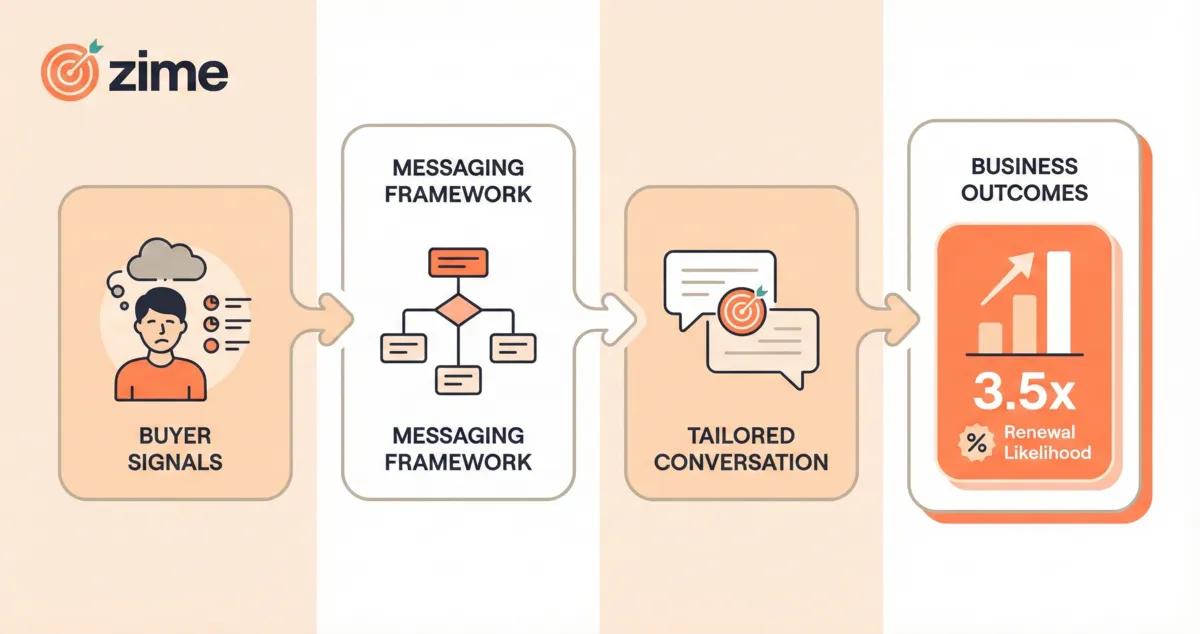
Core pillars include:
IDC research shows that messaging built around use-case-level ROI increases renewal likelihood by 3.5x. This underscores why frameworks must move beyond feature lists toward quantifiable outcomes.
Generic pitches fail because they ignore the unique context of each buying decision. "Every buying decision is a unique, high-stakes opportunity," notes Corporate Visions. Sales messaging should reflect the buyer's world, not a generic profile. When prospects hear reps factor in their own business challenges into initial consultation calls, they're far more likely to engage.
A strong framework allows teams to refine and reuse what works, transforming one-off wins into repeatable success. That transformation starts when every message is anchored in observable buyer behavior, not assumptions.
A single kickoff meeting or slide deck rarely produces lasting behavior change. Neuroscience research confirms that spaced training, which involves repeated learning sessions separated by intervals, leads to more robust memory formation than massed training with short or no intervals.
A systematic review of 23 studies found that spaced online education was superior to massed education for postintervention knowledge, with a standardized mean difference of 0.32. For revenue teams, this means distributing messaging training across multiple sessions, reinforced just-in-time before key calls, rather than cramming everything into annual sales kickoffs.
Adopting a new sales messaging framework requires more than updating a content library. It demands structured rollout, tech-stack alignment, and continuous reinforcement.
Successful CRM adoption unlocks the full value of an investment. It also leads to improved sales performance, better marketing effectiveness, and overall increased productivity. AI sales coaching accelerates new hire ramp-up time by providing structured, self-paced coaching available at any time, eliminating the bottleneck of manager availability.
Traditional enablement struggles to keep pace with evolving objections, new product releases, and shifting buyer behavior. AI-powered coaching addresses these gaps by delivering personalized, in-the-moment guidance based on proven behaviors from top performers.
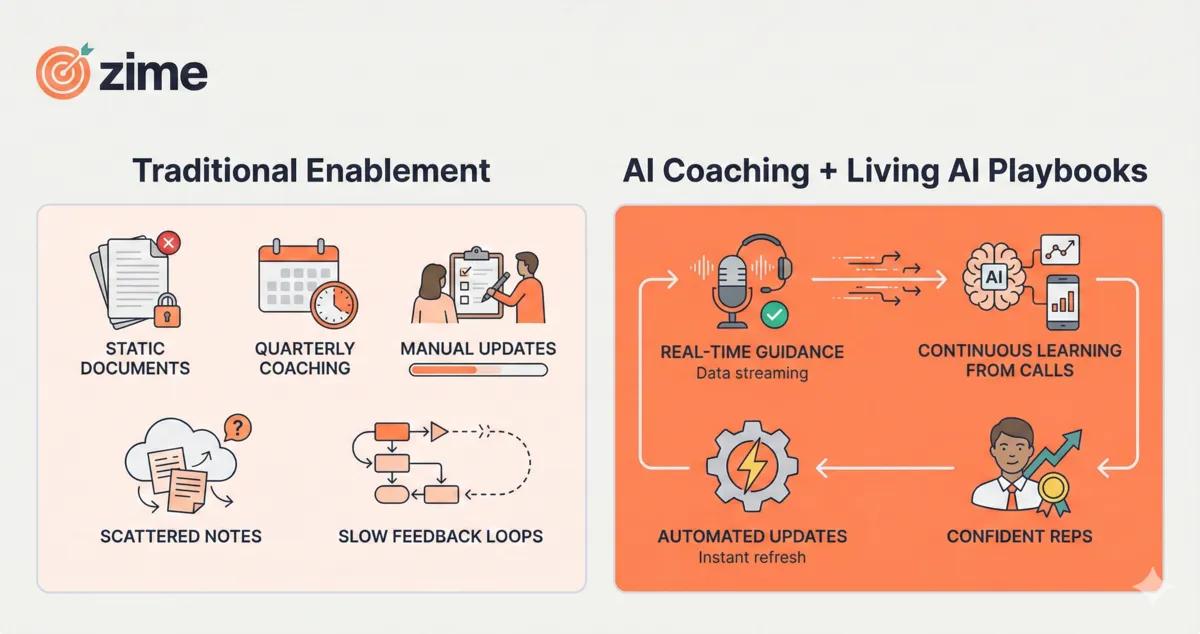
Research from ATD shows that 91% of organizations using AI coaching saw salespeople meet or exceed goals, compared to 69% with traditional methods. Additionally, 79% reported improved quality of customer interactions thanks to AI coaching.
Yet coaching frequency remains a challenge. A Salesloft study found that 53% of sellers received personalized coaching once per quarter or less. AI agents fill this gap by analyzing call data, identifying areas for improvement, and delivering consistent, data-driven feedback at scale.
Snowflake provides a compelling example. The company certified 94% of 3,000 reps using AI roleplays in just a few weeks, saving 1,215 hours of manager grading time per quarter and nearly $700K annually. Reps mastered key messaging and objection handling quickly and independently, boosting confidence and consistency across the global team.
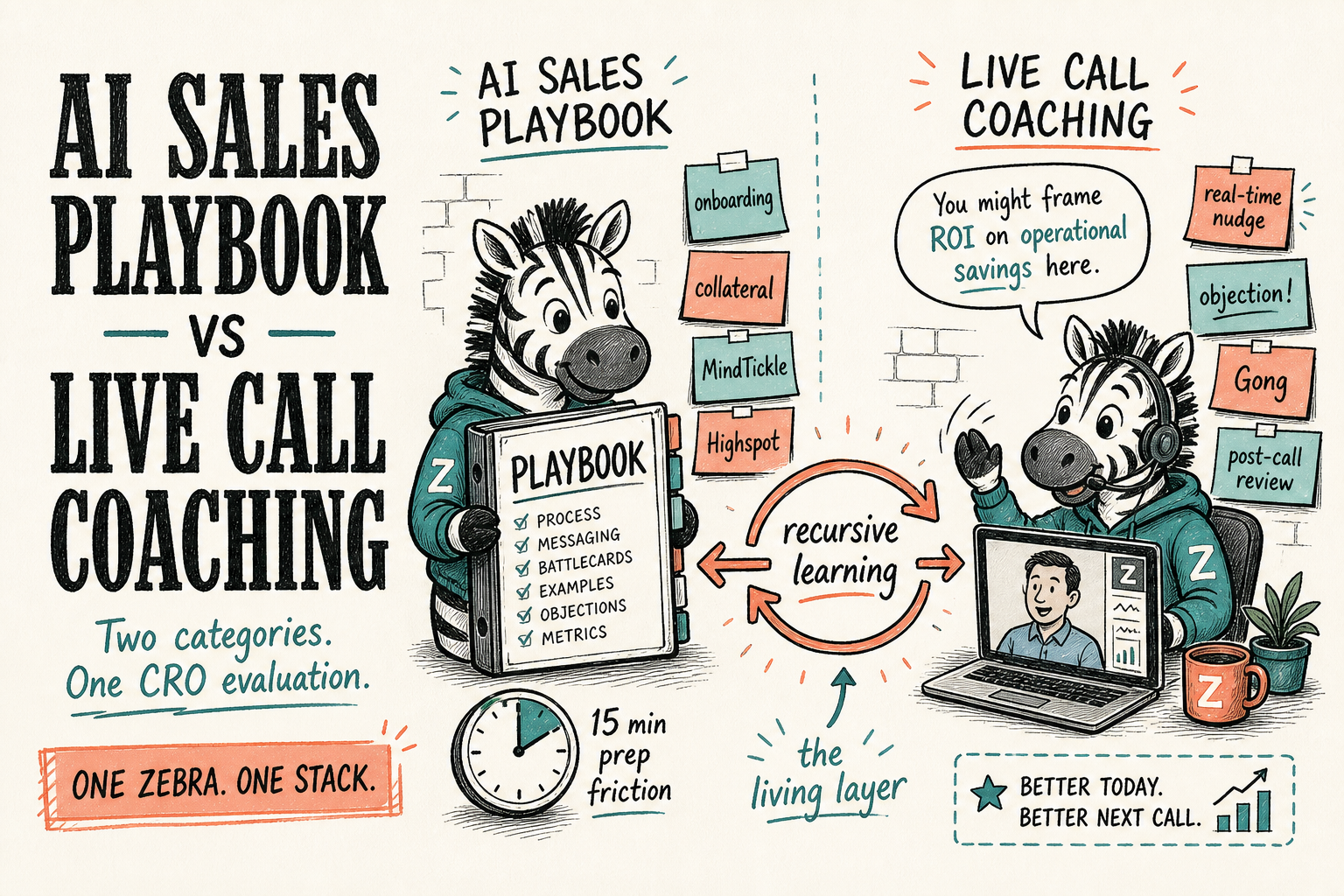
Zime's Living AI Playbooks take this further by continuously learning from real sales conversations, deals, and outcomes. Rather than relying on static playbooks that are manually authored and rarely revisited, these playbooks automatically update guidance to prevent teams from losing deals for the same reasons again.
Measuring messaging impact requires tracking both leading indicators of adoption and lagging indicators of revenue outcomes.
Key metrics include:
Gartner reports that 83% of businesses use sales scorecards and 96% find them effective at improving behaviors and outcomes. Most B2B organizations track win rates, but few understand why they win or lose deals. CRM data lacks depth, and seller interpretations often differ from buyers' actual reasons.
Combining win-loss analysis with buyer feedback, post-deal interviews, and call transcript analysis creates a closed-loop system where insights feed directly back into messaging refinement.
Generative scorecards use AI to analyze sales calls, track selling behaviors, and deliver objective performance scores. AI-powered generative scorecards can cut coaching time by up to 50%, help new reps ramp up 30% faster, and improve rep performance by 20%.
The best sales coaches focus on outcomes, not activities. They use activity metrics to pinpoint areas where they can help each seller improve and to measure impact on revenue goals. AI evaluates calls in real-time, tracking metrics like talk-to-listen ratio, objection handling, and next-step commitment to measure overall call effectiveness.
Deal health scores provide an objective view of pipeline quality based on actual buyer interactions, not rep optimism. Outreach's machine learning model predicts whether a deal will close with 81% accuracy, helping sales teams prioritize winnable opportunities and spot at-risk deals.
Organizations that automate data preparation see forecast precision improve by up to 20% compared to manual data entry methods. Pairing messaging adherence metrics with deal health scores creates visibility into whether reps are executing the framework and whether that execution correlates with forecast accuracy.
Even well-designed frameworks fail when organizations overlook common adoption barriers.
Static training. One-time training sessions produce short-term compliance but not lasting behavior change. Organizations that use just-in-time learning are 2.5x more likely to exceed seller revenue targets and 3.5x more likely to exceed customer retention targets.
CRM drag. 43% of sellers feel like they spend more time than they like on manual data entry, and 69% say they'd be more productive without it. When CRM updates feel like administrative burden rather than value-add, messaging adoption suffers because reps bypass the systems that reinforce new behaviors.
Misaligned KPIs. Clear post-implementation timelines are critical. Identifying the stages of adoption and defining success metrics from the start prevents teams from measuring the wrong things or declaring victory too early.
Messaging frameworks must evolve as markets shift and buyer expectations change. Revenue forecasting provides the feedback loop that keeps messaging current.
Clari customers land their forecast with 95%+ accuracy by unifying revenue signals from CRM, ERP, and third-party systems. Clean data eliminates the 20-30% human bias from manual entry errors and cuts forecast cycle time in half.
Building forecasts in layers, starting with pipeline-stage probability models, adding cohort models for new, expansion, and renewal motions, and baselining with time-series analysis, creates a robust foundation for iteration. Accuracy improves most from better inputs such as definitions, hygiene, and SLAs, not exotic algorithms.
Organizations that treat forecasting as an operational tool rather than a reporting exercise will continuously tune messaging based on what actually moves deals.
Adopting a new sales messaging framework is not a one-time project but a continuous discipline. When reps operate from a shared, buyer-centric playbook, when AI coaching reinforces winning behaviors in the flow of work, and when forecasting insights feed back into messaging refinement, organizations transform scattered conversations into predictable revenue.
Bureau, a no-code identity decisioning platform, faced challenges in sales plays adoption, coaching reps, and win-loss analysis. After implementing Zime's pre-call checklists, CRM insights, and personalized coaching actions, Bureau realized a 30% increase in deal conversion from improved discovery.
Ready to move beyond static training and scale what actually works? Zime's Living AI Playbooks continuously learn from your best performers and deliver deal-specific guidance that drives execution and accountability across every rep, on every deal.
A high-impact sales messaging framework includes buyer-aligned narratives, scalable plays, measurable value propositions, and strong social proof. These elements help reps tailor conversations to buyer signals and business outcomes, driving consistent and effective sales interactions.
Zime's Living AI Playbooks continuously learn from real sales interactions, providing dynamic, deal-specific guidance. This helps sales teams quickly adapt to new messaging, ensuring consistent execution and improved revenue outcomes by reinforcing successful behaviors.
Rolling out new sales messaging involves auditing current gaps, defining success metrics, building modular plays, integrating into workflows, training with spaced reinforcement, and measuring and iterating on adoption metrics. This structured approach ensures effective implementation and continuous improvement.
Spaced learning, which involves repeated training sessions over time, leads to more robust memory formation and lasting behavior change. This approach is more effective than one-time training sessions, helping sales teams internalize new messaging frameworks and improve performance.
Key metrics include win rate by rep and segment, sales cycle length, quota attainment, content and play adoption, and deal health scores. These metrics help assess whether new messaging is effectively driving revenue and improving sales performance.