Blog
Why LMS Training Fails to Change Rep Behavior
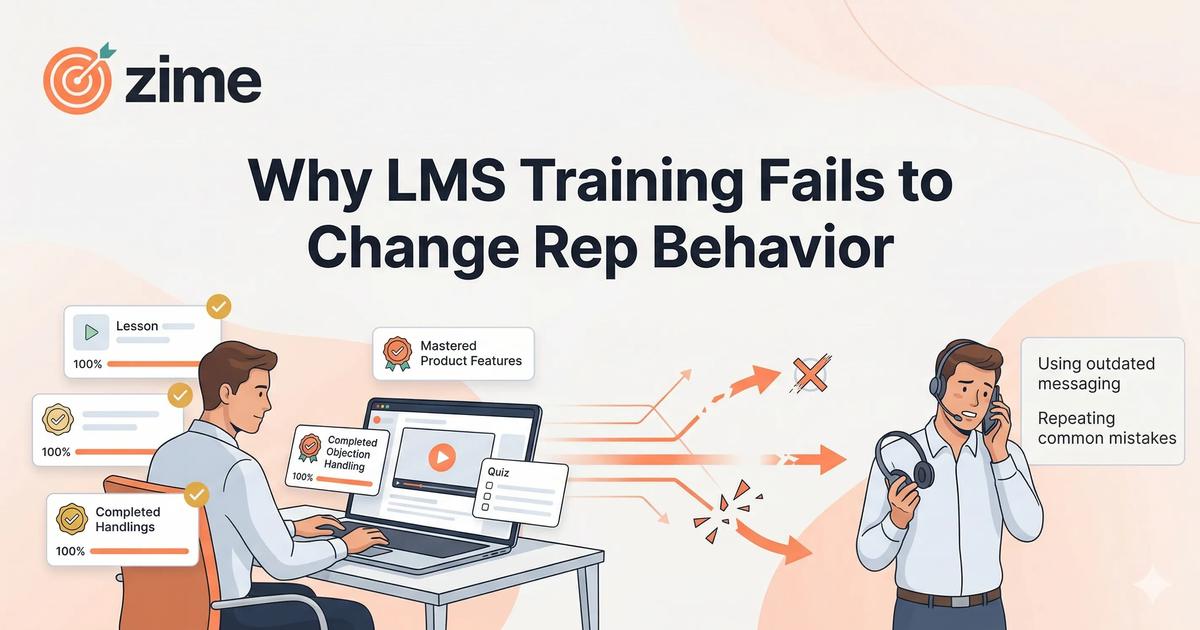
Why Does LMS Training Not Change Rep Behavior? There is a pattern surfacing repeatedly across B2B SaaS revenue teams. Reps complete training. Certifications get
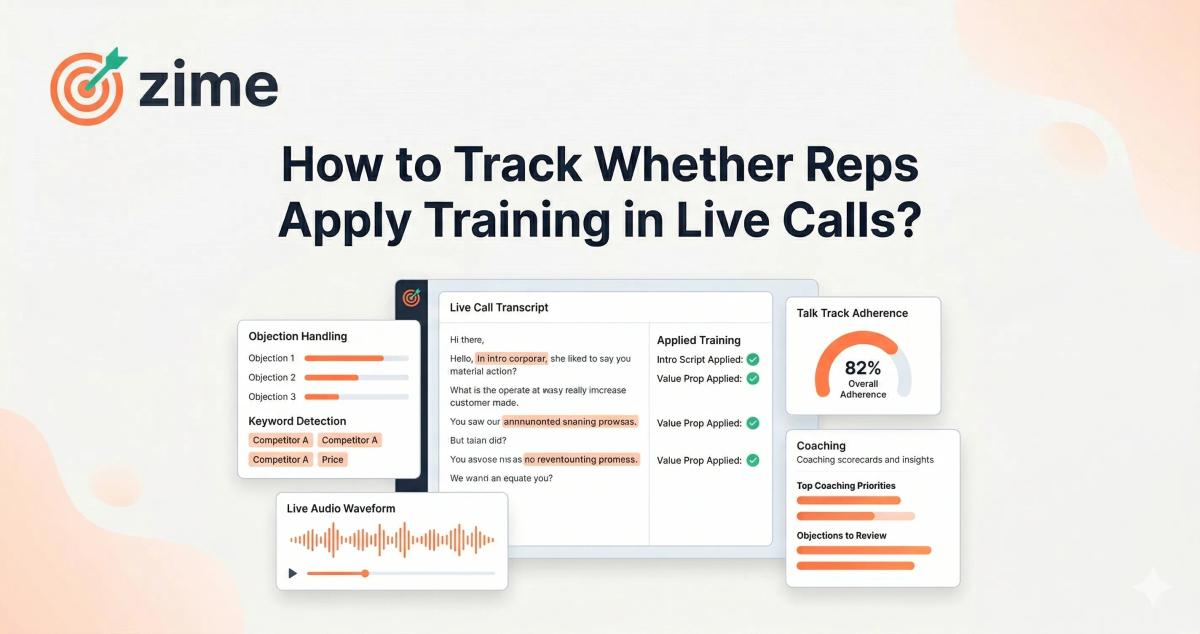
In multiple recent conversations with revenue leaders and sales enablement professionals across B2B SaaS companies, one question kept surfacing with striking consistency: how do you actually know whether your reps are applying what they learned in training once they are on live calls? Not in a role play. Not in a certification quiz. On a real call, with a real prospect, navigating real objections.
This question matters more than most leaders acknowledge. You can build a rigorous training program, invest months in a playbook, and still watch your reps default to old habits the moment a call gets difficult. The gap between training completion and field execution is where most sales enablement investment quietly disappears.
The answer, as practitioners have learned through costly trial and error, lies not in more training but in building inspection, reinforcement, and accountability into the workflow itself.
This challenge sits squarely with the leaders responsible for making revenue teams execute consistently at scale. That includes CROs managing 50-plus rep organizations, VP Sales leaders overseeing mid-market SaaS growth, and sales enablement professionals who are expected to demonstrate measurable impact on win rates and pipeline quality.
These are not teams that lack ambition or effort. They have playbooks. They run onboarding programs. They use LMS platforms and deliver methodology training. The frustration is that none of it reliably changes what reps actually do on discovery calls, negotiation conversations, or competitive objection handling in real selling moments.
The symptom is easy to describe: inconsistent execution across the sales floor. Two reps with the same training, the same playbook, and the same territory will run discovery completely differently. One will surface the business case, map the pain to urgency, and advance the deal. The other will cover the checklist topics and leave the call with a vague next step.
Managers see this in pipeline reviews. Deals get marked as qualified with no documented timeline, no consequence of inaction, no decision criteria established. When revenue leaders dig in, they find that the playbook was theoretically followed but none of the behaviors that actually move deals were executed.
According to research from Gartner, 83% of CSOs report their sellers struggle to adapt to customer needs and expectations, suggesting enablement efforts consistently lag behind what the field actually requires.
The structural root cause is the absence of any closed loop between training and execution. Most organizations treat them as separate functions. Training happens in a room, on a screen, or in a certification module. Execution happens on calls. There is rarely a system that connects the two in real time.
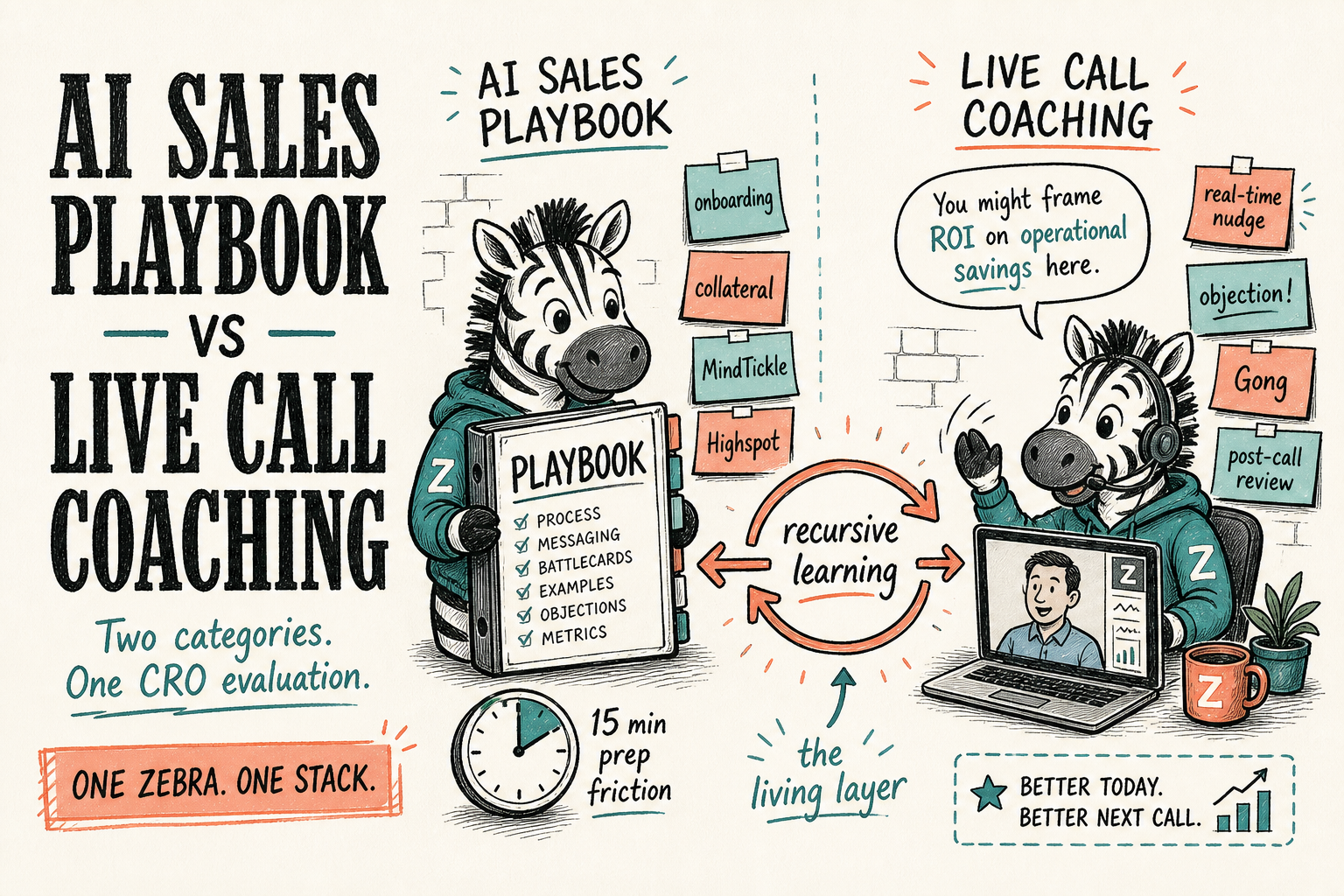
Static playbooks are a central part of the problem. By the time a playbook is approved, formatted, and published, the market has moved. Objections have evolved. Competitors have changed their positioning. Reps who consult the playbook find it academic rather than operational, and they stop referring to it. In multiple conversations with enablement leaders, the phrase "it sits in a PDF somewhere" came up more than once.
Research on behavior change supports this directly. The Ebbinghaus Forgetting Curve shows that humans forget roughly 50% of new information within one day and approximately 90% within one week without reinforcement. Training delivered as an event, without embedded reinforcement, will produce almost no lasting behavior change.
Manager bandwidth is another structural constraint. Frontline managers are often expected to coach their teams on call execution, but without data showing them exactly what each rep did or did not do on a specific call, coaching stays generic. Telling a rep to "do better discovery" without pointing to the specific moment they missed a qualification question is not coaching. It is commentary.
The standard response to inconsistent rep execution usually follows a familiar sequence. First, the team builds or refreshes the playbook, often framed around MEDDIC, Challenger, SPIN, or another established methodology. The belief is that a better-organized document will drive better behaviors.
When the playbook does not produce results, the next step is typically training. A workshop is scheduled, a methodology firm is hired, and reps spend two days in a session. Scores are tracked. Certification is issued. Everyone moves on.
When training fails to produce measurable results, teams often turn to conversation intelligence platforms. Call recordings are reviewed. Smart trackers are configured. Keywords are flagged. The hope is that surface-level activity metrics will expose where execution is breaking down.
Across the conversations that informed this article, nearly every team had attempted all three approaches, and nearly every team reported that while each had some value, none had driven consistent behavior change at scale.
The core failure is that each approach operates in isolation. Playbooks capture knowledge but do not deliver it at the moment of need. Training transfers information but does not require application in real deal contexts. Conversation intelligence records what happened but does not connect the observation to a behavior improvement loop.
Traditional sales training carries a reported failure rate of 84% when it comes to sustained behavior change. An ATD study cited in the same research found that more than 70% of training failure is attributed not to the content itself but to the application environment. Reps return from training to a system with no reinforcement, no accountability, and no signal on whether they are applying what they learned.
Generic conversation intelligence platforms compound the problem by tracking activity instead of behavior. Counting how many times a competitor was mentioned, or whether a call ran over 30 minutes, does not tell a manager whether the rep created genuine urgency, established cost of inaction, or properly mapped decision criteria. Those are nuanced behaviors, and they are nearly invisible to tools built around keyword tracking.
According to Forrester, organizations that lack formalized playbook deployment processes see significantly lower field adoption, with reps frequently citing playbook content as either irrelevant or too academic to apply in live situations. The issue is not the content itself. It is the absence of a system that makes the content actionable at the right moment.
Research from Ebsta and Pavilion's 2024 Sales Benchmarks Report found that 85% of pipeline opportunities are not well-qualified, and 87% of reps are underperforming relative to targets, reinforcing that the playbook adoption gap is not a niche problem. It is a category-level failure.
The organizations making real progress on this problem share a common approach. They have stopped treating training and execution as separate events and have built systems that connect them continuously.
The framework that works in practice follows four connected layers:
Strategy: Define the specific behaviors you want reps to demonstrate on calls. Not generic goals like "better discovery," but precise actions such as surfacing cost of inaction in stage-two calls, or establishing timeline and budget within the first two conversations.
Behavior: Capture what reps actually do on calls, scored against those specific behaviors using your own playbook logic rather than generic AI summaries that miss company-specific nuances.
Action: Deliver that insight to the rep before the next call, not after a quarterly review. Pre-call prep notes that reference what was missed last time, how top reps handle similar situations, and what objections remain open give reps actionable direction at the moment they are most receptive.
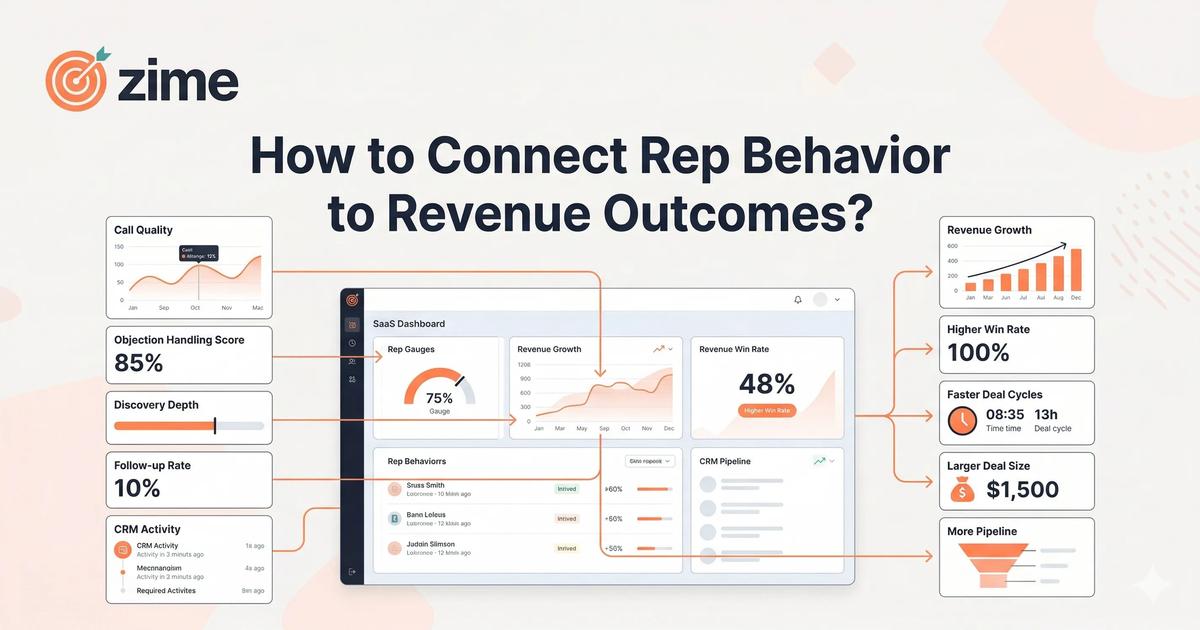
Outcome: Track whether playbook adherence correlates to pipeline movement and win rate, not in aggregate but at the individual deal and rep level. When one company tracked this connection, consequence-of-inaction mentions on calls improved from 40 to 80 instances per period, and early-stage win rate improved from 10% to 18%.
This cycle, running continuously rather than in quarterly training sprints, is what produces compounding behavior change. Companies with formal coaching and reinforcement programs see 28% higher win rates than those without structured programs, and reps receiving consistent coaching achieve 107% of quota compared to 88% for those without it.
During a recent engagement, Navin Madhavan, Head of RevOps at Amagi, a fast-growing media technology SaaS company headquartered in India with a global go-to-market team spanning the US and international markets, described a situation familiar to most revenue leaders:
"The challenge they are saying is discovery. Playbooks are really not credible, or updated, and driving adoption of playbooks is a challenge. Trainings are not working. We're losing revenue here."
Christian Piuma, Founder of SalesLeap, a sales and marketing transformation company working with B2B SMB and mid-market businesses across North America, put the coaching translation challenge in direct terms when describing how difficult it is to move knowledge from a top performer to the broader team:
"One of the big mysteries I've had is trying to coach sales reps that don't possess my brain in terms of being able to assess a situation extremely fast. What are the objections? What are the pain points? Reps miss that all the time. They're so focused on their pitch, they miss the objections. I was unable to translate that prior because it was just my mastery in how I process things."
Anant Saksena, a revenue operations leader overseeing a US sales team of approximately 50+ reps across business development, inside sales, and demand generation at a B2B data SaaS company, framed the core inspection problem with precision:
"When sellers go on review calls, the information they tell on why a deal is not closing is as good as what the seller is saying. We have no secondary insight or conversation intelligence to understand if what the seller is saying is right or not. There's no recording platform, no conversation intelligence in this case."
Step 1: Define behaviors, not topics.Stop writing playbooks that describe what to cover and start writing them around specific behaviors and questions that correlate to deal movement. Anchor each behavior to a deal stage so that expectations shift as opportunities progress.
Step 2: Build the playbook from top rep calls, not theory.Pull recordings from your highest-performing reps and identify the specific questions, phrases, and sequencing they use during discovery or objection handling. This makes the playbook credible. Reps adopt guidance they recognize as real, not academic.
Step 3: Score every call against those behaviors.Use call recording data to apply your playbook criteria to each rep's calls automatically. Track which behaviors were present and which were absent, by rep, by deal stage, and over time.
Step 4: Deliver pre-call prep notes, not post-training summaries.The moment a rep is most receptive to guidance is in the hour before a call, not at the end of a training cycle. Push prep notes to reps in Slack or Teams before every call, referencing what was missed last time and how top reps handle similar situations.
Step 5: Give managers a behavior-level view, not just a pipeline dashboard.Managers should be able to see, by rep, which parts of the playbook are being applied and which are consistently skipped. This converts pipeline reviews from deal status meetings into genuine, targeted coaching sessions.
Step 6: Connect behavior adoption to outcomes.Track whether increased playbook adherence is moving deals forward. If discovery behavior adoption rises but stage conversion does not improve, the playbook itself needs revision. The loop should be continuous, not annual.
Run through this diagnostic before your next enablement initiative:
If most of these questions surface gaps, the problem is not your reps. It is the absence of a system connecting training to execution to inspection.
Tracking whether reps apply training in live calls is not a reporting exercise. It is a system design problem. Organizations that solve it consistently share a common approach: they define specific behaviors, score execution against those behaviors on every call, deliver just-in-time guidance before the next conversation, and give managers the data to coach with precision.
Traditional training has a near-universal limitation. It transfers knowledge without building a mechanism for field application. Closing the gap between sales training and live call execution requires treating coaching as a continuous operational loop, not a quarterly event. Reps who receive consistent, behavior-specific reinforcement achieve measurably higher quota attainment and win rates. The return shows up in pipeline conversion, early-stage win rates, and the top line. Building that system is what separates enablement functions that earn a seat at the revenue table from those that remain training departments.
For revenue leaders ready to act
If you are actively evaluating how to track playbook adoption across your team, Book a Demo with Zime. Understanding exactly where your reps diverge from your playbook is the first step to closing the execution gap.