Blog
How to Use AI-Led Qualification to Prioritize the Right Deals
AI-led qualification uses machine learning to analyze behavioral signals, engagement patterns, and historical data to predict which leads are most likely to con
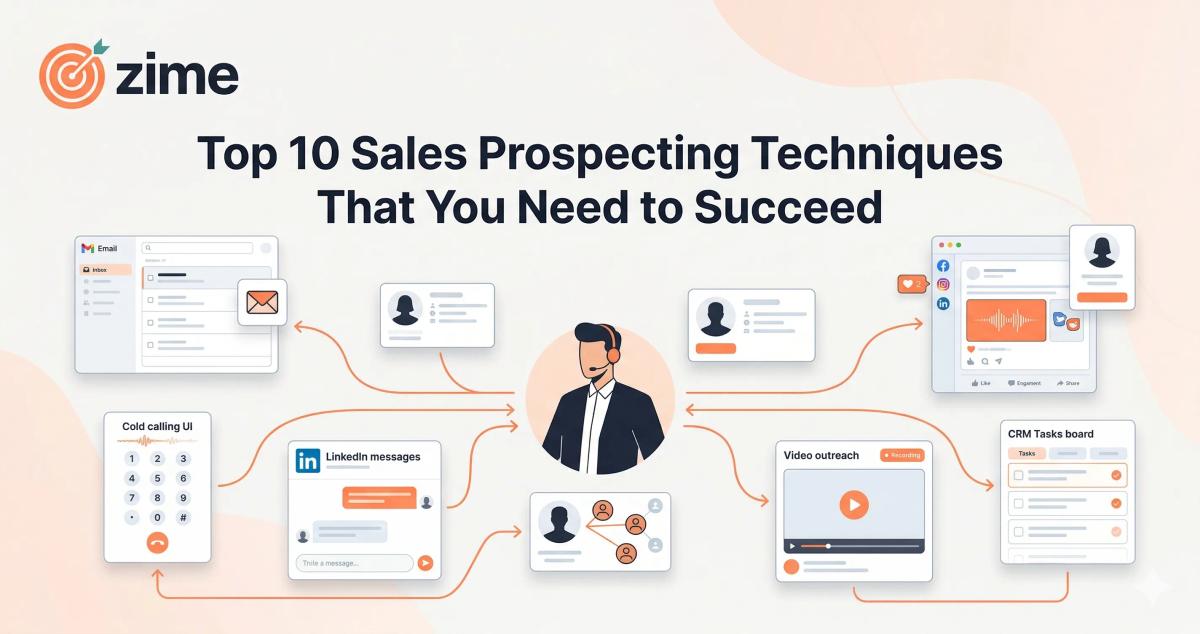
Sales teams using modern prospecting techniques see revenue growth rates of 83% compared to 66% for those without AI-powered approaches. The winning techniques for 2026 include ICP-led targeting, signal-based outreach, account-based prospecting, AI-assisted personalization, and continuous learning from wins and losses. These methods prioritize precision over volume, with 95% of seller research workflows expected to begin with AI by 2027.
Cold volume used to be the default playbook. Dial more, send more, hope more. That approach is collapsing. Inboxes are overflowing, spam filters are smarter, and buyers have learned to ignore anything that feels generic. Research from LinkedIn found that less than 2% of cold calls result in a meeting, while Mailshake reports that 69% of cold email senders saw performance decline year over year due to spam filtering and AI-generated content fatigue.
The winning sales prospecting techniques for 2026 hinge on data, AI, precise timing, and constant learning. Teams that treat prospecting as a system rather than a set of tricks will pull ahead. This guide delivers a top-10 playbook that shows how to operationalize modern sales prospecting inside a repeatable framework. No recycled 2018 tactics. No hacks. Just what actually works.
Buyers are overloaded. They spend 50% of their research time with third-party sources before ever talking to a rep. Meanwhile, sales teams juggle an average of 10 tools to close deals, and only 35% of sales professionals fully trust the accuracy of their own data.
Gartner predicts that by 2027, 95% of seller research workflows will begin with AI, up from less than 20% in 2024. The shift is already underway: teams using AI grew revenue at 83% compared to 66% for those without it. Volume-based outreach cannot keep pace with buyers who expect relevance, trust, and timing.
Key takeaway: Prospecting in 2026 rewards precision over volume, and the gap will only widen.
A modern prospecting system is not a list of tricks. It is an interconnected loop of signals, actions, and feedback.
McKinsey research shows that companies using data-driven sales-growth engines report EBITDA increases of 15 to 25 percent. Gartner adds that by 2025, 75% of B2B sales organizations will augment traditional playbooks with AI-guided selling solutions. As Gartner notes, "Sellers can no longer exclusively rely on intuition-based selling to push a deal over the finish line."
B2B sales-growth champions pull five mutually reinforcing levers systematically to empower their sales organization to derive impact from insights, improve value-based opportunity prioritization, frontline delivery, and continuous learning.
Precision targeting starts with knowing exactly who to pursue and when they are ready. Two techniques form the foundation: ICP-led prospecting and signal-based outreach.
Sales prospecting is the process of identifying and connecting with leads who fit the profile of an ideal buyer. Prospects are leads who have been identified as a good fit for your company, typically because they align with your ideal customer profile (ICP), and who are ready to be moved into your sales process.
B2B marketers should score candidates and customers to prioritize buyers or buying groups for human outreach. Scoring serves as a prioritization mechanism to identify which buying groups are ready for human interaction, but it does not qualify opportunities. Only humans can do that.
How it works in practice:
Signals or inputs required: CRM data, technographic tools, website analytics, and historical win data.
Common mistakes: Treating all leads equally, relying on outdated firmographics, or scoring without behavioral signals.
How to measure success: Lead-to-opportunity conversion rate, meetings booked from ICP accounts, and average deal size.
Signal-based outreach activates third-party and first-party intent cues to reach buyers when problems are top of mind.
Gartner reports that by the end of 2022, more than 70% of B2B marketers were utilizing third-party intent data to target prospects or engage buyer groups. That trend has only accelerated. Agentic AI can now autonomously handle tasks such as prospecting, outreach, and responding to buyer inquiries, reducing seller burden and enhancing customer experiences.
How it works in practice:
Signals or inputs required: Third-party intent providers, website visitor tracking, content engagement data, and competitor research alerts.
Common mistakes: Over-relying on generic intent scores, ignoring first-party signals, or waiting too long to act.
How to measure success: Reply rate on intent-triggered sequences, pipeline generated from intent accounts, and time-to-first-meeting.
AI-driven lead scoring predicts buying readiness by analyzing various data signals, allowing sales teams to focus resources where it counts. Schneider Electric cut 90% of research time using AI-powered prospecting tools, scaling insights and efficiency across sales and marketing teams.
B2B purchases are complex. Gartner found that 77% of buyers said their latest purchase was "very complex" or "difficult," and sellers have only 17% of buyer time when multiple vendors are in play. Winning requires account-based prospecting and multi-threaded outreach.
Account-based marketing (ABM) treats high-value accounts as markets of one. Recent developments in user data accessibility and AI-driven content generation are making ABM a mainstream strategy.
ABM can significantly enhance marketing ROI and accelerate sales cycles. It is equally applicable in both direct-to-buyer and partner-enabled channels, although ecosystem ABM demands additional effort.
How it works in practice:
Signals or inputs required: Account-level intent, organizational charts, engagement history, and deal velocity data.
Common mistakes: Treating ABM as a marketing-only initiative, failing to align sales and marketing, or spreading resources too thin.
How to measure success: Account engagement score, pipeline from target accounts, and win rate on ABM deals.
Relationship mapping is the process of figuring out who's who inside your target account and creating a visual representation of relationships. It goes beyond building an org chart. It is about using networks of people to overcome challenges, build consensus, and create a clear path to close.
Deals with multiple contacts are 37% more likely to close, and cross-department threading improves win rates by 56%. The three groups of key players who drive deals forward are decision-makers, champions, and supporters. Blockers represent resistance and delay.
How it works in practice:
Signals or inputs required: Org-chart data, call intelligence, email engagement, and meeting attendance.
Common mistakes: Single-threading deals, ignoring blockers, or failing to update relationship maps.
How to measure success: Number of contacts engaged per deal, deal velocity, and win rate on multi-threaded opportunities.
Personalization is no longer optional. McKinsey found that 71% of consumers expect companies to deliver personalized interactions, and 76% get frustrated when it does not happen. Three techniques help teams personalize without sacrificing scale.
AI for sales prospecting refers to the use of artificial intelligence tools to identify, engage, and convert qualified prospects more effectively.
Teams that have adopted AI effectively report a 10 to 25% lift in pipeline, and sales teams using AI see a revenue increase of up to 1.3 times compared to those without AI. AI tools automate repetitive tasks like lead scoring and data entry to improve seller workflow and sales productivity.
How it works in practice:
Signals or inputs required: CRM data, engagement history, website activity, and content consumption patterns.
Common mistakes: Over-automating without human review, generic AI prompts, or ignoring data quality.
How to measure success: Reply rate on AI-assisted sequences, meetings booked, and pipeline influenced.
Warm outbound leverages content engagement, webinar attendance, and community participation to reach prospects who have already shown interest.
Buyers research extensively before engaging sales. Digital events and content create signals that turn cold outreach into warm conversations.
How it works in practice:
Signals or inputs required: Marketing automation data, event attendance, and community engagement metrics.
Common mistakes: Ignoring content signals, generic follow-up, or waiting too long after engagement.
How to measure success: Reply rate on warm sequences, content-influenced pipeline, and event-to-meeting conversion.
Referral prospecting uses existing relationships and partner networks to generate introductions.
Referrals convert 71% better than cold outreach and close 69% faster. The best way to make new connections is to leverage your existing relationships.
How it works in practice:
Signals or inputs required: Customer satisfaction data, NPS scores, and partner engagement.
Common mistakes: Asking too early, failing to follow up on introductions, or neglecting to thank referrers.
How to measure success: Referrals generated, referral-to-meeting conversion, and referral-influenced revenue.
The final three techniques focus on timing, preparation, and iteration. They separate top performers from the rest.
Trigger-event prospecting activates outreach when a company experiences a significant change such as funding, executive hires, or product launches.
A complete AI sales research workflow consists of five interconnected components: signal detection, qualification engines, contact intelligence, CRM integration, and analytics. The signal detection layer monitors the internet for buying intent indicators including funding announcements, executive hiring, product launches, and technology adoption.
How it works in practice:
Signals or inputs required: News feeds, funding databases, job postings, and press releases.
Common mistakes: Sending generic congratulations, ignoring the business context, or waiting too long after the trigger.
How to measure success: Reply rate on trigger-based outreach, meetings booked, and pipeline from triggered accounts.
AI-augmented research uses AI to gather and synthesize account information before outreach.
AI research workflows flip the traditional model. AI handles discovery by finding prospects based on buying intent signals, AI provides context by delivering personalization data for each lead, and humans focus on connection by building relationships and closing deals. The result is 3 to 5x more qualified conversations per rep, higher close rates, and dramatically improved team satisfaction.
How it works in practice:
Signals or inputs required: AI research platforms, CRM data, and public data sources.
Common mistakes: Trusting AI output without verification, skipping prep for "small" deals, or failing to update research.
How to measure success: Prep time per account, call quality scores, and meeting-to-opportunity conversion.
Win-loss analysis is a process that uses buyer interviews and surveys to help companies understand the reasons behind their successes and failures in sales deals.
In 2025, 98% of win-loss programs have executive visibility. Sales teams that systematically conduct win-loss analysis see a 17.6% increase in quota attainment and 14.2% higher win rates compared to teams that do not. Anova Consulting found that 60% of sellers are partially or completely wrong about why they lost a deal.
How it works in practice:
Signals or inputs required: Buyer feedback, CRM data, and call recordings.
Common mistakes: Relying solely on CRM data, skipping third-party interviews, or failing to act on insights.
How to measure success: Win rate improvement, quota attainment, and time to implement feedback.
Companies that implement proper win-loss analysis can see up to 40% higher win rates. Sellers who receive buyer feedback achieve up to 40% better win rates versus those who do not.
AI is not replacing reps. It is redesigning how they work. Gartner predicts that by 2027, 95% of seller research workflows will begin with AI. McKinsey estimates that gen AI could open up an incremental $0.8 trillion to $1.2 trillion in productivity across sales and marketing.
AI changes three prospecting workflows:
McKinsey notes that agentic AI will power more than 60% of the increased value that AI is expected to generate from deployments in marketing and sales. Organizations realizing meaningful impact from agentic AI are going beyond simply deploying new agents to improve existing tasks - they are redesigning workflows.
Why volume-based prospecting fails long-term: High-volume outreach erodes sender reputation, triggers spam filters, and trains buyers to ignore you. Campaigns with 50 recipients or fewer get an average 5.8% reply rate, compared to 2.1% for campaigns with 1,000+ recipients.
How top teams turn insights into repeatable systems: B2B sales-growth champions pull five mutually reinforcing levers systematically: finding value, planning campaigns, activating omnichannel journeys, empowering sellers, and continuous improvement. Companies that are using data-driven sales-growth engines report above-market growth and EBITDA increases in the range of 15 to 25%.
Platforms like Zime help revenue teams turn top-performing sales behaviors into repeatable, scalable habits by building Living AI Playbooks that continuously learn from real sales conversations, deals, and outcomes.
Win-loss analysis is the feedback loop that closes the system. Without it, teams repeat the same mistakes and miss the same opportunities.
Corporate Visions research found that 53% of deals marked as lost were actually winnable if not for a misstep in the sales process. Sellers who receive buyer feedback achieve up to 40% better win rates versus those who do not.
How to build a feedback loop:
According to Anova Consulting, 60% of sellers are partially or completely wrong about why they lost a deal. CRM data alone is unreliable: 91% of CRM data is incomplete, and 70% becomes inaccurate annually.
Practical metrics to track:
Bureau, a no-code identity decisioning platform, realized a 30% increase in deal conversion from improved discovery and checklist adherence by reps after implementing Zime's solution.
The mindset shift for 2026 is clear. Prospecting is no longer about volume. It is about relevance, timing, and learning.
The 10 techniques covered here form a system:
Each technique answers the same questions: Why does it matter now? What problem does it solve? How is it executed well? What signals enable it? What mistakes do teams make? How do you measure success?
AI sales coaching is evolving from delayed feedback to real-time, personalized guidance. AI sales forecasting that uses behavioral signals like multi-threading, executive engagement, and accepted next steps outperforms, with an operating model powered by evolving playbooks and AI rep coaching.
Consistency, learning loops, and relevance will define the winners. Teams that build systems, not spray-and-pray lists, will own the pipeline in 2026 and beyond. Ready to operationalize these plays? Zime's Living AI Playbooks turn winning prospecting behaviors into repeatable habits across your entire team.
Traditional prospecting methods like cold calling and mass emailing are becoming less effective due to smarter spam filters, AI-generated content fatigue, and buyers' preference for personalized, relevant interactions.
ICP-led prospecting involves targeting leads that fit the ideal customer profile, ensuring that sales efforts are focused on high-potential prospects. This approach is crucial in 2026 as it prioritizes quality over quantity, improving conversion rates and deal sizes.
AI assists in modern sales prospecting by automating repetitive tasks, enhancing lead scoring, and providing real-time insights. This allows sales teams to focus on building relationships and closing deals, ultimately increasing efficiency and revenue.
Zime helps sales teams by creating Living AI Playbooks that continuously learn from real sales interactions, enabling teams to scale successful behaviors and improve prospecting outcomes through data-driven insights and adaptive strategies.
Sales teams can measure success through metrics such as lead-to-opportunity conversion rates, reply rates on outreach, pipeline influence, and win rates. Continuous analysis and adaptation based on these metrics help refine prospecting strategies.