Blog
How to Audit Sales Calls at Scale (Without Listening to Every Call)
How do you audit sales calls at scale without listening to all of them? It is the right question, and most sales organizations are asking it years too late. Tea
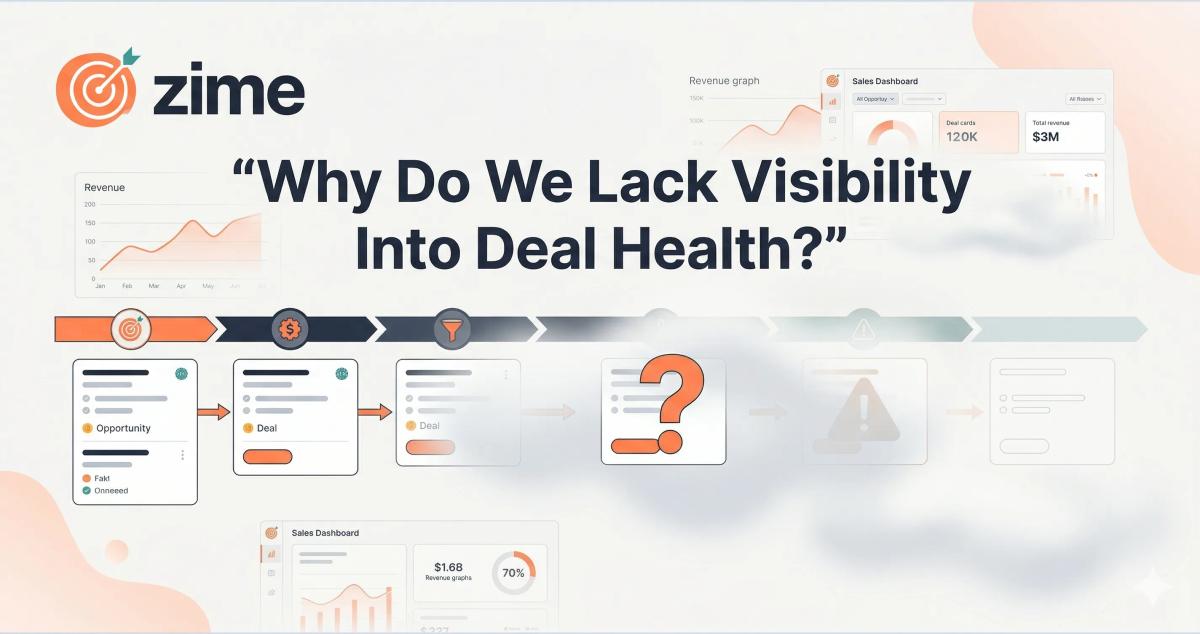
Most sales organizations have more tools than ever. Call recorders. CRM platforms. Forecasting dashboards. Pipeline review cadences. And yet, when a leader asks "where does this deal really stand?", the honest answer is usually a gut feeling wearing the costume of a data point.
The real reason revenue teams lack visibility into deal health is not a technology gap. It is a behavior gap. The tools capture what happened in a call. They do not capture whether the right things happened, why they did not happen, and what that means for the deal's trajectory.
A pattern surfaces consistently across conversations with sales leaders building or scaling enterprise revenue teams: teams are swimming in call recordings and CRM fields, yet managers are still walking into pipeline reviews blind. The problem runs deeper than dirty data or low tool adoption. It starts with a fundamental misunderstanding of what "visibility" actually means.
This challenge hits hardest at revenue teams in the growth and scale phase. Typically B2B SaaS companies with 30 to 300 reps, multiple product lines or segments, and a mix of enterprise and mid-market motion.
These teams have invested in call intelligence platforms, CRM hygiene initiatives, and enablement programs. They run weekly pipeline reviews and schedule regular 1:1s. And yet, late-stage deal slippage still catches them off guard. Coaches still rely on memory and instinct during deal reviews. Reps across the same team run fundamentally different discovery conversations.
If your team has playbooks sitting in a content management system that no one executes on calls, or if your managers spend half the pipeline reviewing figuring out what happened on a deal rather than deciding what to do next, this is exactly the situation being described here.
Deal health is invisible not because leaders are not looking. It is because they are looking at the wrong signals.
Most pipeline reviews assess output: is the deal in the right stage? Has there been recent activity? What is the rep's confidence level? None of these questions answers the real one: is the behavior inside the deal aligned with what wins?
At the rep level, this shows up as inconsistent discovery. Different reps chase different pain points, apply different qualification logic, and handle objections differently. One rep books a strong next step after every call. Another leaves the follow-up open-ended. The CRM shows both deals in the same stage. The manager sees both as progressing.
At the manager level, the problem becomes reactive coaching. Without a structured behavioral signal from the call, managers resort to interviewing reps about deals they should already understand.
At the leadership level, the result is forecast miss. According to Forrester, 79% of sales organizations miss their forecast by more than 10%. A separate Xactly benchmark study found that just 20% of sales organizations achieved forecasts within 5% of actual results. The gap between committed pipeline and closed revenue is, in large part, a visibility gap at the deal level.
Call recording platforms count calls and flag keywords. They do not assess whether the rep understood the intensity of the buyer's pain, whether a clear next step was set, or whether decision criteria were properly mapped. Tracking that a pain point was mentioned is not the same as knowing whether it was deep enough to drive urgency.
The data in most CRMs reflects what the rep chose to log, often after the fact and in fragments. Research shows that 79% of opportunity data never makes it into the CRM at all. According to Gartner, improving CRM data hygiene can increase forecast accuracy by up to 30%, but data hygiene cannot solve a problem that is structural. Reps avoid manual entry not out of laziness, but because it feels like admin work disconnected from their selling motion.
Most teams have enablement content. Some have formal methodologies. But almost none have a systematic way to check whether reps are actually executing the playbook on real calls. The playbook lives in a static document. The deal lives in a dynamic conversation. The gap between them is where deal health becomes invisible.
Without deal-level behavioral data, managers default to forecast reviews where they inspect outcomes and ask reps to justify their numbers. Coaching and forecasting collapse into the same meeting. Neither gets done well. Gartner research confirms that only 45% of sales leaders have high confidence in their own forecast accuracy, a direct consequence of coaching and visibility being decoupled from real deal behavior.
When deal health visibility breaks down, teams respond in predictable ways.
They invest in more technology. A new call recorder. A forecasting tool. A revenue intelligence platform. Each solves a narrow problem but still leaves the interpretation gap open. They mandate CRM hygiene, adding required fields and running weekly data audits. Compliance improves temporarily. The quality of what gets entered does not. They add more pipeline reviews. They increase cadence, invite more stakeholders, and build longer review decks. But adding more meetings to analyze the same incomplete data does not generate better insight.
The common thread across these attempts is that they address symptoms, not causes.
A call recorder tells you that a conversation happened. It does not tell you whether the rep established the consequence of inaction or whether the buyer actually owns the budget. Behavioral understanding cannot be extracted by keyword search or generic analysis without deep contextual tuning to a specific sales motion. One revenue leader at a cloud broadcast and streaming SaaS company put it plainly: the team had engineers extracting insights from call transcripts using generic AI queries, but the nuance of whether a specific objection was truly addressed simply did not surface through those methods.
Increasing meeting cadence compounds the problem. Moving from weekly to daily reviews only accelerates the consumption of bad signals. The real gap is upstream, in what gets captured about deal behavior at the conversation level.
High-performing revenue teams make one critical shift: they stop inspecting outcomes and start inspecting behaviors.
This means playbooks that function as scoring frameworks, not documents. Every call gets measured against specific criteria: Did the rep surface pain and its business consequence? Did they map decision criteria? Did they confirm a next step with stakeholder commitment?
When these signals are visible at scale, two things change. Managers enter every 1:1 with a structured coaching agenda instead of an interrogation. Reps stop operating on autopilot because they can see where they are underperforming against a clear standard.
Research supports this directly. Increasing structured sales coaching from less than 30 minutes per week to over two hours per week raises win rates from 43% to 56%. The difference is not the presence of coaching. It is the presence of behavioral data that makes coaching targeted and specific.
One revenue team that made this shift saw deal review time drop from two hours to 30 minutes, because both manager and rep already knew the risk areas before the meeting started. Another team moved from 40% of calls containing deep pain discovery to 95%, and win rates climbed from 18% to 27% as a direct result.
During a discovery and evaluation conversation, Navin Madhavan, VP Revenue at Amagi, a cloud broadcast and streaming technology company based in Bangalore with a US presence across SMB and enterprise segments, described the highest-stakes dimension of deal health:
"Are you sensing, while we are trying to pitch a new deal, that the customer is already calling out pricing concerns? And hence it's not just about the new deal. There is a potential risk that our existing revenue is also at risk, because there is a potential downsell there."
This reflects a maturity beyond pipeline visibility. His team was looking for account-level deal health, connecting active sales conversations to existing revenue risk in real time.
Christian, a Sales Enablement Leader at a B2B SaaS company in the Bay Area with an established enterprise sales motion and a team rolling out a structured qualification methodology, articulated the gap between inspection and action:
"What is holding up this deal? Gong will tell you some things. But most of the time you probably have to do a lot of investigation before you can figure that out. Now you won't have to. You've cut that time and it's black and white."
Shubhi Tripathi, Head of Sales Operations at a B2B SaaS company in Bangalore with approximately 130 employees and a lean management structure, described the original intent behind investing in deal health tooling:
"The whole idea was that we only had one manager. We didn't have plans to have mid layers, so we thought it would reduce manual intervention. The manager can, at the end of every week, look at the dashboard, hear a few recordings if needed, and quickly assess what skill set any rep is lacking. And they could also pick any deals which were probably Red, Amber, or Green."
David, a Revenue Leader at a cybersecurity SaaS company who has led large enterprise pipeline reviews, framed the core need for direction-based inspection:
"You want to be able to do inspection in terms of your number, but you also want to be able to do it with direction, in terms of fact-based data on what's holding us up. It's no longer: did we get a timeline? It's: here are the areas that are low. Let's talk through and figure out how we close."
Step 1: Define behavioral criteria for every deal stage.
Identify three to five specific behaviors, not activities, that predict advancement at each stage. Was urgency quantified? Was budget authority confirmed? Was a mutual next step committed to?
Step 2: Score calls against the playbook, not just for sentiment.
Generic call scoring flags keywords and measures talk ratios. Behavioral scoring asks whether the rep executed the specific actions your methodology requires at that stage. These are different in predictive value.
Step 3: Surface deal risk, not just deal status.
Build a deal health view that flags behavioral gaps across active pipeline. A deal can be late-stage and still at risk because the champion was never confirmed or a pricing objection was left unresolved.
Step 4: Use coaching notes that connect behavior to next action.
After every pipeline review, managers should leave with a note tying each deal risk to a specific rep behavior and a next step to close that gap.
Step 5: Close the loop with win-loss analysis.
Map which behavioral patterns in early and mid-stage calls correlate with wins versus losses. Use this to evolve the playbook over time, turning closed deals into structured institutional knowledge instead of tribal memory held by a handful of top performers.
Use these diagnostic questions to locate the gap in your organization:
If you answered yes to fewer than three of these, your visibility problem is structural, and additional tools or reviews will not fix it without addressing the behavior layer first.
The reason most sales organizations lack visibility into deal health is not that they are missing data. It is that they are looking at data that does not tell them what they actually need to know.
Visibility into deal health requires insight into rep behavior inside deals, not just activity around them. It requires playbooks that function as live inspection criteria, not static guides. And it requires managers equipped with a structured coaching agenda tied to what is actually happening on calls.
The shift is not from less technology to more. It is from outcome inspection to behavior inspection. Teams that make this shift stop being surprised by forecast misses, stop discovering deal health problems in the final weeks of the quarter, and stop depending on a few top performers to carry a number the whole team should be capable of contributing to.
Deal health visibility is not a reporting problem. It is an execution intelligence problem. And solving it starts with knowing what "on track" looks like at the behavior level, for every rep, on every deal.
If you are ready to act
Book a Demo with Zime to See how behavioral execution gets made visible and coachable in a real sales environment is often more useful than reading about it. Zime operationalizes your playbook into a live scoring framework and gives managers structured coaching agendas tied to actual deal behavior.