6 Best Gong Alternatives for Sales Teams in 2026 (Tested & Ranked)
Looking for Gong alternatives? Compare Zime, Winn.ai, Momentum.io, Avoma, Mindtickle, and Highspot by features, pricing, and use case. Find the right fit for your revenue team in 2026.
The most important question when picking a Gong alternative isn't "which tool has the most features." It's "do you want a generic AI or one custom to your company?" Generic AI like Gong is trained on the average of every SaaS company on its platform, so reps still have to translate insights into what to actually say in your sales motion. Zime is the only Sales Execution AI custom-built to your company's products, competitors, and winning behaviors, which is why it's the strongest pick in 2026. For real-time in-call guidance, go with Winn.ai. For Slack-first revenue orchestration and CRM hygiene, choose Momentum.io. For affordable all-in-one meeting intelligence, Avoma. For structured rep readiness and certification, Mindtickle. For enterprise content enablement, Highspot.
Why Sales Teams Are Looking Beyond Gong in 2026
Gong built the conversation intelligence category. That's not in dispute. But the category has moved on, and so have buyers.
The biggest reason is also the simplest: Gong is a generic AI. It was built to work across every SaaS company on the planet, which means it's trained on the average of all of them. It doesn't know your products, your competitors, your discovery motion, or your ICP. It analyzes calls the same way for a cybersecurity company selling to CISOs and a horizontal HR tool selling to small businesses. That's a fundamental constraint of generic AI, not a bug Gong can patch.
Revenue teams in 2026 are realizing this matters more than they thought:
•
Generic AI produces generic coaching. "This deal has a competitor mention" is not coaching. It's a flag. Real coaching tells your rep how to beat that competitor on this product for this segment, in language your top reps actually use. Generic AI can't do that, because it doesn't know what good looks like at your company. So your reps get nudges instead of coaching, and your managers still have to do the real work themselves.
•
The execution gap is a custom problem. Recording and transcribing a call is the easy 10%. The hard 90% is turning that signal into the right next action for your company. A generic tool can't deliver custom guidance. It can only summarize.
•
Pricing makes the gap worse. Gong typically runs $1,200 to $1,600 per user per year, plus a platform fee that can add $5,000 to $50,000 annually. For a 50-person sales team, that's $80K to $90K a year for an AI that doesn't actually know your business.
•
Buyers want custom. Across every B2B software category, the trend is the same: as AI gets better, buyers want it tuned to their context, not generalized across everyone else's. Sales is no exception.
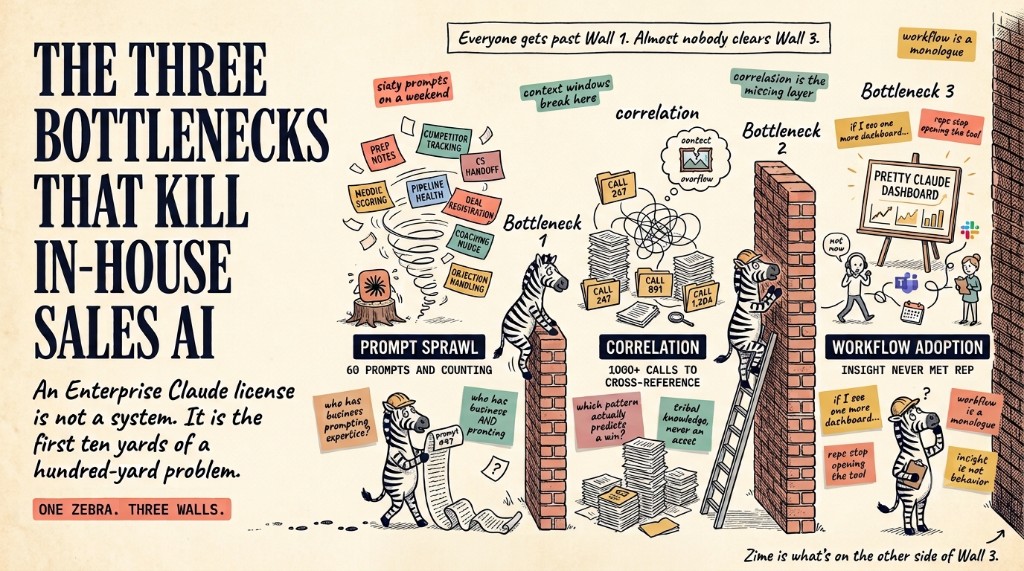
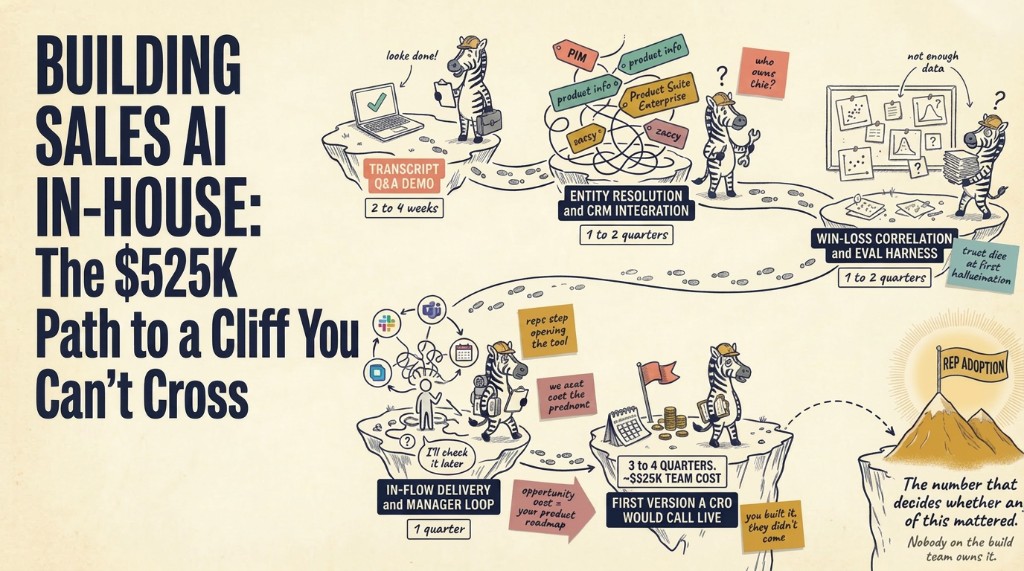
If any of that sounds familiar, you're not alone in trying to work around it. To solve these problems, most GTM companies today are using Gong as a system of record for call recordings, then piping that data into Claude or other AI agents to try to extract real coaching and execution insights. It's a duct-tape stack: Gong captures, a generic LLM interprets, and somewhere in the middle a human is supposed to translate everything into actual rep guidance.
Teams are getting some results from this setup. Smarter summaries. Faster searches across calls. Occasional ah-ha moments. But they're not getting consistent coaching across reps, and they're definitely not getting execution. The reason is the same root cause: a generic LLM bolted on top of a generic CI tool is still generic AI. Two layers of generic don't add up to custom.
This is exactly the problem custom AI is built to solve, and it's why a single-purpose Sales Execution AI is starting to replace the duct-tape stack entirely.
The six platforms below are the strongest Gong alternatives worth evaluating in 2026. We'll cover what each one does best, where it falls short, and crucially, whether it's a generic tool or one that gets custom to your company.
Quick Comparison: Gong Alternatives at a Glance
Tool
Generic or Custom AI?
Best For
Starting Price
Zime
✅ Custom to your company
Sales Execution AI trained on your winning behaviors
Custom
Winn.ai
Semi-custom (your playbook, generic AI underneath)
Real-time in-call guidance
Custom
Momentum.io
Generic AI for orchestration
Revenue orchestration + CRM hygiene
Custom
Avoma
Generic
Affordable all-in-one meeting AI
From $19/user/month
Mindtickle
Custom content, generic AI
Rep readiness + certification
Custom (~$92K avg/year)
Highspot
Generic AI on your custom content
Enterprise content enablement
Custom (3 tiers)
Gong
❌ Generic AI
Enterprise conversation intelligence
~$1,200 to $1,600/user/year
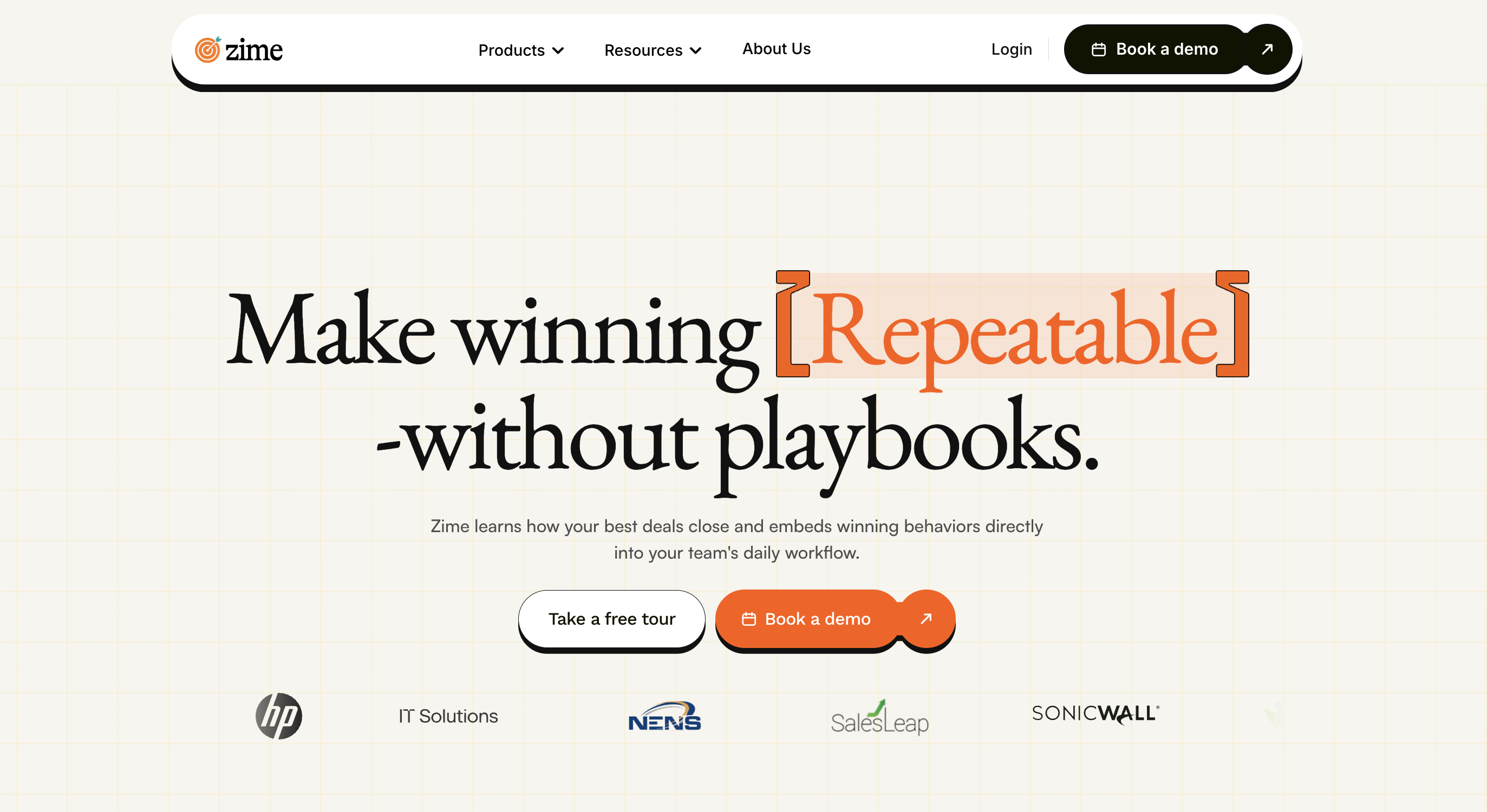
1. Zime: The Best Gong Alternative for Sales Execution AI That Actually Changes Behavior
Best for: Sales leaders who want AI that is custom to their company, not a generic layer bolted on top of their calls.
Here's the simplest way to think about it: Gong is a day 1 AE. Zime is a year 5 AE.
A day 1 AE is sharp, articulate, and can take notes well. But put them on a live deal and they don't know your product deeply, can't anticipate which competitor will come up, don't know which discovery questions actually predict a closed-won, and can't tell when a deal is quietly slipping. They have generic sales skill, not company-specific knowledge. That's exactly what generic AI gives you. Useful summaries. No real judgment.
A year 5 AE at your company is different. They've sat through hundreds of your demos, lost deals to your top three competitors, watched which objections kill which segments, and learned the specific phrases your best buyers use right before they sign. Their advice is sharp because it's yours. That's what custom AI gives you, and it's why Zime's recommendations actually move the needle while a generic tool's get ignored.
This matters because execution is specific. You need a tool that delivers the right discovery questions for your product, handles the right objections against your competitors, and runs your direct sales motion the way your best reps run it. A day-1 AE can't do that. A year-5 AE can.
That's why revenue teams moving off Gong in 2026 are moving toward Zime.
What Makes Zime Different
Here's how Zime stacks up against generic AI tools like Gong across the jobs that matter most for PMM, reps, and sales leaders:
Use Case
Generic AI (Gong)
Zime
How Zime Does It
For PMM & Enablement
Build custom playbooks for each product, competitor, segment
Mid-market and enterprise revenue teams (think SonicWall, Versa, Bureau) that have outgrown keyword trackers and generic call analytics. If your sales leaders are tired of listening to 40+ hours of call recordings a week just to figure out why reps keep missing forecast, Zime automates that entire loop.
Reported Outcomes
According to Zime's customer data, enterprises using the platform see roughly a 20% increase in pipeline from improved discovery, 10% more wins from focusing on conversion-correlated actions, 2+ hours saved per rep per week, and a 50% reduction in manager coaching time. One customer, Bureau Inc., reported a 10% ARR lift by using Zime to turn product launches into just-in-time actions for their sales team.
Why Zime Beats Gong
Generic AI gives every company the same output. Custom AI compounds: the more your team uses Zime, the more it learns about your motion, your buyers, and your winning behaviors, and the sharper every recommendation gets. Reps get coached on your discovery questions. Managers see leaderboards for your playbook. Sales leaders forecast against your past wins. PMMs ship launches that reps can actually execute against in the next call. (See our detailed Zime vs Gong comparison.)
Think of it like the difference between hiring a consultant and growing an in-house expert. A consultant arrives with frameworks but has to learn your business from scratch every engagement. An in-house expert gets sharper every quarter because they're seeing the same patterns again and again, in your context. Generic AI is the consultant. Zime is the in-house expert that never leaves and never forgets.
Bottom line: Gong is generic by design. Zime is custom by design. If you're selling a specific product, to specific buyers, against specific competitors, custom wins.
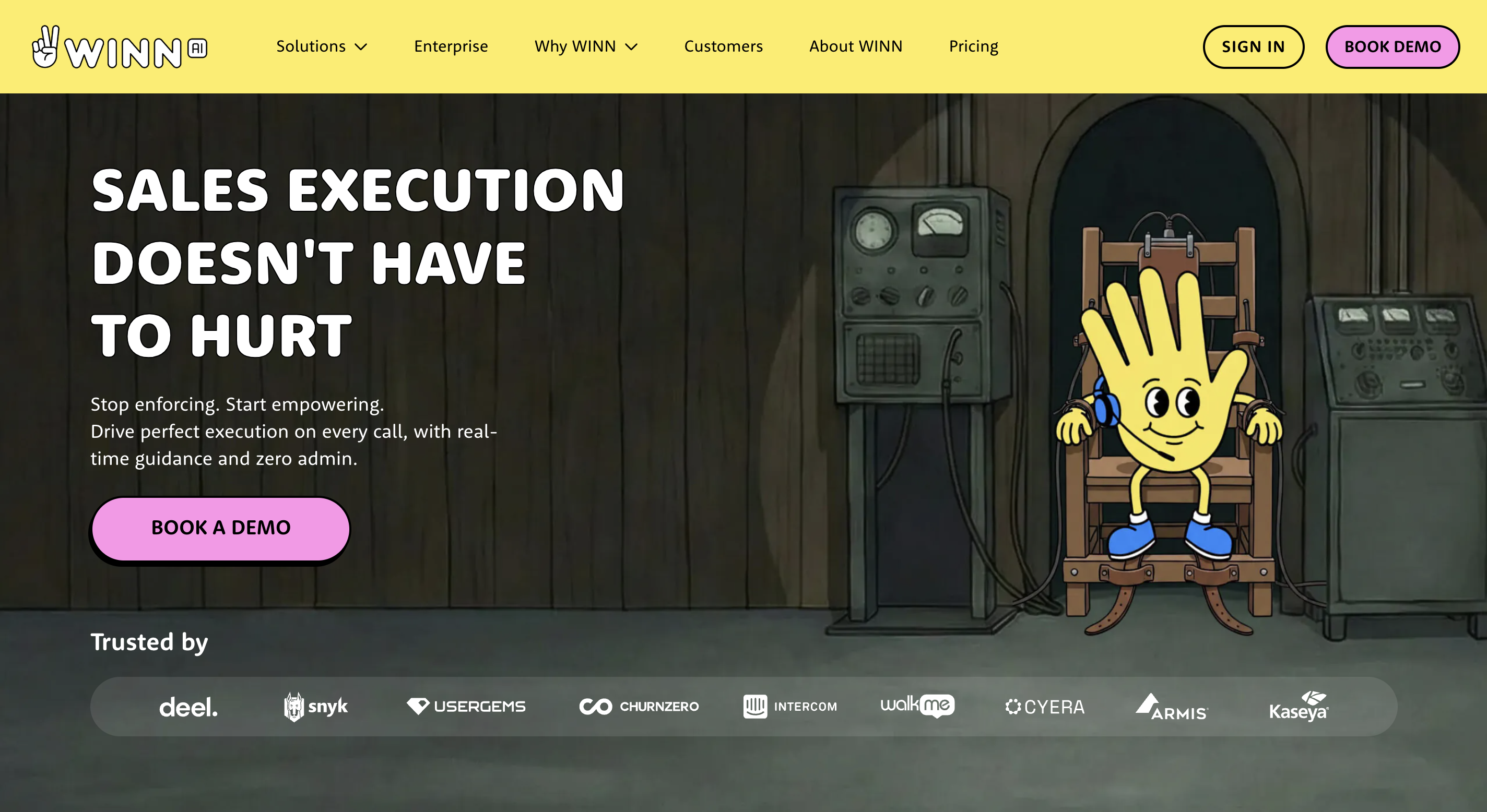
2. Winn.ai: The Best Gong Alternative for Real-Time In-Call Guidance
Best for: AEs and sales teams that want live playbook coaching during calls, not just post-call reviews.
Gong's value shows up after the call ends. Winn.ai's shows up during it. The platform joins your Zoom, Meet, or Teams meetings and acts as a real-time sales co-pilot, tracking talking points, surfacing battlecards, drafting follow-ups, and updating your CRM on the fly.
Key Features
•
Real-time playbook tracking. Shows a live checklist of MEDDIC, SPICED, BANT, or any custom framework points you've hit versus what you still need to cover.
•
In-meeting battlecards and live answers. Detects when a prospect asks about pricing, competitors, or references, and discreetly feeds the rep the right response.
•
Automated CRM updates. Captures structured data and pushes it to Salesforce or HubSpot in one click, including custom fields.
•
Call summaries and follow-up emails. Drafted automatically post-meeting.
•
Playbook deployment. Update a playbook once, and every rep is guided to it on their very next call.
The Winn.ai vs. Gong Positioning
Winn.ai frames itself as a complement to Gong more than a replacement. Gong does post-call review and self-coaching; Winn.ai does live assistance. One enterprise AE at Grammarly reported hitting 227% of quota in large part because Winn.ai's live checklist ensured nothing got missed during calls.
Who It's For
AEs at mid-market SaaS companies where playbook adoption is inconsistent and ramp time matters. Especially strong for new-hire onboarding, since reps follow the company's sales process from day one because the tool guides them through it live.
Trade-offs
Winn.ai is less focused on deep post-call analytics than Gong. If your primary use case is pipeline inspection, forecasting, or long-cycle deal analysis across hundreds of reps, you'll probably pair Winn.ai with another layer (Zime, Momentum, or a lightweight CI tool) rather than replace Gong with it outright.
3. Momentum.io: The Best Gong Alternative for Revenue Orchestration and CRM Hygiene
Best for: RevOps and GTM leaders who need Salesforce to actually reflect what's happening in deals.
Momentum.io isn't a conversation intelligence tool in the traditional sense. It's a revenue orchestration platform—an AI layer that sits across your calls, Salesforce, and Slack and acts on signal automatically. Customers include Zscaler, Ramp, 1Password, Demandbase, Postman, and Alation.
What Momentum Does Best
•
Autopilot CRM updates. Writes call summaries, MEDDIC fields, next steps, and contact updates directly into Salesforce, supporting roughly 98% of CRM field types.
•
Retropilot. Analyzes historical calls to backfill missing CRM fields and clean up pipeline hygiene retroactively.
•
Slack-first deal execution. Auto-creates deal rooms, routes risk alerts, pushes AI-drafted follow-ups to reps, and lets them update Salesforce from Slack buttons.
•
Real-time risk signals. Flags competitor mentions, pricing objections, and churn signals mid-conversation, then notifies the right team instantly.
•
SmartClips. Turns key call moments (objections, competitor mentions) into short shareable video clips within minutes of a call ending.
•
Executive insights. AI-generated reports on customer sentiment, churn risk, and product feedback pulled from clean CRM data.
Who It's For
Mid-market and enterprise B2B teams where Salesforce data hygiene is a chronic problem and sales, CS, and product all need to operate from the same source of truth. If your RevOps team spends its day chasing reps for updates, Momentum eliminates that cycle.
Trade-offs
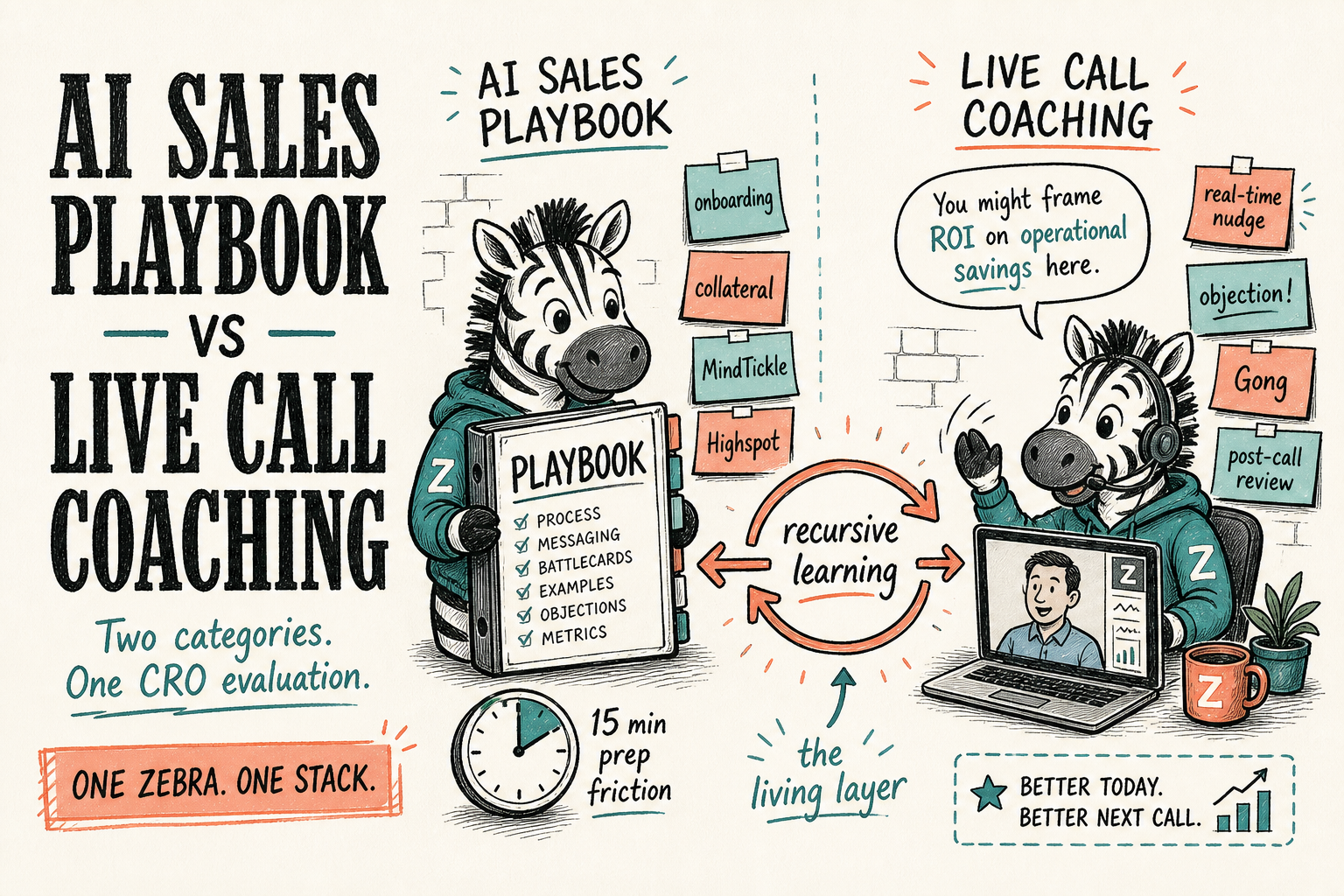
Momentum's core strength is workflow automation and orchestration. It's not primarily a coaching or playbook tool. Teams that need both typically pair Momentum (for CRM hygiene + Slack routing) with a Sales Execution AI like Zime.
4. Avoma: The Best Affordable Gong Alternative for All-in-One Meeting Intelligence
Best for: Startups and scale-ups that want meeting assistance, conversation intelligence, and revenue intelligence in one platform—without enterprise pricing.
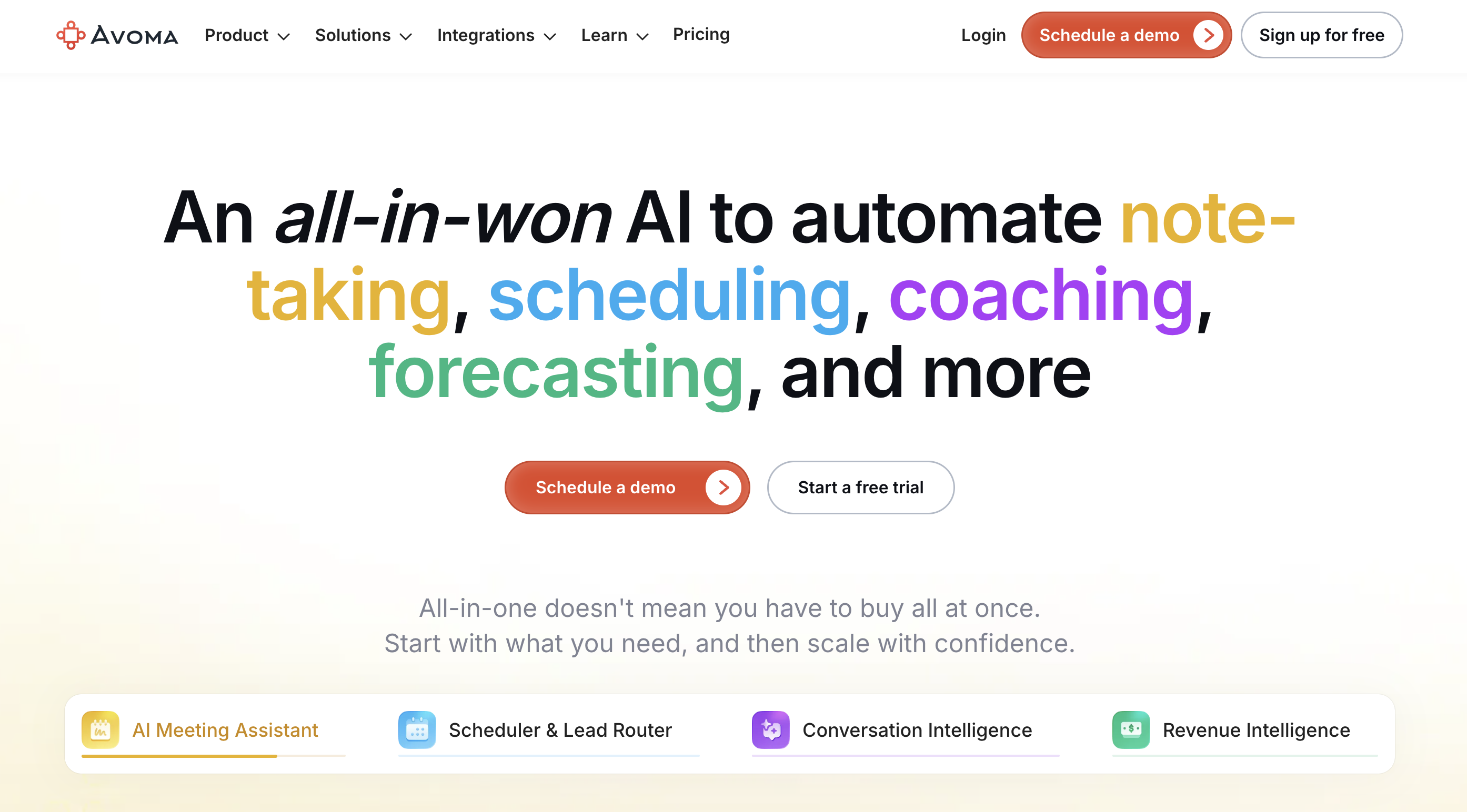
Avoma positions itself as an "AI-first Growth Acceleration Platform." It combines meeting scheduling, AI note-taking, transcription, conversation intelligence, and revenue intelligence (deal health, risk alerts, win/loss analysis) in a single product.
Key Features and Pricing Tiers
•
AI Meeting Assistant (~$19/user/month): Recording, transcription, AI summaries.
The big one is price. Avoma delivers 70 to 80% of Gong's functionality at a fraction of the cost, which makes it popular with Seed-to-Series-B SaaS companies. It also combines scheduling and meetings into one tool, so you're not paying for Chili Piper + Gong + a separate note-taker.
Trade-offs
Avoma's AI is less mature than Gong's for deep conversation analytics at scale. Large enterprise teams with complex GTM motions often find its deal intelligence layer less refined. But for teams under 200 reps, it's one of the best value plays in the market.
5. Mindtickle: The Best Gong Alternative for Rep Readiness and Certification
Best for: Mid-market and enterprise sales orgs that care more about training, onboarding, and skill validation than post-call analytics.
Mindtickle is a revenue enablement platform built around the idea that reps need to be ready before they ever hit a call. It combines structured onboarding, skills assessments, role-plays, coaching, and analytics into a single system, with gamification and a mobile-first design that drives genuine engagement.
Key Features
•
Structured onboarding paths with quizzes, video coaching, and certifications.
•
AI-powered role-plays that let reps practice objection handling and discovery in a safe environment.
•
Readiness scorecards that show managers exactly which reps are skilled and which have gaps.
•
Mindtickle Copilot, an AI assistant that automates content creation and answers rep questions instantly.
•
Deep Salesforce and HubSpot integration that ties training to actual revenue outcomes.
Pricing
Quote-based. Vendr's transaction data shows Mindtickle averaging around $92,000 per year, with large deployments running up to $430,000 annually.
Who It's For
Enterprise sales orgs with performance benchmarks, compliance requirements, or long ramp times. It's particularly strong for industries like financial services, healthcare, and large SaaS where consistent messaging and certified rep skills matter.
Trade-offs
Mindtickle is an enablement platform, not a conversation intelligence platform. It won't replace Gong's live call capture; it addresses a different part of the revenue stack. Many teams pair Mindtickle with Zime or a CI tool: Zime identifies the skill gap from real deals, and Mindtickle delivers the structured training to close it.
6. Highspot: The Best Gong Alternative for Enterprise Content Enablement
Best for: Large revenue orgs that need a single source of truth for content, playbooks, and buyer-facing materials.
Highspot is the category leader in sales enablement software. It centralizes your decks, one-pagers, case studies, and training content, layers AI-powered search and recommendations on top, and gives managers granular visibility into what content actually moves deals.
Key Features
•
Content management system with AI-generated descriptions for searchability.
•
Guided selling that recommends the right asset at the right stage of a deal.
•
Sales plays and playbooks built into daily rep workflows.
•
Training and coaching modules with certifications and analytics.
•
Buyer engagement analytics that show which stakeholders opened your deck, what they read, and for how long.
•
Deep integration with Salesforce, Outlook, Microsoft Dynamics, and more.
Pricing
Custom per-user pricing across three tiers (Core, Advanced, Enterprise). Larger deployments can reach six figures annually. Not published publicly; you'll need a sales conversation to get real numbers.
Who It's For
Enterprise GTM teams with 200+ reps, dedicated enablement staff, and complex content libraries. If "reps can't find the right asset" is a daily complaint at your company, Highspot is the cleanest fix.
Trade-offs
Highspot is a content and enablement platform first, not a conversation intelligence tool. Its AI has improved, but it doesn't analyze live sales calls the way Gong or Zime do. Some users also note the interface can feel cluttered as content libraries grow.
How to Choose the Right Gong Alternative (A Practical Framework)
Before matching a tool to a use case, start with a bigger question: do you want generic AI or custom AI?
This is the decision that actually determines ROI. A generic tool like Gong gives every company on its platform the same output, trained on the average of all SaaS companies. That's fine if your sales motion is also average. But if you sell a specific product, against specific competitors, to specific buyers, in a specific way, a generic AI will always give you generic insights. Your reps will still need to translate those insights into what to actually say, do, and send in your context. The tool hasn't done the job. It's just moved it.
A custom AI like Zime inverts that. It's trained on your calls, your winning reps, your playbook, and your GTM, so every output already speaks your company's language. Reps don't translate. Managers don't interpret. The insight is the action.
Once you've made that call, match the tool to the problem you're actually trying to solve:
•
"Our reps don't follow the playbook." You need custom AI. Pick Zime (Sales Execution AI trained on your winning behaviors) or Winn.ai (live playbook guidance during calls).
•
"Our AI tool gives us generic insights we still have to translate." Pick Zime. This is exactly the gap custom AI closes.
•
"Our forecast is a fiction because Salesforce is dirty." Pick Momentum.io.
•
"Gong is too expensive for our team size." Pick Avoma.
•
"New reps take 6 months to ramp." Pick Mindtickle or Winn.ai.
•
"Reps can't find the right content at the right moment." Pick Highspot.
•
"We don't know why we win or lose deals against our specific competitors." Pick Zime. Generic tools give you generic win/loss patterns. Custom tools give you patterns against your competitors in your stages.
Most mature revenue teams end up running two tools: a custom execution layer (Zime) plus either a content enablement layer (Highspot) or a readiness layer (Mindtickle). Gong itself is increasingly used as a raw call-capture layer underneath these more action-oriented tools, because raw capture is the one thing a generic tool can do as well as a custom one.
The broader pattern across every category of B2B software is clear: custom beats generic the moment specificity matters. In 2026, specificity is the entire game in sales.
Final Takeaway
Gong invented the conversation intelligence category, but in 2026 it's no longer the default choice. The smartest revenue teams are asking a sharper question first: do I want generic AI or one custom to my company?
Generic AI is fine when your problem is generic. But sales is the opposite of generic. You sell a specific product, against specific competitors, to specific buyers, with a specific motion that took your team years to build. Asking a generic AI to drive that is asking it to do a job it wasn't built for. The translation work always falls back on your reps and managers, and you lose most of the value you paid for.
Custom AI flips the equation. The more your team uses it, the more it learns about you, and the sharper every recommendation becomes. That's why Zime, the only Sales Execution AI custom to your company, is where most teams looking past Gong are landing in 2026. If you also need to stop missing moments mid-call, layer in Winn.ai. If you need to fix Salesforce hygiene, layer in Momentum.io. The modern revenue stack looks less like one giant generic tool and more like a custom execution layer + an enablement layer + clean CRM plumbing—each purpose-built for its job.
Tags: Gong alternatives, conversation intelligence, sales enablement, AI sales coaching, revenue intelligence
Sanchit Garg
Cofounder & CEO, Zime
Meaningful goals drive me. My goal is to empower everyone to be a top-performer with accurate nudges in the workflow. Before InnerFit, I founded TravelTriangle for "Holiday Experience," which achieved market leadership with $42mn+ ARR and a team size of 700+ go-getters.
In this Blog
Frequently asked questions
How long does it take to migrate off Gong to an alternative?
remove
It depends on the tool. Lightweight platforms like Avoma and Winn.ai can be live in a few days. Zime typically onboards enterprise teams in about 7 days because it needs to ingest 100+ of your past calls to build custom AI playbooks. Momentum.io can go live in under a week for Salesforce automation. Mindtickle and Highspot are the slowest; expect 2 to 6 months for full content migration, training design, and admin configuration.
Do these alternatives work with Microsoft Teams, Zoom, and Google Meet?
add
All six alternatives covered here support Zoom, Google Meet, and Microsoft Teams as of 2026. The differences show up in how they capture calls. Winn.ai joins as a browser-based co-pilot (no bot in the meeting). Momentum.io and Avoma use meeting bots. Zime integrates across all three plus Slack, Salesforce, and HubSpot without requiring a separate recorder.
Are call recordings from Gong portable if I switch?
add
Partially. Gong exports transcripts and metadata in standard formats (CSV, JSON), but the underlying AI insights (scorecards, topic tags, deal intelligence) don't transfer. When evaluating alternatives, ask whether they offer a migration pathway. Some tools (including Momentum.io's Retropilot) can re-analyze your historical call recordings and rebuild insights from scratch.
How do these platforms handle data privacy and compliance?
add
Most enterprise Gong alternatives are SOC 2 Type II certified and GDPR-compliant, including Zime, Momentum.io, Mindtickle, and Highspot. Things to verify before buying: where data is stored (US vs. EU regions), whether recordings are retained after contract end, whether PII gets redacted from transcripts, and how the vendor's AI models are trained.
Will switching to a Gong alternative actually improve rep adoption?
add
Adoption is the real buying criterion, not features. The single biggest predictor of adoption is whether the AI is generic or custom. Gong's most common complaint from reps is that insights feel generic and don't change day-to-day behavior. Tools that get custom to your company (Zime), or that get custom to your workflow (Winn.ai's live checklists, Momentum's Slack-based deal rooms), tend to see higher daily active usage.
Do I need to replace Gong, or can I run an alternative alongside it?
add
Many teams run both, at least during a transition. The common pattern: keep Gong for call capture and broad conversation search, then layer a more action-oriented tool (Zime for execution, Momentum for orchestration, Winn.ai for live guidance) on top. Zime explicitly supports this and can ingest Gong recordings and turn them into playbook-aware actions without ripping Gong out.
How do I build an internal business case to switch from Gong?
add
Frame it as generic vs. custom AI, then anchor the math. Lead with three numbers: current Gong spend (per-user + platform fee), hours per week your managers spend reviewing calls and translating generic insights into actionable coaching, and your current forecast accuracy. Most leaders are shocked when they total up the manager hours spent doing the translation work a custom AI would do automatically.
What's the biggest mistake teams make when choosing a Gong alternative?
add
Buying generic when they need custom. Most teams enter the evaluation with a feature checklist and pick whichever generic AI tool checks the most boxes. Six months later, reps still aren't following the playbook, managers are still drowning in calls, and the tool is shelfware. The reason is almost always the same: a generic AI gave them generic output that doesn't drive behavior change.
Have industry-leading sales tips sent straight to your inbox.
Sign up for our newsletter to stay updated on how modern technologies are revolutionizing sales methodologies.