Blog
What Is Solution Selling? A Complete Guide
Solution selling is a consultative B2B sales methodology where reps diagnose root-cause problems before co-creating tailored solutions that deliver quantified b
Your team knows the playbook exists. They sat through the training. But when a deal stalls in week six or a pricing objection lands mid-call, that knowledge does not always translate into action. The gap between knowing a methodology and executing it consistently is where revenue leaks.
Sales teams without a defined process miss quota roughly 60% of the time, according to research cited by The Sales Collective. That number is not a reflection of talent. It is a reflection of structure, or the absence of it. The problem is rarely a shortage of effort. It is a shortage of repeatable, reinforced behavior.
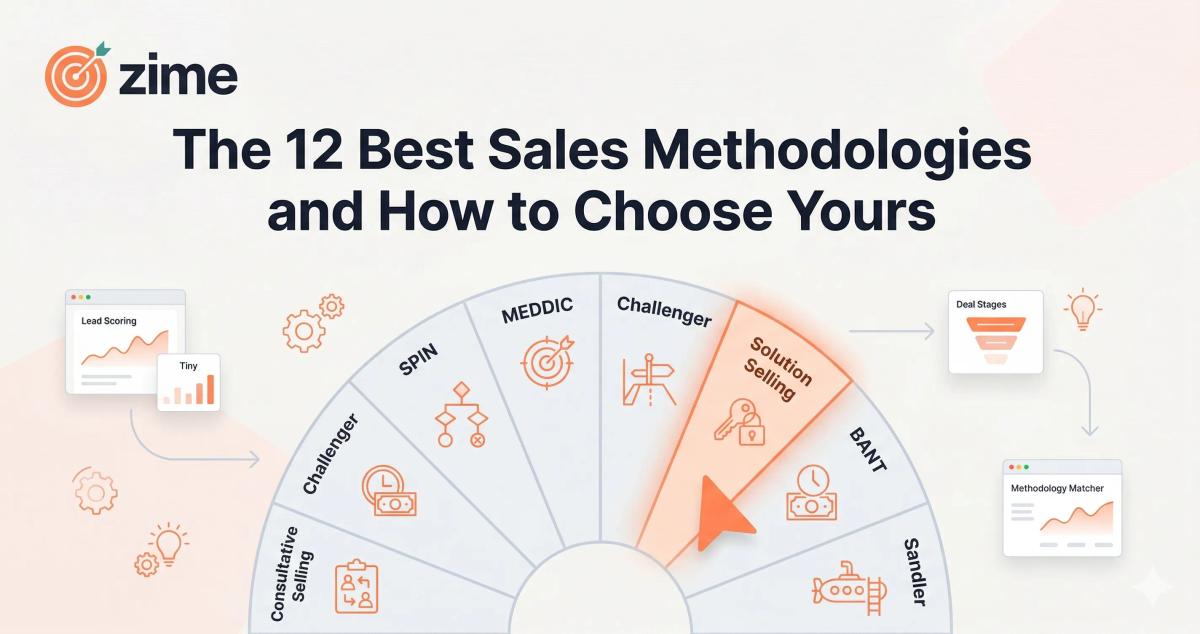
A sales methodology is a structured framework that guides how reps engage, qualify, and close deals, turning tribal knowledge into repeatable behavior. This guide breaks down the 12 most effective methodologies for B2B teams, how to choose the right one for your motion, and what it actually takes to make adoption stick.
A sales methodology is a structured framework that tells your reps how to sell. It shapes the conversations they have, the questions they ask, the way they qualify opportunities, and the tactics they use to move deals forward.
Rather than relying on intuition or improvisation, a methodology gives your reps a repeatable, scalable approach for understanding buyer needs, aligning value, and executing consistently across every opportunity. Think of it as the how behind your sales motion.
Your sales process defines the stages a deal moves through: prospecting, discovery, demo, negotiation, close. The methodology, on the other hand, tells reps what to actually do and say at each stage to maximize their chances of winning.
A well-adopted methodology typically covers four areas:
Without a methodology, every rep sells differently. Some will succeed through sheer talent, but most will struggle to replicate what works. The result is inconsistent execution, unpredictable forecasts, and a coaching nightmare for managers. When one rep closes a deal, no one quite knows why. When another loses one, there is no structured way to diagnose what went wrong.
The most effective sales organizations treat methodology as organizational infrastructure, not just a training topic.
These two terms often get used interchangeably, but they solve different problems. Understanding the distinction helps you avoid a common trap: building a great process with no guidance on how to execute it.
| Aspect | Sales Process | Sales Methodology |
|---|---|---|
| What it defines | The stages deals move through | The approach reps use at each stage |
| Structure | Company-specific pipeline stages | Can be adopted from proven frameworks |
| Core question | What happens next? | How do we execute this? |
| Changes with | Company growth and market evolution | Buyer behavior and competitive positioning |
| Owned by | Revenue operations and sales leadership | Sales enablement and frontline managers |
Your sales process might include stages like Discovery, Demo, and Negotiation. But what makes a discovery call effective? How do you handle a pricing objection in negotiation? That is where methodology comes in.
The best-performing teams treat process and methodology as complementary. The process provides structure. The methodology provides execution guidance. When both are aligned and reinforced in daily workflows, you get consistency without rigidity. Reps know what stage a deal is in and they know exactly what to do to move it forward.
A useful way to think about it: your sales process is the map, and your sales methodology is the driving style. Two reps can follow the same map and arrive at very different destinations depending on how they navigate.
There is no single best methodology. The right choice depends on your deal complexity, buyer type, and team structure. What matters is picking one that fits your motion and then embedding it into how your team sells every day.
SPIN Selling is a discovery-focused methodology built around four types of questions: Situation, Problem, Implication, and Need-payoff. Developed by Neil Rackham in the 1980s after studying over 35,000 sales calls, it remains one of the most widely taught frameworks for consultative selling.
The core idea is that buyers do not change unless they feel the weight of their current problem. SPIN questions help reps uncover latent pain and build urgency by exploring the business implications of inaction. Rather than pitching a product, a skilled SPIN rep leads the buyer to articulate the need themselves, making the solution feel like the buyer's own conclusion.
Here is how each question type works in practice:
One SPIN Selling case study showed a company's won-versus-lost ratio improving from 10% to 23% after implementing the framework with their sales teams. The methodology works because it mirrors how buyers actually think. People buy when they feel the problem is real, urgent, and solvable.
The Challenger Sale flips the traditional relationship-building model. Instead of leading with rapport, Challenger reps teach prospects something new about their business, tailor their message to specific priorities, and take control of the conversation.
Research behind the Challenger Sale found that 40% of top-performing B2B sales reps fall into the "Challenger" profile, making it the most common profile among high performers. This approach works particularly well in commoditized markets where differentiation is hard. By leading with insight, reps position themselves as valuable experts rather than just another vendor trying to make a quota.
The Challenger approach follows a three-step sequence often called the "teach-tailor-take control" model:
Challenger is particularly powerful when combined with SPIN. You can use SPIN to uncover pain during discovery, then shift to Challenger's provocative framing during the demo or proposal stage.
MEDDIC is a rigorous qualification framework designed for enterprise sales with long cycles and multiple stakeholders. The acronym stands for Metrics, Economic Buyer, Decision Criteria, Decision Process, Identify Pain, and Champion.
Teams that adopt MEDDIC tend to see improvements in forecast accuracy because the framework forces reps to validate deal health at every stage. If you cannot identify the economic buyer or articulate the decision criteria, the deal is not as far along as it looks. MEDDIC essentially creates a standardized "deal health score" that every rep and manager can read the same way.
Here is what each element actually requires a rep to validate:
Many enterprise teams have extended MEDDIC to MEDDICC (adding Competition) or MEDDPICC (adding Paper Process) to account for longer, more complex procurement cycles.
The Sandler method is built on mutual qualification. The idea is that both buyer and seller are actively evaluating fit, which flips the typical power dynamic of a sales conversation. Rather than chasing the buyer, Sandler-trained reps position themselves as consultants who need to be convinced the fit is real before investing more time.
Sandler uses two key techniques that set it apart. The pain funnel is a structured questioning sequence that moves from surface-level problems to deeper emotional and financial pain. The goal is to get the buyer to articulate the cost of their problem in their own words. Up-front contracts set clear mutual expectations before each conversation, reducing surprises at the end and preventing "I need to think about it" from killing a deal at the finish line.
Sandler is particularly effective for longer-cycle, consultative sales where trust is paramount. The methodology helps reps disqualify bad-fit prospects early, saving time for opportunities that actually have a chance. One of the most counterintuitive lessons of Sandler is that it is okay, even productive, to end a conversation by agreeing that there is no fit. Buyers remember that kind of honesty, and some of the best referrals come from deals you walked away from gracefully.
Solution Selling is a foundational methodology that focuses on buyer pain points rather than product features. The rep acts like a doctor, diagnosing the problem thoroughly before prescribing a solution.
Where traditional feature-based selling leads with capabilities, Solution Selling leads with context. The rep's first job is to understand the buyer's world deeply enough to prescribe the right solution with confidence. This requires asking questions about the business environment, the impact of the current situation, and what an ideal outcome would look like before a product is ever introduced.
While newer methodologies have built on its principles, Solution Selling remains relevant for teams selling complex products where the buyer's problem is not always obvious at the start of the conversation. It is foundational in the sense that most modern methodologies, including Consultative Selling, Gap Selling, and even the Challenger Sale, borrow from its core principle: sell to problems, not to features.
Closely related to Solution Selling, Consultative Selling is a broader philosophy where the rep acts as a trusted advisor throughout the entire customer relationship. The focus is on long-term value and partnership rather than quick transactional wins.
This approach tends to increase deal size and customer lifetime value because buyers trust reps who genuinely understand their business. The consultative rep does not just show up when there is a renewal or upsell opportunity. They share relevant insights, make proactive introductions, flag risks before they become problems, and position themselves as a resource their buyer would miss if they left.
The challenge is scale. Consultative Selling is time-intensive by design, and most reps do not have the bandwidth to maintain deeply consultative relationships across a large portfolio without strong enablement support. Sales leaders who want to scale this model need tools that surface relevant insights and talking points automatically, rather than expecting reps to research every account manually before every call.
SNAP Selling is designed for the modern, overwhelmed buyer. The acronym guides reps to keep things Simple, be iNvaluable, Align with business objectives, and raise Priorities.
Unlike more complex methodologies, SNAP focuses on reducing friction at every step. The methodology acknowledges a reality that any experienced sales rep recognizes: your buyer has too many meetings, too many priorities, and too little patience for a sales conversation that does not immediately show value. SNAP trained reps learn to cut through noise fast, lead with relevance, and make every interaction feel worth the buyer's time.
SNAP is particularly effective for mid-market and SMB sales where buyers are juggling multiple priorities and have limited time for lengthy discovery processes. It also works well as a complement to other methodologies. You might use SNAP principles for initial outreach and early-stage conversations, then shift to SPIN or Challenger as the deal progresses and the buyer invests more time.
Gap Selling focuses on the distance between a buyer's current state and their desired future state. The methodology, popularized by Keenan's book of the same name, emphasizes understanding and quantifying the business impact of that gap to create urgency for change.
The key distinction in Gap Selling is that urgency is not manufactured. It comes from helping the buyer see the true cost of staying where they are. A rep trained in Gap Selling does not push the buyer to buy. They help the buyer calculate what inaction is actually costing them, and then let that math do the work.
This approach is powerful when ROI justification is critical. In B2B SaaS particularly, buyers often have a vague sense that their current tools are underperforming. Gap Selling gives reps a structured way to make that vagueness precise. By helping buyers articulate the gap in measurable terms, reps build a business case that the buyer's own finance team will not be able to argue with.
NEAT is a modern alternative to older qualification frameworks like BANT (Budget, Authority, Need, Timeline). It stands for Need, Economic impact, Access to authority, and Timeline.
The key difference between NEAT and BANT is the emphasis on economic impact rather than just budget. BANT asks whether the buyer has the money. NEAT asks whether the solution creates enough economic value to justify the investment, which is a fundamentally more buyer-centric question. This framing also opens up conversations about building the business case internally, which is often necessary in larger organizations where budget is allocated by the problem being solved, not by a pre-existing line item.
NEAT is more flexible and lightweight than MEDDIC, making it a good fit for teams that want stronger qualification rigor without the full complexity of an enterprise qualification framework. It can also serve as a gateway methodology for teams transitioning from intuition-based selling to structured qualification for the first time.
Conceptual Selling is built on the idea that buyers do not purchase products. They buy their concept of a solution. The methodology, developed by Miller Heiman, focuses on understanding the buyer's ideal outcome and positioning your offering to match that vision.
This approach requires reps to do something that goes against natural instinct: stop talking about your product and start asking about the buyer's concept of success. What does winning look like to them? What would a successful implementation mean for their team? What does failure look like, and how do they want to avoid it? When reps understand how the buyer mentally frames the problem and the solution, they can position their offering in those terms rather than in the vendor's own language.
This approach helps reps avoid getting stuck in feature-by-feature comparisons. Instead, conversations center on whether your solution aligns with how the buyer thinks about solving their problem, which is a much harder thing for a competitor to undercut on price.
The Value Selling Framework centers on demonstrating tangible, personalized value to every stakeholder involved in a deal. Reps learn to articulate ROI in the buyer's specific terms rather than relying on generic value propositions.
The framework distinguishes between business value (what the solution does for the organization) and personal value (what it does for the individual stakeholder). A VP of Sales cares about win rates and ramp time. A CFO cares about cost reduction and ROI. A frontline manager cares about whether the tool will actually make their day easier. Effective value selling speaks to all of these dimensions in the stakeholder's own language.
This methodology is particularly effective in competitive deals where price pressure is high. When you can quantify the value you deliver in precise, stakeholder-specific terms, you justify premium pricing and differentiate on outcomes rather than features. Sales teams that invest in strong value calculators and ROI tools consistently outperform those relying on qualitative value pitches alone.
Command of the Sale, popularized by Force Management, emphasizes rep control over the deal process through meticulous preparation and execution. The methodology focuses on two dimensions: commanding the message (ensuring it resonates) and commanding the process (preventing deal slippage).
Command of the Sale teaches reps to attach their solution to the buyer's positive business outcomes (PBOs), required capabilities, and metrics for success. Every conversation is structured around making the buyer feel the gap between where they are and where they need to be, and then demonstrating that your solution is uniquely positioned to close it.
Teams that adopt this approach often see reduced slippage and higher win rates on qualified opportunities because reps are trained to proactively manage every step of the buyer's internal process, not just the external conversation. This includes managing the champion, anticipating internal obstacles, and making it easy for the buyer to build the business case internally.
| Methodology | Best For | Sales Cycle | Complexity |
|---|---|---|---|
| SPIN Selling | Complex B2B, consultative | Medium-long | Medium |
| Challenger Sale | Commoditized markets | Medium-long | High |
| MEDDIC | Enterprise, multi-stakeholder | Long | High |
| Sandler | Professional services, complex | Medium-long | High |
| Solution Selling | Custom/complex products | Medium-long | Medium |
| Consultative Selling | Enterprise account management | Long | High |
| SNAP Selling | SMB, inside sales | Short-medium | Low |
| Gap Selling | ROI-critical, status quo deals | Medium-long | Medium |
| NEAT Selling | Mid-market SaaS | Short-medium | Low-medium |
| Conceptual Selling | Custom, configurable solutions | Long | High |
| Value Selling | Competitive, multi-stakeholder | Medium-long | Medium-high |
| Command of the Sale | Enterprise, high slippage risk | Long | High |
With so many options, the answer depends on your specific context, not on which methodology is most popular this year. Here is what to consider.
Short, transactional cycles call for a different approach than 12-month enterprise deals. SNAP works well for fast-moving SMB sales. MEDDIC is built for complex deals with multiple stakeholders and long timelines.
A useful rule of thumb: the more complexity, the more stakeholders, and the more organizational risk involved in the buyer's decision, the more qualification rigor your methodology needs to provide. A startup selling a $5,000 annual SaaS contract does not need the same framework as a team closing $500,000 enterprise deals. The overhead of running MEDDIC on a transactional sale will slow your team down. The absence of it on an enterprise deal will cost you forecast accuracy.
Technical buyers respond differently than C-level executives. The Challenger Sale can be highly effective in commoditized industries where insight-led selling creates differentiation. Solution Selling is a natural fit for custom or complex products where the problem is not obvious. Sandler works well in industries where buyers are wary of being sold to, such as finance or legal services.
Consider not just who you are selling to, but how they are used to being sold to. In industries where buyers have been pitched the same way for decades, a methodology that surprises them with insight or respects their time differently than the average rep will stand out. In industries where buyers are risk-averse and trust-driven, methodologies that prioritize genuine qualification over fast-talking will serve you better.
Some methodologies, like Sandler, require extensive training and a significant mindset shift. Others, like NEAT, are lighter-lift and easier to adopt quickly. Factor in your ramp time, enablement resources, and whether your managers are equipped to coach the methodology effectively.
A large, distributed sales team needs a methodology that can be taught, reinforced, and coached at scale. That often means choosing a framework with clear, memorable components that managers can reference in 1:1s and deal reviews without a manual in front of them. A lean team with experienced reps might have more flexibility to absorb a more complex framework. Match the cognitive load of the methodology to the capacity of your team to absorb it.
Modern methodologies work best when embedded directly into your CRM, conversation intelligence tools, and enablement platforms. If your methodology lives in a static playbook but not in the tools reps use daily, adoption will fade within weeks.
The gap between what is taught in training and what is reinforced in the tools reps use every day is where most methodology initiatives quietly die. Your CRM stages should reflect your methodology's qualification requirements. Your call review process should reference your methodology's conversation framework. Your coaching cadence should be structured around the behaviors the methodology requires.
Many successful teams blend elements from different frameworks. You might use MEDDIC for qualification and Challenger for messaging, or combine Gap Selling's current-state analysis with Value Selling's ROI focus. Blending is common and effective as long as you are intentional about it. Consistency in application matters more than methodological purity.
The most effective blended approaches assign specific frameworks to specific moments in the deal cycle. SPIN or Gap Selling for discovery. Challenger for positioning. MEDDIC for qualification reviews. Value Selling for the proposal and negotiation stages. When each framework has a clear home in the sales process, reps know which tool to pick up and when.
Picking a methodology is the easy part. Successful adoption is where most teams struggle. According to Forrester, 89% of B2B sales enablement teams plan to launch a new sales methodology in the coming year. Yet most of those rollouts underdeliver. The failure mode is almost never the methodology itself. It is the implementation. Here is a practical rollout sequence that works.
Before changing anything, map your existing pipeline stages and identify where execution breaks down. Which stages have the longest dwell time? Where do deals stall or slip? This analysis reveals which elements of a new methodology will have the biggest immediate impact.
Do not try to change everything at once. A targeted audit will often reveal that 80% of your revenue leakage is concentrated in one or two stages. Fix those first. Building early wins from a focused methodology rollout builds organizational confidence that the change is worth the effort, which makes broader adoption easier to achieve.
Assign specific sales plays from your chosen methodology to each pipeline stage. For example, you might require SPIN questions in Discovery and Gap Selling's future-state definition in Demo. This makes the methodology concrete and actionable rather than abstract theory.
Reps do not struggle because they do not understand the methodology. They struggle because they do not know what it looks like in practice on a specific type of call with a specific buyer persona. Making the methodology stage-specific removes that ambiguity. When a rep enters the Discovery stage in the CRM, the right questions and play card should be immediately accessible.
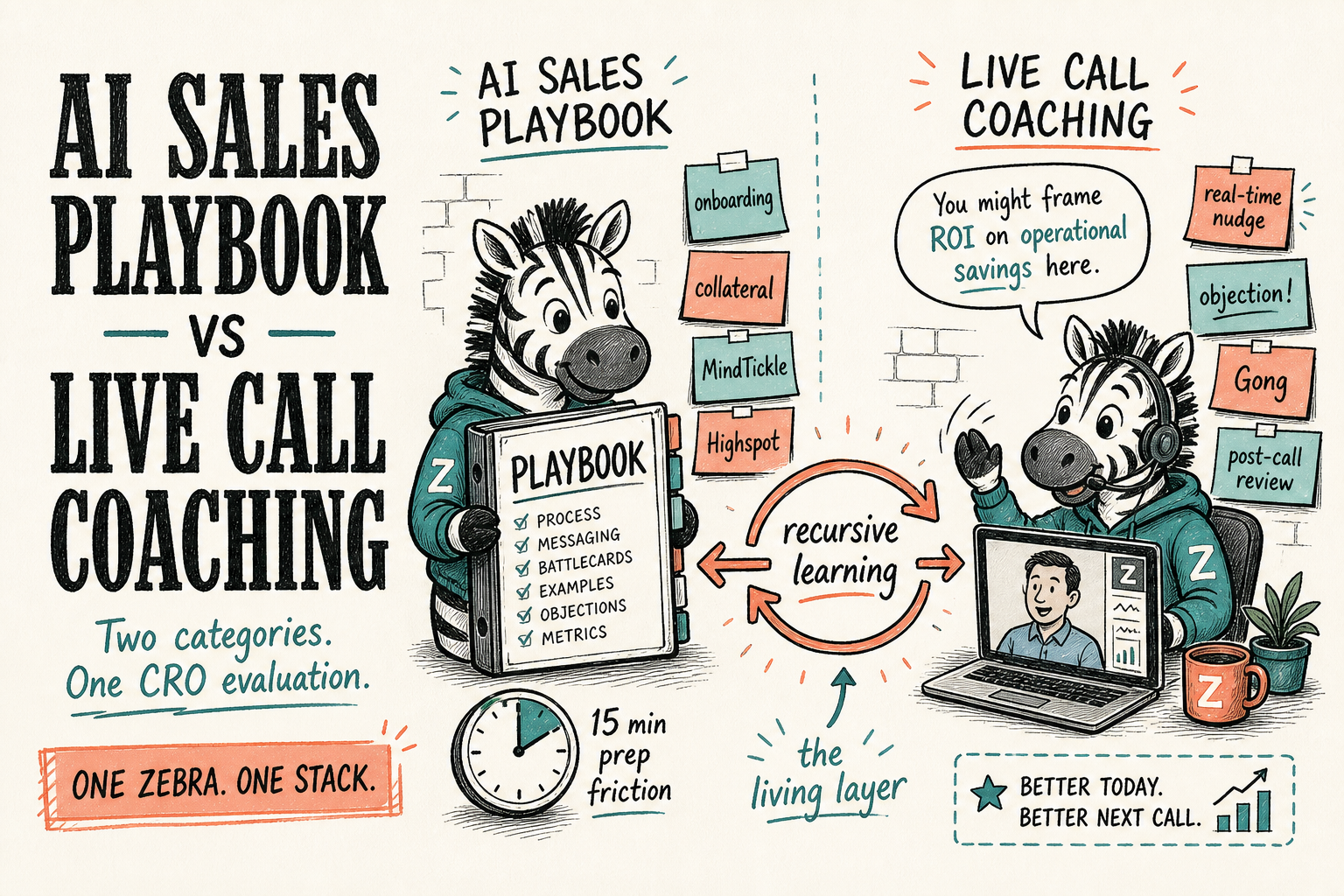
A single training workshop is not enough. Build an ongoing reinforcement program that includes role-plays, call reviews, and just-in-time guidance. The most effective teams surface coaching tips and templates directly in the flow of work, not in a separate learning management system that reps never open.
Research consistently shows that lack of training is the barrier most commonly cited by sales leaders when asked why sales process implementation fails. But the training gap is not just about volume. It is about timing and format. Training that happens weeks before a rep needs to apply a skill will not stick. Training that surfaces at the moment of need, during a live deal, on a real call, is what changes behavior.
AI coaching platforms are making this kind of in-workflow reinforcement scalable across entire teams. Instead of waiting for a 1:1 or a formal review, reps can get real-time guidance on what to do next based on the current state of their deal.
Define what good looks like. Are reps using the new questioning techniques? Are deals being qualified more rigorously? Track sales productivity metrics like discovery call quality and stage-to-stage conversion rates, not just closed-won revenue. Adjust your coaching based on what the data shows.
One technology company that implemented a structured adoption program saw methodology adoption rates rise from 60% to 82% within six months, resulting in a 15% increase in revenue within the first year. The lesson is not that adoption metrics are vanity metrics. They are leading indicators. When adoption is high, revenue outcomes follow. When adoption is low, no amount of pipeline management will fix the underlying problem.
Markets evolve. Buyer expectations shift. Schedule regular reviews to analyze win-loss patterns and refine your approach. The best teams treat their methodology as a living system, not a static document.
A quarterly methodology review should examine: where are deals stalling and why? Are win-loss patterns pointing to gaps in qualification, messaging, or late-stage execution? Have buyer priorities shifted in ways that require updating the discovery framework? Treating the methodology as a living asset, rather than a one-time rollout, is what separates teams that see compounding improvement from those that plateau after the initial training lift.
Tip: Teams that embed methodology guidance directly into rep workflows, surfacing the right actions at the right time, see higher adoption than teams relying on training alone. See how Zime makes this work.
A few myths persist that trip up even experienced sales leaders.
"You can master a methodology from reading a book." Mastery requires practice, feedback, and real-world application on active deals. Reading is just the starting point. The cognitive leap from understanding a framework conceptually to applying it naturally in a live conversation with a skeptical buyer is enormous. Most reps need dozens of coached repetitions before new behaviors become instinctive.
"One methodology fits all situations." Most teams blend approaches or use different methods for different segments. Flexibility is a feature, not a bug. A rigid insistence on methodological purity often hurts the team's ability to adapt to what a specific buyer actually needs.
"Methodology replaces talent." A methodology is a force multiplier that makes good reps great. It is not a substitute for core sales skills. Curiosity, resilience, communication ability, and business acumen all matter. A methodology gives those skills a structure to work within. Without the underlying skills, even the best framework will not save a fundamentally weak rep.
"Once trained, always trained." Without consistent reinforcement, adoption fades within weeks. Execution has to be embedded in daily workflows, not just covered in onboarding. The forgetting curve is real in sales just as it is in every other field. Behavior changes through repetition and coaching, not through a single event.
Sales methodologies fail for four primary reasons: complexity, lack of reinforcement, lack of measurement, and lack of integration with the tools reps actually use. The most common failure modes are related to execution and reinforcement, not the methodology itself.
Lack of reinforcement. Training happens once and is quickly forgotten under quota pressure. Without a structured reinforcement cadence, reps will revert to their default selling habits within weeks of a methodology rollout. This is not a character flaw. It is how human behavior works under stress.
No manager buy-in. If frontline managers do not coach to the methodology in 1:1s and deal reviews, reps will not use it. Managers are the single most important variable in methodology adoption. A manager who runs deal reviews using the methodology's framework sends a clear signal: this is how we evaluate deals here. A manager who ignores the framework tells reps it is optional.
Disconnected from tools. If the methodology lives in a static playbook but not in the CRM or conversation intelligence platform, it dies. The tools reps use every day define what behaviors get reinforced. If the CRM does not prompt MEDDIC qualification, MEDDIC will not get done. If call review does not reference the methodology's conversation framework, reps will not internalize it.
No accountability. Without visibility into whether reps are applying new behaviors, there is no way to coach or drive improvement. Leading indicators like discovery call quality, methodology adherence scores, and stage-to-stage conversion rates need to be tracked and reviewed regularly. Without accountability, methodology adoption becomes voluntary, and voluntary rarely scales.
This is why leading teams embed their methodology directly into rep workflows, surfacing the right actions at the right time without manual effort.
Methodology adoption is ultimately a culture question as much as a training question. Teams that use their methodology consistently are not just well-trained. They share a common language, a shared mental model of what good selling looks like, and a set of shared expectations about how deals should be run.
Building that culture requires a few non-negotiable commitments from leadership. The methodology has to show up in how deals are reviewed, not just how reps are trained. Deal reviews should be structured around the methodology's qualification criteria. If a rep cannot answer MEDDIC questions about a deal they have called close, that is a coaching moment, not a forecasting adjustment.
Sales leaders should model the methodology themselves. When a VP of Sales asks SPIN-style questions in a discovery call they join, or uses Gap Selling's framework to diagnose a stalled deal in a pipeline review, they signal to the entire team that this is not just training content. It is how the organization thinks about selling.
Enablement data from Highspot shows that organizations using sales plays with their revenue teams are 32% less likely to struggle with seller engagement. When methodology is embedded into play-level execution, it stops being abstract and starts being operational.
A sales methodology only works when it becomes how your team actually sells, not just something they learned in a training session. The gap between training and execution is where deals slip and forecasts become unreliable.
The teams that win consistently do not just pick a methodology. They operationalize it. They embed the right behaviors into daily workflows so reps get guidance in the moment, managers see where to coach without replaying every call, and leaders forecast based on execution reality rather than optimism.
Request a Demo: see how Zime turns your methodology into consistent execution.
What is a sales methodology, and why does it matter?
A sales methodology is a structured framework that guides how reps engage, qualify, and close deals. It transforms intuition-based selling into repeatable behavior by giving every rep a consistent set of principles for discovery, qualification, and deal progression. Without one, every rep sells differently, making it nearly impossible to diagnose performance gaps, coach consistently, or forecast accurately. Teams with a well-adopted methodology consistently outperform those without one.
What are the four main types of selling methods?
The four broad types are transactional selling, solution selling, consultative selling, and provocative (Challenger-style) selling. Each varies in how much the rep leads the conversation versus responds to the buyer's stated needs. Transactional selling is feature-focused and fast. Consultative and provocative approaches require deeper discovery and insight. Most B2B sales organizations blend elements from multiple types depending on the complexity of the deal and the sophistication of the buyer.
Can a sales team use more than one methodology at the same time?
Yes, and many of the best teams do. For example, you might use MEDDIC for qualification and Challenger for messaging, or combine SPIN for discovery with Value Selling for the proposal stage. The key is being intentional about when and how to apply each approach, and ensuring reps understand the distinctions so they are not blending frameworks arbitrarily. Consistency in application matters more than choosing a single "pure" methodology.
How long does it take to fully implement a new sales methodology?
Initial rollout and training typically take a few weeks. However, achieving full adoption with consistent execution usually requires several months of ongoing reinforcement, coaching, and integration into daily workflows. Teams that embed guidance directly into rep tools see faster adoption than teams relying on periodic training alone. Realistically, plan for a 6-to-9 month horizon from rollout to consistent behavioral adoption across the full team.
How do you measure whether a sales methodology is actually working?Track leading indicators like discovery call quality, stage-to-stage conversion rates, qualification completeness scores, and sales cycle length rather than just closed-won revenue. Leading indicators show whether reps are applying the methodology effectively to improve deal health before outcomes are finalized. When those metrics improve, revenue outcomes typically follow. If your closed-won revenue is not improving despite good leading indicators, the problem is likely elsewhere in the funnel or in your product-market fit.
Which sales methodology works best for SaaS companies?SaaS teams often succeed with MEDDIC or MEDDICC for complex enterprise deals and SNAP or Gap Selling for SMB and mid-market sales. The best fit depends on your product's complexity, average deal size, and buyer sophistication. Many SaaS teams blend elements from multiple methodologies, using lighter qualification frameworks for high-velocity segments and heavier ones for strategic enterprise accounts. The most important variable is not which methodology you choose but whether your team actually applies it consistently.
What is the most common reason sales methodology rollouts fail?
The most common reason is a failure to reinforce new behaviors after the initial training event. Methodology rollouts fail for four primary reasons: complexity, lack of reinforcement, lack of measurement, and lack of integration with the tools reps use every day. Reps revert to old habits quickly under quota pressure unless the methodology is embedded in their CRM, call reviews, 1:1s, and deal reviews. A one-time training event, no matter how well designed, is not enough to change behavior at scale.
How do I get my sales managers to actually coach to the methodology?
Start by restructuring deal reviews around the methodology's qualification criteria. When managers must ask MEDDIC questions in every pipeline review, the framework becomes part of their standard operating procedure, not optional guidance. Provide managers with a coaching rubric tied directly to the methodology, and include methodology adherence in rep performance scorecards. Managers coach to what is measured. If the methodology is not in the scorecard, it will not be in the coaching conversation.