Blog
Why Do We Lack Visibility Into Deal Health?
Most sales organizations have more tools than ever. Call recorders. CRM platforms. Forecasting dashboards. Pipeline review cadences. And yet, when a leader asks
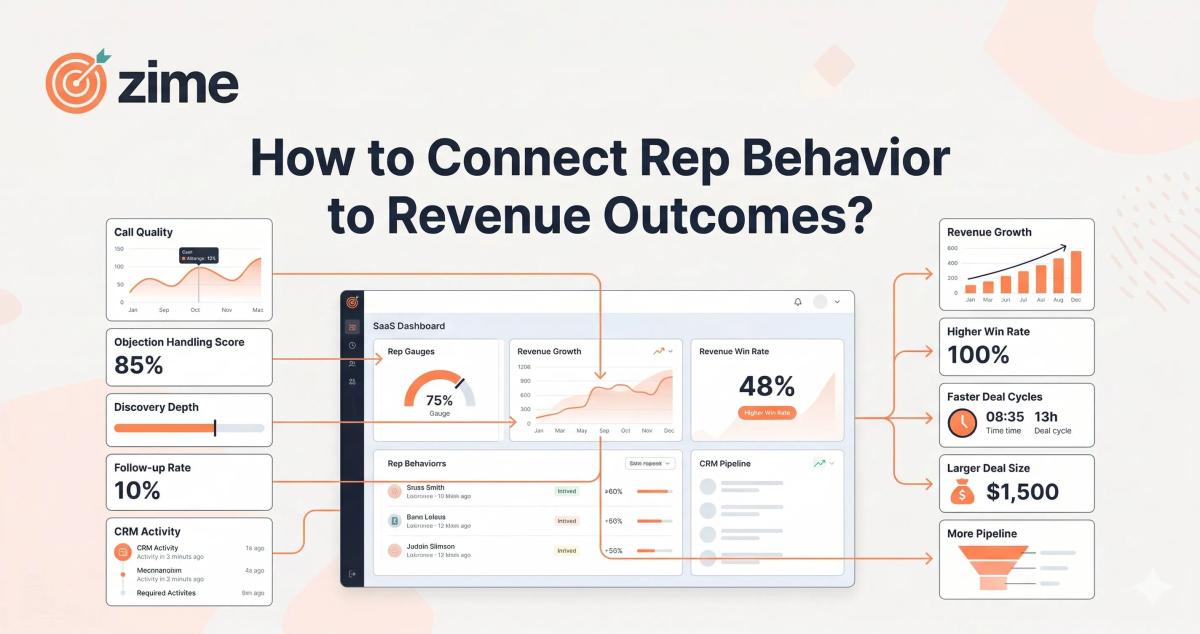
Connecting rep behavior to revenue outcomes is one of the most persistently unsolved problems in B2B sales leadership. Revenue teams have dashboards full of activity data: calls made, emails sent, meetings booked, pipeline stage distributions. Yet when quota attainment falls short or win rates slip, leaders cannot point to the specific behaviors that drove those results. They know the outcome. They do not know what caused it.
The answer starts with a simple but structurally demanding shift: stop measuring what reps do and start measuring how they do it. The difference is between tracking that a discovery call happened and knowing whether the rep surfaced a compelling reason to move, confirmed the decision criteria, and set a mutually committed next step. The first tells you activity happened. The second tells you whether revenue-driving behavior happened.
Connecting rep behavior to revenue outcomes requires three things: a defined behavioral scoring framework built from your winning deals, a mechanism to apply that framework to every call automatically, and a data loop that ties behavioral scores to actual deal progression. Without all three, the gap between how reps behave and how deals close remains invisible.
This challenge belongs primarily to VP Sales, CROs, and Revenue Enablement leaders at B2B SaaS and tech services companies in the growth and scale phase. These are organizations with 20 to 300 reps, active sales motions, and a performance distribution that follows the familiar pattern: 20 percent of reps driving 60 to 80 percent of revenue.
The leaders dealing with this problem most acutely are the ones who have already tried the standard playbook. They have run methodology training. They have documented best practices. They have invested in call recording. They hold weekly pipeline reviews. Yet the performance spread between their top and average reps has not closed. They know what their best reps look like in outcomes. They cannot explain or replicate what those reps look like in behavior.
This is the exact operational state that prevents scale: an organization where winning knowledge exists but lives in a few people's heads, not in a system that the rest of the team can execute against.
The core operational breakdown is a measurement mismatch. Revenue teams measure lagging indicators, outcomes that appear after the fact: closed revenue, quota attainment, win rate, pipeline coverage. These numbers describe what already happened. They offer no insight into the behavioral choices that produced the result or failed to.
According to ValueSelling Associates and Training Industry research, only 25 percent of sales organizations directly measure the behaviors that drive sales success. Three-quarters of sales leaders still rely on lagging indicators as their primary performance signal. The same research found that 81 percent of companies that can connect behavior to results have sales practices that build buyer trust and credibility, compared to only 44 percent of companies that cannot make that connection. The organizations measuring the right things win more.
At the rep level, the breakdown is inconsistency. Two reps in the same segment and deal stage behave completely differently on calls and log the same CRM stage. Without behavioral data, managers have no way to distinguish between them until outcomes diverge weeks later.
At the leadership level, the breakdown is decision-making without evidence. Coaches instinctively target their weakest performers based on outcomes, when the more productive intervention is identifying the specific behavioral gap and fixing it before the outcome arrives.
Calls logged, emails sent, meetings held: these are easy to count and easy to report. They do not differentiate a rep who runs excellent discovery from a rep who shows up to calls and talks about features. McKinsey research on sales performance found that top 30 percent of reps outperform the bottom 30 by a factor of four, and that top reps spend 22 percent more time in meaningful customer interactions. That time difference matters. But the quality of what happens in that time matters more, and that is what most organizations do not measure.
Every sales organization has a handful of reps who run exceptional discovery, handle objections fluently, and build genuine urgency with buyers. Their colleagues know these reps are good. They cannot explain why in precise, repeatable terms. The knowledge is tacit, oral, and fragmented. It survives in war stories at sales kickoffs, not in operational frameworks that average reps can use on their next call.
Research shows that 79 percent of opportunity data never makes it into the CRM accurately. What does get entered reflects the rep's post-call interpretation, shaped by natural optimism and the cognitive bias toward action. A rep who had a pleasant conversation will often advance the deal stage. Whether the buyer expressed genuine urgency or clear budget authority is rarely captured.
Without behavioral data, sales managers coach reactively. A deal slips, and the manager asks the rep what happened. The rep explains it. The manager offers advice based on that narrative. The advice is general because the input was general. Research from CSO Insights shows that increasing structured coaching from under 30 minutes per week to over two hours per week lifts win rates from 43 to 56 percent. The variable is not more coaching time. It is coaching that is targeted, specific, and grounded in what the rep actually did on the call.
The standard response to a performance spread is more training. Teams invest in methodology certifications, frameworks like MEDDIC or SPIN, and quarterly enablement sessions where top reps share what is working. Teams also invest in documentation: playbooks that describe the ideal discovery flow, objection-handling guides, battle cards, competitive frameworks.
A more sophisticated set of teams adds activity accountability: CRM hygiene requirements, pipeline review templates, and activity dashboards that track call volumes and email response rates. All of these feel like the right solution because they address things that are visibly broken.
Methodology training fails at the adoption stage. A rep who genuinely learns the MEDDIC framework in a two-day session still has no feedback mechanism to know whether they are executing it correctly in their next call. Knowledge and behavior are not the same thing. The rep reverts to their default patterns under the pressure of a live deal.
Playbooks fail for two reasons. First, they are built once and go stale quickly because the market, the competition, and the buyer's language evolve constantly. Second, they describe what good looks like in the abstract but offer no mechanism to verify whether the rep's actual call performance matches the description. As one revenue leader in the IT services sector described during a recent conversation, playbooks in organizations are put in a place like Highspot and updated periodically, but no one is reviewing calls to check if reps have actually hit the play.
Activity dashboards fail because they measure presence, not impact. A rep who logs 20 calls per week and a rep who logs 10 calls per week may have the same or opposite performance outcomes. The number of calls is not the signal. What happened on those calls is.
The organizations that successfully connect rep behavior to revenue outcomes do one thing fundamentally differently: they build a closed-loop system between behavioral execution and deal results.
The loop works like this. First, they identify the specific behaviors that correlate with deal progression in their sales motion, not generic best practices but nuances unique to how their buyers make decisions. Then they apply behavioral scoring to every call, measuring whether those behaviors occurred and at what quality level. Then they tie the behavioral scores directly to deal outcomes, which behaviors appeared most often in closed-won deals and which appeared in stalled or lost ones. Finally, they feed that data back into coaching conversations so that managers arrive at every 1:1 with specific, evidence-based inputs.
The power of this loop is in the specificity. When a team tracks whether reps are surfacing the consequence of inaction in discovery calls and ties that behavior to deal progression rates, they can measure the exact impact of improving that one behavior. One company tracked this precisely: when calls containing deep pain-surfacing conversations improved from 40 percent to 95 percent of all discovery calls, win rates improved from 18 to 27 percent. That is not a vague enablement outcome. That is a revenue number attached to a behavioral change.
Revenue leaders across B2B SaaS and tech services consistently describe the same gap: activity is visible, behavior is not.
Bharat Sobti is a Senior Revenue Leader at Innovaccer, a healthcare SaaS platform serving large enterprise health systems in the United States. His team operates enterprise sales cycles with a globally distributed team. He identified the structural starting point precisely:
"We haven't really even cracked the fact that we should have a standard set of activities that we are doing and then measuring against. We are letting the seller lead the process. What we haven't done is created a playbook."
Bharat Sobti, Senior Revenue Leader, Innovaccer
Anant Saksena leads sales at a B2B SaaS company with approximately 55 field reps in the US and a 30-person inside sales function. His team had previously attempted to deploy a call recording tool without success and was evaluating how to build structured execution. He described the core gap:
"We don't have a set framework of saying what activities our sellers should do in stage one, two, or three of the pipeline. There's a playbook, but there are no tech-level defined activities, given our business is based on the time and uniqueness of each account."
Anant Saksena, Sales Leader, B2B SaaS (India and US operations)
Navin Madhavan is VP Revenue at Amagi, a cloud broadcast and streaming SaaS company headquartered in Bangalore with enterprise and SMB sales teams across the US. His team had been using a call recording tool for six to nine months when he articulated what was still missing:
"It's good to score reps on what they're doing in the call. Marrying that back to either their targets, or how much they're booking quarter on quarter, is also something I want to see. That connection is what we haven't fully made yet."
Navin Madhavan, VP Revenue, Amagi
Vibhor Mishra leads the people function at Tavant, a technology and product engineering company with approximately 3,000 employees globally and a mix of product and services revenue. He described the limits of incentive-based approaches to behavior change:
"We have tweaked our sales commission plans to incentivize AI and data sales a lot more. But incentives are important, not sufficient. If the reps are going on the field but they don't know how to pitch AI first, how to handle objections, how to build their differentiation, then even putting the incentives will not get the outcomes."
Vibhor Mishra, Head of People, VPTavant
Start by analyzing your last 20 to 30 closed-won deals. Identify what the rep did on calls that you believe drove the outcome. Focus on specific behaviors, not generic principles. For example: "Rep quantified the cost of inaction in monetary terms" or "Rep confirmed budget authority before advancing to Stage 3." These become your behavioral criteria.
For each deal stage, define three to five behaviors that must be present to justify advancement. Attach a scoring standard to each behavior. Scoring should be binary or graded, not subjective. The criteria you define here become your inspection standard, not just your training content.
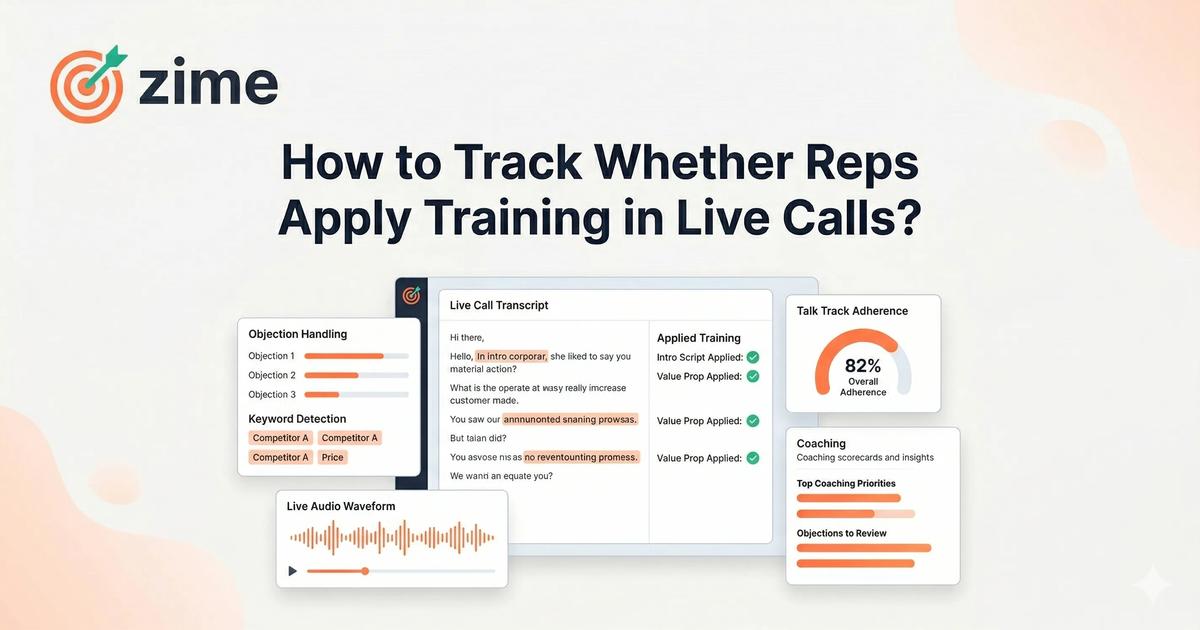
Replace manual call sampling with automated behavioral scoring. Every call transcript is evaluated against the rubric. Every call produces a behavioral score. Reps receive immediate post-call feedback. Managers receive aggregated behavioral scores before coaching sessions, not after.
Track the correlation between behavioral score distributions and deal outcomes over time. Which behaviors, when present at a high rate, correlate with stage advancement? Which behaviors, when absent, correlate with stall or loss? This data becomes your evolving playbook, one that improves continuously based on what your team's actual deal history shows, not on what product marketing believed would work at the start of the year.
Use these questions to assess where the behavioral-to-revenue connection is breaking down in your organization:
The inability to connect rep behavior to revenue outcomes is not a technology problem or a training problem. It is a measurement problem. Revenue organizations have spent decades measuring what happened, not what caused it to happen.
The shift is operational and specific: define the behaviors that drive your sales motion, score them on every call, and tie those scores directly to deal movement over time. When you do this, the performance gap between your top reps and the rest of your team becomes actionable, not just observable. Coaching becomes targeted, not reactive. And the connection between rep behavior and revenue outcomes stops being an aspiration and becomes a process.
If you are ready to act
Making this connection in practice requires more than a framework. It requires a system that applies your specific behavioral criteria to every call, scores them consistently, and surfaces the patterns that predict your outcomes. Zime is built to create exactly this. Book a Demo for a short working session using your own deals and your own sales motion to see how this approach closes the gap your team is facing.