Most sales teams have a cadence. Fewer have one that actually works.
The difference between a sequence that generates meetings and one that burns leads comes down to structure, timing, and execution. Those details are easy to overlook and expensive to get wrong. In 2026, that gap matters even more because buyers are moving across more channels, expecting more personalization, and ignoring outreach that feels generic or overly automated.
This guide breaks down how to build a sales cadence from scratch, the best practices that separate high-performing sequences from noise, and the common mistakes that quietly kill your pipeline. It also adds the strategic context teams need, where cadences have to support both human selling and increasingly AI-assisted workflows.
What is a sales cadence?
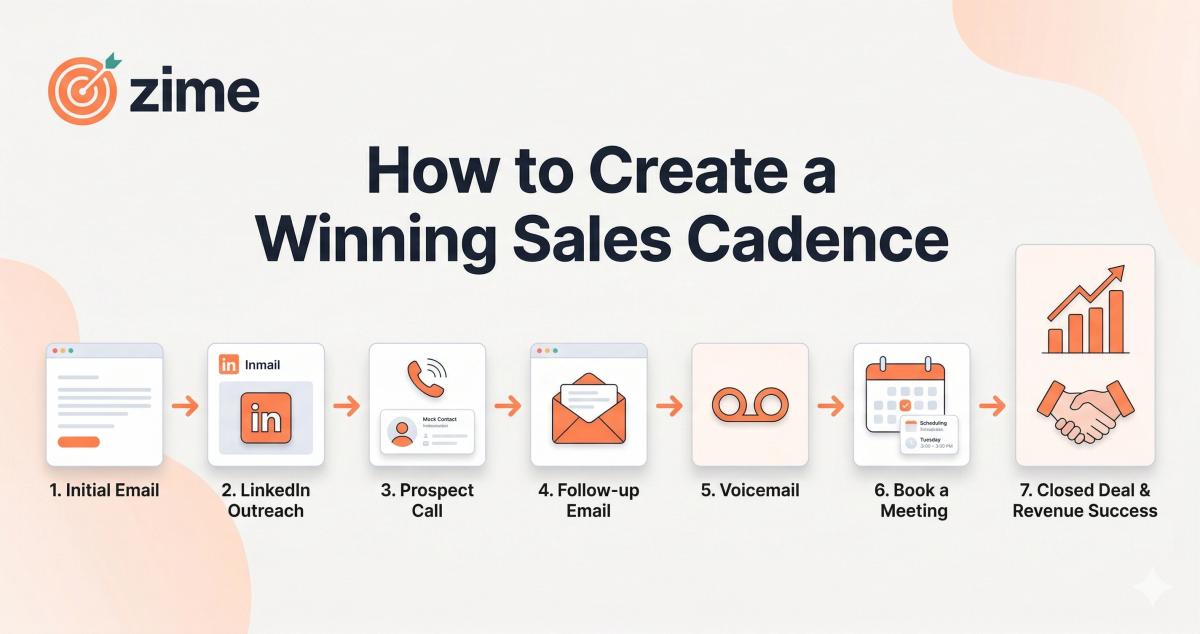
A sales cadence is a structured, repeatable sequence of outreach steps designed to engage prospects over a set timeframe. Effective cadences use a multi-channel approach, combining email, phone, and LinkedIn, typically involving 8 to 12 touchpoints spread across 10 to 21 business days. The goal is to maximize engagement while avoiding the spray-and-pray trap that burns leads and damages your brand.
That definition matters because it separates a true cadence from random follow-up. A cadence is not just “reaching out again.” It is a planned sequence with intent behind every step. Each touchpoint has a purpose, whether that purpose is opening a conversation, building familiarity, sharing value, or creating enough context for the next interaction to land.
Two terms are worth defining upfront.
Touchpoint: A single interaction with a prospect, whether that is an email, call, voicemail, LinkedIn message, or even a meaningful social engagement.
Cadence timing: The strategic spacing between each touchpoint, usually two to three days apart, so you stay top of mind without overwhelming the buyer.
Think of your cadence as the rhythm of your outreach. Too fast, and you become noise. Too slow, and you are forgotten. In the middle is the zone where persistence feels professional rather than pushy.
There is another reason cadences matter now. B2B buyers are used to frictionless, channel-flexible experiences in their personal and professional lives. McKinsey’s research on hybrid selling shows that more than two-thirds of B2B buyers prefer remote human interactions or digital self-service at many purchasing stages, and that buyers want more channels, more convenience, and more personalization overall. A cadence is the operational way to deliver that expectation consistently.
Why sales cadences drive predictable pipeline
A well-built cadence transforms your outreach from improvisation into a system. That unlocks several advantages for your team.
Increased sales efficiency by eliminating guesswork
When reps follow a proven sequence, they stop wondering what to do next. That mental overhead, “Do I call? Send another email? Wait?”, disappears. The cadence answers those questions before they are asked, freeing reps to focus on the conversation itself.
That efficiency matters because sellers already spend a significant share of their time on non-selling work. Salesforce has reported that 72% of sellers’ time is wasted on non-selling tasks in its sales operations research, which is a big reason why structured cadences and automation have become so central to modern sales execution. The more your process reduces ambiguity, the more rep time shifts toward actual selling.
Higher conversion rates through persistent multi-touch outreach
Most deals require multiple touches before a prospect responds. One-off emails rarely do the job. A structured cadence with 8 to 12 touchpoints across channels increases the odds that your message lands when the buyer is actually ready to engage.
The reason is not just repetition. It is familiarity. When outreach arrives in a predictable but not annoying rhythm, it starts to feel like a professional conversation rather than an interruption. Buyers often need several exposures before they trust the message enough to respond, especially in complex B2B categories where the buying committee is large and the stakes are high.
Consistent buyer experience with standardized outreach
Every prospect should receive the same quality of engagement, regardless of which rep contacts them. Consistency protects your brand and ensures that your best practices are not locked inside your top performers’ heads.
This is where many teams struggle. Their best reps have a personal system that works, while the rest of the team improvises. The result is uneven performance and unpredictable pipeline. Standardized cadences reduce that variance.
Scalability across your team
Once you have built a winning cadence, rolling it out to the entire team takes days, not months. New hires ramp faster because they are executing a proven playbook rather than inventing their own approach.
That scale effect becomes even more important when your buyer experience spans multiple channels. McKinsey’s B2B research emphasizes hybrid selling as the dominant model because it allows broader and deeper engagement across the customer journey. Cadences are the tactical layer that makes hybrid selling repeatable.
How to build a sales cadence that converts leads
Ready to build your own? Let’s walk through the process step by step.
1. Define your goal and target audience
Your cadence structure depends entirely on who you are reaching and why. An outbound cold cadence for enterprise prospects looks nothing like a follow-up sequence for inbound demo requests.
Segment your leads by persona, industry, buying stage, or deal size. A one-size-fits-all cadence consistently underperforms compared to tailored approaches because generic messaging fails to address specific pain points. HubSpot’s sales sequence guidance also stresses that ICP and goal determine everything from messaging to channel mix to sequence length.
Start by answering a few practical questions.
- Who is the cadence for, specifically?
- What outcome are you trying to drive?
- What objections are most likely at this stage?
- What proof points would matter to this buyer?
An enterprise VP of Revenue Operations does not need the same story as a mid-market sales manager. A first-touch cadence for a cold prospect should earn attention. A post-demo cadence should reduce uncertainty and move the deal forward.
2. Decide on the number of touchpoints
Most B2B cadences involve 8 to 12 touches over two to three weeks. Higher-value deals or complex sales often require more touchpoints, sometimes 15 or more, to build enough trust and familiarity.
The right number is not arbitrary. It should reflect the buying cycle, level of awareness, and degree of internal consensus needed to make a decision.
Use this logic.
- Shorter sales cycle, fewer touches.
- More urgent pain, fewer touches.
- Complex buying committee, more touches.
- Low awareness, more educational touches.
- High ticket and high trust, more relationship-building touches.
Start with a baseline, then adjust based on what your data tells you. If replies cluster around the third or fourth touch, do not assume that every sequence should end there. A better question is whether the final touches are still offering value or simply repeating the first message.
3. Set your timing and spacing
Space touchpoints two to three days apart to remain present without becoming a pest. After an initial email, follow up within 48 hours. That is often when engagement is highest, especially if your first message created even a small amount of interest.
The rhythm matters as much as the content. Too compressed, and you overwhelm. Too spread out, and you lose momentum.
This is also where it helps to think like the buyer. If someone is evaluating software, they are likely juggling internal calls, emails, vendor demos, and daily work. Your cadence should be frequent enough to stay visible and respectful enough to fit into that environment.
A cadence that is too aggressive can create resistance. A cadence that is too slow can feel like the rep has lost interest. The sweet spot is steady, useful persistence.
4. Map out channels for each touchpoint
A multi-channel mix is non-negotiable. Email, phone, and LinkedIn each play a different role.
Here is a simple example.
| Day | Channel | Purpose |
|---|
| 1 | Email | Introductory message |
| 2 | LinkedIn | Connection request |
| 3 | Phone | Call and voicemail |
| 5 | Email | Value-focused follow-up |
| 7 | LinkedIn | Direct message |
| 9 | Phone | Follow-up call |
| 10 | Email | Final feedback request |
This sequence creates multiple opportunities for engagement across different contexts.
The logic behind multi-channel outreach is supported by current B2B buying behavior. McKinsey’s hybrid selling research says customers want the right mix of in-person interactions, remote contact, and digital self-service, and that more than 90% of B2B sales organizations now view the omnichannel reality as equally or more effective than before COVID-19. Your cadence should reflect that mix rather than forcing every buyer through one channel.
5. Script compelling personalized messages
Every touchpoint should provide value, not just ask for a meeting. Share an insight, reference a trigger event, or address a pain point you have researched.
Personalization works because it makes your message feel relevant instead of mass produced. McKinsey has found that personalization most often drives a 10% to 15% revenue lift, with company-specific lift ranging from 5% to 25% depending on execution and sector. Salesforce’s State of Marketing report also found that 83% of marketers recognize the shift toward personalized, two-way messaging, but only one in four are satisfied with how they use data to power those moments.
That gap is the opportunity. Most teams know personalization matters. Fewer know how to do it well.
Strong personalization is not about inserting a first name and company name into a template. It is about showing the buyer that you understand their context. That might mean:
- Referencing a recent funding round.
- Noting a product launch.
- Acknowledging a hiring trend.
- Mentioning a shift in their market.
- Connecting your solution to a specific operational bottleneck.
Use low-pressure, conversational CTAs. “Would it make sense to explore this?” lands better than “Book 30 minutes with me now.” Your tone should invite a response, not force one.
6. Choose the right sales cadence tools
Your cadence is only as good as your ability to execute it consistently. An email cadence tool with CRM integration helps automate sequences and track engagement.
Tools that auto-populate CRM fields and surface next-best actions keep reps on track without adding administrative burden. The less friction, the higher the adoption.
This is especially important because the modern sales stack is not just a sending system. It is a decision support system. McKinsey’s research on B2B sales and tech says gen AI tools can create account plans, scan market and company research, and build action plans tied to CRM and pipeline data. The point is not automation for its own sake. It is to reduce low-value work and increase the quality of each next step.
7. Test, monitor, and optimize
A sales cadence is never done. Treat it as a living system that evolves based on performance data.
- Which touchpoints generate the most replies?
- Where do prospects drop off?
- Which subject lines produce opens but not responses?
- Which segments need more context?
Learning from both wins and losses allows you to continuously refine your approach. Static cadences decay. Active cadences improve.
A practical way to think about optimization is to separate signal from noise. An open rate might tell you your subject line worked. A reply rate tells you the body of the message worked. A booked meeting rate tells you the sequence worked end to end. Each metric answers a different question.
Sales cadence best practices for higher response rates
Building the cadence is step one. Executing it well is where the real gains happen.
Use a multi-touch, multi-channel approach
Relying on a single channel limits your reach. Some prospects live in email. Others respond to calls. LinkedIn warms up relationships before the first direct outreach. Combine all three.
This matters because buyers do not think in channels, they think in terms of convenience and relevance. A healthy cadence meets the buyer where they are rather than forcing them into one mode.
Time your outreach strategically
Follow up quickly after any engagement signal, such as an email open, a LinkedIn profile view, a website visit, or a call pickup. Momentum matters.
Timing also shapes how your outreach is perceived. A timely follow-up looks attentive. A delayed follow-up can feel disconnected from the moment.
It also helps to define what happens after the cadence. If a prospect does not convert, they should not vanish into a black hole. Route them into a nurture path, a future re-engagement sequence, or a lower-intensity follow-up plan. That keeps the door open without spamming them.
Balance automation with personalization
Automate the sequence of touchpoints while personalizing the important ones. Trigger events, such as job changes, funding announcements, product launches, and leadership hires, are powerful hooks because they demonstrate relevance.
HubSpot’s sequencing guidance is useful here. It recommends prospect research before enrollment and notes that even 60 seconds of research per prospect can dramatically improve response rates by making outreach feel relevant instead of mass produced. That is a strong reminder that personalization does not have to be time consuming to be effective.
The best teams automate logistics and personalize judgment. They use technology to save time, but they still use human context to decide what is worth saying.
Align cadence and content with the buyer stage
Early touches should educate and provide value. Later touches can be more direct. An email cadence for a cold prospect should look different from a follow-up sequence after an intro call.
A useful framework is this:
Awareness stage: Share insight, problem framing, or industry context.
Consideration stage: Show how your approach works, with relevant proof.
Decision stage: Reduce friction, clarify next steps, address objections.
This structure keeps your cadence from sounding repetitive. It also gives every touchpoint a job to do.
Include a follow-up and nurture path
Do not abandon prospects who do not convert immediately. Move them into a long-term nurture sequence to stay top of mind. The deal you lose today might close in six months.
This is especially true in B2B, where timing often matters as much as fit. A prospect may like your solution and still be unable to move because of budget, internal priorities, or staffing. A respectful nurture path keeps the relationship alive.
Know when to stop reaching out
Use a breakup or feedback email at the end of your cadence. Something like, “I have not heard back, should I close the loop on this?” This final touch often re-engages silent prospects by inviting a response rather than demanding one.
The breakup email works because it lowers pressure. It gives the prospect an easy way to respond without committing to a meeting. In some cases, that is exactly the nudge needed to restart the conversation.
How to choose the right channels for your outreach cadence
Each channel has strengths. The key is matching the channel to the context.
Email
Email is best for initial outreach, delivering content like case studies, and executing cold email cadences at scale. It is asynchronous, so prospects can engage on their own time.
Email also gives you room to explain value without forcing an immediate response. That matters in more complex sales where the buyer needs context before they are ready to talk.
Phone and voicemail
Phone is best for creating human connection, building rapport, and adding urgency. A well-timed call can accelerate a deal that has been stuck in email limbo.
Phone still matters because it changes the interaction from written communication to live conversation. Even when the prospect does not answer, voicemail adds a human signal that email alone does not provide.
LinkedIn and social selling
LinkedIn is best for warming up prospects, researching trigger events, and making initial contact through connection requests. It adds credibility and context that cold outreach alone cannot provide.
This channel is especially useful when your buyer is active on social or when you need to establish familiarity before the first call.
When to use each channel
Different scenarios call for different channel mixes.
High-value accounts: Start with LinkedIn research, send a highly personalized email, follow up with a call.
High-volume prospecting: Lead with automated email, call engaged prospects, use LinkedIn to supplement.
Warm leads: Call first if timing is urgent, then follow up with an email recap.
A simple way to decide is to ask, “What is the least intrusive channel that can still create momentum?” Start there, then add other channels as needed.
How to personalize your sales cadence at scale
Personalization drives response rates. The challenge is doing it efficiently.
High-touch personalization for strategic accounts
For top-tier accounts, manually research the company and individual. Customize every message. Reference specific challenges, recent news, or mutual connections.
This level of effort is worth it when the deal size justifies it. Strategic accounts often involve more stakeholders, longer cycles, and more scrutiny. A highly tailored cadence can create the credibility needed to keep the deal moving.
Segment-based personalization
For mid-tier accounts, personalize based on shared attributes such as industry, job title, or common pain points. You are not writing from scratch, but you are not sending generic templates either.
This is often the best balance for teams that need both efficiency and relevance. You can create a core message architecture, then tailor the proof points, opening line, and call to action by segment.
Automated personalization tokens
For high-volume outreach, use merge fields like {FirstName} and {Company}. Templates with smart personalization tokens balance efficiency with authenticity.
The important distinction is this. Tokens are not personalization by themselves. They are just placeholders. Real personalization comes from the insight that surrounds them.
Personalization boundaries matter too
There is a fine line between relevant and intrusive. Gartner’s personalization guidance warns that personalized communications can cross the line when they feel irrelevant or invasive, and that too much personalization can trigger negative reactions.
That is a useful caution for sales teams. Just because you can mention a recent event does not mean you should, unless it adds value. Relevance should always come before cleverness.
How AI and automation improve sales cadence execution
Automation handles the repetitive work. AI surfaces the insights that make your cadence smarter over time.
Automating CRM hygiene and follow-up tasks
Automation can capture call notes, update CRM fields, and schedule follow-up tasks without manual effort. This closes the execution gap where reps know what to do but do not have time to do it.
That gap is expensive. If a rep has to manually log every touch, update every stage, and set every reminder, the cadence becomes fragile. Automation makes the system more reliable.
Using buyer signals to trigger next steps
AI can detect engagement signals, such as email opens, replies, hesitation during calls, and website activity, then recommend the next best action in real time. Instead of following a rigid sequence, your cadence adapts to buyer behavior.
This is where AI becomes strategically useful rather than just convenient. The goal is not to replace the cadence. It is to make the cadence responsive.
McKinsey’s work on gen AI in B2B sales says these tools can help drive profitable growth by increasing sales productivity, boosting revenue generation, and streamlining internal processes. Their earlier research also notes that AI in marketing and sales can lift revenue by 3% to 15% and sales ROI by 10% to 20% when applied well.
That does not mean AI fixes a weak sales motion on its own. It means AI is strongest when it improves the quality and speed of a process that already has discipline.
Learning from win/loss data to optimize cadences automatically
Continuous win/loss analysis surfaces which cadence patterns lead to wins. Platforms like Zime can auto-update playbooks based on what top performers actually do, embedding winning behaviors across the team without manual intervention.
That matters because static playbooks decay over time. Markets change. Messaging fatigue rises. Buyer expectations shift. The cadence that worked last quarter may not be the cadence that works now.
Tip: Static playbooks decay over time. The most effective cadences learn from every deal, won and lost, and evolve automatically.
Outbound sales cadence examples that generate meetings
Let’s look at a few proven structures you can adapt.
The 7-touch multi-channel B2B sales cadence
A balanced two-week cadence mixing email, phone, and LinkedIn. Ideal for most B2B outreach:
- Day 1: Introductory email
- Day 2: LinkedIn connection request
- Day 3: Phone call and voicemail
- Day 5: Value-focused follow-up email
- Day 7: LinkedIn message
- Day 9: Follow-up call
- Day 10: Final email, feedback request
This is a good starting point because it creates enough exposure without dragging on too long. It also gives each channel a distinct role.
The content-driven outreach cadence
Every touchpoint delivers educational content, such as case studies, industry insights, or relevant research. Best for complex sales with longer cycles where trust-building is essential.
This cadence works especially well when the buyer needs to justify a new approach internally. Content gives them something useful to forward, discuss, or compare.
The cold email cadence for high-volume prospecting
An email-heavy cadence with more touches, designed for SDRs targeting large prospect lists. Automation handles the volume, while personalization tokens add relevance.
The key risk here is sounding robotic. High volume is not a license for low quality. Even in a scaled sequence, the first line, subject line, and CTA should feel thoughtful.
The effective follow-up cadence after an intro call
Designed to maintain momentum after an initial meeting. Recap value, provide additional resources, confirm next steps. This is where many deals stall, so a structured follow-up prevents drift.
The best post-call cadences do three things well. They restate the buyer’s problem in the buyer’s words, they make the next step easy, and they keep the internal champion equipped with something they can share.
Metrics to track sales cadence performance
You cannot improve what you do not measure. Here is what to watch.
Open rates and reply rates
Open rates indicate the effectiveness of your subject lines. Reply rates indicate message relevance. Low open rates usually mean your subject lines are not compelling. Low reply rates usually mean the content is not resonating.
Do not overreact to a single metric in isolation. A high open rate with a low reply rate can mean curiosity without conviction. A lower open rate with a strong reply rate may mean you are reaching a smaller but better-targeted audience.
Meetings booked and conversion rates
The ultimate measure of cadence success is meetings booked. Everything else is a leading indicator. Meetings booked is the outcome that matters.
You should also look beyond the first meeting. How many meetings convert to opportunities? How many opportunities convert to pipeline? How many deals from the cadence actually close? That downstream view tells you whether the cadence is creating true demand or just shallow activity.
Cadence completion and drop-off points
Where do prospects go cold? Where do reps abandon the sequence? This data reveals friction points in your process.
If most drop-offs happen after the second email, the issue may be the message. If reps consistently skip phone steps, the issue may be rep comfort or a poor channel order. If sequences are abandoned late, the issue may be fatigue or lack of visible payoff.
Rep adherence to the cadence
Are reps following the prescribed steps or skipping them? Low adherence often signals a coaching opportunity, or a cadence that is too cumbersome to execute.
Harvard Business Review makes a related point in its sales coaching coverage, noting that overly general feedback and unfocused judgments can increase resistance rather than openness to change. The same logic applies to cadences. If the sequence is vague, too long, or too complicated, reps will improvise their way out of it.
Common sales cadence mistakes to avoid
Even well-designed cadences fail when execution breaks down. Watch for the following patterns.
Mistake 1: Sending too many touches too quickly
Sending too many touches too quickly leads to prospects feeling spammed. You burn leads and damage your brand’s reputation. Space your touches appropriately.
A cadence should feel persistent, not desperate. If every message arrives before the buyer has had time to absorb the last one, you are compressing the relationship instead of building it.
Mistake 2: Not segmenting by persona or industry
Generic cadences underperform. Tailoring your approach to specific audience segments consistently yields better results.
This is one of the easiest mistakes to fix and one of the most expensive to ignore. Different buyers care about different outcomes. A CFO cares about risk and efficiency. A VP Sales may care about conversion and team productivity. A RevOps leader may care about workflow and data quality.
Mistake 3: Ignoring buyer engagement signals
Rigidly following a pre-set sequence without adapting to buyer behavior, such as email opens, website visits, or call engagement, is a missed opportunity.
Signals should influence sequence order, message content, and timing. If a buyer is showing interest, your cadence should react. If a buyer is disengaged, your cadence should soften.
Mistake 4: Failing to update cadences based on results
Static playbooks lose effectiveness over time. Your cadence either evolves based on what the data tells you, or it decays.
Sales teams often assume that once a sequence is built, it can simply be reused forever. In reality, market conditions, buyer expectations, and channel saturation all shift. The cadence has to shift with them.
Strategic overview of sales cadences in 2026
A modern sales cadence is not only a sequence of touches. It is part of a larger revenue system that connects data, rep behavior, buyer signals, and content.
The strongest teams treat the cadence as a bridge between strategy and execution. Strategy defines the audience and message. Execution turns that strategy into a repeatable field motion. Without the bridge, teams end up with nice-looking playbooks that do not consistently reach buyers.
- The best cadence programs in 2026 tend to share a few traits.
- They are segmented by buyer type and deal motion.
- They are designed for multichannel engagement.
- They combine automation with human judgment.
- They are monitored through clear performance metrics.
- They learn from outcomes rather than staying static.
That is especially important because buyer behavior has moved decisively toward hybrid engagement. Customers want convenience, more channels, and a personalized experience, while Salesforce’s marketing research shows most leaders agree the era of one-way messaging is over. A sales cadence is the practical way to translate those trends into daily selling behavior.
A simple framework for building a cadence that actually works
If you need a practical way to think about sequence design, use this framework.
Step 1: Define the target. Who is this for, and what problem are they trying to solve?
Step 2: Map the journey. What would a reasonable buyer need to know before they reply?
Step 3: Choose the channels. Which mix of email, phone, and social best fits the account?
Step 4: Assign each touchpoint a job. Is it meant to introduce, educate, validate, or close the loop?
Step 5: Personalize the first and most important touches. Make the opening feel relevant.
Step 6: Measure and refine. Use reply data, meeting conversion, and rep adherence to improve the sequence.
This framework works because it forces discipline. Instead of asking, “How many times should we follow up?” it asks, “What does the buyer need to experience for this to feel valuable?”
How to make cadences easier for reps to follow
The best cadence in the world will not help if reps ignore it. Adoption is an execution problem, not just a design problem.
- Make the sequence simple enough to remember.
- Reduce unnecessary steps.
- Keep templates easy to customize.
- Show reps which touchpoints matter most.
- Connect cadence completion to pipeline outcomes.
- Use workflow tools that surface the next best action at the right time.
This is where AI and automation can have real leverage. When the system does the prep work, reps are more likely to follow the playbook because the playbook feels lighter to execute.
The role of content in a sales cadence
Content is not just a marketing asset. It is a cadence asset.
The right content can do several jobs. It can educate the buyer, give a champion something to share internally, answer objections before they become blockers, and create a reason for the next touch.
- Good cadence content is short, specific, and relevant. Think:
- A short case study tied to the buyer’s industry.
- A benchmark or data point.
- A relevant article on a common pain point.
- A before-and-after example.
- A concise ROI angle.
Not every touchpoint needs a long asset. Sometimes a well-framed insight is enough. The goal is to move the conversation forward, not to overwhelm the buyer with material.
What good cadence personalization looks like in practice
A personalized cadence often sounds simple because it is specific.
Instead of saying, “We help teams improve performance,” it might say, “We noticed you recently expanded your SDR team, and many teams at that stage struggle to keep messaging consistent across reps.”
Instead of saying, “Just checking in,” it might say, “You mentioned during your hiring push that onboarding time is a priority. I thought this example from another growth-stage team might be relevant.”
Instead of saying, “Are you free next week?” it might say, “Would it be helpful if I sent a short breakdown of how other SaaS teams are using cadence data to reduce rep drop-off?”
That level of specificity signals effort. It also makes the buyer feel seen, which is a major advantage in crowded inboxes.
The best way to think about post-cadence nurture
Not every prospect is ready now. That does not mean they are lost.
Post-cadence nurture is the bridge between active outreach and future opportunity. It should be lighter, slower, and more value driven than the primary cadence.
- Good nurture tracks can include:
- Periodic insights
- Relevant case studies
- Product updates that map to the original pain point
- Quarterly check-ins
- Trigger-based reactivation when company news changes
This is where many teams leave money on the table. They spend heavily to generate interest, then fail to stay visible once the primary sequence ends. Nurture keeps the relationship warm without demanding immediate action.
Turn your sales cadence into repeatable revenue
The best sales cadences are not static documents. They are dynamic systems that learn and adapt. Tying cadence execution directly to revenue outcomes is how you build a predictable pipeline.
This is where most teams hit a wall. They build the cadence, train the reps, and then execution drifts. Reps skip steps. Playbooks go stale. The gap between strategy and field behavior widens.
Platforms like Zime address this by embedding winning behaviors directly into daily workflows. Instead of hoping reps follow the playbook, you surface the right action at the right moment automatically. Continuous win/loss analysis updates your cadences based on what actually works, so your team improves with every deal.
That approach fits the broader direction of the market. The value comes not from replacing the rep, but from helping the rep execute the right motion more consistently.
Request a demo to see how Zime turns your sales cadence into a system that compounds results over time.
Frequently asked questions about sales cadences
What is the ideal number of touchpoints in a B2B sales cadence?
Most B2B cadences include 8 to 12 touchpoints spread over two to three weeks. The exact number depends on deal complexity, buyer persona, and whether the lead is inbound or outbound. Higher-value deals often require more touches because more stakeholders are involved and the buyer needs more proof before responding.
How long should an outbound sales cadence last?
A typical outbound cadence runs 10 to 21 business days. Shorter cadences work for transactional sales. Longer ones suit complex enterprise deals where trust-building and internal consensus matter more. The right length depends on your product, buyer urgency, and channel mix.
Should your sales team use different cadences for different personas?
Yes. Tailoring cadences by persona, industry, or deal size improves relevance and response rates. A one-size-fits-all approach usually underperforms because different buyers care about different outcomes, risks, and proof points. Segmenting by persona is one of the highest-leverage improvements a team can make.
What is the 10-3-1 rule in sales?
This benchmark suggests that for every ten prospects you contact, you may expect three meaningful conversations and one closed deal. Results vary widely by industry, deal size, and cadence quality, so it is best treated as a directional benchmark rather than a fixed rule. Strong targeting and personalized follow-up can improve the ratio.
What is the 2-2-2 rule in sales?
This rule recommends following up within two days, then again in two weeks, and once more in two months. It is a simple framework for staying top of mind without being pushy. It works best when paired with relevant, non-repetitive messages at each stage.
Can you use the same sales cadence for inbound and outbound leads?
No. Inbound leads are warmer and typically require fewer, faster touches. Outbound leads require more persistence and education because they did not explicitly ask for your outreach. Using the same cadence for both usually leaves value on the table.
What does post cadence mean in sales?
Post cadence refers to the nurture or follow-up sequence that begins after a prospect completes your primary cadence without converting. Prospects in post cadence move into a long-term marketing or sales nurture track instead of being abandoned entirely. That keeps the relationship alive until timing or priority changes.