Blog
How to Use AI-Led Qualification to Prioritize the Right Deals
AI-led qualification uses machine learning to analyze behavioral signals, engagement patterns, and historical data to predict which leads are most likely to con
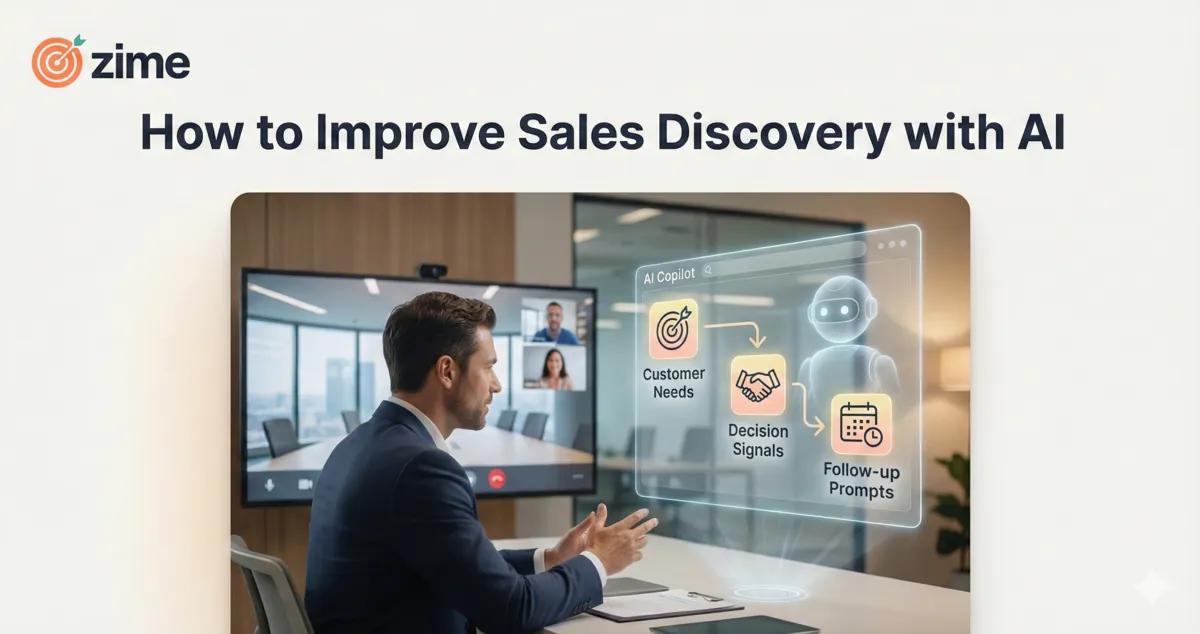
AI improves sales discovery by automating conversation analysis, predictive scoring, and personalized outreach, helping teams qualify opportunities faster and more accurately. Companies using AI-driven discovery see 30% higher deal conversion rates, while 95% of sales workflows will begin with AI by 2027, transforming manual processes into data-driven insights.
• AI-powered conversation intelligence analyzes 100% of buyer interactions, replacing manual note-taking with automated summaries and action items
• Predictive scoring models use 300+ signals from CRM data, calls, and emails to assess deal health and prioritize opportunities
• 78% of sales professionals report improved B2B prospecting outcomes using generative AI for personalized outreach
• Teams implementing AI-guided coaching programs see 36% improvement in win rates
• Forecast accuracy improves by 20-30% when AI replaces traditional forecasting methods
• Automated playbook updates reduce 20-30 hours of manual work to just 1-3 hours of guided review
By 2027, 95% of workflows will begin with AI, up from less than 20% in 2024. For revenue teams still relying on static scripts and gut instinct, that shift represents both a wake-up call and an opportunity. Sales discovery with AI is now the fastest path to better qualification, deeper buyer insight, and higher pipeline conversion.
This guide walks through the practical steps to embed AI into every discovery call, from conversation intelligence and predictive scoring to coaching and change management.
Artificial intelligence in sales refers to the use of AI in sales tools and processes to help sellers work more efficiently, simplify the buyer journey, and enhance the overall customer experience. When applied to discovery, AI transforms a historically manual, inconsistent phase into a structured, insight-driven process.
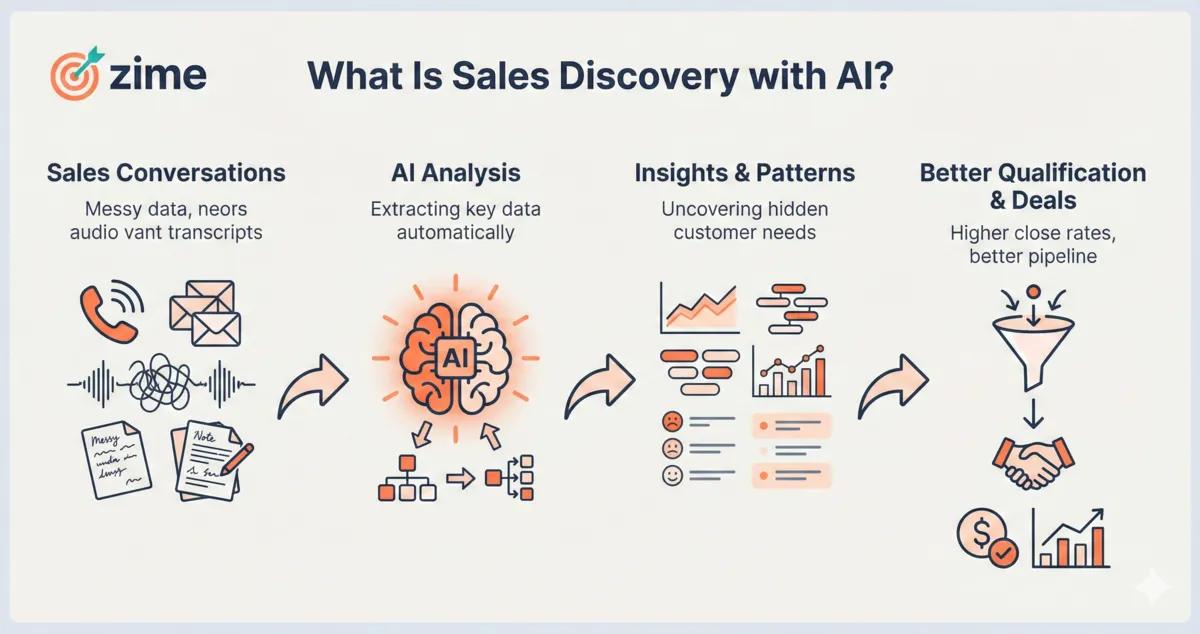
Sales reps who use insight-driven sales discovery processes build better rapport with buyers and close more deals. Effective sales discovery requires collaborative conversations between buyers and sellers in which each party has a stake in uncovering challenges and finding solutions. A structured process guides discussions from initial qualification through the final buying stage, using an iterative method of offering insights and asking probing questions.
Conversation intelligence, which uses AI to automatically analyze sales conversations and identify important moments, sentiments, and patterns, sits at the center of modern discovery. Rather than relying on memory or scattered notes, teams gain a single source of truth for buyer needs, objections, and next steps.
Key takeaway: AI-driven discovery replaces guesswork with data, helping reps ask better questions and qualify opportunities faster.
Sales performance is under pressure across every industry. Win rates are declining, fewer reps are hitting quota, and forecasts are harder to trust. Every quarter, revenue teams review the same results: missed numbers, uneven execution, and deals that seem strong but don't convert.
A core problem lies in how reps spend their time. Reps spend just 28% of their week actually selling, with the majority consumed by deal management, data entry, and administrative tasks. When discovery happens, execution gaps in qualification, problem diagnosis, and opportunity progression lead to inconsistent performance and late-stage surprises.
Buyers cite issues that sellers often overlook. According to Corporate Visions, buyers say sellers present too little competitive differentiation, poor needs discovery leads to misalignment, and there's a lack of timely response or interest in fulfilling requests. Sellers, meanwhile, tend to attribute lost deals to external factors like pricing or product features.
The result is wasted pipeline, inaccurate forecasts, and repeated losses for the same reasons. Without a way to surface these patterns, teams remain stuck in a reactive loop.
AI is not a single tool but a set of capabilities that work together to elevate discovery quality and speed. Below are the 3 building blocks that matter most.
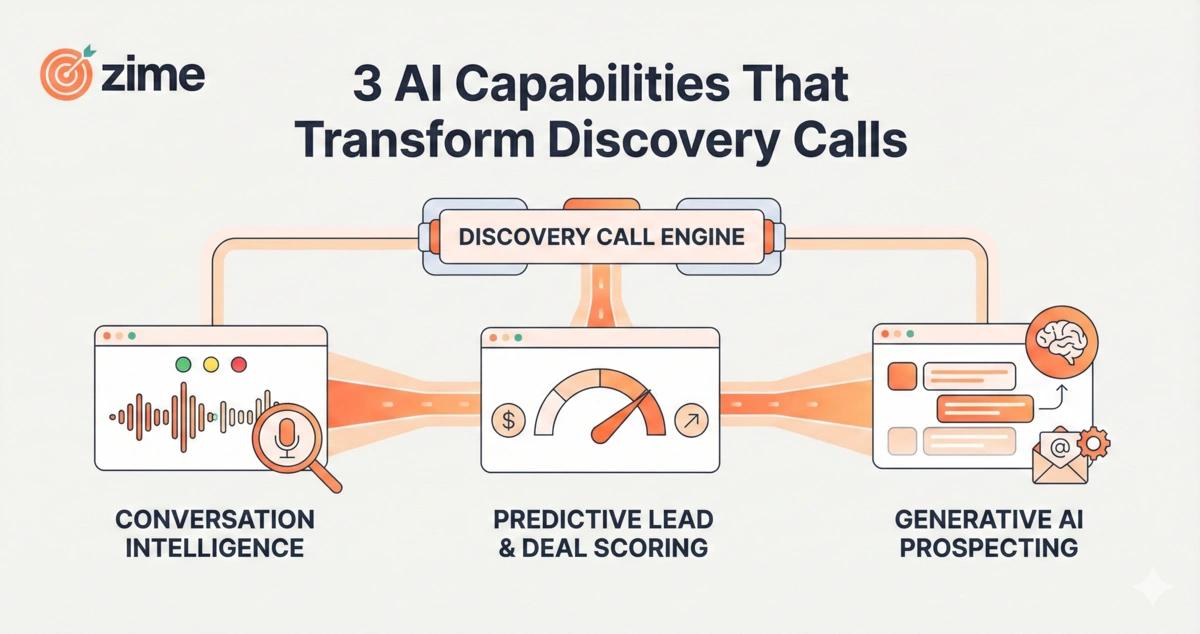
Conversation intelligence (CI) is AI technology that automatically analyzes sales conversations, identifying important moments, sentiments, and patterns. A good CI tool highlights significant moments and offers actionable feedback in real time and as follow-up action items.
CI simplifies all kinds of work that goes into tracking conversations, following up, and understanding buyers' motivations. When buyers spend only 5% of their purchase journey with your rep, every sales conversation is high stakes.
Key benefits include:
Tailoring relevant enablement content to B2B buying committees increases consensus in their decision-making by 20%. Just 12% of go-to-market leaders are satisfied with their existing customer engagement technology, which underscores the gap CI can fill.
Predictive opportunity scoring uses AI to help sales teams prioritize their efforts by identifying which opportunities are most likely to close. Scoring models analyze historical data to identify patterns and trends, using machine learning algorithms to continuously improve accuracy over time.
Deal scores predict the probability of winning open deals in your pipelines, which can help teams prioritize and focus on deals with higher chances to close. Scores reflect a percentage probability: a score of 85 predicts an 85% likelihood of winning the deal.
Platforms like HubSpot and Dynamics 365 use 300+ signals from CRM data, calls, emails, and conversation intelligence features to assess deal health. These scores are refreshed automatically when key deal signals change, ensuring reps always have current guidance.
Generative AI has moved beyond hype into practical application. 78% of sales professionals report GenAI tools have improved their B2B prospecting outcomes significantly or moderately. Lead engagement, such as custom emails and communications, is the most commonly selected broad use case, with 48% of respondents indicating its use.
Gen AI can monitor organizational attributes, including product launch timing and top-management changes, and predict individual customer needs. This allows reps to tailor outreach and discovery questions to what matters most for each account.
Deep sellers, those who adopt certain habits and technologies, are nearly 2x more likely to exceed their quota than shallow sellers. Among B2B salespeople globally who exceeded quota, 75% use AI.
Practical implementation requires more than software selection. Teams need a clear workflow that connects pre-call preparation, in-call guidance, and post-call follow-through.
Step 1: Prepare with AI-generated insights
Before every call, reps should review AI-generated account briefs that aggregate CRM data, recent interactions, and external signals. Sales discovery is an important step in the sales process that helps qualify prospects and uncover their pain points. A good discovery call sets the stage for the entire sales lifecycle.
Top reps follow the 80/20 rule: they let the prospect do 80% of the talking. AI-generated prep ensures reps arrive with the right questions, not a generic script.
Step 2: Use dynamic playbooks during the call
AI continuously monitors market shifts, competitor moves, and sales performance to auto-update sales playbooks. Teams replace 20-30 hours of manual monitoring, editing, and distribution with 1-3 hours of guided review and enablement.
Platforms like Seismic, Zime, Highspot, and Klue integrate with existing sales enablement stacks to provide dynamic content delivery and micro-coaching. This ensures reps always have access to the most current guidance, not outdated battlecards.
Step 3: Capture and act on post-call signals
After the call, AI tools automatically generate summaries, update CRM fields, and flag next steps. Bureau, a no-code identity decisioning platform, saw its sales reps save an hour each day on CRM updates and realized a 30% increase in deal conversion from improved discovery and more efficient processes.
Conversation intelligence tools also detect patterns across calls, surfacing objections and competitor mentions that inform future discovery questions.
Step 4: Close the feedback loop
Organizations that treat AI as a continuous learning system, rather than a one-time deployment, see the best results. Allina Health, a nonprofit health system, launched an AI agent in under 90 days by prioritizing cross-functional collaboration, clear scope, and specific requirements. The result: 23% improvement in service levels and 8,000 hours saved annually.
Measuring the impact of AI on discovery requires more than tracking activity. Teams should focus on outcome-based metrics that connect discovery quality to revenue.
Win-loss analysis
Win-loss analysis helps answer one of the most important questions in revenue execution: Why did we win or lose that deal? According to Anova Consulting, 60% of sellers are partially or completely wrong about why they lost a deal. AI-powered win-loss analysis reviews 100% of buyer interactions across calls, emails, and CRM data, providing a more comprehensive and objective view.
Forecast accuracy
According to Gartner, fewer than 50% of sales leaders have high confidence in their forecasts. AI-powered forecasting can improve forecast accuracy metrics by 20-30% compared to traditional methods. World-class sales teams aim for 80-95% accuracy.
Pipeline and deal progression
Track metrics such as deal progression rate, win rate, sales cycle length, and pipeline coverage ratio. High-performing B2B teams maintain an average pipeline coverage ratio of 3x to 4x quota to reliably hit revenue targets.
Coaching effectiveness
Organizations with highly effective training are 2.9x more likely to strongly agree that mentoring or coaching is encouraged on a regular basis. Link coaching interventions to deal outcomes to measure real impact.
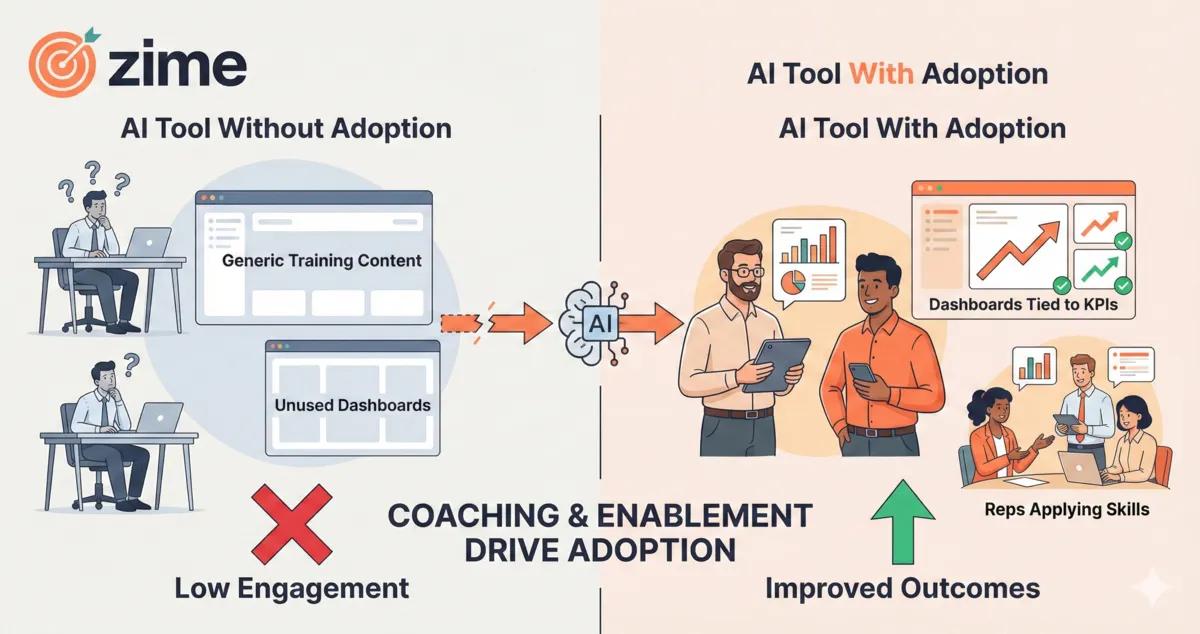
AI tools only deliver value when reps actually use them. Adoption requires a combination of coaching, enablement, and cultural change.
Data-driven coaching
The best sales coaches focus on outcomes, not activities. According to Zengar Folkman, 60% of reps are more likely to leave their jobs when their manager is a poor coach. Data-driven coaching helps managers pinpoint problematic behaviors and see what leads to success for high performers.
Go-to-market leaders surveyed said implementing AI-guided sales coaching programs improved reps' win rate by 36%. The key is to tie coaching conversations to real behavioral data, not anecdotal feedback.
Continuous enablement
Adoption isn't just logins. Define metrics that map to performance outcomes, including active user rate, completion to application ratio, manager endorsement, and time-to-competency for critical skills.
Managers are the multiplier for adoption. Expect them to enroll learners, discuss progress in one-on-ones, and assign real tasks tied to learning. Content that's long, generic, or disconnected from day-to-day workflows will not stick.
Successfully launching an LMS isn't an IT project. It's a change management initiative. The same applies to AI-powered sales tools.
Shift from compliance to competence
Reward demonstrated skill improvement rather than course completion. Run small, controlled experiments: test different notification cadences, course lengths, or manager nudges. Replace static CSV exports with dashboards tied to role KPIs.
Sales discovery has long been a bottleneck, limited by manual processes, inconsistent execution, and lack of visibility into what actually works. AI changes that equation by embedding intelligence directly into the flow of work.
Teams that adopt structured, AI-driven discovery see measurable results: higher win rates, faster sales cycles, and more accurate forecasts. Bureau, for example, realized a 30% increase in deal conversion from improved discovery and more efficient sales processes.
The shift from static scripts to Living AI Playbooks, which continuously learn from real sales conversations, deals, and outcomes, is already underway. For organizations ready to make behavior, not content, the center of sales execution, platforms like Zime offer a practical path forward: adaptive playbooks, deal-specific guidance, and automated workflows that help every rep sell like the best.
Ready to move beyond static training?
AI-driven sales discovery uses artificial intelligence to transform the traditionally manual and inconsistent discovery phase into a structured, insight-driven process. It helps sales reps build better rapport with buyers and close more deals by providing data-driven insights and guidance.
Conversation intelligence uses AI to analyze sales conversations, identifying key moments, sentiments, and patterns. This technology provides actionable feedback and reduces manual note-taking, helping sales reps understand buyer motivations and improve engagement.
Predictive scoring uses AI to prioritize sales efforts by identifying opportunities most likely to close. It analyzes historical data to predict deal success, helping teams focus on high-probability deals and improve pipeline management.
AI enhances sales coaching by providing data-driven insights into rep performance, allowing managers to focus on outcomes rather than activities. This approach improves win rates and helps reps develop critical skills through continuous enablement and adaptive learning.
Zime's AI-powered platform transforms sales discovery by embedding intelligence into workflows, leading to higher win rates, faster sales cycles, and more accurate forecasts. It offers adaptive playbooks and deal-specific guidance to help reps sell more effectively.