Sales playbooks exist in nearly every B2B organization. Most of them collect dust.
This is not a content problem. It is not a training problem. It is a behavior change problem, and it is far more structural than most revenue leaders realize. Across conversations with sales operations leaders, enablement professionals, and CROs at scaling technology companies, one pattern surfaces repeatedly: the playbook looks good in a presentation but does not travel into the field.
Here is the direct answer: sales playbooks fail to drive behavior change because they are built for documentation, not execution. They capture what someone believed was true at the time of writing, not what top performers are actually doing today. And they reach reps through training events and content portals, not at the moment a real deal requires a critical decision.
The rest of this article breaks down the structural causes, the most common failed attempts, and what actually works.
Who Is Really Facing This Problem
The leaders dealing with this most acutely are not inexperienced. They are sales enablement practitioners with solid methodologies, well-organized content libraries, and no measurable behavior change to show for the effort.
These organizations are typically mid-market to enterprise SaaS companies that have scaled their headcount faster than their systems. They have invested in tools like Gong, Clari, Highspot, or MindTickle. They have deployed MEDDIC, Challenger, or SPIN methodologies. They have run sales kickoffs with certified trainers. And yet, they still see inconsistent discovery calls, pipelines stuck in early stages, and win rates that vary by rep rather than by segment or market.
The profile is consistent: high investment, partial adoption, and compounding frustration at every level of the revenue organization.
The Real Problem
The symptoms are visible to anyone running pipeline reviews. Managers notice that two reps working the same segment are interpreting the playbook completely differently on calls. Discovery quality varies so significantly that one rep surfaces a compelling consequence of inaction while another closes the same call without understanding why the customer would move at all.
At an organizational level, this creates pipeline unpredictability. Forecasts become guesswork. Marketing and sales point fingers at each other. Meanwhile, the core execution gap, the distance between what top reps do intuitively and what average reps do habitually, remains invisible and unaddressed.
In enterprise sales, where cycles run anywhere from 12 to 36 months, this gap compounds. A rep who never learns to create urgency around cost of inaction is not just losing one deal. They are contributing to a pattern of stalled opportunities that looks like a market problem but is actually an execution problem.
What Is Actually Causing This
Most playbooks fail before they ever reach the field. The root causes are structural.
Playbooks are built on assumptions, not observed behavior
Most playbooks are written by enablement teams, PMMs, or external consultants. They document what should happen in theory. They rarely capture how top-performing reps actually navigate a qualifying conversation with a specific persona, handle a pricing objection mid-cycle, or create urgency with a customer sitting on legacy infrastructure. Reps read these playbooks, recognize they do not reflect reality, label them "academic," and revert to their own instincts. According to Forrester, 89 percent of B2B sales enablement teams plan to launch a new sales methodology each year, and they report this pattern year after year because sellers simply are not using the methodology in the field.
Playbooks become stale faster than they are updated
Competitive dynamics shift. New products launch. Buyer objections evolve. A playbook that took three to six months to build is often outdated before it is fully deployed. No static document can keep pace with a live market.
Manager bandwidth is the silent killer
Sales managers carry pipeline ownership, forecasting pressure, recruiting responsibilities, and administrative load simultaneously. Consistent behavioral coaching, which requires reviewing actual calls, identifying specific gaps, and reinforcing the right questions before the next deal, rarely survives a busy quarter. Without inspection, there is no accountability. Without accountability, there is no sustained adoption.
Generic AI tools cannot capture company-specific nuances
Organizations deploy call intelligence platforms expecting them to bridge the execution gap. But most of these tools surface keyword-based trackers, generic summaries, and activity metrics. They can tell you how many times a word was said. They cannot tell you whether the rep asked the right question at the right moment, to the right persona, in a way that actually moved the deal forward.
What Sales Teams Usually Try First
Revenue leaders who recognize the adoption gap typically move through a predictable set of interventions:
- They rebuild the playbook, investing weeks or months in documentation workshops and stakeholder reviews
- They launch formal methodology training, often tied to Sales Kickoff events or dedicated enablement sprints
- They configure Gong trackers and smart call scorecards to measure keyword compliance across the team
- They enroll managers in coaching certification programs
- They implement enablement platforms with centralized content repositories and new content governance processes
Each of these represents real investment, reasonable logic, and genuine intent. The problem is not that these approaches are wrong. The problem is that each addresses the symptom rather than the structural cause. They improve the quality of the playbook or the skill of the trainer. They do not change what the rep does on the next qualifying call.
Why These Approaches Fail
Training programs produce short-term awareness, not lasting behavior change. A McKinsey global survey of more than 1,200 respondents across sales roles found that fast-growing companies were 80 percent more likely than slow-growing companies to achieve commercial results from sales training. The differentiating factor was not the training design itself but the reinforcement structures, manager accountability systems, and certification-based follow-through built around it.
Without reinforcement, information from a kickoff fades within weeks. This is not a failure of the training itself. It is a structural gap between a point-in-time learning event and the ongoing flow of real sales activity.
Keyword trackers create a false sense of measurement. A rep can say every required phrase on a discovery call and still lose the deal because they said it to the wrong stakeholder, at the wrong stage, without connecting it to a genuine business driver. Compliance with words is not the same as execution of behavior. The signal that matters is deal movement, not phrase frequency.
Methodology rollouts fail when they are not connected to live deals. MEDDIC and Challenger work when embedded in the rep's current pipeline and reinforced by a manager reviewing real calls. When they exist only in slide decks and LMS modules, they are learned and immediately forgotten. McKinsey data further shows that outperformers are 57 percent more likely to tailor their learning programs and 1.3 times more likely to outperform peers in revenue growth, precisely because generic programs do not produce the same lift as approaches tied to specific business nuances.
What Actually Drives Behavior Change
Behavior change in sales teams requires three things that static playbooks and one-time training programs cannot deliver: situational relevance, consistent inspection, and feedback loops that connect daily rep behavior to revenue outcomes.
Living playbooks replace static documentation
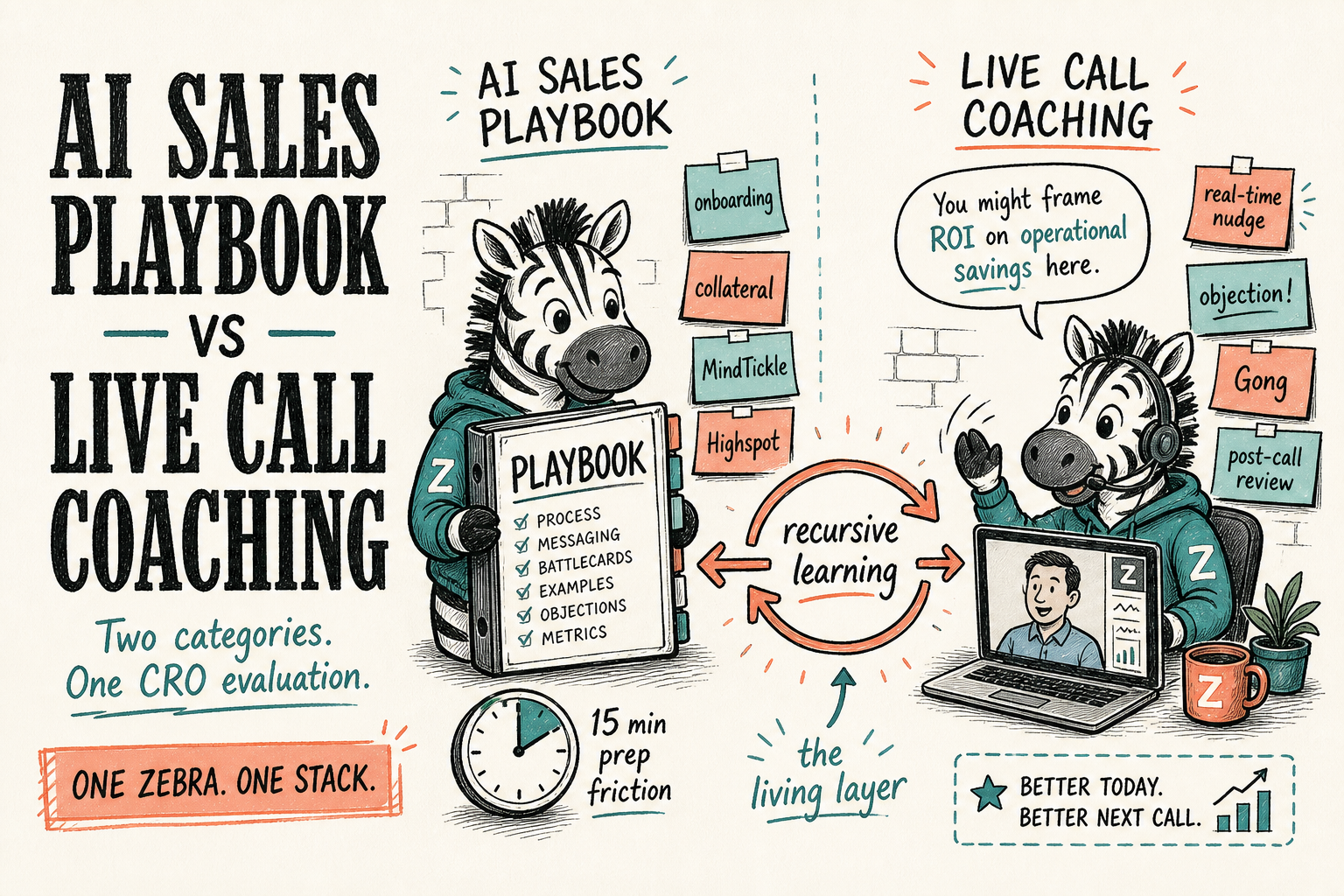
Instead of a document representing what someone believed six months ago, a living playbook reflects what is winning deals today. It is built from real call data across top-performing reps, validated against CRM outcomes, and updated as market conditions evolve. It shows reps not just what to do but how their best peers actually do it, with real examples tied to real deal progression.
Just-in-time coaching replaces calendar-based training
Behavior changes when the right information reaches the rep at the moment it is needed, not three weeks earlier in a training room. Pre-call prep notes that surface open objections from the previous conversation, highlight which questions correlate highest with deal progression, and show how top reps handle similar situations produce behavior change in a way that batch training simply cannot replicate.
Inspectable execution signals enable real manager coaching
Managers cannot coach what they cannot see. When deal-level data shows which qualifying criteria are missing from each opportunity, which behaviors correlate with pipeline movement, and which reps are consistently skipping critical steps, coaching becomes targeted and specific rather than generic and directional. CSO Insights research shows that companies with aligned sales enablement and dynamic processes achieve win rates 17.9 percent higher than average.
Win-loss data closes the learning loop
When the system learns from both wins and losses and feeds that intelligence back into the playbook, the organization gets smarter over time. Organizations with formal enablement achieve a 49 percent win rate on forecasted deals, compared to 42.5 percent for those without structured enablement processes.
What Sales Leaders Are Actually Saying
These patterns are not theoretical. They surface in direct conversations with revenue leaders navigating this challenge at scaling technology companies.
"We transcribe calls, but are we doing the right level of introspection? I don't believe that we are. I don't think any company has got enough time to do that level of introspection. That is where the right system can automate it to a great degree."
Varadarajan Srivatsan, AI Practice Sales Leader, Tavant Technologies
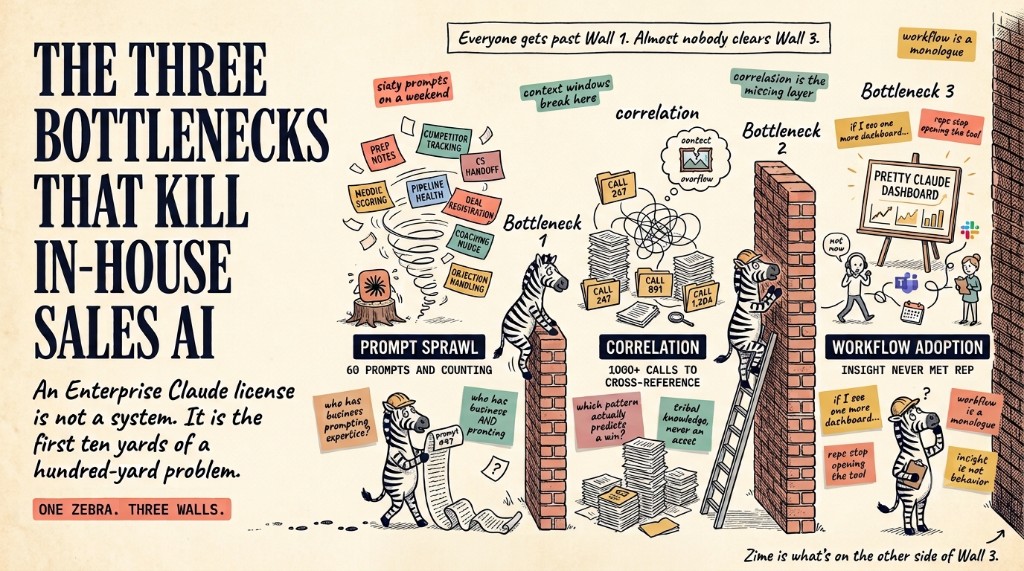
"Playbooks take a lot of time to build, and they become stale quickly. And then you can run trainings and LMS, but we know they don't work. You can keep trying to configure your call intelligence tool for company nuances, and I've seen enablement leaders spend a year trying. It just doesn't work."
Sanchit Garg, Co-founder, Zime
A Practical Framework to Improve Playbook Adoption
If you are ready to move from documentation to execution, use this five-step framework as a starting point.
Step 1: Audit what your top reps actually do, not what your playbook says they should do.
Review 20 to 30 calls from your best closers. Identify the exact questions they ask, the moments they probe for consequence of inaction, and how they navigate budget and timeline conversations with different personas.
Step 2: Connect playbook behaviors to deal outcomes.
For each behavior you want to reinforce, validate it against your CRM data. Which questions, when asked, correlate with deals advancing to the next stage? Which objection-handling approaches appear in won deals and are absent from lost ones?
Step 3: Segment your playbook by deal stage and motion.
Early-stage discovery requires different behaviors than late-stage negotiation. New logo acquisition calls for different messaging than expansion plays. Segmenting by deal stage, persona, and sales motion makes the playbook immediately relevant rather than generically applicable.
Step 4: Embed playbook guidance into the rep's daily workflow.
Pre-call prep notes, post-call behavioral scorecards, and automated CRM note population reduce friction. When the playbook comes to the rep at the right moment rather than requiring the rep to seek it out, adoption rises naturally.
Step 5: Give managers inspectable signals for weekly coaching conversations.
Pipeline review should include behavioral data alongside deal status. Which reps are missing key qualifying criteria across their book of business? Which deals show no documented consequence of inaction? These signals make manager coaching specific and productive rather than general and unmemorable.
If You Are Facing This Problem
Use this diagnostic to assess where your execution gap sits:
- Are your reps interpreting the playbook differently on similar calls across the same segment?
- Do your managers coach proactively, or only reactively when a deal slips or a quarter misses?
- Can you see, at the deal level, which qualifying behaviors are present or missing right now?
- Is your playbook being updated based on recent win-loss data, or is it more than six months old?
- Are average reps executing discovery at the same level as your top performers, or is there a wide gap?
- Can your enablement team demonstrate a direct link between their programs and revenue outcomes, or are they measured on training completion rates alone?
If you answered no to three or more of these, the problem is structural, not motivational.
Conclusion
Sales playbooks do not drive behavior change because behavior change requires more than documentation. It requires situational relevance, consistent inspection, and feedback loops that connect what reps do on calls to what actually wins deals. The organizations closing the execution gap are not building better slide decks or running more training sessions. They are building systems that surface the right guidance at the right moment, give managers the signals they need to coach with precision, and learn continuously from both wins and losses.
The question is not whether your sales playbook is well-written. The question is whether it is reaching your reps at the moment they need it most, in the language their best peers actually use, with the data to prove it moves pipeline. That is the standard against which every playbook adoption strategy should be measured.
Take the Next Step
For revenue leaders ready to act: Book a demo to explore how execution systems built on living playbooks and behavioral inspection signals can directly improve discovery consistency, manager coaching quality, and early-stage win rates across your team.