Blog
Why Don't Sales Playbooks Drive Behavior Change?
Sales playbooks exist in nearly every B2B organization. Most of them collect dust. This is not a content problem. It is not a training problem. It is a behavior
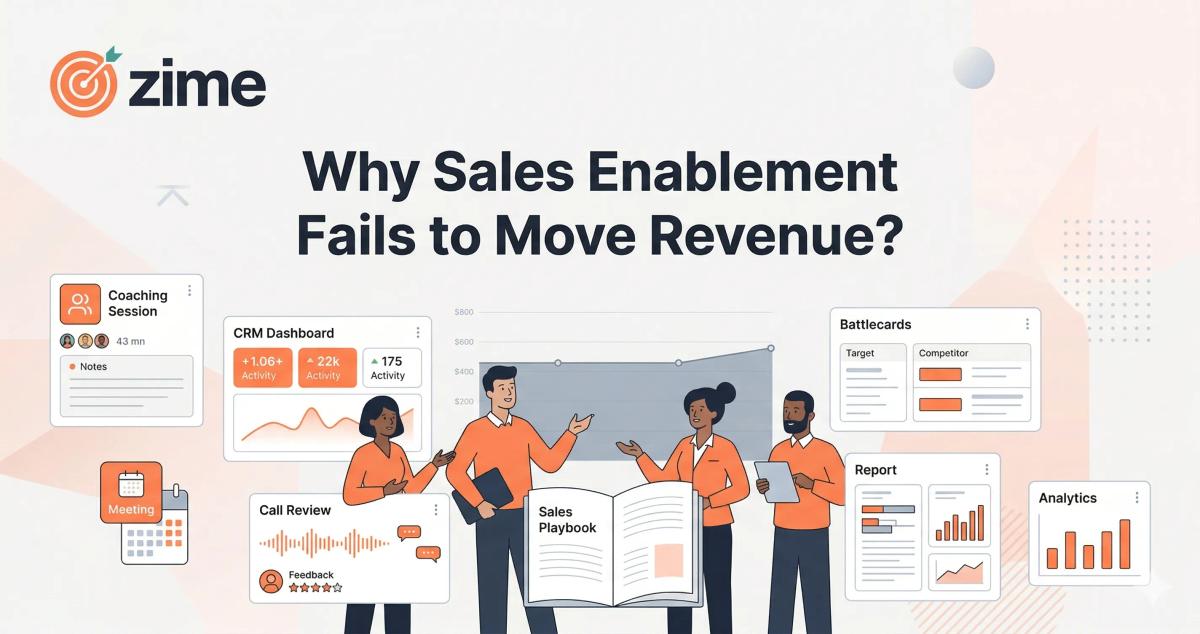
Sales enablement fails to move revenue because it focuses on knowledge transfer rather than behavior change. Most organizations build playbooks, run training programs, and deploy expensive tools. None of these initiatives reliably change what reps actually do on a live customer call. The result is predictable: pipeline stalls, win rates plateau, and revenue targets get missed, quarter after quarter.
This is not a theory. It is a consistent pattern emerging from conversations with CROs, VP Sales, and enablement leaders across mid-market and enterprise B2B companies. The problem is structural, not motivational. And it has a specific anatomy worth understanding.
The leaders facing this challenge are not beginners. They are experienced revenue professionals who have already tried the standard playbook. They have invested in training, deployed conversation intelligence tools, and documented best practices in centralized knowledge bases.
They lead teams of 30 to 200 reps. They are accountable to board-level revenue targets. And despite all the enablement infrastructure in place, they still cannot consistently predict what a rep will actually do when they face a pricing objection, a competitive displacement, or a stalled late-stage deal.
This problem is especially sharp in complex B2B environments. Sales cycles run 9 to 18 months. No two deals are identical. And the difference between a win and a loss often comes down to a single conversation handled well or handled poorly.
The symptoms are visible in every pipeline review. Deals stall in mid-stage without a clear reason. Reps mark opportunities as qualified when exit criteria were never met. Coaching conversations cover the same ground week after week. When enablement teams audit playbook adoption, it is inconsistent at best, invisible at worst.
According to Gartner, 77% of sellers struggle to complete their assigned tasks, pointing to a systemic failure in how enablement is designed and delivered. The issue is not rep willpower. It is that enablement infrastructure is built for information consumption, not for execution support in the moment a rep needs it most.
In conversation after conversation with enterprise sales leaders, one insight repeats itself: the challenge is not defining what great sales execution looks like. The challenge is operationalizing it across a distributed team in real time.
Four structural failures compound each other, and most organizations are dealing with all four simultaneously.
Static documentation does not survive contact with reality. Playbooks, call guides, and battle cards are created at a point in time and rarely updated at the pace the market evolves. By the time a rep needs the guidance, the document is outdated, buried in a shared folder, or simply never opened.
Behavioral reinforcement does not happen at scale. Organizations rely on managers to coach reps in weekly 1:1s or pipeline reviews. But managers are handling their own pipelines, escalations, and 8 to 15 direct reports simultaneously. Proactive behavioral coaching is the first thing that breaks down when bandwidth runs thin.
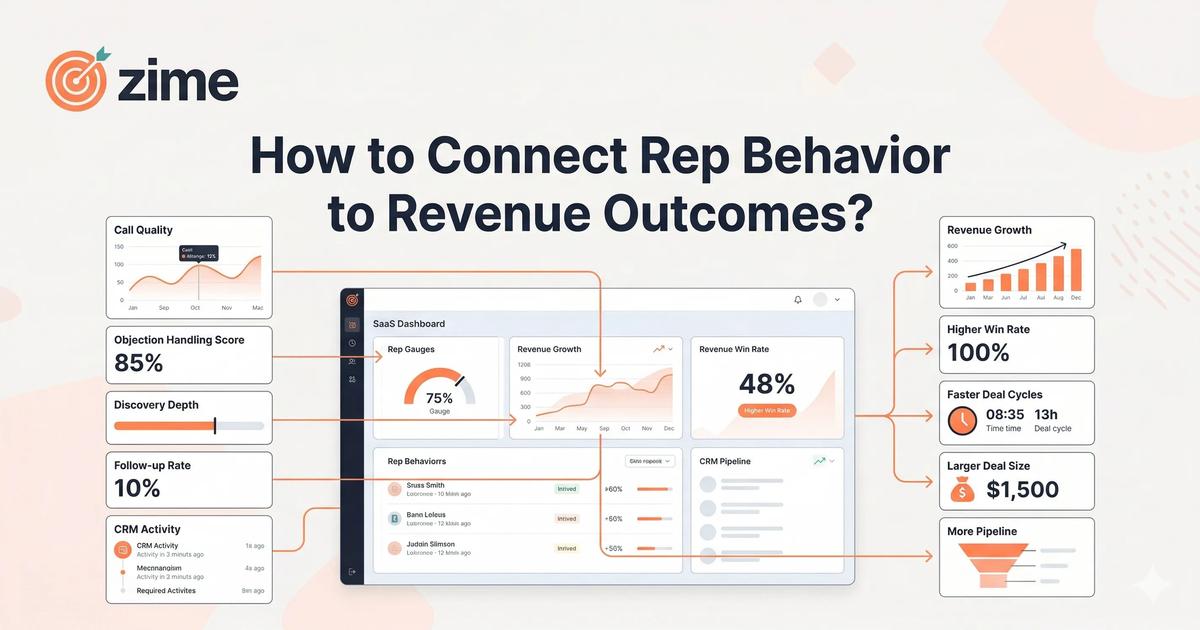
There is no inspectable execution signal. Leaders can see what is in the CRM. They can see deal stages and activity counts. What they cannot see is whether a rep actually handled the pricing objection, built the right ROI case, or asked the discovery questions the playbook required. Without that signal, coaching is reactive and decisions are guesswork.
Knowledge lives in Slack and documents, not in the rep's workflow. Field teams encounter information in threads and shared drives, but there is no mechanism to know if that knowledge is changing how reps run deals. The information exists. The behavior change does not follow.
Forrester has noted that measuring the impact of behavior-change initiatives in sales has been "notoriously difficult to assess," and that only recently have enablement platforms started connecting training activities to real sales outcomes through CRM integration.
The standard response to underperforming sales teams follows a recognizable sequence.
First, organizations roll out a sales methodology: MEDDIC, SPIN, Challenger, or a custom variant. They train the team, certify reps, and update the CRM to reflect the new qualification criteria.
Second, they invest in conversation intelligence tools that record calls, transcribe them, and surface keyword-level insights. Leaders get dashboards showing talk ratios, competitor mentions, and deal risk scores.
Third, they produce more content: more playbooks, more battle cards, more enablement sessions. A new sales play gets launched after every competitive event or product release.
Fourth, many organizations deploy AI-assisted note-taking tools that auto-populate CRM fields after calls. Leaders assume this will create the visibility needed to coach better.
Each of these attempts is logical in isolation. The problem is that none of them close the gap between what the playbook says and what the rep does on the next call.
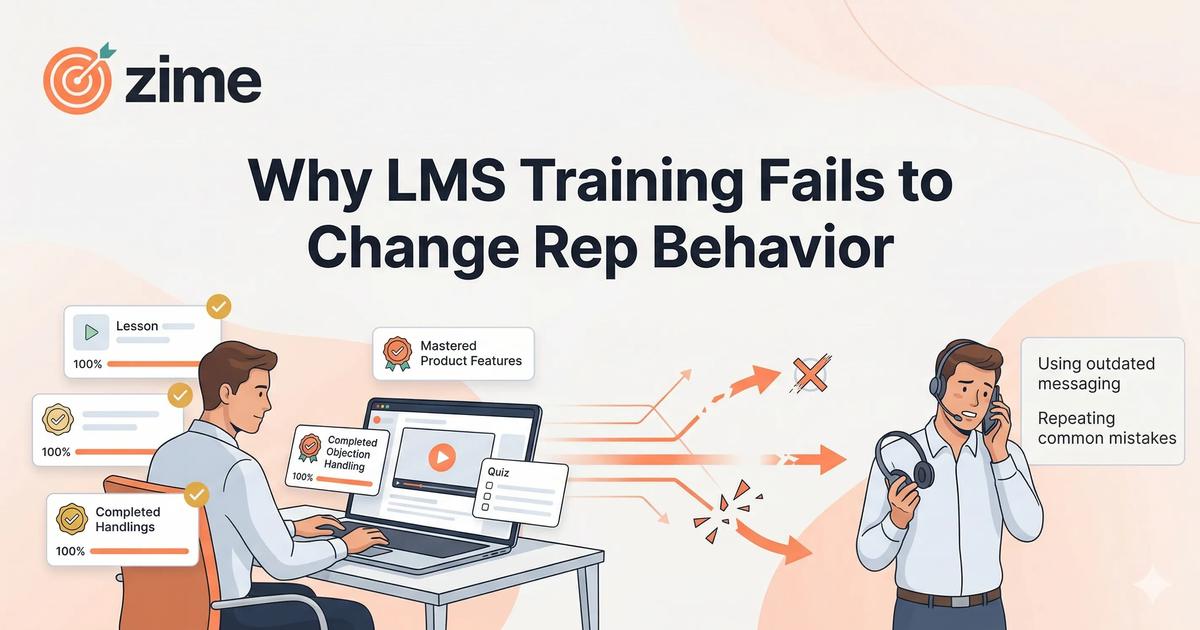
Training creates awareness. It does not change behavior in the field. Research from Gartner shows that organizations using just-in-time, contextual learning support are 2.5x more likely to exceed seller revenue targets compared to those relying on traditional training alone. That gap tells the story.
Conversation intelligence tools generate data. But as one sales leader observed during a direct review of their tool stack, the AI-generated CRM notes were too detailed for anyone to actually read and act on. Managers got reports. Reps got summaries. Neither translated into a change in how the rep handled the next discovery call. As one enterprise sales ops leader said plainly: "Nobody is going to read this."
HubSpot research demonstrates that when sales playbooks are actually operationalized, not just documented, teams see a 25% improvement in call-to-demo conversion and up to 63% growth in closed ARR within months. The question is never whether playbooks work. It is whether anyone is actually using them.
The underlying failure is a design problem. Sales enablement programs are built around content delivery and activity measurement. They are not built around behavioral inspection and just-in-time correction. Without a system that tells the manager which rep is skipping a specific behavior in a specific deal stage, and then helps the rep correct it before the next call, nothing in the pipeline actually changes.
According to Forbes, accelerating sales results through behavior change requires identifying the right behaviors, implementing reinforcement programs, and measuring both leading and lagging indicators. Most organizations do the first step. Almost none do the other two.
The organizations that consistently move revenue through enablement share a different operating model.
They start with what top reps actually do, not with what should happen in theory. The best playbooks are not written by enablement teams in isolation. They are built by analyzing how the top 10 to 20% of the team runs deals, identifying which behaviors correlate with wins, and codifying those patterns in a way others can replicate.
They make the playbook inspectable on every call. Instead of asking reps to self-report compliance, they apply the playbook to actual call recordings automatically. This moves coaching from opinion to evidence: here is what was done, here is what was missed, here is what a top rep does in the same situation.
They deliver coaching in the rep's existing workflow. Reps do not want a new application to check before a call. What works is a contextual nudge, in the communication channel they already use, delivered before the next relevant conversation, showing the specific gap and how peers have handled it.
They connect execution signals to pipeline reviews. When managers can see, at the deal level, what behaviors are missing and what objections are unresolved, the pipeline review becomes a coaching session rather than a status update. That is where behavioral improvement begins to compound across the team.
McKinsey research on B2B sales performance consistently shows that organizations reinforcing specific field behaviors and providing managers with execution visibility outperform peers on revenue growth and pipeline consistency.
These are not isolated observations. Revenue leaders across B2B SaaS are describing the same structural breakdown.
During a recent engagement, Navin Madhavan, Head of Revenue Operations at Amagi, a cloud SaaS company providing broadcast and streaming infrastructure to major media networks, shared the state of their enablement program. Amagi operates across the US and India, with a sales team spanning enterprise and mid-market segments, and a full modern stack that includes Salesforce, a call recorder, a forecasting tool, and Highspot for sales enablement.
"Playbooks are really not credible, or updated. It's in an embarrassing state, and driving adoption of playbooks is a challenge, trainings are not working, and so on. We're losing revenue here."
Navin Madhavan, Head of Revenue Operations, Amagi
Revenue leaders who want to move from enablement activity to revenue impact can follow five steps.
Run this diagnostic before your next enablement investment.
If three or more of these are true, the issue is not the quality of your enablement content. It is the absence of an execution layer that connects the playbook to daily rep behavior.
Sales enablement fails to move revenue when it stops at information delivery. Building a playbook, running a training, or deploying a conversation intelligence tool does not, by itself, change what reps do on live calls. The organizations that do see consistent revenue improvement from their enablement investment are the ones that build a continuous loop: from best practice identification, to behavioral inspection, to just-in-time coaching, to pipeline visibility. Until that loop exists, the gap between the strategy in the deck and the execution in the field will keep producing the same result. Missed targets. Inconsistent pipelines. And the next enablement initiative facing the same structural problem.
See How It Works in Practice
If your playbook is not translating into consistent field execution, the problem is not the content. It is the absence of a system that applies the playbook to every call, surfaces execution gaps for managers, and coaches reps in the workflow they already use. Zime is built to solve exactly this. Book a 30-minute working session to see how revenue teams operationalize playbooks inside real sales environments, with live data and execution signals, not slides.