Built for Everyone, Right for No One: How SonicWall Closed the Channel Execution Gap with a 40% Behavior Lift
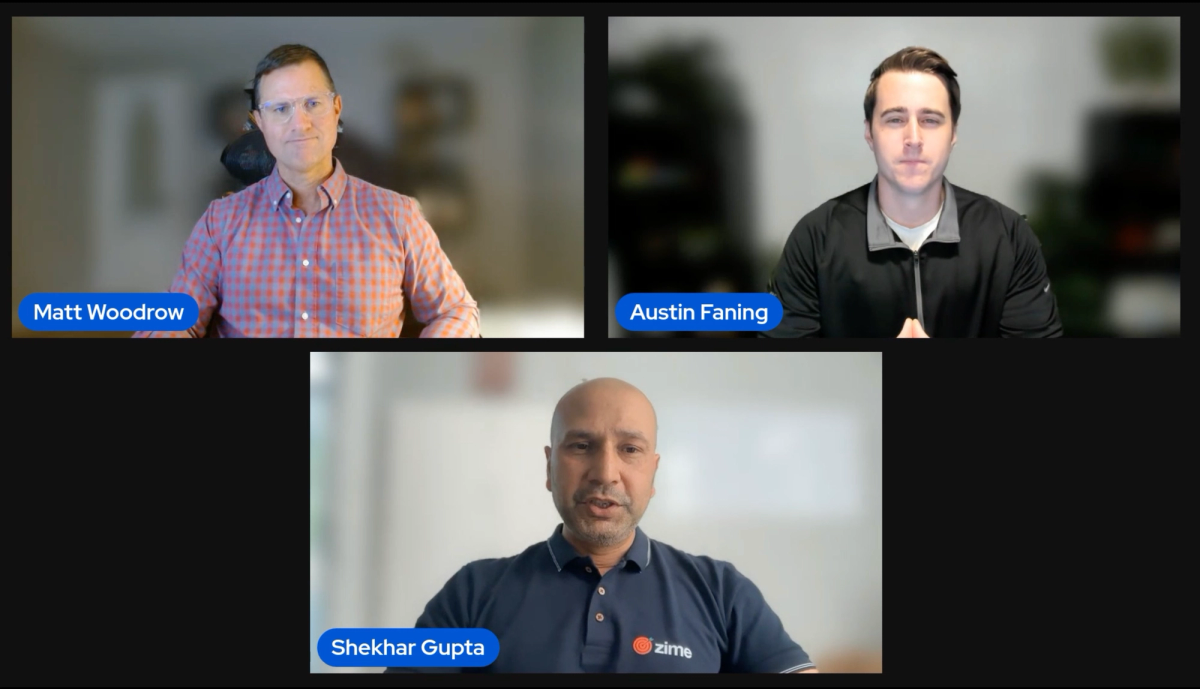

A conversation with Austin Fanning, Senior Director of Revenue AI, and Matthew Woodrow, Senior Director of North America Channels, SonicWall, with Shekhar Gupta, Chief Growth Officer, Zime AI.
Most AI sales tools are built to work for as many customers as possible, out of the box, with nothing tweaked. For SonicWall, that was exactly the problem.
SonicWall runs one of the largest partner ecosystems in cybersecurity: 17,000+ partners spanning distributors, nationals, resellers, and MSPs, each selling differently, each at a different stage of a sales cycle that can run anywhere from a single month to a full year. Layer in a legacy hardware install base transitioning into recurring-revenue SaaS, and a product line dense with its own acronyms and naming conventions, and the shape of the business resists anything generic.
In this conversation, Austin Fanning and Matthew Woodrow share what it took to move from tribal knowledge to a governed, measurable sales motion, and why "purpose-built" ended up being the only option that worked.
A business too complex for off-the-shelf AI
When SonicWall began evaluating AI tools, the first thing they ruled out was anything built for the average customer.
"A lot of what we were looking at off the shelf was built for as many possible customers out of the box, without tweaking anything," Fanning explains. That works for some business models. It didn't work for SonicWall's.
The company is, in Woodrow's words, "100% channel friendly." Every deal touches a partner relationship, an end customer, and often a specific product motion, all at once. Some partners run monthly recurring transactions. Others carry multi-year education deals through E-Rate funding cycles. No single playbook could hold that much variation.
SonicWall needed a system built around how the business actually operated, not one that asked the business to conform to the tool.
Where the tribal knowledge was hiding
Before the shift, SonicWall's best practices lived in the same place most companies' do: inside the heads of their top reps.
"We had a lot of sales reps doing a lot of amazing things," Fanning says, "and we had a lot of people that were missing the mark." The gap wasn't talent. It was that nothing captured what good looked like, or made it visible to the rest of the team.
Even something as fundamental as asking for the next step, closing the loop at the end of a call, was inconsistent across the field. Rather than trying to fix everything at once, the team picked one behavior, measured it, and built from there. "You're not gonna fix everything with every sales rep all at once," Fanning notes. "If you focus in on targeted key behaviors... you're gonna have a very beneficial experience."
Trust, not surveillance
The hardest requirement wasn't technical. It was cultural.
"It had to have ROI to the sales teams," Fanning says. "If we didn't have something that could really feel like it was working alongside the reps... we couldn't move forward with a tool of any capacity."
Woodrow frames it the same way from the channel side: adoption comes down to whether a tool feels like coaching or like monitoring. "If it's used in the context of a coaching structure, it's that much more powerful," he says. "It doesn't come across as, hey, we're introducing this tool to keep an eye on you... it turns into, hey, let's work through this together."
That distinction, coaching versus surveillance, shaped how the system was rolled out from day one.
The impact on the field
~40% increase in reps consistently asking for next steps, the single behavior SonicWall targeted first
1.5–2x increase in deals sourced by reps actively using the system, compared to those who weren't
~1 hour returned per rep, per week, previously spent writing manual deal-recap reports
8,000–10,000+ recorded conversations now feeding SonicWall's context model
For Fanning, the numbers matter less than what they represent: managers spending less time reconstructing what happened on a call, and more time coaching against what actually happened.
Beyond the surface of the iceberg
Woodrow describes the shift using an image that came up independently on both sides of the partnership: an iceberg, with the visible 10% representing what a team already knows, and a much larger, unexamined 90% sitting below the surface.
"We've been so focused on what we can see," Woodrow says, "and the assumptions we've made about why we're not transacting with partners... now we're getting below the surface and understanding what's in that 90%."
What's next
SonicWall's next focus is forecasting: using the same behavioral evidence that improved rep execution to harden pipeline confidence, flagging what's real and what isn't before it reaches a QBR.
The team is also extending the model past sales, feeding customer language and product feedback back into marketing and product organizations so that messaging and roadmap decisions are grounded in what customers are actually saying, not assumptions about what they might say.
The broader lesson from SonicWall's experience holds regardless of company size or channel complexity: a sales motion only creates value when it's built for how the business actually runs, not for how an average business might.
The challenge was never a lack of good behaviors in the field. It was knowing where they lived, and making them repeatable.