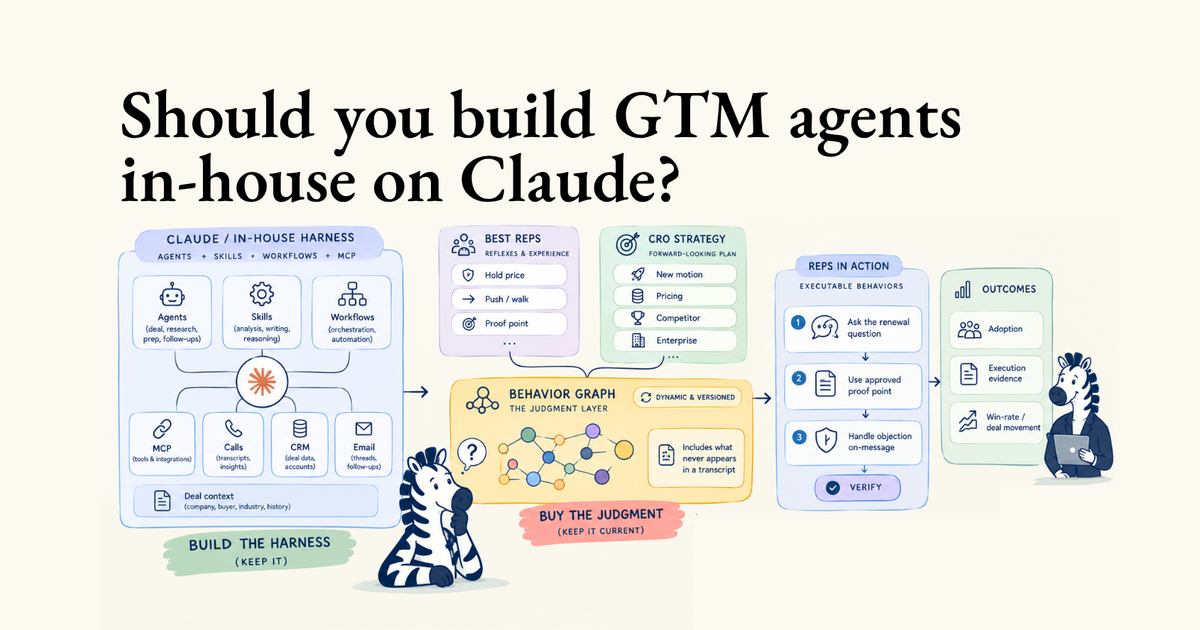
Build vs Buy Sales AI: The Honest Math on Building Zime In-House with Claude
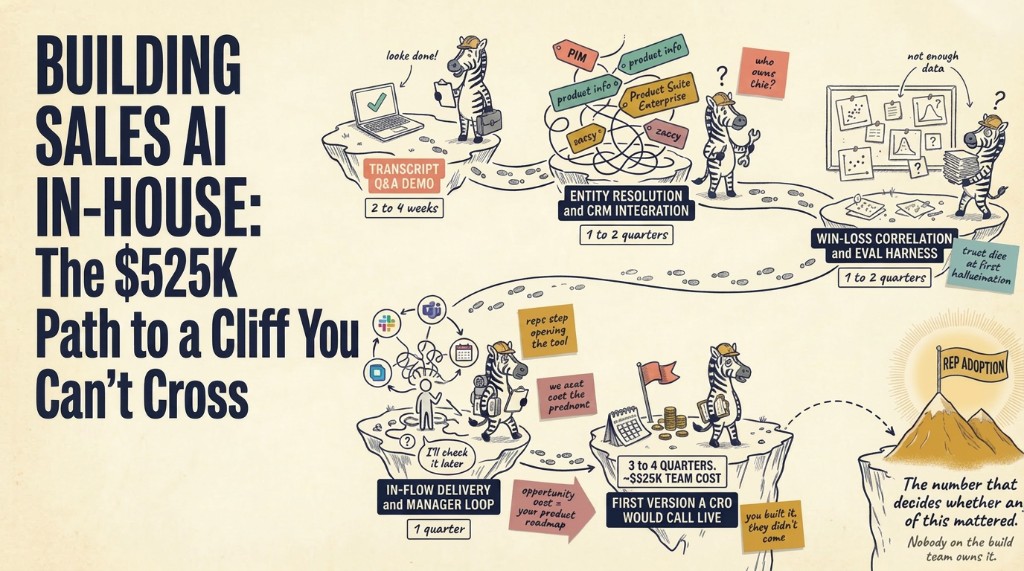

You can build a demo of this in a weekend. Claude plus your Gong exports plus a Slack webhook produces something that looks 80% of the way there. The other 80% is what does not show up in a demo. This post is the honest math on building Sales Execution AI in-house, written for the AI engineer, architect, or technical leader who has been asked to evaluate whether your team should build what Zime does instead of buying it.
We wrote this because we would rather lose a deal to an honest "no" than win one against a straw man. So here is the short version, and then the work behind each line:
This is not a hypothetical argument. We have had this exact conversation on 17 discovery calls in the last 12 months, and the language keeps repeating. Juhi Ranjan at TrueFoundry put the arc plainly:
This document is what happens after that sentence.
The definition
Building Sales Execution AI in-house with Claude, ChatGPT, or your own engineers is possible but structurally more expensive than buying, because the demo that takes a weekend hides five production problems (entity resolution, sparse-data correlation, evaluation, adoption, and cross-customer priors) that take three-plus quarters and a cross-functional team to solve, only for the piece that actually moves win rate, changed rep behavior, to remain unowned.
What are you actually rebuilding when you build sales AI in-house?
Zime is not a chatbot over call transcripts. It is six connected systems, and the demo-able part is roughly one of them. If your evaluation frames the build as "an LLM plus a RAG layer over Gong exports," you are scoping the demo, not the product.
A working session with your CRO and sales leaders that extracts the strategy living in their heads: what a hard discovery question sounds like, how the business case framework works, what actually beats each named competitor. That strategy is not in your CRM or your call recordings.
Four inputs fused into one model of how your company sells: leadership interviews, cross-customer playbook priors for your initiative type, your company's vocabulary learned from transcripts, and CRM plus call-recording integrations for deal metadata.
The brain sliced along four dimensions: product line, industry, persona, competitor. Every winning behavior links back to actual won-call examples: top-performer phrasing and the customer response it earned.
Three touchpoints inside Teams and Slack. Before the call: three prioritized actions. During the call: live queries grounded in past wins. After the call: measurement of whether the behaviors happened.
Before every pipeline review, managers get three coachable risks per deal. This is the piece that makes behavior stick. Rep-facing tools alone do not change behavior; the manager loop closes it.
Every deal that moves forward or backward in the CRM retrains the brain on which behaviors correlated with the movement, sliced by product, persona, and competitor. Daily cadence, not batch.
A transcript-Q&A bot covers part of the brain and part of rep enablement. That is the demo. The win rate impact lives in the rest. David Stokey, VP Global Enterprise Sales at RedSeal, named the scope problem directly:
Claude is a fine substrate. It is not a fine product. And the strategy that makes the brain useful is not in your data. As Chitresh Yadav, VP and Global Head of Sales Engineering at Versa Networks, put it: "AI can reach some level, but not to the human level, because there is a context that you need to build in." Your top reps run that strategy instinctively and nobody wrote it down. Any system trained only on your existing data learns your average behavior, including everything your CRO is trying to fix.
Why does the DIY sales AI demo look 80% done at week 2?
Because the demo is a transcript-Q&A workflow, and transcript Q&A is not the hard part. Feed a long-context model your last 50 Gong calls, prompt it to summarize objections, and you will get an output that reads like your best pattern-recognition rep did the analysis. That output is genuinely useful. It is also the entire visible surface of the product, which is why it deceives.
Every DIY sales AI project we have watched starts with the same false confidence. The engineer runs a proof-of-concept in a week. The CRO sees a summary of last quarter's deals and nods. A budget gets carved out. Somebody says "we could probably ship this in a quarter." And then, month two, the engineer runs into the fact that the demo was on cherry-picked calls with clean transcripts, and production means every call, every customer, every mispronunciation, every ambiguous competitor mention, every stalled deal that never had a clean stage transition to correlate against.
The demo runs on transcripts. Production runs on the whole workflow, and every additional data source is another integration, another entity resolution problem, another set of edge cases nobody scoped.
What five problems don't show up in the sales AI demo?
These are the problems we would expect a strong engineer to hit somewhere between the prototype and month six. None of them are unsolvable. All of them are expensive, and one of them (cold start) is not solvable with more engineering.
There is also a subtler ceiling that shows up in the demo-to-production transition, one that is not technical at all. Matt Siegel at inriver named it: "I do it one-off every time. It doesn't live somewhere, it doesn't aggregate, it doesn't consolidate. That's the only drawback to letting Claude or ChatGPT do it. You lose the ability to visualize it." Every DIY workflow is an artisanal exercise for the person running it. Nothing persists. Nothing compounds. The organization does not learn from its own selling.
Run Zime against your own last 50 deals in 30 days.
We will show you exactly what the vertical brain surfaces that a Claude-over-Gong workflow does not.
Who actually needs to be on the team to build sales AI in-house?
Here is the part that has nothing to do with engineering skill.
| Role | What they own | Without them |
|---|---|---|
| AI engineer | The brain, the pipelines, the evals | Nothing gets built at all |
| Product manager | Adoption, rep trust, iteration on what reps actually use | A technically impressive tool nobody opens |
| CRO / sales leadership | The strategy itself, hours of structured interviews, ongoing arbitration of "is this advice right" | The system learns your average, not your strategy |
| CRM owner / RevOps | What the Salesforce data actually means: which fields are real, which are theater | Entity resolution built on fiction |
| Front-line managers | Running the accountability loop in pipeline reviews | Recommendations are read, nodded at, and ignored |
The uncomfortable point in that table: the AI engineer is the wrong sole owner, through no fault of their own. An engineer's success metric is model quality: retrieval accuracy, answer groundedness, latency. Those are necessary. But the product here is changed rep behavior, and its metrics are adoption, behavior completion rates, and ultimately win rate. That is a PM's job, and a PM with sales-tool scar tissue at that.
In every in-house version of this we have seen, nobody owns the adoption number. The tool gets built, demoed to applause, used for three weeks, and quietly abandoned, and the retro concludes "the model wasn't the problem." Ameeth Dubey at Atomicwork described this exact pattern from a prior attempt:
The model was fine. The workflow was fine. Nobody owned the number that mattered, and the tool died on the vine. That is why Zime ships with a forward-deployed engineer model and a manager accountability layer instead of just an API key. The hard part was never generating text. It is getting a specific rep to ask a specific hard question on Thursday's call, and a manager to notice whether they did.
What is the real cost of building sales AI in-house vs buying?
Assumptions are stated so you can rerun them with your own numbers. Fully loaded cost (salary, benefits, equity, overhead) in US market terms, benchmarked against public compensation data (Levels.fyi 2026 US bands and Radford 2026 Tech Talent Snapshot for senior AI/ML, PM, and RevOps roles at Series B to public-company stage).
| Role | Fully loaded annual | Cost for 9 months |
|---|---|---|
| Senior AI/ML engineer | $320,000 | $240,000 |
| Product manager | $220,000 | $165,000 |
| RevOps / CRM owner | $160,000 | $120,000 |
| CRO + sales leadership time | Opportunity cost, not billed | Very real |
| First 9 months | ~$525,000 |
A reasonable objection: not everyone hires all three roles net-new. In practice, many companies staff the first version by pulling partial time from an existing AI engineer, PM, and RevOps lead. That reduces the incremental payroll line, but it does not reduce the total effort. It spreads the opportunity cost across other roadmaps that then move slower. The full-time cost above is the honest total-cost number.
The timeline, honestly
| Milestone | Realistic estimate |
|---|---|
| Transcript Q&A prototype (the demo) | 2 to 4 weeks |
| Entity resolution + CRM integration that survives your actual Salesforce | 1 to 2 quarters |
| Win-loss correlation with an eval harness leadership will trust | 1 to 2 quarters (overlapping) |
| In-flow delivery + manager loop + adoption iteration | 1 quarter |
| First version a CRO would call "live" | 3 to 4 quarters |
| Zime, first playbook live | 3 to 6 weeks depending on data readiness |
And then it never ends. Year-two maintenance (pipeline upkeep, integration breakage, model migrations, new products and competitors entering the vocabulary, eval regression) is realistically 25 to 40% of an engineer plus continued PM attention. Call it $100,000 to $150,000 per year, forever. Jacqueline Gantt, Head of Sales at OpenRouter, named it thinking through her own build: "That would be more manual. Yes, have AI help build it, but it is going to be more manual. And then, of course, the maintenance of it." The word "maintenance" is where most build-vs-buy math quietly falls apart.
The biggest number is not on the table: opportunity cost. Those are three of your most expensive people spending three quarters building internal sales tooling instead of shipping the product your customers pay you for. Versa Networks saw a 10% win rate lift and a 20% increase in SASE pipeline within a quarter of Zime going live. Two quarters of foregone impact is not a rounding error.
When does building sales AI in-house actually make sense?
For a handful of situations, honestly, it does.
If your data restrictions are extreme (defense, certain healthcare workloads, jurisdictions that will not permit any transcript to leave your VPC), buying may not clear the bar. If your sales motion is unlike anything else and there is no cross-customer prior worth inheriting (a single product, single segment, stable competitive set, no new initiative in the next 12 to 18 months), the cold-start argument weakens and the build case gets stronger. If your in-house ML infrastructure already does most of the five problems above for a different product line, the marginal cost of extending it is lower than the marginal cost of adopting a new vendor.
There is also a size boundary. The argument here is strongest for enterprise buyers with 100+ reps and multi-product motions. For smaller teams (below 30 reps, single product, stable pricing), the build case is more defensible, because the total surface area is smaller and the opportunity cost of a single engineer is different math. If that is you, the honest answer is that you may not need Zime yet, and you certainly do not need to fund an internal build. A leaner path (Claude with a well-curated set of prompts, run manually by the rep who wants to use it) may be enough until you cross the complexity threshold.
For everyone else, the pattern is boringly consistent. The demo takes a weekend and creates false confidence. The production system takes three or four quarters and a cross-functional team. Nobody in-house ends up owning adoption, so impact never materializes even when the tech works. The cold-start and cross-customer problems remain unsolved at any budget. You could build it. It will cost more than buying it, take a year longer, need a team rather than a person, and the part that actually moves win rate was never an engineering problem to begin with.
The customers who worked through this decision most carefully make the argument most cleanly on the other side. Austin Fanning, VP of Sales at SonicWall, ran the analysis before expanding his Zime deployment from 40 to 85 licenses:
The chatbot is the commoditized layer. The vertical brain that categorizes, correlates, and coaches is the layer worth paying for. Mickey Singh, Global Head of Sales Enablement at Versa Networks, put the invitation more directly: "Ask ChatGPT the same question. Compare the answer. See how different it is, or the same it is. Or is it better?" The right way to evaluate Sales Execution AI is on your data, not on our claims.
DIY Claude + Gong stack vs Zime, at a glance
For technical buyers who want the comparison in one place:
| Dimension | DIY Claude + Gong + internal engineering | Zime |
|---|---|---|
| Entity resolution | Build and maintain your own vertical ontology from scratch | 2.5+ years of accumulated cybersecurity, hardware, and services ontologies inherited on day one |
| Cross-customer priors | Single-tenant data only; new initiatives start from zero | Priors from every customer in the vertical; new initiatives inherit patterns |
| Evaluation harness | 6 to 18 months to build; contextual prompt tuning is the hidden cost | Included; the FDE team maintains it quarterly |
| Adoption ownership | Unowned by default; typically dies in month three | Manager accountability layer + FDE-led rollout; Versa Networks reached 74% MEDDIC adoption and MyAdvice reached 87% checklist adoption within six weeks |
| Hallucination containment | You build the eval suite (RegLab 2024 baseline: 58-82% on domain-specific tasks) | Included; quarterly ZBook approval and RLHF cycle owned by the FDE team |
| Maintenance forever | 25 to 40% of an engineer plus PM attention, in perpetuity | Included in the subscription; vendor absorbs model churn and API breakage |
| Time to first playbook live | 3 to 4 quarters | 3 to 6 weeks depending on data readiness |
| Year 1 team cost | ~$525,000 in team, plus tooling and per-query API cost | Annual subscription, fraction of a single engineer's line item |
| Year 2+ cost | $100,000 to $150,000 per year, forever | Annual subscription with expansion, not renewal drag |
| Who owns the context graph | You (if you build the storage layer correctly) | You, via MCP; queryable by Gong, Claude, Salesforce Einstein, any tool in the stack |
The last row is the one most build-vs-buy conversations skip past. If the goal of the internal build was "own our context so we are not locked into a vendor," Zime is the buy option that meets that goal. Zime builds the vertical context graph and exposes it via MCP so your existing tools query your context. Gong becomes a client of your intelligence layer, not the other way around. The vendor relationship is inverted.
We have written the early-stage version of this same systems argument in why founder-built Claude playbooks break at 10 reps, and the mechanics of the entity layer in why your AI sales tool keeps getting it wrong.
Related concepts
Numbers in the cost section are stated assumptions benchmarked against Levels.fyi 2026 and Radford 2026 comp bands, not quotes. Rerun them with your own data. External sources cited in this piece: CrossNER (Liu et al., AAAI 2021); Ghaddar and Langlais, COLING 2018; Stanford RegLab "Large Legal Fictions" (Dahl et al., 2024); Anthropic published pricing (2026); Levels.fyi 2026 US compensation bands; Radford 2026 Tech Talent Snapshot.
Keep your engineers on your product. Buy the outcome.
We will run Zime against your own last 50 deals in 30 days and show you exactly what the vertical brain surfaces that a Claude-over-Gong workflow does not. If it does not clear the bar for your team, you walk away, no cost. If it does, the annual contract activates on day 37.
Questions or a technical deep-dive on any claim in the five-problems section? We are happy to get your AI team on a call with ours.