Blog
Is a context graph enough for your GTM agents?
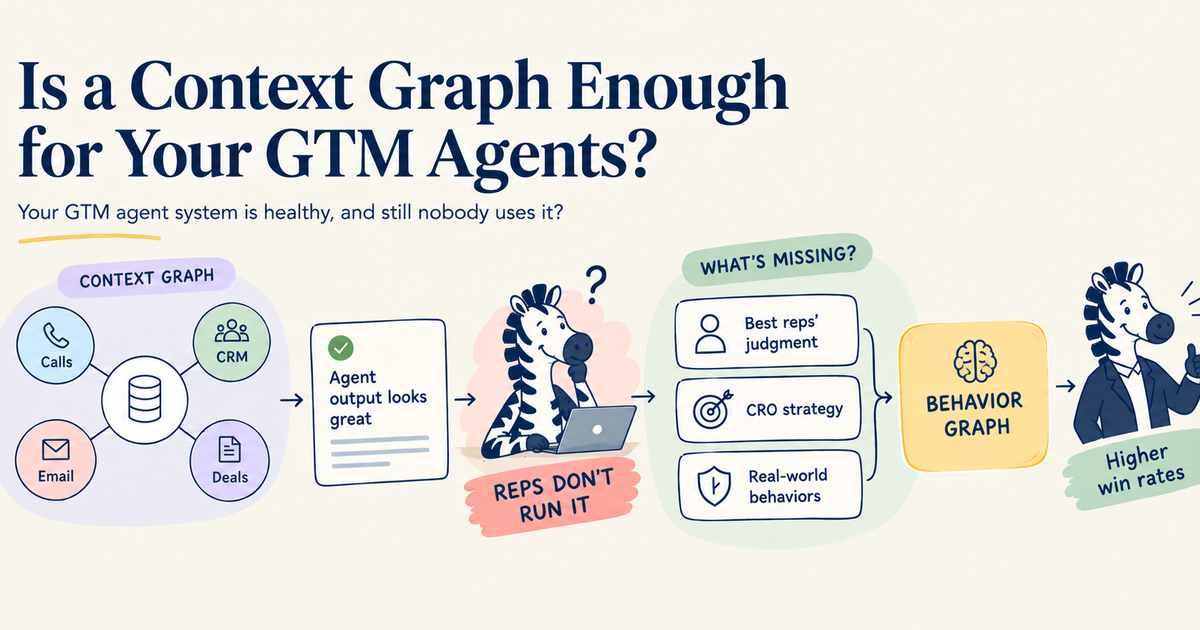
Your GTM agent is in production. Maybe you already shipped a context graph. Self-built, bought, or planning to get one. You wired it into your agents over MCP.
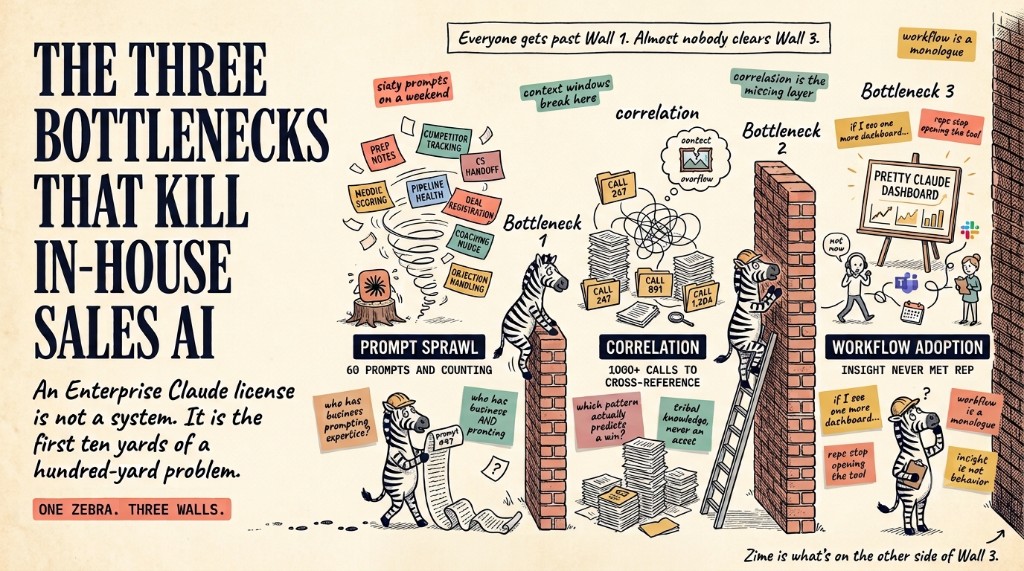

In-house sales AI stalls at three predictable bottlenecks: prompt sprawl across use cases, correlation across hundreds of calls, and the workflow layer needed to turn insights into rep behavior. Each requires a different kind of expertise most sales orgs don't have in-house, which is why enterprise Claude licenses, willing teams, and one working prototype almost never add up to a system that moves revenue.
A working sales AI system needs one hundred prompts minimum, each requiring both business context and prompting craft. Most orgs stall trying to hire the person who has both.
Single-call insight is easy. Cross-referencing patterns across hundreds of calls against deal outcomes breaks context windows and requires a purpose-built retrieval and correlation layer.
Insight without workflow is a prettier dashboard. Pre-call nudges, in-call battle cards, pipeline review surfaces, and manager accountability tools each have to be built, integrated, and tuned.
A conservative in-house build lands around $900K to $1.2M per year in fully loaded cost across three role profiles, before ongoing maintenance and before rep-adoption work.
Under ten reps, a single product, one motion, and a dedicated AI operator on staff. Above that scale, the compounding curve of a specialist vendor wins.
Every mid-market and enterprise GTM team now has AI. Enterprise Claude or ChatGPT licenses are standard. Reps are experimenting. RevOps is writing prompts. Sales leaders are asking, reasonably, why they should buy Sales Execution AI when they already have the raw ingredients.
The answer is not that AI is hard. Step 1 is trivial. Step 2 is not.
Step 1 is a single use case, done end to end. A call ends, a prompt runs on the transcript, a formatted summary lands in Slack or email. Every enterprise Claude account can do this in a weekend. Most of the internal experiments we hear about start here, and they work.
Step 2 is where the wheels come off. One use case becomes a hundred. Each has to run across hundreds of calls to find what actually correlates with wins. Then someone has to build the workflow surfaces that put those insights in front of a rep at the moment they can act on them. That's three bottlenecks stacked on top of each other, each with a different failure mode, each requiring a different resource profile.
Peter Kim, Head of GTM at WestBridge Capital Management, put the pattern more sharply than most, in an April 2026 conversation:
Here's what each of the three bottlenecks actually looks like, in the words of leaders who ran into them.
The bottleneck is not writing the first prompt. It is writing, maintaining, and fine-tuning the next ninety-nine.
A working sales AI system covers deal timelines, competitor mentions, product objection handling, pain-point classification, buying-signal detection, MEDDIC completion, prep notes, post-call recaps, CRM field updates, pipeline health flags, sales-to-CS handoffs, coaching moments, and channel partner registration behavior. That's not one hundred prompts as a metaphor. That's one hundred prompts as a floor, and it grows every quarter as sales motions evolve.
Aman Rangrass, Global Head of Revenue at Skan, is the sharpest example of someone who did the work himself and reported back honestly. In a February 2026 call, he described his own build:
Sixty prompts to make one dashboard work is the floor of a single use case, not the ceiling of complexity. Each prompt needs someone who understands both the business context (what a good MEDDIC discovery looks like, what a fatal objection is in your category, what a clean sales-to-CS handoff must contain) and the prompting craft (how to structure context, how to constrain output, how to test for regression when the underlying model changes).
Beyond volume, there is a separate accuracy tax that only shows up at scale. Rep scoring, for example, breaks in ways a single-call prompt cannot see: vendor and partner calls, ghosted or ten-minute calls, calls that fall in the wrong deal stage for the playbook being scored against, multiple calls at the same stage, calls with attendees from multiple internal domains, deal-stage families where similar calls should score similarly. Each is a workflow requirement that has to be encoded, not a prompting flourish. Skipping them produces confident scores that reps and managers stop trusting inside a month.
The bottleneck: a dedicated resource with real business plus prompting expertise. In most orgs, that person does not exist. RevOps has the business context but not the prompting depth. Data engineering has the technical depth but not the sales context. The intersection is thin, and the people who have it are usually already employed by AI companies.
Even if every prompt from Bottleneck 1 works on a single call, the value only unlocks when they run across hundreds of calls and correlate with wins and losses. Otherwise the patterns and anti-patterns stay tribal knowledge, stuck in the heads of your top reps, never turned into an asset.
This is where enterprise Claude deployments hit their natural ceiling. David Stokey, VP Global Enterprise Sales at RedSeal, is running exactly the setup most CROs are considering. Enterprise Claude license, a smart team, willingness to build. In a July 2026 conversation he described the missing layer directly:
Then the more honest version, further into the same call:
The gap between "maybe correlate some of the data" and "we don't really have a way to correlate all of the data" is the second bottleneck in one exchange. It is not a Claude limitation. It is a context window limitation, a data pipeline limitation, and a correlation engine limitation stacked together. No single prompt can hold a thousand call transcripts, cross-reference them against CRM stages and outcomes, and return a stable ranked list of what actually predicts wins.
The underlying technical problem is documented across the NER and information extraction literature. Cross-domain named entity recognition F1 drops sharply when models are asked to identify entities outside their training distribution (Liu et al., CrossNER, AAAI 2021). Long-context retrieval accuracy degrades before the context window is even full, particularly on domain-specific entity resolution tasks (Stanford RegLab, Dahl et al. 2024). For a deeper look at why the underlying context problem is structural, not just technical, see our post on the entity resolution tax that generic AI pays inside sales workflows.
Aman named the underlying reason from the technical side, again in February 2026:
Building this correlation engine is not a prompting problem. It is a retrieval, ranking, and pipeline problem. It requires an ML-adjacent engineering team, a clean data layer, and the domain expertise to know what to correlate against. This is a very different resource profile from Bottleneck 1, which is why teams that clear the first hurdle almost always stall at the second.
The bottleneck: resources and expertise to build a correlation engine that survives context window limits. Without it, the patterns and anti-patterns behind your wins and losses stay tribal knowledge, and no amount of Claude access changes that.
See what a correlation engine looks like running on your calls.
Book a 30-minute session with the Zime team.
Even if you clear the first two bottlenecks and have a hundred clean prompts running across a correlation engine that surfaces real patterns, none of it moves revenue until it changes rep behavior. That requires a workflow layer: pre-call prep notes delivered before the meeting, in-call nudges surfaced at the right moment, pipeline review dashboards for managers, leaderboards, deal-stage playbooks, coaching moments delivered to the right rep at the right time, opportunity maps that stitch deal, account, partner, and contact together, and RBAC across the whole thing.
Each of those is a product surface. Each one has to integrate with the rep's actual tools, be maintained as those tools change, and be tuned until reps actually use it. This is the bottleneck that even Claude power users hit hardest, because insight without workflow is just a prettier dashboard.
David Laclair, Senior Sales Enablement Manager at Precisely, said it in one line, in a March 2026 conversation:
That is the workflow gap in one quote. Claude and Copilot can produce beautiful outputs. What they cannot do, out of the box, is nudge a rep to complete their MEDDIC checklist before a stage-three call, flag a fatal objection pattern to a manager during a pipeline review, or push a competitive battle card into Slack the moment a competitor's name surfaces in a transcript. Those workflows have to be built, maintained, and evolved as the sales motion changes.
The bottleneck: resources and expertise to build and maintain a full workflow surface. Product engineering, front-end work, integration work with CRM and Slack and email and calendar, and ongoing tuning based on rep adoption data. It is the largest of the three by headcount and the one most likely to be underestimated at the start.
Build path components, honestly costed. US fully loaded compensation figures below assume base plus bonus plus equity plus benefits at typical enterprise SaaS ratios (roughly 1.35 to 1.4 times base). Base ranges are drawn from Levels.fyi 2026 data and Radford's 2026 US Technology Compensation Survey.
| Bottleneck | Role profile required | Fully loaded annual cost | Timeline to production |
|---|---|---|---|
| Prompt sprawl | Senior GTM engineer with prompting depth (base $180-220K) | $270-310K | 3 to 6 months to stand up, permanent to maintain |
| Correlation engine | ML engineer + data engineer (base $200-250K each) | $560-700K combined | 6 to 12 months to production-grade |
| Workflow layer | Full-stack product engineer (base $180-220K) | $270-310K | 6 to 12 months for a first surface, ongoing to expand |
| Total | Three to four hires | $1.1M to $1.32M per year | 12 to 18 months to full system |
The rounder version of that number: about a million dollars a year, before any accuracy work, any adoption work, or any of the ongoing feature development that a specialist vendor treats as its core product roadmap. And this is only the direct headcount cost. It excludes engineering leadership time, model API spend, infrastructure, and the "unknown-unknown" ongoing burden as underlying models, tools, and sales motions evolve.
For context, the current Anthropic Claude API pricing at production sales-transcript volumes typically runs another $50K to $150K per year on top of the headcount above, depending on call volume and how aggressively you retrieve.
David Stokey's build-vs-buy posture is the one most sales leaders actually hold, once they see the math. From the same July 2026 call:
That is not "we gave up." That is "we could, but we would rather spend our engineering capacity on our own product." For most CROs, that is the right answer. Sales Execution AI is a category with dedicated vendors compounding on shared learnings across hundreds of GTM teams. An internal build competes against that compounding with a headcount of three or four.
Read the full build vs buy cost decomposition, including partial-time-team scenarios and data-residency edge cases, in our Build vs Buy for Sales AI analysis.
The table above is the aggregate. Your team's number is different, and your CFO will want the specific one. Answer six questions below to generate a readiness scorecard across the three bottlenecks and a 12 to 18 month roadmap sized to your actual GTM shape. The output is a page you can screenshot or forward for the internal build vs buy conversation.
Honestly, sometimes it does. If you have fewer than ten reps, a single product, one motion, and a deep AI operator on staff, the ROI on Claude plus custom prompts can be real. Aman at Skan is the archetype: he built something that worked for his team and gave him meaningful lift, at a scale where the correlation problem is still tractable inside a single practitioner's head.
The steelman for building extends further in specific cases: teams with genuine data residency constraints that require model deployment inside their own VPC, teams whose sales motion is so unusual that no vendor has patterns to compound against, teams with existing ML infrastructure and a dedicated AI platform team. In those cases the build cost is amortized against work that has to happen anyway, and the buy path loses its compounding advantage.
But in the mainline case, even in the best DIY scenario, the ceiling is visible. Aman himself named the limits: only two people in his company truly understood the full context, CRM data was a mess, generic tools broke on multi-product complexity, and the tooling was "immature" even after his sixty-prompt build. If your company plans to grow past that starting point, the internal build starts accruing technical debt in exactly the places you cannot afford it, right when you need the correlation engine and workflow layer most.
The honest cutover point: if you have more than ten reps, more than one product, or a channel motion, the buy path pays back inside twelve months on saved engineering cycles alone, before any revenue lift.
We will build your first playbook free during a 30-minute session. You bring one sales motion, one competitor pattern, or one handoff problem. We show you the correlation and workflow layer on your calls, live.