Blog
Why Founder-Built Claude Sales Playbooks Stop Working at 10 Reps
Claude is brilliant at first-draft sales playbooks. It fails as an operating system. Here's what breaks at 10 reps, why your reps won't adopt it, and what good looks like.
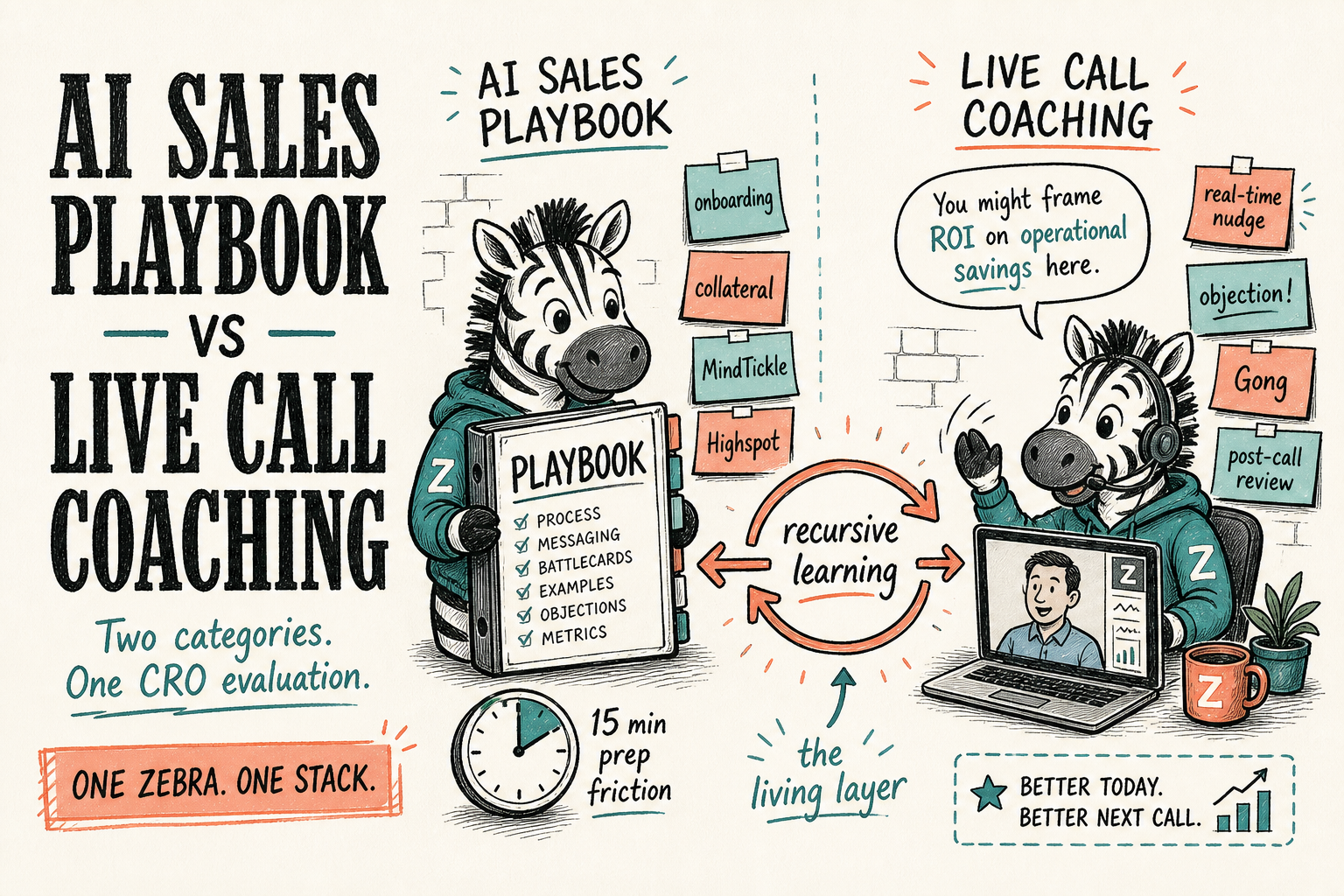

AI sales playbooks codify what reps should do across a deal or a quarter, while live call coaching AI intervenes in the thirty seconds of a live call. They solve different problems, and most sales orgs need both, not one. The evaluation question a CRO should actually ask is not "which one," but "which sequence, and how do they connect."
AI sales playbook software (Highspot, Seismic, MindTickle, Salesloft) codifies enablement content and process. It scales onboarding but fails on adoption, freshness, and moment-of-truth application.
Live call coaching AI (Gong, Clari Copilot, Chorus, Second Nature) surfaces what happened in calls. Most of it is retrospective review, not in-the-moment intervention.
The Highspot-Seismic merger (February 2026) is consolidating the playbook side, and Gong's Mission Andromeda expansion is pushing live-coaching vendors into forecasting and enablement.
Both are pitched as "make reps better." They solve different problems and belong at different layers of the stack. The question is not "which one" but "which sequence, and how do they connect."
Zime is an AI-native sales enablement platform in the Sales Execution AI category. It operationalizes the playbook against live call evidence, so live coaching updates the playbook and the playbook shapes the next call.
AI sales playbook software is enablement content plus process, codified and delivered to reps. It answers "what should a rep know, and when." Vendors in this category include Highspot, Seismic, MindTickle, and Salesloft. The category is consolidating: Highspot and Seismic announced their merger in February 2026, creating the largest single vendor on the playbook side.
Live call coaching AI is a system that observes what reps do on calls and either intervenes in the moment or surfaces coaching afterward. It answers "what is this rep doing right now, and what should they do differently." Vendors include Gong, Clari Copilot, Chorus, and Second Nature. This category is also shifting: Gong's Mission Andromeda expansion (February 2026) has pushed the platform into forecasting and enablement, complicating the category boundary from the coaching side.
The confusion is that both categories now use "AI" and both are marketed as solutions to the same CRO problem: reps not consistently executing. The mechanisms are different. Playbook software delivers pre-authored content. Live coaching AI generates observations from actual rep behavior. One is a top-down artifact. The other is a bottom-up signal. Understanding this split matters more in 2026 than in 2024 because both sides are now claiming the other's territory in their pitch decks.
AI sales playbook software wins at three things: standardizing onboarding, centralizing collateral, and giving enablement teams a system of record for what reps are supposed to know. If a new AE joins on Monday, the playbook is where they learn how to run a discovery call by Friday.
Where it fails is adoption, freshness, and moment-of-truth application. All three failure modes show up in buyer conversations.
On adoption, Austin Fanning, Senior Director at SonicWall, described the friction of using existing enablement in the middle of a workday (July 2026):
Fifteen minutes of prep friction is the reason your reps are not using the playbook you paid to license.
On freshness, playbooks encode what worked at a snapshot in time. Product changes, competitors reposition, ICPs shift. The playbook does not update itself. Enablement teams do quarterly refreshes, sometimes annual ones. By the time the update ships, half of it is already stale. This is the playbook decay problem we've written about at length: the artifact ossifies faster than the market moves.
On moment-of-truth application, static playbook content assumes the rep will remember the right module when they need it. On a live customer call, when a buyer raises a specific objection, the rep does not open MindTickle. They wing it, or they use whatever pattern they used last time, or they lose the moment. Fanning again, on the same MindTickle experience (October 2025):
The pattern is not that playbook software is bad. It is that codified content, no matter how well-organized, does not translate into rep behavior on its own.
Live call coaching AI wins where playbook software fails: at the moment of execution. Puranjay Mahapatra at Bureau captured the underlying need directly (June 2026):
That is a specific request for coaching that is tied to deal stage, prior call context, and the immediate next customer conversation. It is a request for the GTM context model to show up in the prep notes, not for another training module.
The critique of the current category is that most of it is not actually live. Gong, Chorus, and the majority of Clari Copilot's coaching surface are post-call review tools. They record the call, analyze it after the fact, and surface observations to managers, who then coach reps in a one-on-one days later. The workflow that Mike Morrone, Senior Manager at SonicWall, described is representative (May 2026):
That workflow is useful. It is also fundamentally retrospective. The rep already lost the moment. The manager reviews it after. The coaching happens later. For CROs measuring win rate impact, the loop from call to coaching to changed behavior is measured in weeks, not seconds. This is where the well-documented sales training decay problem lives: research from the Sales Management Association and applied learning literature has consistently found that reps forget the majority of training content within ninety days when it is not reinforced in the context of live work. Retrospective coaching alone does not close that gap.
The second failure mode of live call coaching AI is that most vendors deliver generic observations. Dr. Nick DeArmas at Kiddom described this precisely (June 2026):
Generic pattern-matching against best practices is what most AI coaching produces today. Contextual guidance grounded in this rep's deal, this buyer, this product, is what buyers are asking for and rarely getting.
Run this evaluation framework against what your team actually does today.
Book a 30-minute session and we'll walk it through on your last thirty calls.
CROs conflate playbook AI and live coaching AI because both vendors show up in the same RFPs, use overlapping language, and claim adjacent territory in their pitches.
Playbook vendors add AI features and claim they now coach. Live coaching vendors add process content and claim they now enable. The category boundaries have blurred at exactly the moment when CROs are trying to consolidate their sales tech stack. The Highspot-Seismic merger on the playbook side and Gong's Mission Andromeda expansion on the coaching side are both moves toward each other's territory.
Martin Mackay, Chief Revenue Officer at Versa Networks, framed the CRO-level problem this way (June 2026):
That is a CRO diagnosing a process gap, not a tool gap. The temptation is to solve process gaps by buying tools. The trap is buying two tools that both claim to solve it and end up solving different parts, with reps caught in the middle.
The behavioral research supports the conflation risk. Enablement content utilization studies published by SiriusDecisions/Forrester and CSO Insights over the past several years have consistently reported that a large majority of sales enablement content, commonly in the 60-70% range, goes unused by reps within twelve months of publication. Separately, sales training effectiveness research (Sales Management Association, CSO Insights) has documented the retention gap between classroom or module-based training and behavior applied on live calls. Both categories over-promise on rep behavior change because both are measured on activity (content views, calls analyzed) rather than on execution (behavior changed, deals won).
Four axes matter for evaluation. Everything else is feature-level noise.
Does the tool operate before, during, or after the customer conversation? Playbook AI is primarily before. Most live coaching AI is after. Genuine in-the-moment coaching is a narrow slice of the market.
Is the tool delivering static content (documents, videos, modules) or dynamic intervention (real-time nudges, contextual prompts, personalized guidance)? Playbook AI is content-heavy. Live coaching AI ranges from observation to practice simulation.
Is the tool standalone, or does it read from and write to the rest of the sales system? A playbook that lives in a portal your reps never open is worth zero. Live coaching that does not update CRM or connect to the playbook is a dashboard.
Is the guidance authored by enablement, or learned from your actual calls and deals? Playbook AI is authored. Most live coaching AI is learned from calls but not fed back into the playbook. The disconnect is where most CRO budget waste lives.
| Axis | AI Sales Playbook Software | Live Call Coaching AI | Named Vendors |
|---|---|---|---|
| Timing | Before the call, mostly async | After the call, sometimes during | Playbook: Highspot, Seismic, MindTickle, Salesloft. Coaching: Gong, Clari Copilot, Chorus, Second Nature |
| Artifact | Static content, modules, certification | Observations, transcripts, scorecards, occasional real-time nudges | Authored content vs learned observations |
| Integration | LMS-adjacent, weak CRM feedback loop | Call recording plus CRM sync, weak playbook feedback loop | Both categories have gaps to the other side |
| Evidence source | Authored by enablement | Learned from calls but not fed back into playbook | The gap is the opportunity |
The evaluation question a CRO should ask each vendor is not "what features do you have." It is "what does a rep actually do differently in their next call because of your tool, and how do you measure that."
On pricing, playbook AI platforms typically price per rep per year in the $600 to $1,500 range for AI-enhanced tiers, based on published vendor pricing pages and G2 aggregate data as of Q3 2026. Live call coaching AI typically ranges from $1,200 to $2,400 per rep per year for full platforms. Combined stacks land in the $2,000 to $4,000 per rep per year range before implementation and integration costs. For a hundred-rep team, that is $200K to $400K in software alone, which is why the sequencing question below matters more than the feature question. If you want the deeper cost and timeline math, our build vs buy analysis breaks the full stack down for CROs at evaluation time.
The honest answer depends on your scale and motion.
For sub-thirty-rep teams with a single product and a single motion, one layer often suffices. If your onboarding is the bottleneck, playbook AI. If your onboarding is fine but your existing reps are stuck, live coaching AI. Two tools for a small team is usually over-buying.
For mid-market and enterprise teams, both, but sequenced, and the value comes from how they connect.
If your reps are not following any consistent process, you buy playbook AI first. Codify the motion. Give enablement a system. Get the baseline.
If your reps follow the process but lose winnable deals to execution gaps, you buy live coaching AI next. Instrument what actually happens on calls. Surface what your top reps do that others do not.
The trap is stopping there, with two disconnected tools. The playbook sits in one system. The call insights sit in another. Neither updates the other. Reps get two sets of guidance, and neither reflects what is currently winning in this quarter's deals.
Fanning at SonicWall articulated the connected-system version that CROs actually want (May 2026):
That is not two tools. That is one system where live call evidence continuously updates the playbook, and the playbook shapes what reps do on the next call. The playbook becomes living. The coaching becomes contextual. The feedback loop closes.
Zime is that layer.
Zime is an AI-native sales enablement platform in the Sales Execution AI category. It sits between call capture and pipeline forecasting: Gong captures the call, Clari forecasts the deal, and Zime operationalizes the playbook against live call evidence.
Zime does not replace playbook AI or live coaching AI. It is the connective layer between them, updating the playbook from what is actually winning in your calls and delivering that guidance back into the next rep interaction. For a CRO evaluating this space in 2026, the question is not playbook vs live coaching. The question is: which layer of my stack is missing, and what connects them.
If you are evaluating what to add to your stack in 2026, the useful conversation is not another product demo. It is thirty minutes on your specific execution gap and what closes it, running on your last thirty calls.