The Sales Productivity Paradox


The Paradox Nobody Wants to Admit
Sixty percent. That's the share of Chief Sales Officers who said at this year's Gartner CSO & Sales Leader Conference that hitting their revenue target feels largely outside their control.
Sit with that number for a moment. These are not underfunded, understaffed organizations. The companies in that room have invested in CRM modernization, sales enablement platforms, AI copilots, and expensive consulting engagements. Their reps have been trained, retrained, and trained again. Their processes have been audited, redesigned, and audited once more.
And yet. 60% of the people responsible for revenue say the outcome doesn't feel like theirs to control.
That's not a motivation problem. It's not a talent problem. It's a structural one, and Gartner's research finally gave it a name.
Gartner's Diagnosis: A Design Problem
Gartner VP Analyst Dan Gottlieb stood at the front of the room and delivered what might be the most clarifying insight about enterprise sales in years: the constraint isn't effort, investment, or even AI adoption. It's that sales operating models were built to scale by adding headcount, not by making every rep systemically better at the behaviors that close deals.
In other words: organizations have been solving a design problem with a training solution. They've hired coaches, built playbooks, and run enablement sessions. But if the system, the daily workflow, the pipeline review, the CRM update loop, the pre-call prep, doesn't inherently guide a rep toward the right behavior, training evaporates the moment the quarter gets noisy.
This is a deceptively hard problem. Most organizations have the strategy on paper. The challenge is making strategy operational at the individual rep level, in the actual flow of daily work, not in a quarterly kickoff presentation.
The mechanism for doing that has historically not existed. Which is why, despite all the investment, the productivity gains never compound the way they should.
The Manager Effectiveness Blind Spot
The Gartner data on sales managers is uncomfortable reading for any VP of Sales.
Only 18% of sales managers say they lead high-performing teams. The reason, Gartner found, isn't a coaching skill gap: it's a role design failure. More than half of managers report that their day-to-day reality looks nothing like their job description. They are buried in CRM hygiene, administrative calls, forecast roll-ups, and status updates, the very activities that crowd out the coaching, behavior-shaping, and deal-level scrutiny that actually move seller performance.
The irony is sharp: the people most responsible for rep development are spending the least time on it. Managers aren't failing at leadership. They're drowning in work that was never supposed to be theirs, work that technology should have eliminated years ago.
The organizations that will win this decade aren't just investing in rep-level AI tools. They're rethinking the manager's operating model: where do they get deal-level context quickly? How do coaching conversations become data-driven rather than instinct-driven? How do pipeline reviews surface the right signals without three hours of prep?
The AI Capacity Measurement Problem
Gartner's conference made one thing clear about the current state of AI in sales organizations: most companies have deployed AI. Very few have measured it.
The data on seller time reallocation is striking. Revenue teams that successfully shift time from low-impact administrative work to high-impact sales activity, including calls, meaningful pipeline engagement, customer conversations, they generate 3.3× more revenue growth than those that don't. The math is unambiguous.
But Gartner flagged a critical failure mode: only 72% of organizations that free up seller time through AI actually reinvest those savings into high-value activities. The rest let the time dissipate, absorbed back into the administrative noise that AI was supposed to eliminate.
This is the AI implementation insight that most sales technology vendors don't want to surface: the ROI of an AI tool isn't captured at the point of implementation. It's captured, or lost, in what happens to the hours it creates. If there's no system to redirect those hours toward meaningful work, the investment produces data, not outcomes.
Designing Behavior Into the System
Gartner's prescription sounds simple. The execution is where it gets hard.
"Design winning behaviors into the system" means that the right play should be the default play, not the exception that emerges when a rep has time to think, prepare, and be thoughtful. Most reps don't have that time. The quarter is always noisier than the plan.
The organizations getting ahead of this problem have recognized three specific places where behavior design has the highest leverage:
1.
Pre-call and pre-meeting preparation: The quality of a sales conversation is determined before it begins. Reps who walk in with deal-specific context, relevant objection handling, and a clear objective close at higher rates, but most reps don't have the time to prepare this rigorously for every meeting. The system should do it for them.
2.
CRM discipline and data quality: Pipeline visibility is only as good as the data behind it. The CRM update loop, hated by reps and critical for managers, breaks down when it feels like an administrative burden with no personal upside. When AI removes that friction and updates CRM automatically from call context, data quality improves and rep time is redirected to selling.
3.
Pipeline review and coaching infrastructure: Managers need a clean signal: which deals need attention, which behaviors need reinforcing, and where time is being lost. When pipeline reviews surface the right deal-level insights without hours of prep, managers can spend their 1:1 time coaching, not extracting information reps already gave to a CRM tool that nobody reads.
The Living Playbook: From Document to Infrastructure
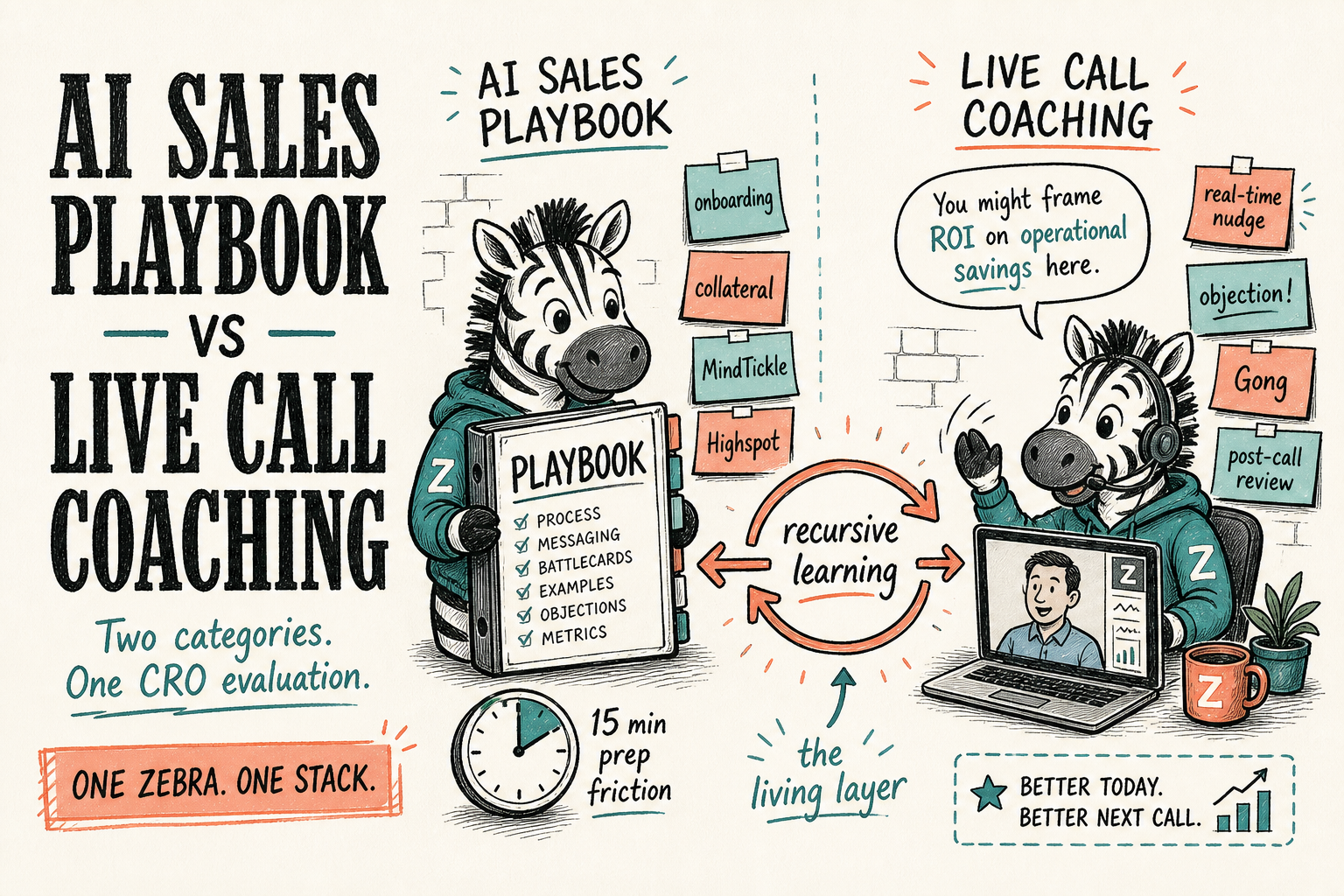
Every sales organization has a playbook. Almost none of them are alive.
The traditional playbook is a document, built in a good quarter, updated occasionally, consulted rarely. By the time a rep needs it in a live deal conversation, it exists somewhere in a shared drive, five clicks away and six months out of date. It captures what the team knew when they wrote it. It does not adapt to what the team learns every week.
The shift that Gartner's research implicitly points toward, and that leading sales organizations are beginning to operationalize: from playbook as document to playbook as infrastructure. A system that learns from every deal, surfaces the right guidance at the right moment in the rep's workflow, and evolves as the market evolves.
This is the core infrastructure challenge of sales in 2025: not choosing between more AI tools, but building the connective layer that makes winning behaviors automatic, embedded in the rep's daily workflow, not appended to it.
Zime is built on exactly this premise. The product isn't another point solution for a specific sales task. It's the operating layer that sits in the flow of work, surfacing the right context before a call, capturing what happened after one, updating the pipeline automatically, and showing managers a clear picture of where attention is needed. It makes Gartner's prescription operational.
What This Means for Sales Leaders in 2025
The Gartner conference was, at its core, a call to rethink the unit of improvement in sales. For the past decade, that unit has been the individual: hire better, train harder, coach more. The next era of sales performance improvement has a different unit: the system the individual operates within.
This shift has four practical implications for every CSO and VP of Sales right now:
→
Audit where your AI time savings actually go: If your reps are spending less time on administrative tasks, confirm that time is going to pipeline engagement and customer conversations, not to Slack, email, and internal meetings. If you can't measure it, you can't manage it.
→
Redefine the manager's job description: If 82% of your managers are not leading high-performing teams, the question isn't whether to invest in manager training. It's whether their daily reality creates space for the activities that actually move performance.
→
Measure behavior, not just output: Revenue is a lagging indicator. The behaviors that produce revenue, including call prep quality, objection handling discipline, pipeline hygiene, are leading ones. If you're only managing to quota attainment, you're managing to last quarter's decisions.
→
Design for the average rep, not the star: Your top performers are going to figure it out. They always do. The productivity and revenue gain sits in the 60% of the sales org that's capable of performing like the top 20%, if the system they operate in is designed to make the right behavior the default behavior.
Gartner gave the sales world a sharp diagnosis this year. The operating model built for headcount-based scaling is running out of runway. The replacement isn't more technology layered on top of a broken operating model. It's a fundamentally different infrastructure: one where the system does the work of ensuring winning behaviors happen, not one where individual heroics compensate for system gaps.
That's a different kind of investment than most sales leaders are used to making. But if 60% of CSOs feel revenue is out of their hands, the case for a different approach has never been more urgent.
Ready to act on the insight?
Design winning behaviors into your system, not just your training.
Zime embeds the right sales behaviors into the daily workflow of every rep and manager, making Gartner's prescription operational, measurably, at scale.
Explore Zime AI