Blog
Why Your AI Sales Tool Keeps Getting It Wrong
Why AI sales tools hallucinate on competitors and products. The fix isn't a better model. It's a cleaner entity ontology. Versa Networks case study.

Recently, CIOs and revenue leaders from UKG, BlackLine, Asana, Kiteworks, and Lumentum sat down for a thought leadership dinner on AI in enterprise go-to-market. No vendor pitches. No slides. Just the people who actually buy and deploy AI at scale, describing what's working and what isn't.
One word came up more than any other. Not efficiency. Not automation. Not pipeline.
Context.
When the moderator asked what one word captures the promise of AI, the first answer was "context." The Asana executive followed immediately: "context being so important." The BlackLine CIO framed the entire data problem around it: "without data you cannot have context. Without context you cannot leverage AI."
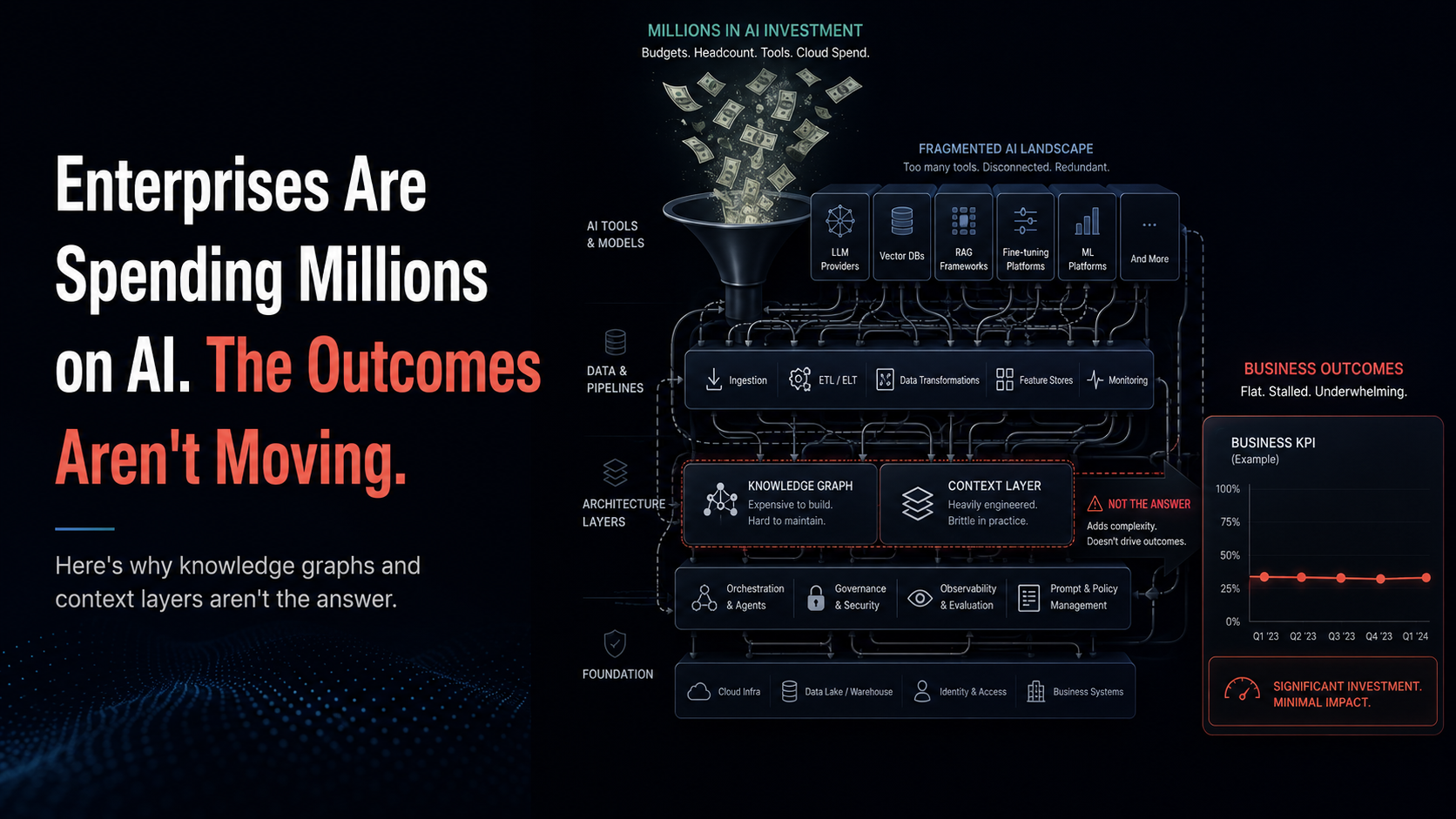
They are right. And they are also describing exactly why most enterprise AI investments in sales aren't moving the number — a pattern Gartner has now quantified. In a May 2025 survey of 506 CIOs, 72% reported their organizations are breaking even or losing money on their AI investments.
Before going further, the real distinction worth naming. Enterprise GTM teams have two fundamentally different types of information, and most AI tools only see one of them.
Digital exhaust. Everything that gets recorded automatically. Call transcripts. CRM updates. Email threads. Pipeline stages. Win-loss notes. This is abundant, structured, and increasingly easy to query with AI.
Company context. Everything that doesn't get recorded. Your CRO's strategic priorities for the quarter. The positioning your PMM developed for a new product. The discovery pattern your top rep uses that nobody has ever written down. The channel motion that's different in EMEA versus NORAM. This is what actually drives how your company wins — and it almost never makes it into a system.
Generic AI is excellent at the first category. It can summarize your calls, surface your pipeline risks, and draft your follow-up emails. It is completely blind to the second.
This is the context gap, and it is the reason your AI investments are producing activity without outcomes. Zime explains the underlying architecture of this problem in detail in How Zime's Knowledge Graph Powers Contextual Sales Execution.
Think about what no AI tool currently has access to:
None of this is in your CRM. None of it is in your call recordings. It exists in the heads of your best people, and it evaporates the moment they leave the room.
The Lumentum CIO put it directly: "Sales people come to sell you something. What we need is sales people to come and help us solve the problem."
That is not a data problem. Every CRM in the room was full of data. It is a context problem — the gap between the data a system can capture and the company-specific intelligence that actually drives how your team wins. Zime calls this distance the strategy execution gap, and it is where most enterprise AI investments quietly stall.
The Asana executive said something every CFO needs to hear: "The metrics for go-to-market are still pretty much the same."
Pipeline quality. Conversion. Seller productivity. NRR. Quota attainment.
What's changed is the denominator. The UKG executive described it as density: "Previously, for a group of sellers we signed about 20 accounts. Now with the right toolsets, they can handle 70 to 100."
The moderator's CFO had already rejected the "we saved 10 hours per week" argument. Rightly so. Nobody wants efficiency theater. They want to know if reps are closing more, and whether the AI investment is the reason.
The CIOs who are getting there are measuring one thing: are reps executing the company's strategy, and can we verify it?
Almost none of the tools in the market answer that second half. Conversation intelligence platforms record what happened. Sales readiness platforms train reps for what might happen. Neither category was designed to know what your company's strategy is this quarter, or to verify whether reps are executing it. That is a category gap, not a feature gap. Zime breaks down what closing this loop looks like in practice in AI Sales Coaching: From Feedback to Real Time Guidance.
The BlackLine CIO named the real issue: "Data was always a problem. What's happening with AI is that the impact of bad data quality is much more visible."
True, but incomplete. The deeper issue isn't quality. It is type.
Quality fixes do not bridge the gap between digital exhaust and company context. You can have perfectly clean call recordings, perfectly structured CRM fields, and perfectly tagged win-loss notes — and still have AI that produces generic recommendations because it has never seen how your company actually sells.
The companies that will win the next 18 months are the ones that find a way to capture their company context, and make it usable by every rep, on every deal, in real time.
The Kiteworks CIO made the most interesting point of the evening: "I think the days of build versus buy are gone. I think it is buy and build."
Buy the platform. Enable your people to build on top of it. Evolve from there.
This is the right instinct, but it carries a critical distinction. Building internal dashboards, micro-apps, and workflow automation on top of foundation models is tractable. Teams are doing it today. The Kiteworks CIO's example of a pipeline dashboard built in two weeks is real, and impressive.
Capturing your company's context — the strategic intent, the winning patterns, the product knowledge, the channel nuances — and deploying it to every rep in a way that compounds with every deal? That is not a build problem. That is a new category of infrastructure that requires a different kind of system, one designed from the start to learn how your specific company sells.
The Asana executive was honest about where they are: building internally because the market is too noisy and the stakes are too high to bet wrong. That is a reasonable position. But as the moderator observed, the window to standardize is closing, and whoever captures their company context first compounds fastest.
The BlackLine CIO described what good looks like: sellers who arrive "prepared with a pitch that is individualized and personal, based on the audience they're speaking to."
Not a generic deck. Not a prompt-engineered email. A pitch that reflects your company's actual strategy, your product's actual differentiation, and this buyer's actual situation.
When AI has your company context, three things change that don't change with generic AI.
When your CRO decides Q3 is about expanding into the channel, that intent can be in every rep's workflow within a week — not filtered through enablement sessions that 40% of the team attends.
The discovery questions your best rep asks, the objection framing that closes competitive deals, the multithreading approach that wins enterprise. These stop being tribal knowledge and start being executable guidance for every rep. Zime walks through how this works in How AI-Driven Sales Playbooks Empower Reps to Win More Deals.
The question that matters isn't "did the rep use AI?" It is "did the rep execute the strategy?" Context-aware AI can answer that. Generic AI cannot.
At the end of the dinner, the moderator asked each executive: "The promise of AI, one word."
The answers: context. Limitless. Transformation. Velocity. Value.
Every word maps to a real aspiration. But for GTM specifically, the word that drives revenue is context — because context is what generic AI is missing, and context is what determines whether your reps execute your strategy or their own improvised version of it.
The UKG executive described the ideal state: AI that tells reps "what are the five things you should focus on today that will yield results and outcomes." Not generic best practices. The five things that are right for this rep, this account, this quarter's priorities.
That is only possible when the AI knows how your company sells.
Data and context are not the same thing. If your AI investment is built entirely on digital exhaust — recordings, CRM, transcripts — it is missing the layer that actually drives how your company wins. Ask your vendor: what does this system know about our specific strategy, our top performers, our winning patterns?
Insights without execution verification is Phase 1. The CIOs at this dinner were all asking for Phase 2: AI that closes the loop between what leadership decides and what reps do. If your current stack can't answer "did the rep execute the play, and did it work?", you have an execution gap.
This is the operational test. When your CRO decides something changes this quarter, how many days before every rep in the field is executing it? If the answer is weeks or months, you have a context deployment problem that no amount of data infrastructure solves.
Zime is the Sales Execution AI built for enterprise GTM teams, designed to capture your company's context — strategy, winning patterns, product knowledge, channel nuances — and deploy it to every rep.