Why Your AI Sales Tool Keeps Getting It Wrong

The Model Isn't Broken. The Contextual Execution Is.
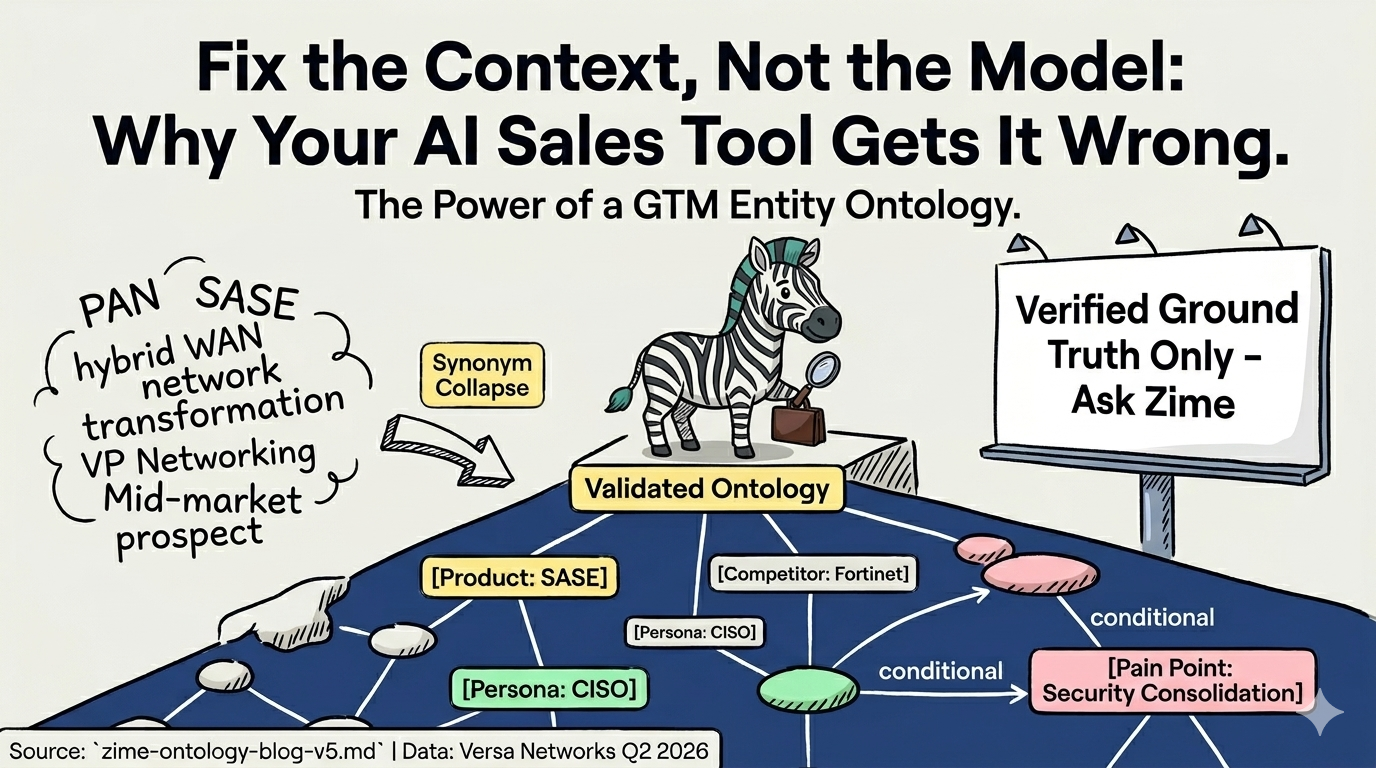
An entity ontology is a structured map of products, competitors, personas, pain points, objections, industries, and their relationships that allows AI systems to reason accurately about a company's go-to-market motion.
You've seen this before. Your team deploys an AI tool. It gets call recordings. It reads the CRM. It has access to everything.
And still, the prep note before a Palo Alto Networks call refers to them as a "prospect" instead of a named competitor. The summary flags "SASE" as an unknown acronym. The coaching output tells your rep to lead with the SD-WAN pitch on a deal that's clearly a Managed SD-WAN play.
We saw a near-identical version of this play out at Versa Networks. In a workshop, the team caught a Zime-generated note that suggested a customer wanted to replace their SD-WAN with a more SASE-like approach. The account team immediately flagged it. The customer had been clear they were only focused on SD-WAN. The words were present in the call. The context was wrong.
This is the problem Zime has spent the last two years building infrastructure to solve. And it starts with something most GTM teams have never actually built: a clean, exhaustive, maintained list of what we call entities, the foundational vocabulary of your sales motion.
What is an entity in sales AI?
An entity is any named thing that your GTM team sells around, talks about, and needs to know. Products, competitors, pain points, objections, personas, industries you sell into, regions with different pricing or buying behavior, and deal stages in your CRM are all entities.
These aren't just taxonomy. They're the ontology, the structured vocabulary that every downstream AI decision depends on.
Versa is a good illustration of why this matters. In their sales motion, SD-WAN, SSE, and SASE are not synonyms and they are not interchangeable. As one of their reps put it: networking buyers get led with SD-WAN, security buyers get led with SSE, and SASE is the combined story. In large enterprises, networking and security often sit in separate buying centers, so the same account may need two entirely different pitches depending on who picks up the phone.
A generic AI that treats SD-WAN, SSE, and SASE as interchangeable keywords will produce the wrong prep, the wrong coaching, and the wrong summary, every time. Not because the model is weak. Because nobody told it which word means what, to whom, in which deal.
When a rep asks "what should I say about security consolidation to this CISO at a mid-market healthcare company?", the AI needs to already know:
"Security consolidation" is a pain point, not a feature.
The CISO persona buys differently than the VP of Networking.
Mid-market healthcare is a segment with specific buying triggers.
Which of your products maps to which pain point, and what the win looks like.
Without that clean entity list, the AI guesses. It pulls generic patterns from generic data. It gives you a confident-sounding answer that would fail on any real call.
That's not a model quality problem. GPT-4, Claude, Gemini, any of them will hallucinate in this gap. The fix isn't a smarter model. It's better ground truth.
What numbers you want to hit on entity resolution
If you're going to build or buy an entity layer, these are the three metrics worth tracking.
Most teams never measure any of these because they don't realize the entity layer is what's actually broken. They blame the model.
Why is an entity ontology hard to build?
Building a real entity ontology is hard for four reasons: no single source has everything, the same concept goes by multiple names, entities change constantly, and entities are conditional on context rather than flat tags.
How do you build an entity ontology?
Zime builds an entity ontology in five steps: onboarding extraction from public sources, human verification with the customer's team, mapping of phonetics and canonicals, retroactive tagging of historical data, and periodic refresh. Budget three to four weeks of focused work for an initial build, then ongoing maintenance on a quarterly cadence.
Step 1: Onboarding extraction
Step 2: Human verification
Step 3: Phonetics and canonicals
Step 4: Tagging historical data
Step 5: Periodic refresh
Why validated context beats more data
More data is not the same as better context. Often it's the opposite.
Abdul Al-Nachawati, a Sr. Account Executive at Process Street, surfaced the buyer's version of this directly on a sales call:
Every tool in his stack worked. Each one produced output. What was missing was a layer that made any of those data sources coherent across the others.
At Versa, the team's Head of Sales Operations praised Ask Zime AI, our internal Q&A system, specifically because it returned "clean validated" information and avoided hallucinations from open web search.
That praise didn't come from the AI being clever. It came from the AI being constrained to ground truth the team had approved.
The same conversation surfaced the flip side. When discussing extending Zime to handle RFP-style queries, he immediately flagged a risk: RFP content includes financial answers, roadmap material, and information that shouldn't be exposed in customer-facing sales conversations. He asked us to separate RFP queries from competitive sales queries so the new data wouldn't pollute the trusted AMA answers reps already relied on.
That's the ontology problem stated cleanly by a customer: enterprise sales AI doesn't get better by ingesting everything. It gets better by knowing what each thing is, where it belongs, and when it should be used.
The trust is also fragile. In the same review, a single inaccurate report nearly cost confidence in the entire system. His warning was blunt: if the data is wrong, "people will stop having faith in the report." Validated context isn't a nice-to-have. It's the whole asset.
Results at Versa Networks
Key data points from Versa Networks' usage of Zime through Q2 2026:
What does an entity ontology enable?
A clean entity ontology produces accurate behavioral patterns, operational metrics leadership can act on, hidden expansion signals, measurable competitive intelligence, correct pre-call prep notes, and meaningful coaching. It's the foundation everything else runs on.
When Zime says reps who ask about network architecture in early-stage SASE deals win more often, that pattern is only meaningful if "SASE deals" is a clean, consistent category. Without the ontology, the insight is noise. The model is pattern-matching across deals that aren't actually comparable.
At Versa, Zime tracks MEDDIC checklist compliance across the sales org. Adoption is running above 70%, with the prior month at 74%, numbers shared directly with sales leadership to reinforce rep behavior. That's only possible because the behaviors being tracked sit on top of clean, consistent tagging.
Call data, once entities are clean, surfaces things CRM never will. In one Versa weekly review, Zime's analysis showed that 17% of prospects in SD-WAN, SASE, and ZTNA conversations were actively talking about switching firewalls, including which incumbent firewall and what pain was driving the switch. That's a concrete cross-sell signal that didn't exist in any pipeline report.
Once competitors are tagged consistently as entities, the questions change. Not "what did the rep say?" but "where are we winning and losing?" In a Versa dashboard review, the team could see Fortinet appearing in 31 deals at a 45% win rate, Cato appearing less frequently but won more often, and Netskope flagged as a tougher loss pattern. That's not a summary. That's a GTM decision-making surface.
The pre-call checklist Zime surfaces 30 minutes before a meeting is generated from the entity context: what product is in play, what competitor is likely present, what persona is on the call. If those entities are wrong or incomplete, the checklist is wrong.
When a manager reviews a call and sees "rep failed to address competitive positioning," the AI knows what competitive positioning means in that specific deal context because the entities are defined. Generic AI doesn't know this. It guesses.
Entity ontology vs. CRM tags vs. knowledge graph
These three concepts often get conflated, but they do different things.
An entity ontology, as we use the term, is a knowledge graph specifically tuned to a company's go-to-market motion. It includes the products, competitors, personas, pain points, objections, and the conditional relationships between them, plus the phonetics layer that maps how each entity is named differently across reps, customers, and competitors. Without that GTM-specific tuning, a generic knowledge graph won't know that PAN is a competitor in most contexts and a partner in one specific product line.
David Stokey, VP Global Enterprise Sales at RedSeal, put the practical version of the CRM-tag problem on a recent sales call:
That isn't a Salesforce problem. It's the structural ceiling of any system that depends on flat, human-applied labels. The data is whatever the rep typed in. The AI inherits that.
Why you can't just buy this from a model provider (or build it in-house)
The most common version of this objection comes directly from buyers. Tyler Neubauer at HG Insights put it plainly in a June 2026 sales call:
It's a fair question. The data exists. The frameworks exist. The models are capable. So why is the ontology layer the thing that's hard to replicate in-house?
OpenAI doesn't know your product line. Anthropic doesn't know your competitors. No foundation model has the slightest idea what "PAN" means in the context of your specific sales motion, or why SASE deals close on a different timeline than SD-WAN deals.
A prompt library doesn't fix this. You can feed a transcript to ChatGPT and get a coherent summary. But coherence isn't accuracy. The summary will use your competitor's marketing language back at you because the model absorbed it from the internet. It will miss the distinction between a VP of Networking and a CISO because nobody told it that distinction matters in your specific motion.
Austin Fanning, a Senior Director at SonicWall, framed the right architectural answer from the buyer side. In a June 2026 call, he said:
His company's private equity owner has mandated that all data consolidates into Claude as the enterprise AI layer. Which means SonicWall isn't choosing between Claude and a chatbot replacement. They're choosing how their call data, structured and categorized, gets into Claude. That choice is what an entity ontology actually represents.
The entity ontology is the thing that makes AI specific to you rather than generic to everyone. It's the layer that converts a capable language model into an AI that actually knows your business.
Building it is unglamorous work. Crawling sitemaps, running verification workshops, mapping synonyms, refreshing periodically, watching for the moment a customer worries about "polluting" a trusted answer with the wrong data. None of that looks good in a demo.
But it's why, when a sales leader at Versa goes to share a Zime-generated report with their CRO, they trust the numbers. And it's why, when a rep asks the system "what do I need to know about this deal before my call tomorrow," the answer is actually useful.
Ready to act on the insight?
Zime builds the entity and context infrastructure that makes enterprise sales AI reliable.
If your team is trying to build this in-house, or if you've hit the wall where generic AI keeps missing your specific motion, the context graph methodology is something we'll walk through in a 30-minute session.