Blog
Why Your AI Sales Tool Keeps Getting It Wrong
Why AI sales tools hallucinate on competitors and products. The fix isn't a better model. It's a cleaner entity ontology. Versa Networks case study.
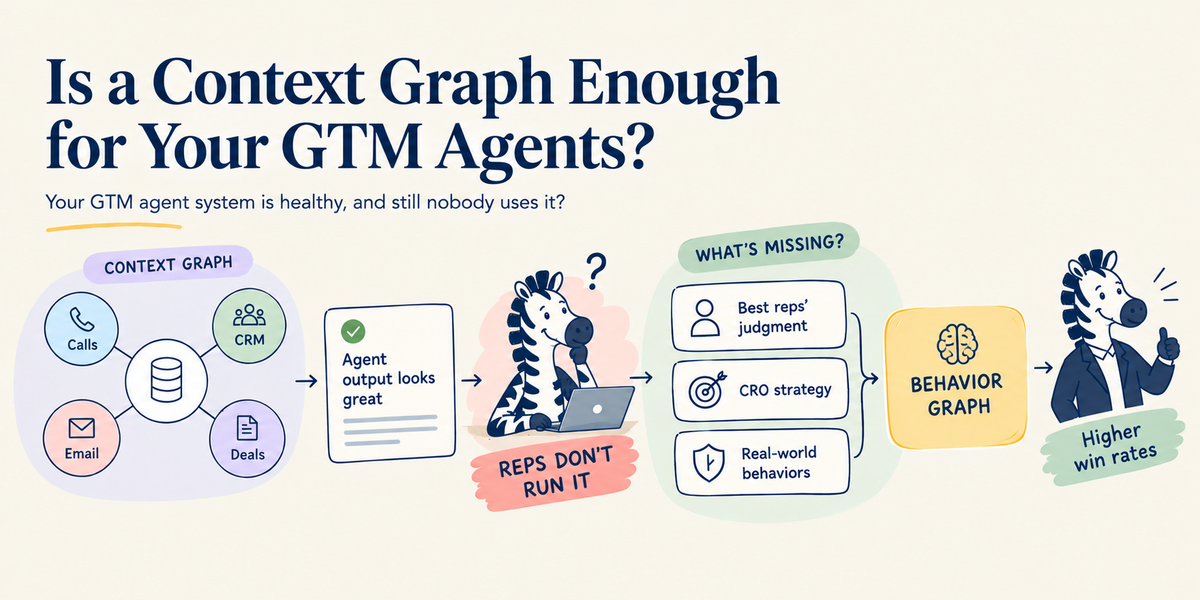
Your GTM agent is in production. Maybe you already shipped a context graph. Self-built, bought, or planning to get one. You wired it into your agents over MCP. It works. It answers questions about deals, drafts follow-ups, and writes a prep note before every call. Uptime is fine. Latency is fine. Reps have access.
Two weeks in, you pull a usage report. The prep notes get opened. But when you check with the reps, nothing gets used on a live deal.
You can’t figure out why, because in every internal test the output looks good. You read it yourself and think, this is right.
The context graph you built or bought is not the suspect. Foundation Capital called context graphs AI's trillion-dollar opportunity in December 2025, and reconstructing the deal is a necessary layer. Every GTM agent depends on it. If you have one, keep it. If you are adding one, add it.
Here is the part that does not show up in your evals.
You can’t see this problem from the dashboard. You have to sit in a deal.
Watch a live deal, not a demo. A rep is on a call. The buyer raises a value-realization objection, tied to a competitor who entered the market eight weeks ago. The rep opens your agent on the second screen.
Your agent answers. The answer is accurate, well-sourced, and might even have a recommendation. The rep reads it, closes the tab, and is still looking for guidance of the ‘secret sauce’. Without which he is not comfortable going back to the client. So he went back to old habits - maybe message the manager, top rep, etc.
So hold two facts together. Your context graph works. Your reps still do not run its output on the deals that decide the quarter. Ameeth Dubey at Atomicwork described this exact pattern from a prior attempt:
"This is what we tried to build internally with ChatGPT. The only problem is adoption."
Ameeth Dubey, Atomicwork
Narrow it down. Where exactly does the process break?
The agent produces a recommendation. That step works. So generation is not the failing step. The break is one step later, when the rep decides whether to act.
What are reps checking in that second? They are applying their judgement to see if this would really work with the real-world clients! And this judgement is different for AEs, CS, SEs, CAMs, personas, products, competitors, regions etc. A statistical read of past deals is not something you repeat in front of a buyer with your quota attached to it.
That is the failure: correct output, missing real-world judgment (or precise behaviors).
Your agent reasons over data exhaust. Calls, CRM records, email, closed deals. It ranks what correlated with wins and surfaces the pattern. Which means it can only know what someone happened to say on a recorded call.
Three inputs never made it there:
"If I hear something like our competitors, Fortinet or Palo Alto or Zscaler, I'm thinking whether my rebuttal to those were inline to our strategy.”
Chitresh Yadav, Versa Networks
No retrieval strategy recovers what was never logged. This is why it fails: they all assume the missing input is somewhere in the corpus, waiting to be fetched.
A behavior graph adds on top of the context graph and encodes three inputs into a model specific to your company:
It gives the move to run for this motion, this role, this product, this competitor, authorized as the company's proven way to win.
Not just our read. HFS Research profiled Zime in July 2026 and named the same failure: the CRO's plan does not convert to sales execution, so reps revert and win rates stall. Their prescription is this layer. Learn from how deals were actually won, turn that into scoreable behaviors, ship them where reps already work.
Now imagine the same objection, same call. The recommendation arrives carrying the best rep's judgment about what is best in this scenario, aligned with the CRO’s strategy. The rep runs it. That is adoption, seen from the inside.
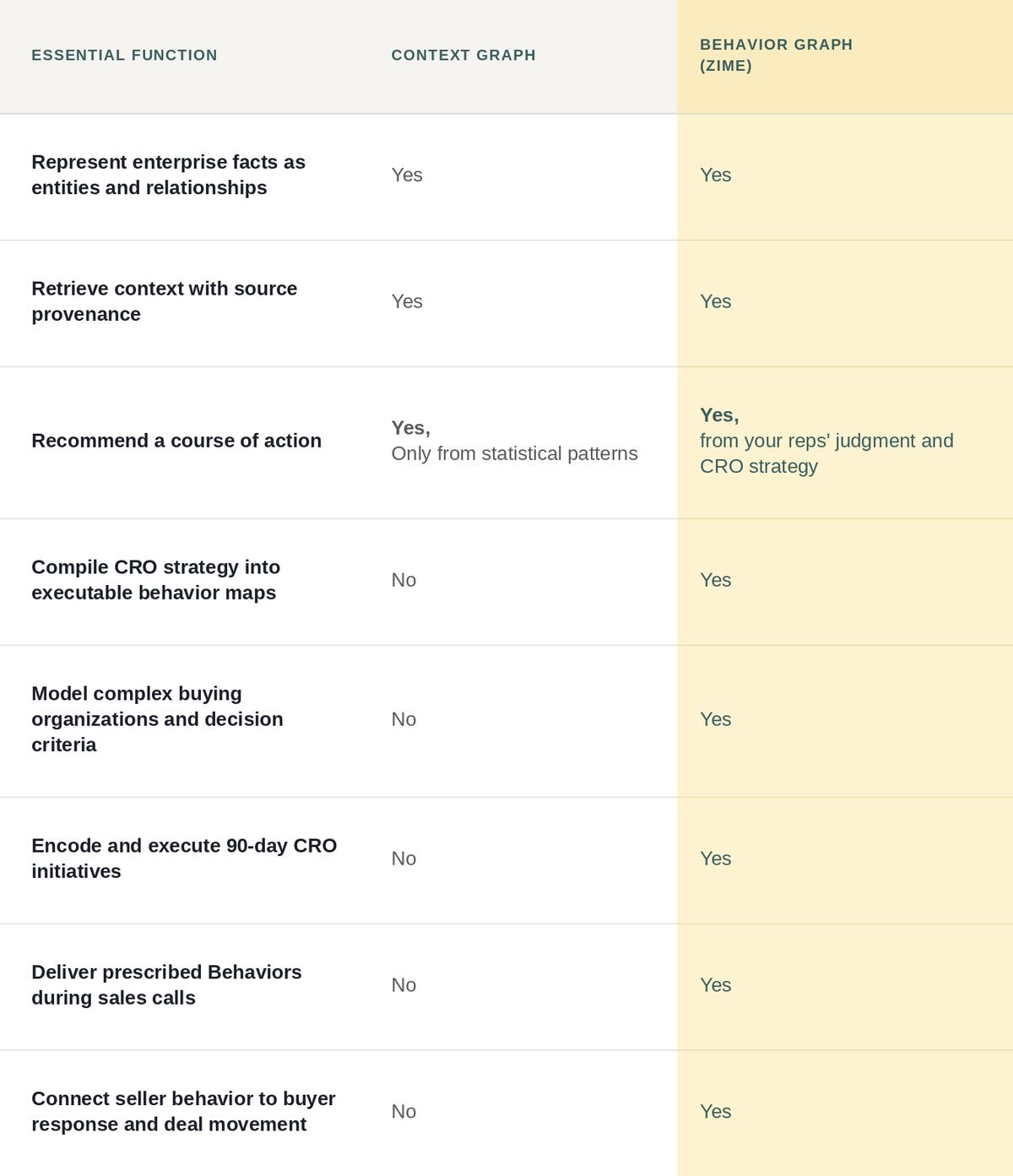
Here is a clean comparison as a capability sheet.
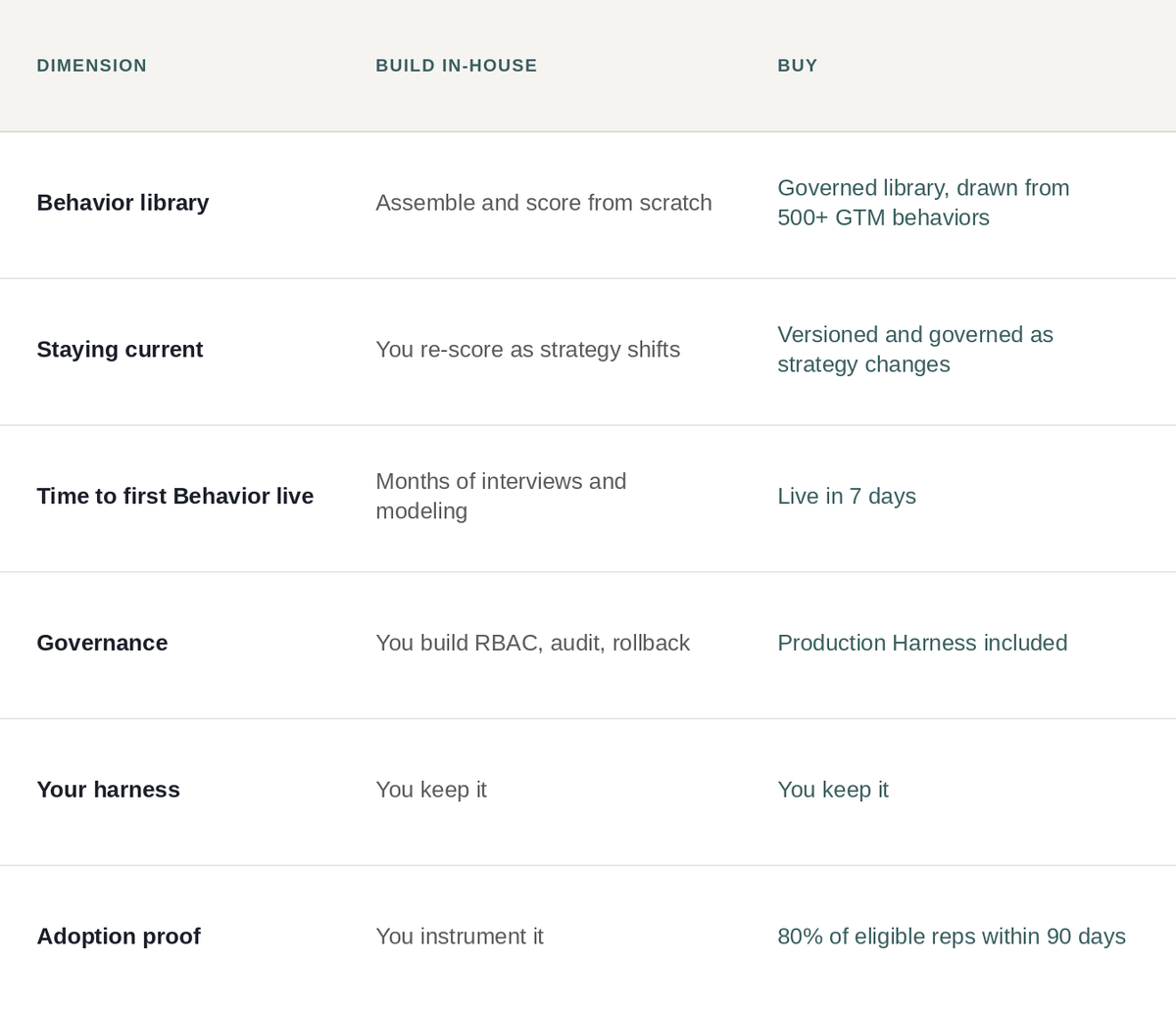
Keep the harness. That part is not in question. The skills, agents, workflow surfaces, and MCP plumbing your reps use are yours, and no vendor should touch them.
The judgment layer is the piece worth buying, for a reason that is not about difficulty. You could build it.
Start with the effort. The Signal profiled a CRO who built his own revenue operating system in Claude Code. Tim Geisenheimer at Hatch: 8 internal apps, 20 skills, a 39,000-line forecasting cockpit, sole author, 8 months after opening his first terminal. Cost so far, by his own estimate, "hundreds of hours, probably more."
The part worth studying is what he did by hand. 18 context files, 43 memory files, and a Sales Bible distilled from 409 calls of his single best rep. He did not mine that. He studied the rep and wrote it down. That is judgment elicitation, done manually, for one rep at one point in time.
Now price your version across every role, product, competitor, and motion. That is months, not weekends.
And months is where it turns on you. While you interview, score, and map, your CRO reprioritizes, a competitor launches, and the team starts selling differently. The library ships stale on day one.
So you start the refresh, and the refresh has the same problem. Every cycle begins behind the strategy it is meant to execute. That is the real cost, and it is not the hours. Your best AI people spend their quarters catching up to a strategy that already moved, instead of compounding return on one that landed.
The full in-house math is in Build vs Buy Sales AI and Three Bottlenecks in In-House Sales AI.
Also, buying the judgment layer with Zime is not adding another vendor with your context graph. Zime has its own context graph. If you have a context graph, it elevates the one you have. If you do not, you are not blocked.
Your suite is green because it graded reconstruction. If the failing step is whether a rep acts, the suite has to grade that instead.
Six dimensions are worth instrumenting. Below is how they look in a reference scenario built on a context layer, against Zime's modelled scenario and targets.
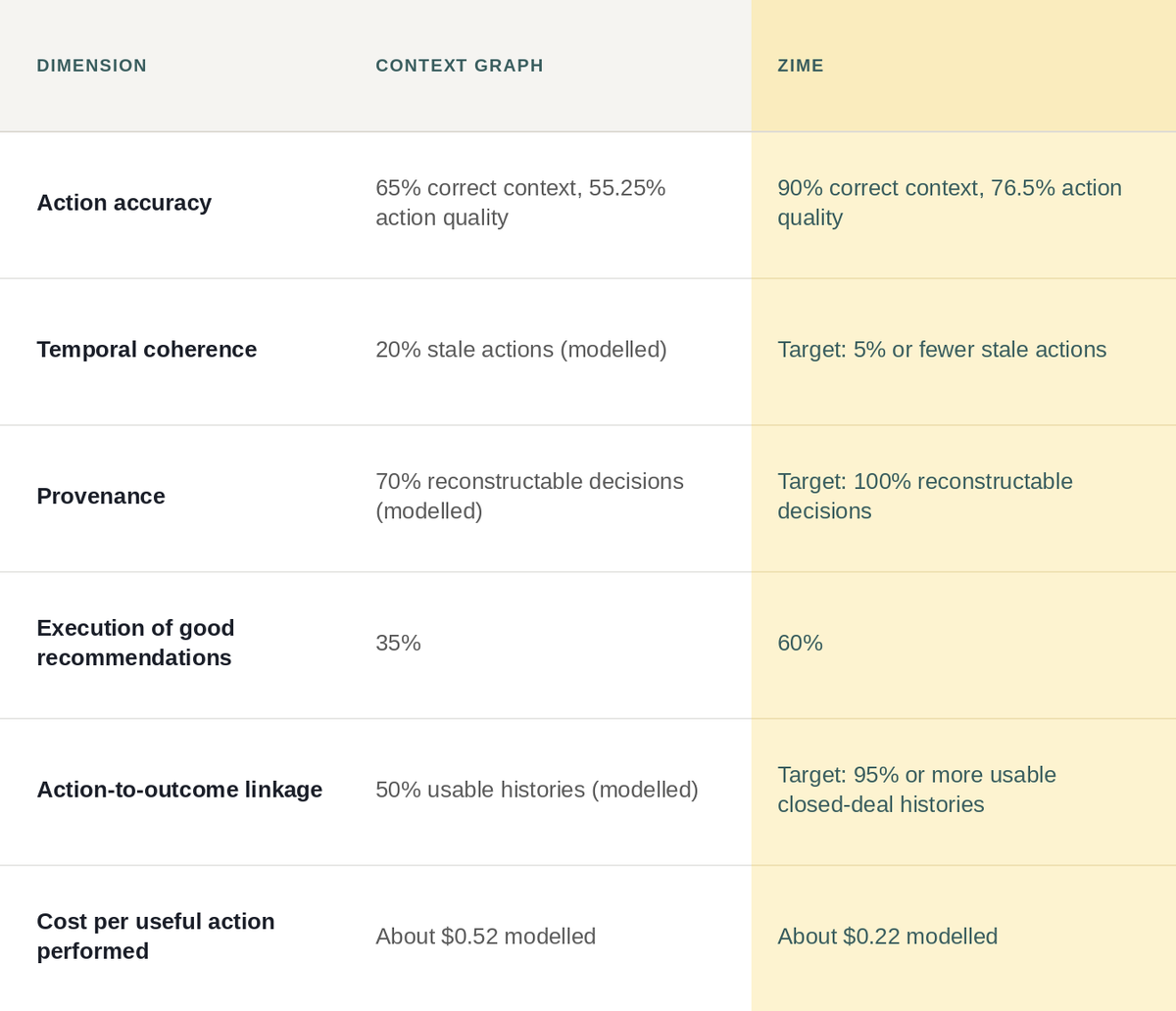
Modelled end to end, that is 2.4X as many useful actions performed and 58% lower cost per useful action
Martin Mackay, CRO at Versa Networks, described the requirement in his own words:
"I wanted Zime to understand my playbooks and coach reps. No other tool does this."
Martin Mackay, CRO, Versa Networks
Versa reported a 10% increase in win rates, an outcome HFS Research cited in its July 2026 Services-as-Software Hot Tech profile of Zime.
At Bureau, the same challenge surfaced in discovery:
"There's not enough discovery done... we're unable to establish clear impact with customers."
Ranjan R Reddy, Founder & CEO, Bureau Inc.
After the fix, average deal size rose 30%, and ARR improved 10%.
The agents you built stay yours. Zime supplies the layer underneath them: judgment elicited from your best reps, your CRO's authorized strategy, and behaviors that reach a rep with a receipt attached. Live in 7 days on your own data, which is enough to prove one Behavior before you scale it.
Want to pressure-test any claim in the root-cause section first?
Is a context graph enough for GTM, or do I need a behavior graph on top, and should I build or buy it? Not on its own. A context graph handles entities, retrieval, provenance, and win/loss patterns, and it will recommend a course of action from statistical patterns. What it cannot do is compile your CRO's strategy and best reps' judgment into executable behavior maps or prescribe a Behavior on a live call, because those need inputs that were never logged. On build versus buy: keep your harness, take the behavior graph as a dependency, because the governed library goes stale while you assemble it.
My evals are green. Why is adoption still flat? Because the evals measure reconstruction, and reconstruction is not the failing step. The rep is checking provenance, not accuracy. Guidance that reads as a statistical suggestion does not get run in front of a buyer, however well it scores.
Doesn't my context graph already tell reps what to do? Yes. Both systems recommend a course of action. The difference is upstream: one reasons from patterns in past data, the other from your reps' judgment and your CRO's authorized strategy.
I don't have a context graph yet. Do I need one before Zime? No. Zime ships Execution Context, so you are not blocked. Get a context graph either way, since that layer is necessary, and Zime elevates whichever one you end up with.
Will Zime replace the agents I already built? No. The harness stays yours. Zime supplies the judgment layer underneath so reps trust what your agents say.

