The Entity Resolution Tax: How Much Pipeline You Lose Because Your AI Doesn't Know Your Vocabulary
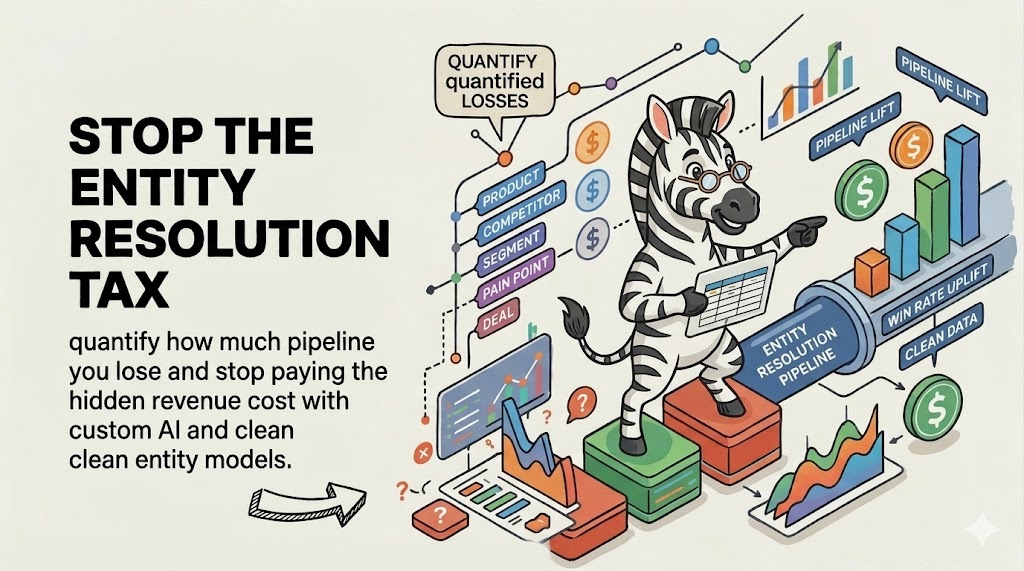

Every sales team running AI in 2026 is paying a tax it has not measured. The tax is the revenue lost every quarter because the AI cannot reliably tell your products, competitors, segments, and pain points apart from one another. For a 100-rep mid-market team selling $200,000 deals, the math comes out to roughly $2.4 million per quarter, or $9.6 million per year. For an enterprise team selling $750,000 deals, it lands closer to $5.6 million per quarter. The number scales with deal size, which means it lands hardest exactly where the AI is supposed to help the most.
This post puts the formula in your hands. Plug in five inputs and you get the dollar number your team is paying every quarter to entity errors. The math is sourced from real customer data: misclassification patterns from Versa Networks calls, deal registration uplifts from SonicWall, productivity gains from MyAdvice, and category-confusion examples from Kiddom. The formula is intentionally simple enough to paste into a board deck.
Read on, run the numbers, and decide whether the tax is worth continuing to pay.
What is the entity resolution tax, and why does every sales org pay it without knowing?
An entity, in the sales-AI sense, is any named thing your team sells around: products, competitors, pain points, objections, personas, segments, deal stages. Entity resolution is the AI's ability to identify which entity is which, consistently and correctly, every time it shows up in a call or a CRM field or a prep note.
When entity resolution works, your AI tells the rep that the deal at Atlas Health is a SASE play against Palo Alto in the mid-market healthcare segment with a CISO buyer who cares about consolidation. When it doesn't, the AI tells the rep that Atlas Health wants "secure networking" against "the firewall vendor" in "enterprise," which is technically not wrong and operationally useless.
The tax is paid in three places. Coaching that addresses the wrong objection. Prep that surfaces the wrong case study. Pipeline reviews that mis-attribute deal risk to the wrong competitor or the wrong stage. None of these failures shows up as a budget line item. All of them show up as deals that close at a lower rate than they should.
The reason the tax is invisible is that nobody runs the experiment. You cannot easily compare "the deal where the AI confused SD-WAN and SASE" against the counterfactual "the same deal where the AI got it right." So the tax compounds quietly, attributed to "AI isn't quite there yet" rather than to a measurable revenue cost. This post is an attempt to make it measurable.
The full conceptual treatment of why entity resolution is hard, and why most teams never build it correctly, lives in our earlier post Why Your AI Sales Tool Keeps Getting It Wrong. The post you are reading now is the quantification.
The formula: how to calculate your entity resolution tax in five inputs
Here is the chain the formula encodes. Of every 100 deals your team runs, AI gets at least one entity meaningfully wrong on E of them. Take E = 12: that is 12 deals where the rep walks into the call with the wrong competitor framing, the wrong case study, or the wrong objection response surfaced in their prep. ΔW measures the share of those 12 affected deals you would have won if the entity context had been clean. Take ΔW = 10: that is roughly 1.2 deals out of every 100 lost specifically to entity confusion. Multiply across your full deal volume and at your ACV and that loss converts to a dollar figure. The formula is just this chain written compactly.
The five inputs are the things every CRO already tracks. Reps and deals per quarter come from your CRM. ACV comes from your finance team. The two unknowns are E and ΔW. The next two sections explain why we anchor those at 10 to 15% and 10% respectively, and why those are conservative against what real customers have measured.
If you want the short version: multiply your reps, your deals, twelve percent, ten percent, and your ACV. That number is your quarterly tax. Multiply by four for annualized.
Why does our formula use 10-15% when academic research documents 22-94%?
The most direct measurement of generic AI error on domain-specific tasks comes from Stanford's AI Index Report 2026, which evaluated hallucination across 26 top models and found rates ranging from 22% to 94% on benchmark tasks. That is not a typo. State-of-the-art models, including the frontier names, are wrong somewhere between roughly one-quarter and nine-tenths of the time on specialized tasks, depending on the model and the task.
So why does our formula use 10-15%? Because raw model error rate is not the same as deal-consequential entity error rate. Most generic AI errors on a sales call happen on entities that do not move the deal: a missing modifier, an over-generalized industry, a mis-tagged stage. The 10-15% in our formula captures only the share of deals where an entity error is consequential enough to affect the win/loss outcome. Below that threshold, errors annoy reps but do not change pipeline. Above it, they do.
The academic literature brackets this cleanly. General-domain NER, the foundational measurement of entity recognition accuracy, has been benchmarked for over a decade. Ghaddar and Langlais (COLING 2018) established a state-of-the-art F1 score of 87.95% on OntoNotes 5.0 and 91.73% on CoNLL-2003, the two standard benchmarks. That ceiling means generic NER produces entity-level errors at 8-12% even in optimal lab conditions on entities the model was explicitly trained for. Compound that across the 5 to 10 entities present in a typical sales deal (product, competitor, segment, persona, pain point, stage), and the probability of at least one entity error per deal lands between 40% and 60%, just from the best-case ceiling.
Specialized-domain NER is significantly worse. Liu et al. (AAAI 2021), introducing the CrossNER benchmark for cross-domain entity recognition, reported that "the averaged F1-score of the best model is not yet perfect (lower than 70%)" once models are applied to specialized domains they were not trained on. That is a 30%+ entity-level error rate in real-world cross-domain conditions, which is structurally what a B2B sales motion looks like to a generic LLM.
The most directly analogous study comes from the legal domain. Dahl et al. (Stanford RegLab, 2024) measured hallucination rates in general-purpose chatbots applied to legal queries and found they hallucinated "between 58% and 82% of the time." Legal is structurally similar to technical B2B sales: dense specialized vocabulary, named entities, high stakes for accuracy, and substantial domain-specific context that does not appear in general training data. The Stanford RegLab number is the closest available published proxy for what generic AI does to a technical sales motion at the raw error level.
This pattern is consistent with the broader enterprise picture. McKinsey's State of AI in 2025 found that nearly one-third of respondents have already reported consequences stemming from AI inaccuracy. The problem is not isolated to any one vendor or category.
Our 10-15% per-deal entity error rate is therefore conservative against all of this. We use it because it represents the share of deals where the error is consequential enough to affect outcomes, not the raw rate at which models produce errors. At Versa Networks, Dogu Narin flagged a competitive reporting issue mid-deployment that captures the pattern precisely:
Cisco was showing up in a competitive analysis bucket where it had no business being. The deal data was real. The classification was wrong. For a company running SASE go-to-market against a specific named set of competitors, that misclassification is the difference between deploying a Palo Alto displacement playbook and a Cisco coexistence playbook. Same data, different conclusions, opposite actions.
The product side has the same failure mode. In the same Versa conversation, Dogu pushed back on AI output that grouped Versa's four discrete product lines under marketing language:
The failure also happens upstream of the call itself. Neil McKeown, evaluating Zime at Kiddom, watched a prep tool generate competitive analysis based on what it inferred from Kiddom's public website:
The AI made a reasonable inference from public data and named entities that were structurally wrong. Kiddom is not in LMS. Google Classroom is not their competitor. Every downstream recommendation built on those wrong entities is wrong. We will use 12% as the midpoint for the worked example, which sits well below what the research documents and well within what customer experience supports. Adjust upward if your category is more technical or your competitive landscape denser. Adjust downward if your motion is simpler.
Why is 10% the right recovery rate to assume for affected deals?
The recovery rate is the second variable CROs push back on. "Ten percent of affected deals sounds high. Are you sure?" The honest answer is that 10% is conservative against the numbers Zime customers have measured at the overall lift level.
an AVP, who runs partner sales at SonicWall, described what happened across product lines after Zime was deployed for channel partner sales:
SonicWall's 16% overall deal registration lift, and 60% on some product lines, is the across-all-deals number. Versa Networks has reported a 10% win rate lift on Unified SASE deals after deploying Zime, alongside a 20% pipeline lift and over 2 hours per week saved per rep and manager. Again, the 10% is across all SASE deals, not just the ones with entity errors.
The formula's ΔW is more specific than either published number. It measures the share of deals where AI got at least one entity meaningfully wrong (the affected subset) that you would have won if the context had been clean. Versa's overall 10% lift comes from multiple sources: better playbook adherence, sharper discovery, MEDDIC discipline, faster ramp, and entity-aware coaching among them. Entity recovery is one driver among several.
This is why 10% as the formula's default for ΔW is conservative. The product E × ΔW (12% × 10% = 1.2% of total deals lost to entity confusion specifically) lands well below the headline win rate lifts Versa and SonicWall report across all their factors. We use the conservative number deliberately, because the formula targets only the entity-driven loss, not the full set of improvements clean Sales Execution AI can deliver.
The deeper question is why entity resolution drives lift at all. Tarangita Gupta, who runs GTM transformation at Tenarai, named the mechanism cleanly:
The point Tarangita is making is that entity resolution is not just an in-call classification problem. The right competitor entity, the right segment entity, the right pain-point entity all carry external context that the rep needs but the call itself does not contain. A clean entity model is the connective tissue between what was said on the call and what the rep should do next, and that tissue is what the recovery rate actually captures. That missing external context is the subject of a companion post, The Context Gap.
Worked example: what the tax looks like for a 100-rep mid-market team
Plug the formula in.
100 reps
10 deals / rep / quarter
12% entity error rate
10% recovery rate
$200,000 ACV
The intuition behind the number is simpler than it looks. Your team runs 1,000 deals per quarter. On 120 of them (the 12% error rate), the AI is producing meaningfully wrong context. If your team would have won 10% more of those 120 deals had the context been right, that is 12 deals per quarter you are losing to entity confusion. At $200K ACV, 12 deals is $2.4M. Annualized, $9.6M.
That number sits between two things that should matter to a CRO. It is roughly the cost of one to three additional senior account executives. It is also a multiple of the typical Sales Execution AI line item. The math is rarely close, which is the point.
How the tax scales: a sensitivity table across team profiles
The biggest lever in the formula is ACV. The math scales linearly with deal size, which means the tax lands disproportionately on enterprise and strategic teams.
| Profile | Reps | Deals/qtr | Error | Recovery | ACV | Quarterly | Annual |
|---|---|---|---|---|---|---|---|
| SMB / velocity sales | 100 | 20 | 10% | 10% | $50,000 | $1.0M | $4.0M |
| Mid-market | 100 | 10 | 12% | 10% | $200,000 | $2.4M | $9.6M |
| Enterprise | 100 | 5 | 15% | 10% | $750,000 | $5.6M | $22.5M |
| Strategic / mega-deal | 50 | 3 | 15% | 10% | $2,000,000 | $4.5M | $18.0M |
Three observations from the table. The first is that ACV does most of the work. Doubling deal size doubles the tax linearly. This is why enterprise teams pay a disproportionate share of the entity resolution tax even though they have fewer reps and fewer deals.
The second is that the error rate matters more in technical categories. Enterprise SaaS, cybersecurity, networking, and infrastructure all carry dense competitive landscapes and overlapping product taxonomies, which is exactly where generic AI is most likely to misclassify. The 15% in the enterprise row is not a worst case. It is the realistic case for technical sales.
The third is that velocity teams pay less per quarter but pay continuously. The SMB profile pays $1M per quarter, which annualized is still $4M, and that tax compounds with rep count growth more aggressively than enterprise does. The mid-market row is the worked example most teams should benchmark against. The enterprise row is the one the CFO should look at twice.
What separates teams paying the tax from teams that have stopped paying it?
The honest framing is that no team is paying zero. Even the most sophisticated Sales Execution AI deployments still produce occasional misclassifications. The question is whether the error rate is structural or residual.
Structural error rate is what you get with a generic AI tool that treats your motion as the average of all motions. The error rate sits at 10 to 15% and does not improve over time, because the model is not learning your specific entities. Your reps catch the errors, ignore the tool, and the dashboards keep producing confident outputs that nobody trusts.
Residual error rate is what you get with custom Sales Execution AI deployed correctly. The error rate drops into the low single digits within the first quarter, continues to drop as the system ingests more of your specific deals and outcomes, and the remaining errors are caught and corrected by Forward Deployed Engineers as part of ongoing configuration. The tax is not eliminated. It is reduced to the residue your team can absorb.
Chad Erickson, evaluating Zime at MyAdvice, described the immediate operational change when the entity context starts working:
Twenty minutes a call is not directly an entity resolution outcome, but it is the downstream signal that the system is producing context the rep can use without manual correction. When reps trust the system enough to skip the verification step, the system is producing entities clean enough to act on. That is what "stopping paying the tax" looks like in the daily workflow.
The path to that state is custom playbook codification, top-performer pattern extraction, workflow embedding, and ongoing configuration. None of those are model-level work. All of them are the systems work that sits around the model and that no API call can replace. Versa Networks, SonicWall, Tenarai, and Bureau have all walked this path on different motions in different categories. The common thread across all of them is that the entity model gets specific, and the tax falls.
Sources and methodology
The error rate range used in this post (10 to 15% per-deal entity error) is conservative against the published academic and analyst literature on AI accuracy in specialized domains.
- Stanford HAI, AI Index Report 2026. Documents hallucination rates ranging from 22% to 94% across 26 leading models on benchmark tasks.
- Dahl, M. et al. (Stanford RegLab, 2024). Large Legal Fictions. Documents 58 to 82% hallucination rates in general-purpose chatbots applied to legal queries.
- Liu, Z. et al. (AAAI 2021). CrossNER. Documents averaged F1 below 70% (a 30%+ entity-level error rate) when models are applied to specialized domains they were not trained on.
- Ghaddar, A. and Langlais, P. (COLING 2018). Establishes state-of-the-art F1 scores of 87.95% on OntoNotes 5.0 and 91.73% on CoNLL-2003.
- McKinsey & Company, The State of AI in 2025. Documents that nearly one-third of respondents have already reported consequences from AI inaccuracy.
Customer evidence and Zime-specific data points are drawn from Zime customer call transcripts over the last 12 months for Versa Networks, SonicWall, Tenarai, Kiddom, and MyAdvice. Named attribution used with customer permission.
The takeaway
The entity resolution tax is the single largest unmeasured cost in most sales-AI deployments. The math is straightforward enough to fit in five inputs. The data is real enough to anchor to customer numbers. The number is large enough to matter at the board level for any team running enterprise motion.
The tax is not the AI's fault. It is the result of a missing entity layer that no off-the-shelf model can provide on its own — the layer Zime builds and maintains as your Context Graph. Closing that gap is what custom Sales Execution AI does, and it is why teams that have walked the path do not go back. A knowledge graph on its own is not enough to close it, a distinction we unpack in Why Knowledge Graphs Aren't Enough for Enterprise AI ROI.
Run the numbers. The formula is yours.
Want us to model it for your team?
Book a 30-minute session. We will calibrate the formula against your actual data, show you which lever is doing the most damage in your specific motion, and build your first playbook free.