Your skill.md Is Killing Your GTM AI: Why AI Tools Fail in Sales Teams

At SonicWall, the reps recording the most calls close 3x more deals than the rest. That number comes from Austin Fanning, VP Sales at SonicWall, on an internal review on November 18, 2025, referencing SonicWall's live deployment across their North America sales team. It is a customer-cited number from an active enterprise account, not a benchmark. And the gap it names is not about the recording tool. It is about which reps have a live behavioral rubric coaching them before every call, and which reps are working from a skill.md file someone wrote six months ago and never touched again.
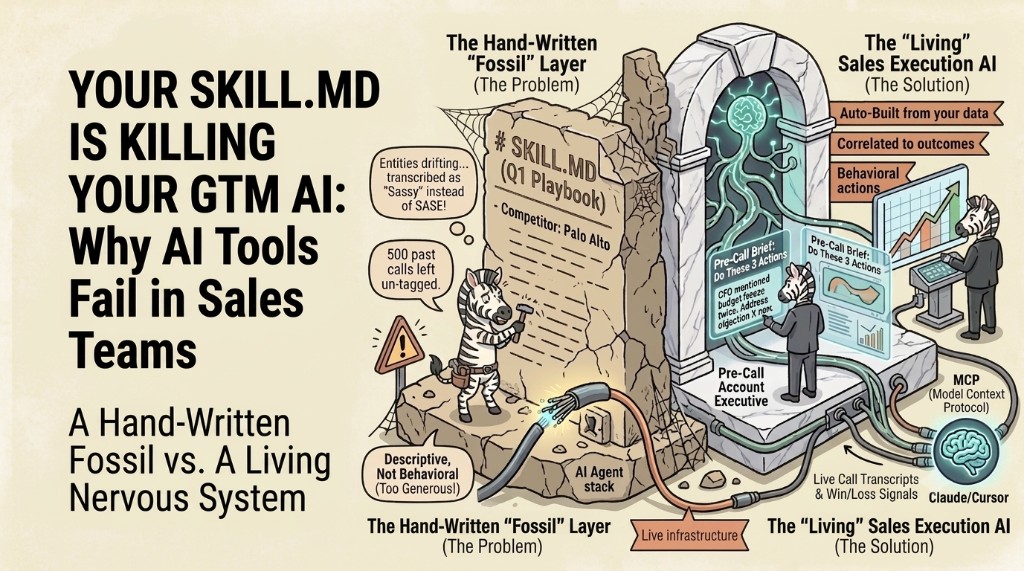
A skill.md is a markdown context file that lets AI agents query your GTM playbook, and it has become the default primitive for AI-forward sales teams building custom coaching, prep, and CRM workflows. Hand-written skill.md files rot within a quarter, because they cannot update themselves as buyer entities, competitor names, and winning behaviors shift. A living skill.md is the alternative: a markdown context layer that auto-generates from your call data, updates continuously with your win/loss signals, tells reps what to do rather than describing what good looks like, and is queryable by any agent in your stack via MCP.
Sai, Forward Deployed Engineer and Dev Rel at TrueFoundry, described the DIY version in his own words on a June 2026 call:
That is the archetype. A GitHub repo of markdown files per department, plugins on top, MCP servers wiring them into Claude and Codex. It feels productive. It is productive, for about a quarter. Later on the same call, he named the maintenance tax directly: "I have to still keep it updated all the time... I still have to manually do it."
The problem is not the file. The problem is that the file, written the way most teams are writing it today, is a fossil the day it is committed.
What is a skill.md, and why is every AI-forward GTM team building one?
A skill.md is a markdown file that encodes a team's expertise in a form AI agents can query. Claude Code exposes it as SKILL.md. Cursor uses rules files. Every serious agentic system now expects domain knowledge to live in markdown that any model or agent can reference. This is not a trend. It is the default primitive for how expert context gets exposed to AI.
Applying the pattern to GTM is inevitable. Reps are already firing questions into Claude, ChatGPT, and internal agents before every call. Those agents need context. That context needs to live somewhere queryable, versioned, and cheap to update.
Austin Fanning, VP Sales at SonicWall, described the same pattern from the customer side on a June 2026 call:
A Claude prep agent stitched together with a markdown file of playbooks, product notes, and battle cards. The same architecture Sai runs at TrueFoundry, now inside a mid-market cybersecurity company with real deals moving through it. The instinct is right. The maintenance model underneath it is what breaks.
Why do hand-written skill.md files fail in sales teams within a quarter?
Hand-written skill.md files fail for four structural reasons: entities drift and nothing tells you, updates never re-tag the past, one file collapses multiple call types into one rubric, and descriptive rules do not drive live rep behavior. Each one is boring in isolation. Together they explain why AI tools fail in sales teams once the honeymoon quarter ends.
Sai named the trap directly on the same June 2026 call, describing his own DIY setup: "I have to still keep it updated all the time... this worked, this did not work, I still have to manually do it, or maybe keep this thing updated, and run a cron job... update karte, dump in the context..." That is what every one of the four failure modes sounds like from inside the maintenance loop. An operator who built the system, and is now the human patch layer keeping it from drifting.
When is a hand-written skill.md actually enough?
Not every team has this problem. A hand-maintained skill.md remains sufficient in three cases.
The four failure modes above are structural for teams past these boundaries. Multi-product, multi-motion, multi-persona, or past fifty reps. That is where a hand-written file cannot compound fast enough to stay accurate, and the DIY approach becomes a source of confidently wrong AI output rather than helpful context.
How do Hyperspell, Glean, Gong, Mindtickle, and Zime compare as sales AI context layers?
Once the problem is framed as "living skill.md," the vendor landscape gets clearer than any analyst quadrant. Same architectural instinct across all five. Five different products. Only one is a skill.md that actually drives winning behavior in the live deal.
| Dimension | Hyperspell | Glean | Gong | Mindtickle | Zime |
|---|---|---|---|---|---|
| Category | Horizontal context graph | Enterprise search | Conversation intelligence | Sales enablement | Sales Execution AI |
| How context is built | Ingest connectors, generic graph | Index existing docs | Record and transcribe calls | Written by content teams | Auto-built from your calls, deals, and outcomes |
| How it updates | On data refresh | On new file indexed | On new calls | Manual authoring | Continuously, tied to win/loss signals |
| Correlated to win/loss | No | No | Partial, patterns across 5,000 companies | Partial via Journey scoring | Yes, tied to your own deal history |
| Behavioral vs descriptive | Descriptive | Descriptive | Descriptive | Descriptive | Behavioral, criterion-referenced per call |
| Live query surface (MCP) | Yes | Yes | Its own UI | Its own UI | Yes, headless via MCP |
Austin Fanning at SonicWall named the distinction on a June 2026 call, comparing Zime against the sales enablement anchor:
We have written the deeper mechanics of why generic AI mis-classifies competitors and products in Why Your AI Sales Tool Keeps Getting It Wrong, and the financial cost of a stale ontology in The Entity Resolution Tax.
See how Sales Execution AI keeps your context alive.
We'll pull your last 50 deals and build your first living playbook free. Book a 30-minute session with the Zime team.
What does a living skill.md actually look like inside Sales Execution AI?
A living skill.md has four properties. Each one has a customer proof point behind it.
It auto-generates from your call data instead of being authored by hand in a workshop.
It updates continuously with your win/loss signals rather than on a manual review cadence.
It tells reps what to do on this specific call, not what good looks like in general.
It is queryable by any agent in your stack via MCP, so it is infrastructure, not a doc.
1. Auto-built from your calls, not authored by hand.
Versa Networks did not write their playbook in a workshop. Zime pulled the last 50 deals at one stage, tagged customer responses by intensity and use-case category, and correlated with outcomes. The behaviors that came out of that analysis are what the skill layer scores against now. No one guessed. The data pointed. Austin Fanning, at SonicWall, made the design choice explicit on a June 2026 call: "if you're looking at playbook adoption or playbook creation, use Zime for that. Go to the native Zime tools."
2. Correlated to outcomes, not observations.
Martin Mackay, CRO at Versa Networks, asked the question this whole thesis is built on directly on a June 2026 call:
That is the CRO's actual job. Not "did the rep follow the process," but "does following this specific process actually cause the deal to move." A living skill.md answers that question with your data, refreshed as the answer changes. Static skill.md files never ask it.
3. Behavioral, not descriptive.
The rubric does not say "handle objections well." It tells the rep, in the pre-call brief, exactly which objection to address on this specific call given what happened on the previous ones. Chad Erickson at MyAdvice quantified the productivity impact of that shift on a January 2026 call: "we've saved our reps at least 20 minutes... this is an additional 30 minutes of time savings." A description helps a human write a coaching plan. An action changes what happens on the call.
4. Live infrastructure, queryable by any agent via MCP.
The moment your skill layer is queryable by Claude, Cursor, Gong Enable, or the rep's own AI assistant, it stops being a doc and becomes infrastructure. Mickey Singh at Versa Networks named the architectural bet on an April 2026 call:
A skill.md that cannot be queried by any agent your team runs is a Google Doc with better syntax. This is what MCP for GTM leaders actually unlocks: a company-owned context surface that every agent in your stack calls into.
What does this mean for a CRO trying to make strategy stick to rep behavior?
Every CRO has a strategy. Almost none can get their reps to execute it consistently. The gap is not a training problem. It is a context problem. The CRO's marching orders live in their head, and no tool has ever seen them.
Martin Mackay, CRO at Versa Networks, said it directly on a June 26, 2026 call:
This is a CRO of a public-reference security company calling the playbook problem his single biggest professional failure of the last half-decade. Not because he is a bad CRO. Because there was no tool that could turn a quarterly strategy into consistent rep behavior on live deals.
A living skill.md closes that gap. Zime is an AI-native sales enablement platform that helps enterprise sales teams execute winning behaviors in live deals, not just in training. Sales Execution AI identifies the behaviors most correlated with deal advancement from your last 50 deals, encodes them into the pre-call brief, and scores every subsequent call against them. Strategy becomes consistent rep behavior becomes measurable win rate.
How do you know if your skill.md is aging or learning?
Five diagnostic questions to run on the files sitting in your GTM repo right now. Toggle each one that is true for your setup.
If four out of five answers embarrass you, that is normal. It is the state we see in every AI-forward GTM team that has done the work to get this far. If your skill.md was written by a person and the last 500 calls have not been re-tagged since it was last updated, it is aging, not learning.
Sai articulated the reader's own thought process out loud near the end of a candid evaluation of the DIY approach: "My only criteria is quality... Can I just write a skill and solve this instead of using a new product?" That is the question every AI-forward operator asks. It is the right question. The answer for teams past fifty reps, multi-motion, or multi-product is that you cannot, because the failure modes above are structural. For teams inside those boundaries, you can, and you probably should.
Related concepts
The skill.md instinct is right. The market will validate it. Every enterprise GTM org will have a version of this within eighteen months, whether they know it by that name or not. The question is not whether you need one. You already know you do. The question is whether yours is a document that ages, or a nervous system that learns.
Turn your skill.md into a nervous system that learns
A living skill.md auto-generates from your calls, updates with your win/loss signals, tells reps what to do on this specific call, and is queryable by any agent in your stack via MCP. That is the Sales Execution AI category.
Book a 30-minute session. We'll pull your last 50 deals and build your first playbook free.