What does a sales agent built on Claude and Gong transcripts cost at production scale?
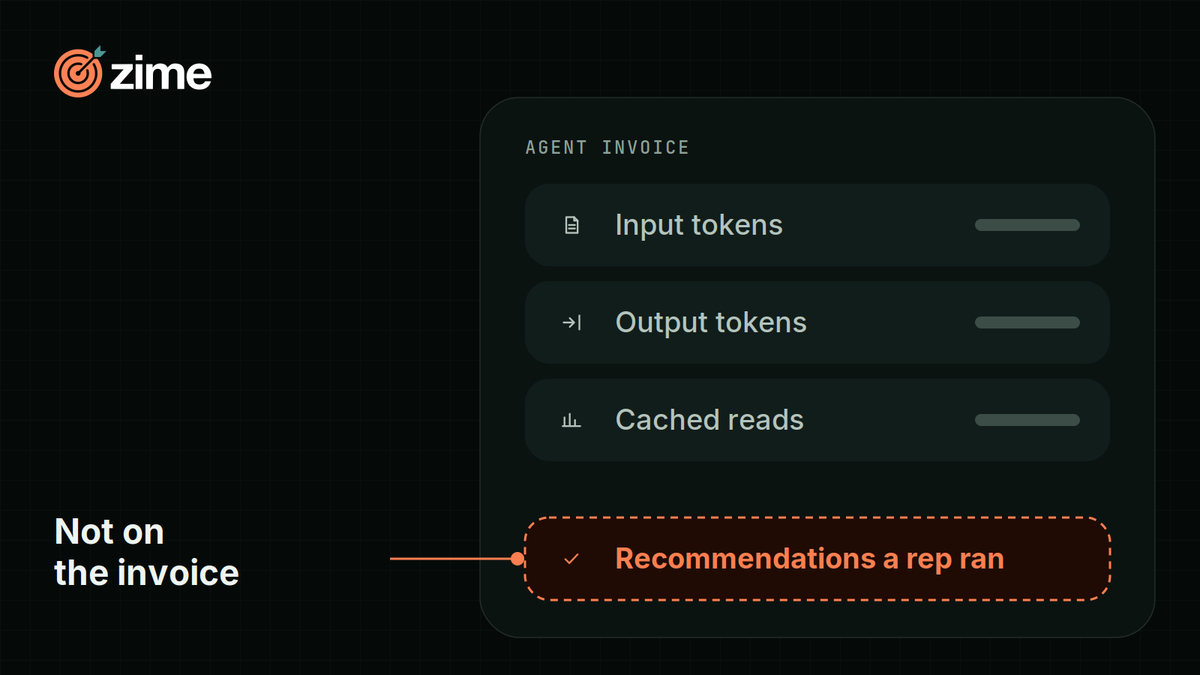

- You built a sales agent on Claude and Gong transcripts, and its model bill is small. Claude's rates are public: about $20,000 a year at 200 reps, near $30,000 with upkeep. Pricing a call takes ten minutes.
- But that bill divides by the wrong number. It counts transcripts read. The hard part of this work is getting reps to run what the agent recommends. So the number you need is the cost per recommendation a rep actually runs.
- And more tokens will not move that number. A longer prompt or a bigger model raises the bill. The rep decides after the answer is written. That choice rests on how your best reps decide and what your CRO decided this quarter. Neither is in a transcript.
- Reps run what their best peers would do. A behavior graph is where that lives. It holds how your best reps decide, what your CRO decided this quarter and what your past deals show. Your best people teach it, including what never shows up in a transcript. Collecting it is interview work, and it moves every quarter.
- So keep your build, and count the moves reps run. Zime runs on Claude, so nothing you built gets thrown out. Count each move a rep ran, tied to the strategy behind it and the deal it touched. That count is how you know the guidance ran. Ask any vendor, us included, what a recommendation reps run costs at your volume.
You are an AI engineer, and your finance partner has just posted in the planning thread. "What does the sales agent cost at 200 reps?" You open the invoice. It takes a minute to answer.
Your agent reads Gong transcripts, calls Claude, and posts a prep note before every call. You wired it over MCP.
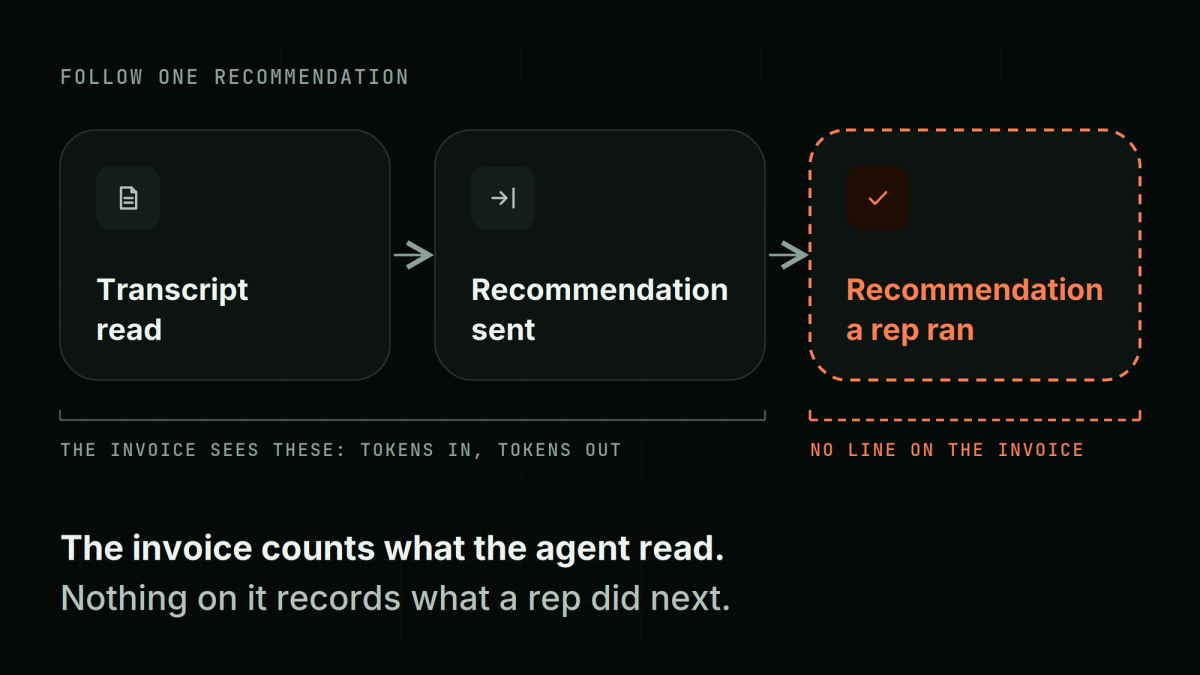
The invoice shows input tokens, output tokens and cached reads. No line shows what reps did with the notes.
That is good work, and the number is easy. The build is not what the thread is asking about.
Then your CRO replies. "What do we get for it?" Reps ask you things in DMs too. "Why this move for this deal?" You have a bill and no answer. So what does one recommendation cost when a rep actually runs it?
Price the call, then the fleet
Here is the arithmetic, assumptions in the open. Say 200 reps, ten recorded calls per rep per week, and a transcript of about 9,000 tokens.
Add 3,000 tokens of instructions and 800 of output per call. Use Claude Sonnet 5.5's list rates: $2 per million input tokens and $10 per million output tokens, as of October 2026.
Now add rep questions. Say five a day per rep, each loading 30,000 tokens of deal context and returning 600. This is illustrative arithmetic, not a measured result. At list rates, the model bill for 200 reps lands near twenty thousand dollars a year.
- Call analysis. 8,660 calls a month at about three cents each, about $277 a month.
- Rep questions. 21,000 questions a month at about seven cents each, about $1,386 a month.
- Total. About $1,663 a month, about $20,000 a year, before caching and batch discounts.
Test one: price a real call.
Count the tokens in a transcript your agent read, multiply by the rate card, and compare with that call's invoice line. Pass: you land within a few percent. Fail: the invoice runs well above your arithmetic, so something resends context or retries.
The invoice counts what the agent read. Nothing on it records what a rep did next.
Takeaway: the model bill is real, small and easy to check.
What the invoice leaves out
Two lines are missing from that ledger. The first is the upkeep.
Week three. Your CRO changes the pricing motion for a new AI add-on. The guidance is now wrong in seven skills. You edit seven files.
Every cached prefix that held the old text misses and is written again. Your evals re-run across all twelve skills.
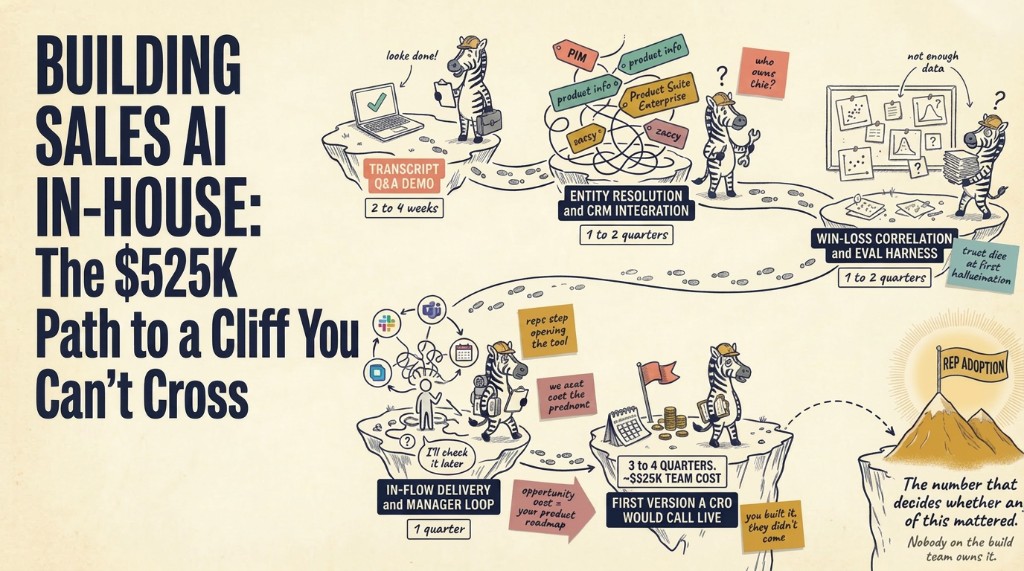
Say 24 engineer hours per change, four strategy changes a year and $100 an hour loaded. Four is one every three months, the fast end of the three-to-six-month range in our build-or-buy post. That is 24 × 4 × $100, or $9,600 a year. All illustrative; swap in your own.
Add that to the model bill and the year runs near $30,000.
One CRO who built his revenue stack in Claude Code shows the shape. Eight months in, the know-how is still written by hand: a Sales Bible from 409 calls of one rep.
No customer or analyst has published a measured year-one dollar total for this build, and Zime has not either. The upkeep above is one term, not a build total.
The second line is the pipe that feeds the agent. Gong's help page says the API is available to all customers, with limits of 3 calls a second and 10,000 calls a day.
Steady state is easy: about 290 requests a day, at one per call. History is harder. A 150,000-call backlog takes fifteen days at that cap.
Test two: check your backlog. Divide your call history by 10,000. Pass: under a week. Fail: longer, so plan the backfill.
Peter Kim, Head of GTM at WestBridge Capital Management, watches CROs drop call recordings into Claude and start asking questions.
"...inadvertently, you've become a builder. That's a dangerous place to be, because you're going to spend a ton of ops cycle time on that."
Peter Kim, Head of GTM, WestBridge Capital Management
Ops cycle time is the line no invoice carries. Neither says what the spend produced.
Takeaway: upkeep and the transcript pipe never show on the model bill. So what should you divide by?
Divide by what reps ran
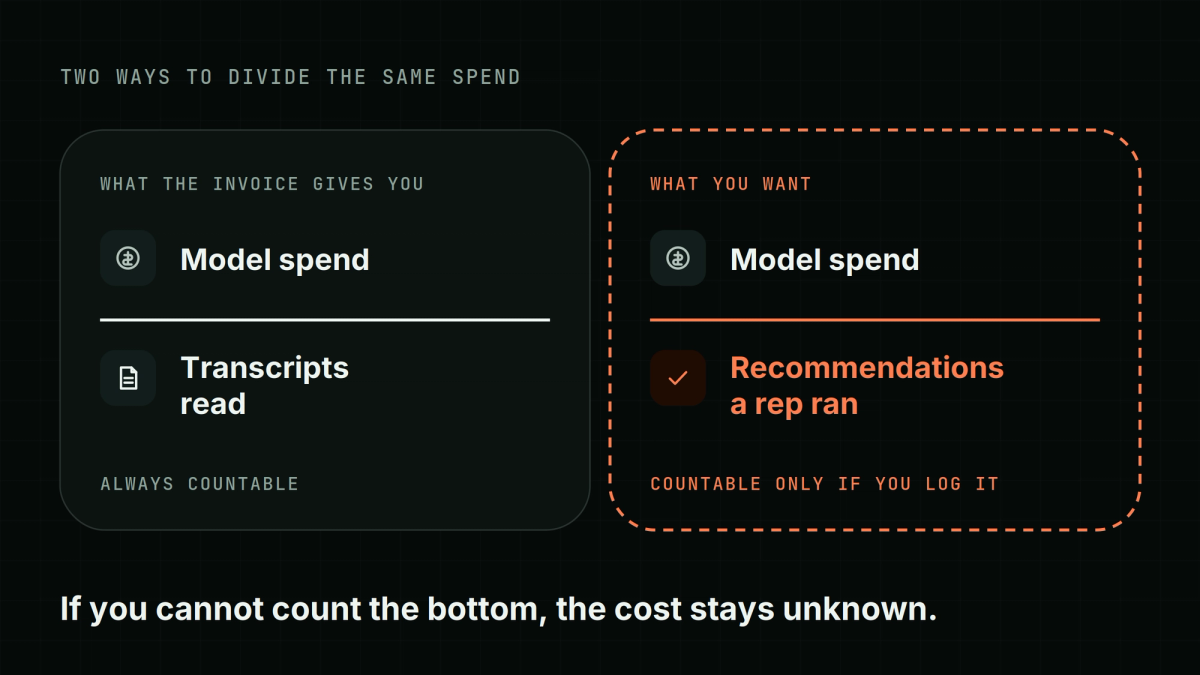
Cost per acted recommendation = (generation + maintenance) ÷ recommendations reps run.
200 reps asking five questions a day is 21,000 recommendations a month. Generation is about $1,663 a month, with call analysis included as overhead on those 21,000. That is about 8 cents per recommendation sent.
If reps run one in three, each recommendation run costs about 24 cents: three times the invoice. Add $800 a month of upkeep ($9,600 ÷ 12) and it is about 35 cents. At two in three, the same all-in spend is about 18 cents.
If your logs cannot say which ones a rep acted on, the cost is unknown. The bill's size does not change that.
Test three: try the division. Divide last month's spend by the recommendations reps acted on. Pass: you can pull that count from your logs. Fail: you cannot, and the number that matters stays hidden.
Chitresh Yadav runs sales engineering at Versa Networks, with more than 100 SEs across four regions. He already ran AI in Claude for follow-ups and prep notes. His in-house agents gave him visibility without adoption.
"This is the dashboard I typically see, and it is drowning me. When I go to my org level, I'm drowning because it shows everything."
Chitresh Yadav, VP and Global Head of Sales Engineering, Versa Networks
A dashboard that shows everything is a bill by another name. It shows what ran in the system. Versa then counted moves on live deals, and 79% of its SEs were running the right technical discovery within three months, up from 20%. Brent Bair, a Regional Sales Leader there, sees it from his team's side.
"As I look at my team, the adoption rate has improved. I think it's become ingrained in our sales DNA now that this is incredibly valuable as we're progressing through deals."
Brent Bair, Regional Sales Leader, Versa Networks
That is a denominator, counted. Versa's 10% rise in win rates also appears in HFS Research's July 2026 profile of Zime.
A rep runs a move that looks like what the company's best reps would do, with a winning deal behind it. Zime calls that a Behavior. The model that produces it is a behavior graph. It holds your best reps' decisions, your CRO's current strategy and your past deals.
It is elicited from your best reps through FDE-run interviews and RLHF, including what never shows up in a transcript. FDE-run interviews are Zime's forward-deployed engineers interviewing your best reps. RLHF is scoring and correcting each move until your best reps would run it.
Yes, a context graph recommends too. The difference is upstream.
If you have one, keep it. If you are adding one, add it.
Zime counts Behaviors run, tied to the strategy that authorized them and the deals they moved. We publish no price here and will not call it cheap.
Takeaway: divide by the recommendations reps run, and the cost has a denominator.
The same question, a quarter later
A quarter later, your finance partner asks the same question. You answer with two numbers: the model bill, and what each move a rep ran cost.
Your CRO sees which moves ran, under which strategy, on which deals.
MyAdvice sells digital marketing and practice management to law firms and healthcare practices. At MyAdvice, checklist adoption rose from 66% to 87%. Separately, fatal objections fell from 38% to 4%.
Chad Erickson, its VP of Sales & Strategy, explains why volume matters.
"When the volume increases, we see Zime as a critical part of the equation to allow them to be more efficient."
Chad Erickson, VP of Sales & Strategy, MyAdvice
Volume is the production-scale question. The MyAdvice figures above measure what reps did, not what the system sent. What changed is the bottom of the division.
Takeaway: the same spend reads differently once you can count what ran.
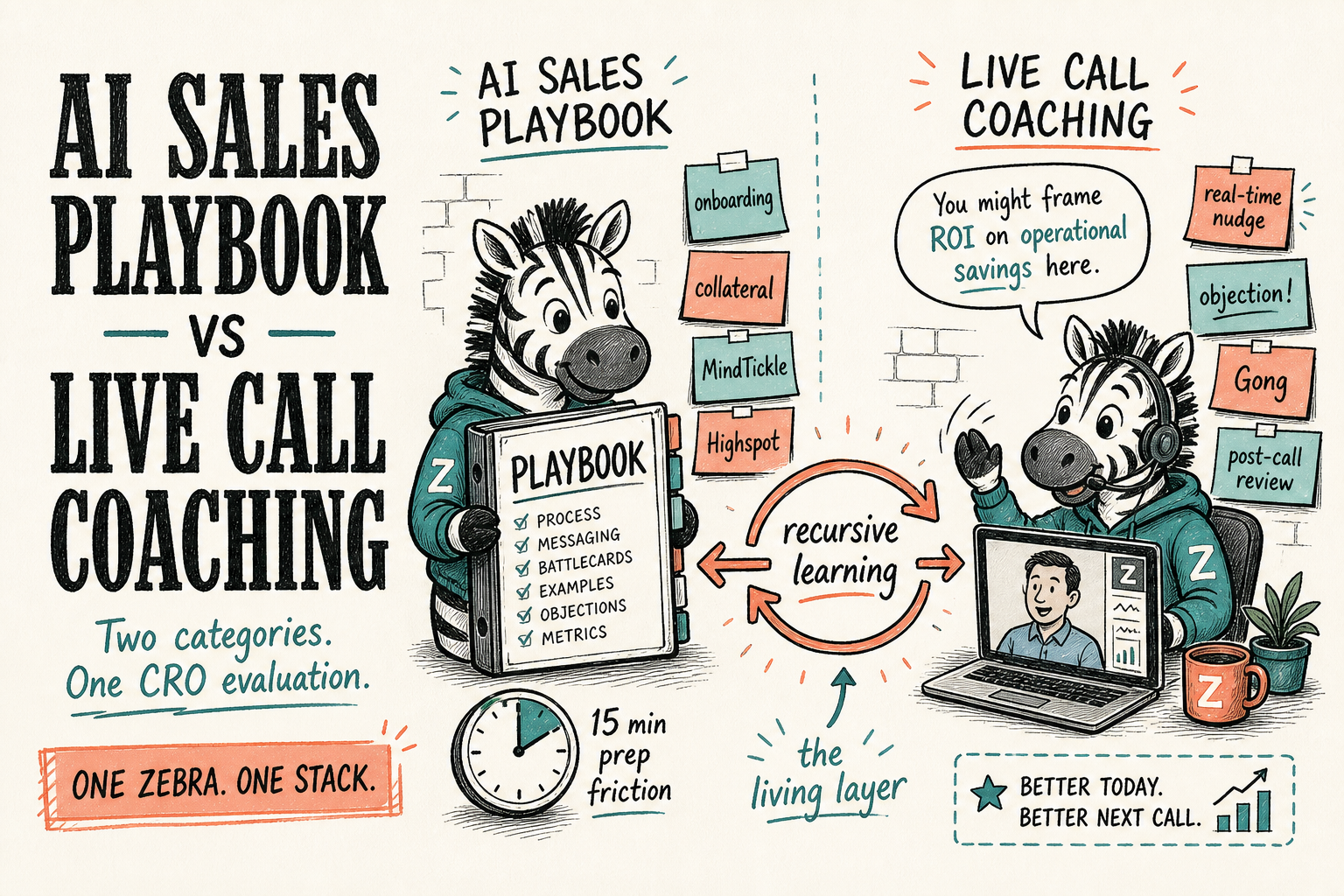
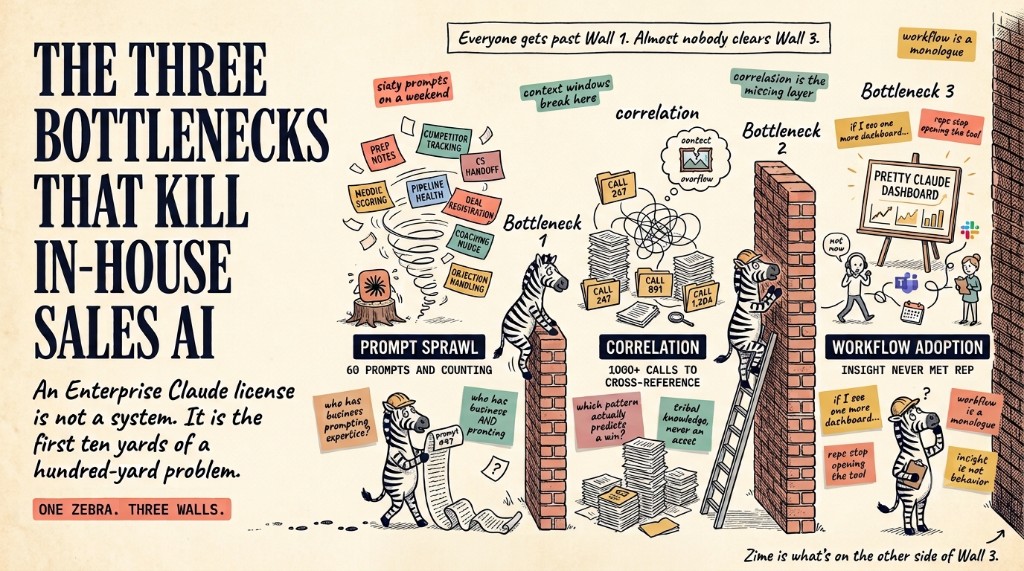
Related: our build-or-buy post, Three Bottlenecks in In-House Sales AI, Build vs Buy Sales AI, Your skill.md Is Killing Your GTM AI.
Keep your build. Count what runs. The agents and workflows you built stay yours. Zime adds the moves your best reps would run, each with the winning deal behind it, and counts which ones reps ran. Live in 7 days on your own data, enough to prove one Behavior before you scale it. Want to run the division on your own deals first?
FAQ
What does a sales agent built on Claude and Gong transcripts cost at production scale? On illustrative assumptions of 200 reps, ten recorded calls per rep per week and five rep questions a day, the model bill at Claude Sonnet 5.5 list rates is near $20,000 a year. Maintenance of the guidance is a second cost on top of this, estimated in the post at about $9,600 a year, which puts the year near $30,000. Gong's API cap sits outside that figure, and no measured year-one build total is published. What decides the cost is the price per recommendation a rep actually runs. Zime counts that as moves reps ran, tied to the strategy that authorized them.
Why not use the call summaries my conversation intelligence tool already gives me? Use them. Conversation intelligence analyzes calls well, and Zime does that too. Both kinds of tool recommend. The difference is upstream: one reasons from past calls, the other from how your best reps decide and what your CRO decided this quarter.
Do I have to replace the agent I built on Claude? No. Your harness, agents and Claude build stay. Zime runs on Claude and connects to your agents over MCP.
How do I know a rep ran the recommendation? Count moves, not logins. Zime's measure is Behaviors run: the specific move for a deal, tied to the strategy that authorized it and the deals it moved.
What does Zime cost at my volume? This post gives no Zime price and will not call it cheap. Ask every vendor, Zime included, what one recommendation a rep ran costs at your volume, and how it counts that it ran.