Why Founder-Built Claude Sales Playbooks Stop Working at 10 Reps
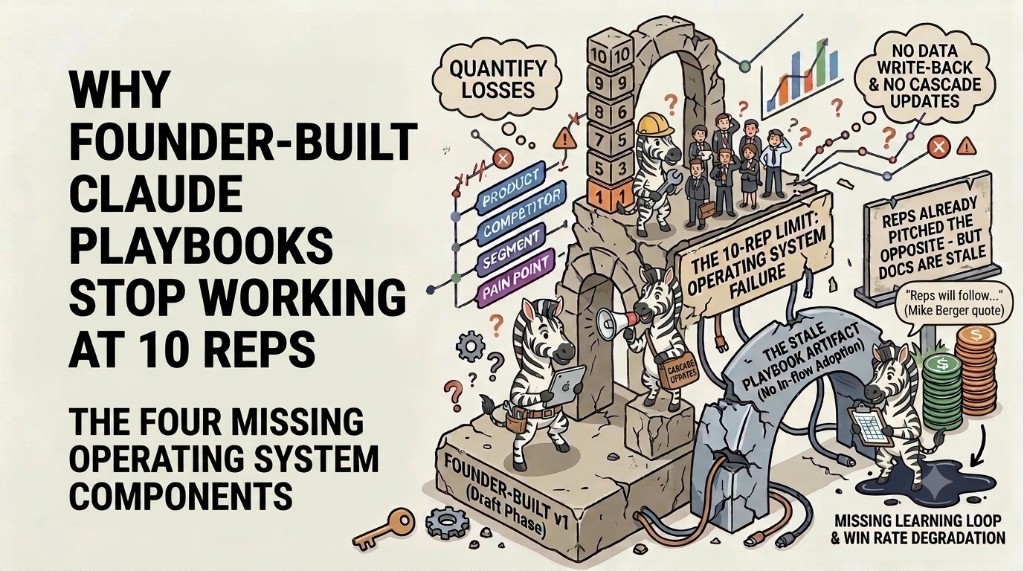

A Claude-built sales playbook works as a 30-minute first draft and fails as an operating system. Founder-built Claude playbooks break because they have no data write-back from real calls, no mechanism to cascade updates to reps, no in-flow adoption layer, and no learning loop tying rep behaviors to win-loss outcomes. The Claude part is brilliant. The system around it is missing.
If you are a founder reading this, somebody on your team has already pitched you the opposite. Maybe it was you. The pitch usually sounds like: "I'll spend a Sunday with Claude, dump my brain into a Project, and we'll have a real playbook by Monday." The first version is impressive. Six weeks later the doc is stale, the reps are not opening it, and the founder is back to doing pipeline reviews on every deal personally. This post is about why that pattern is so consistent, what specifically breaks, and what an actual operating-system-grade playbook needs to do.
It is written for three readers at once. The early-stage founder who has not tried this yet. The VC platform operator or fractional advisor who is currently building Claude playbooks for portfolio companies. And the head of sales at a 30 to 100 rep company who tried it earlier in the journey, hit a wall, and is wondering what to do differently this time. We will start with why the pattern is so universal, walk through the four failure modes, and finish at what a playbook actually has to be to survive contact with a real sales floor.
What is a sales playbook as an operating system?
A sales playbook is not a document. It is the operating system your reps use to run deals, and an operating system has to do five things continuously: (1) ingest fresh evidence from every call, (2) keep entity precision current as competitors, products, and personas shift, (3) cascade updates to reps in the channels they already use, (4) deliver guidance in the flow of work before, during, and after calls, and (5) close the loop by scoring whether the behavior happened and correlating it to outcomes. A Claude-built v1 does one of those five things. The other four are where the system breaks.
Ingest fresh evidence from every call, continuously, not from a one-time snapshot.
Keep entity precision current as competitors, products, and personas shift.
Cascade updates to reps in the channels they already use.
Deliver guidance in the flow of work, before, during, and after calls.
Close the loop by scoring whether the behavior happened and correlating it to outcomes.
Why does every early-stage founder try to build their sales playbook in Claude first?
The founder-built Claude playbook is the most rational first move in early-stage sales scaling, which is exactly why it gets attempted so often.
The founder has the brain. They have closed the early deals personally. They know which objection on which persona usually opens the door, which competitor displacement story moves which buyer, which vertical decodes "we are evaluating" as a real signal versus a polite no. That knowledge is locked in the founder's head, distributed across Slack threads with the first AE, and scattered in twenty channels they have not opened in months. Claude is, genuinely, the best tool ever invented for getting that knowledge out of the founder's head and into a document.
So the founder does it. They open a Project, paste in their pitch deck, drop in five call transcripts, write a couple thousand words of context, and ask Claude to produce a playbook. Claude produces a playbook. It is structurally complete, well-organized, covers the personas, names the competitors, lays out a discovery framework. The founder is impressed. They share it with their first three AEs.
This is also what happens at the VC platform level. Anisha Gupta, who works on the platform team at First Round Capital and supports founders across the portfolio, described the same pattern from the operator side on a June 2026 call:
She is not a hobbyist. She is methodical, technically capable, and working with founders every day on the exact gap between founder-led sales and a real sales motion. The Claude-built playbook is the first thing she reaches for. It is the first thing they all reach for.
That is the trap. The trap is not that Claude produces a bad playbook. Claude produces a good playbook. The trap is the implicit assumption that a playbook is a document.
A playbook is not a document. A playbook is the operating system reps use to run deals, and an operating system has to be doing five things continuously: ingesting fresh evidence, updating itself, distributing changes to the people who need them, getting consumed in the flow of work, and learning from outcomes. A Claude-built v1 does one of those five things. It produces a first version. The other four are where the system breaks.
What actually breaks in a founder-built Claude sales playbook?
There are four failure modes. They are not opinions. They are mechanical. Every founder who tries this hits them in roughly the same order.
These four failures stack. Each one makes the next one worse. Stale evidence produces a stale playbook, the stale playbook does not cascade, the un-cascaded playbook does not get adopted, the un-adopted playbook produces no signal back, and now the founder is the system again. Pipeline review on every deal. Cadence breaks. The founder burns out on it. The playbook becomes an artifact of the era when they tried.
Why won't your reps adopt a founder-built Claude playbook?
Even before the four failure modes catch up with you, there is a more immediate problem: reps will not use it.
Reps do not call playbooks academic because they hate playbooks. They call them academic because most playbooks they have ever been handed were generic, top-down, written by someone who has not closed a real deal in two years, and disconnected from the call they are about to be on in eight minutes. A Claude-generated playbook, even one assembled by the founder personally, smells the same to them on first read. It is structurally complete and tonally clean, which is itself suspicious to a rep who has lived through three previous playbook initiatives that died.
Mike Berger of Harmonic put the rep-side credibility problem about as cleanly as anyone has, on a July 2025 Zime call:
The last sentence is the entire problem in seven words. Even if a rep followed them to a T, which they don't. The founder can produce the most beautiful Claude playbook in the history of GTM and the reps will treat it the way they treat every other static document handed to them: open it once, decide it doesn't apply to their deal, never open it again.
The credibility gap is not closed by polish. It is closed by precision. The playbook has to be visibly trained on the team's actual won and lost deals, with specific names and specific moves, and it has to update in response to what happens. Otherwise the rep is right that it is hearsay.
Why does generic AI lose at competitor, product, and persona precision?
There is a second, technical reason a Claude-built playbook degrades faster than founders expect, which is worth being explicit about because the founder pitch usually waves it away.
Claude is excellent at generic patterns. It is, by construction, a model of generic patterns. Ask Claude to handle "the budget objection" and it will give you a thoughtful, well-structured answer that draws on hundreds of thousands of sales conversations across thousands of companies. Ask Claude to handle the specific way Customer X in Vertical Y responds to the budget objection when Competitor Z is in the room and the deal is in early-stage discovery, and the answer starts to drift toward the average of those hundreds of thousands of conversations. Which is not what closes the deal.
This is the "entity resolution" problem in sales AI, and it is not a new problem. Cross-domain named entity recognition research has documented for years that generic NER models degrade sharply when moved outside their training distribution. The CrossNER benchmark (Liu et al., 2021) showed F1 score drops of 20 to 30 points when general-purpose NER models were applied to specialized domains such as science, music, or politics; later domain-adaptation work (Ghaddar and Langlais) extends the same finding across professional vocabularies. Stanford's RegLab has documented similar degradation patterns for LLMs on domain-specific tasks, with hallucination and mis-classification rates rising as vocabulary specificity increases. The pattern is the same one your sales team is fighting: the model was not trained on your competitors, your product line, your buyer language, and every additional degree of specificity is a place it will guess.
The precision your sales motion actually needs lives entirely in the entities. The specific competitor names. The specific phonetic variants buyers use ("are you Solv with a V? SH? Solve-health?"). The specific objection patterns that emerge in your vertical and only in your vertical. The specific behaviors your top reps do that your middle reps do not. These are not generic patterns. They are your patterns, and they have to be extracted from your call data with high fidelity and re-tagged every time your competitor set or product line shifts.
We have written about the mechanics of why generic AI mis-classifies competitors and products elsewhere, and the financial cost of getting it wrong is large enough that we built a calculator for it. The relevant point here is that a Claude Project, no matter how well-prompted, is not a system for keeping entity precision high across a year of evolving call data. It is a chat session that has read some calls and remembered them imperfectly. Which is fine for a first draft. Not fine as the system reps run on.
What does the Claude playbook problem look like when you scale it past 50 reps?
A founder might read this and think: fine, the Claude playbook is a starter motion, we will replace it once we have real volume. The problem is that the replacement does not happen on its own, and the failure modes do not get easier with scale. They get harder.
Solv Health is a useful data point here. Solv has been operating for eight years, sells into urgent care clinics with a real enterprise motion, and has a fully built-out modern GTM stack: Salesforce, HubSpot, Gong recording every call, Claude Enterprise for the whole team, Glean as the internal knowledge layer. Their team is also methodical: they have built company context files in markdown for personas, buying reasons, and competitors. They are doing all the things a thoughtful operator would do.
And it is still not working.
Evan Cory, Head of Marketing at Solv Health, described the exact same problem the early-stage founder hits, just at a much larger scale, on a June 2026 call:
That is failure mode 1 (no data write-back) and failure mode 2 (no cascade) showing up at year eight, with a million-dollar AI stack already in place. The markdown files are nicer than the Claude Project. The underlying system is the same: an artifact someone wrote, with no mechanism to keep itself current, and no way to push changes to the people on calls.
Evan went on to articulate the limit cleanly:
The word that matters there is "frontier." A battle card built by asking Claude to summarize calls is, at best, an average of what was on the calls. A frontier-quality battle card requires the system to know your specific won-lost patterns, the specific moves your top reps make, the specific competitor mentions that correlate to which outcomes, and to keep that knowledge current as the data shifts. None of that is a prompt-engineering problem. It is an infrastructure problem.
The lesson from Solv is the one founders need to internalize earliest: this gap does not graduate. If you do not solve it at 10 reps, you will still be solving it at 80 reps, with a more expensive stack and more reps frustrated at how outdated the playbook feels.
See what a real operating-system playbook looks like in production.
First deployment goes live in 7 to 14 days. Book a 30-minute session with the Zime team.
What does a sales playbook need to function as an operating system?
Return to the five components from the top of this post: ingest fresh evidence, keep entity precision current, cascade updates, deliver in the flow of work, and close the loop on outcomes. A playbook that does all five is what actually gets adopted, and each component composes very differently in a Claude-built doc versus a real Sales Execution AI deployment.
Here is what that operating-system shape looks like in practice. Jerry Dimos at Process Street described the in-flow piece directly on a March 2025 call:
That is the cascade and the in-flow layer working together. The system knows what is on the call, knows what behaviors matter for this stage and persona, and pushes the relevant guidance to the rep where the rep already is. The rep does not have to remember to consult the playbook. The playbook consults them.
The comparison across the three common approaches looks like this:
| Dimension | Founder-built Claude playbook | RevOps / enablement static playbook | Sales Execution AI |
|---|---|---|---|
| Time to v1 | 1 weekend | 6 to 9 months | 7 to 14 days (FDE-led) |
| Who updates it | Nobody, after week 2 | Enablement, quarterly at best | The system, continuously from new calls |
| Update cadence | Manual, irregular | Quarterly | Daily / weekly automated, founder approves additions monthly |
| Where it lives | Notion / Google Doc / Claude Project | LMS, slide deck, PDF | Slack, Teams, Zoom, Salesforce, in the flow of work |
| How reps consume it | They don't | They tolerate the training | They get prep notes, in-call assists, post-call coaching |
| Adoption rate | Low after week 2 | Low throughout | Targeted at 80 percent of reps doing the behaviors |
| How it learns | It doesn't | It doesn't | Behavior scored after every call, tied to win/loss outcomes |
| What good looks like | Founder is impressed | Compliance metric exists | Win rate moves on the target initiative |
The right way to read this table is not as a buy-versus-build pitch. It is as a description of what an operating system has to do, and a recognition that the Claude doc and the static enablement deck are doing one of those five things each, while the actual job requires all five running together.
We have written about this from the inverse angle: why you cannot build sales execution AI in Claude alone (yet) walks through the three internal-build paths (prompt library, Claude plus RAG on transcripts, full internal build) and what each one misses. The early-stage founder version of that argument is the post you are reading now: the same systems problem, just hitting you at 10 reps instead of 100.
If you want to see what an operating-system-grade playbook looks like once it is operational, the Versa Networks 12-month case study is the longest-running example we have published.
When does the Claude approach actually work for an early-stage team?
It is worth being honest about where the Claude playbook is the right answer. There is a real window.
If you are pre-seed, pre-product-market-fit, with one or two reps including the founder, and your motion is still being invented every week, a Claude-built playbook is genuinely the right tool. The motion is changing too fast for any system to keep up with. The reps are senior enough to fill in the gaps themselves. The founder is on every call anyway. In that mode, the Claude doc is a thinking aid, not an operating system, and it does its job.
The window closes faster than founders expect. Anisha named the moment well:
The phrase "hacky Claude system" is precise. It works for the case it was built for and it does not extend.
Our rough heuristic is that the Claude approach holds up until you have three reps who are not the founder, or until the founder stops being on every call, whichever comes first. Past that, the four failure modes start compounding, and the system needs to evolve into something with the missing four components.
Related concepts
If you are an early-stage founder building a Claude playbook right now and you are starting to feel the seams, we work with companies from 10 reps and up. The first playbook is operational in 7 to 14 days. The shortest path to seeing whether this is the right fit is a 30-minute conversation.
See what a real operating-system playbook looks like
Claude is a brilliant component. The operating system around it, data write-back, entity precision, cascade, in-flow delivery, and a learning loop, is what turns a first draft into a playbook your reps actually run on.
First deployment goes live in 7 to 14 days. Book a 30-minute session with the Zime team.