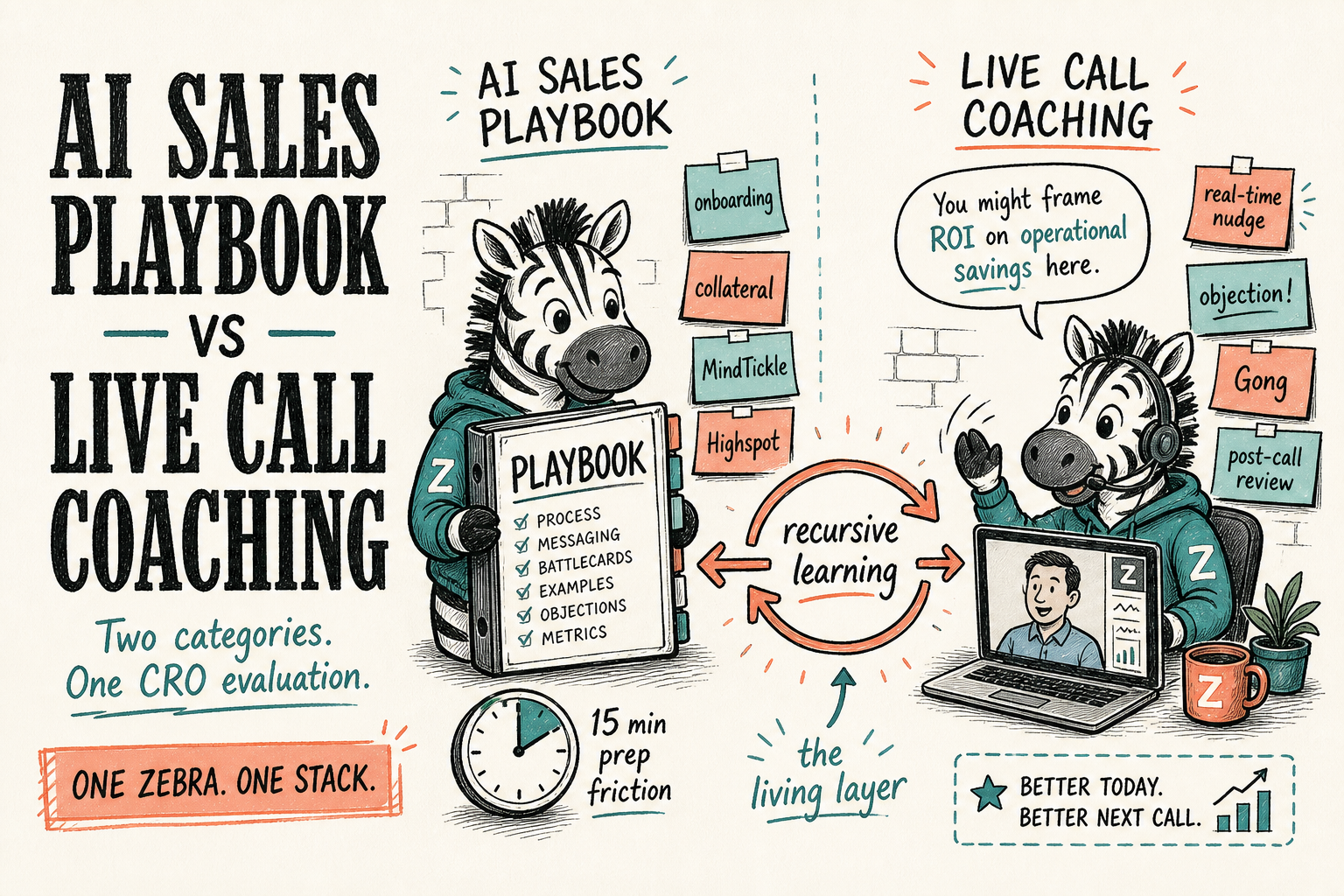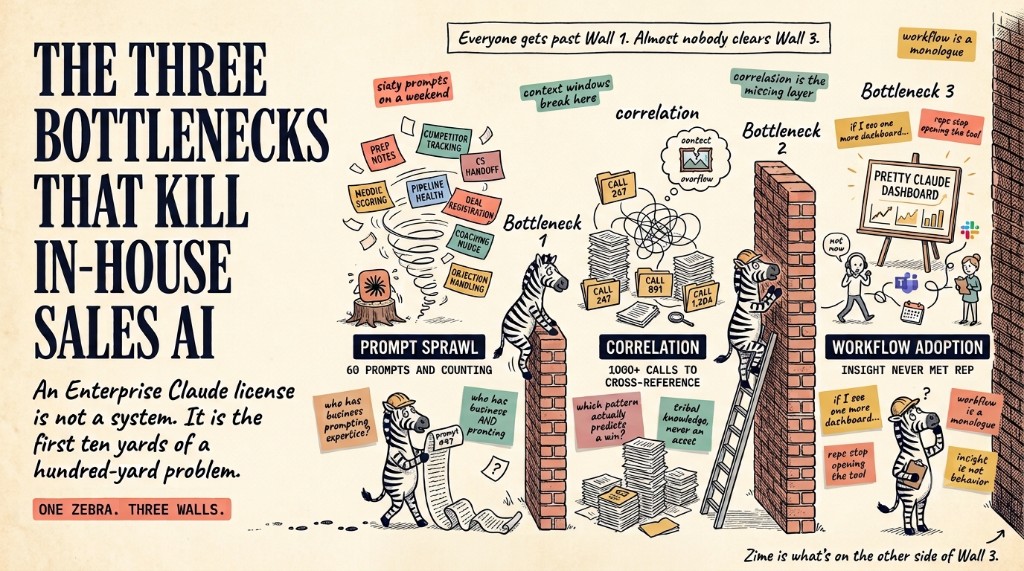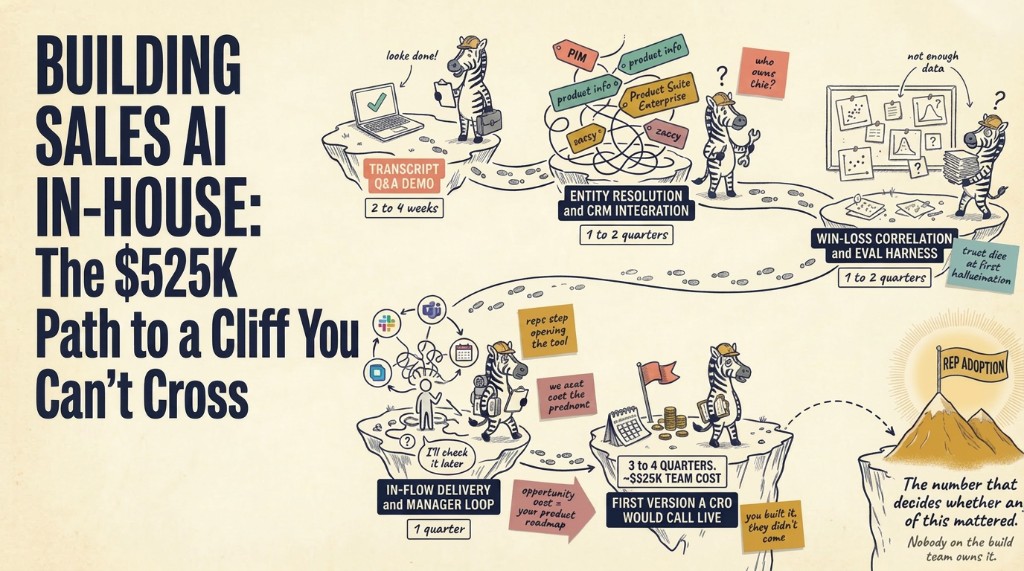
How do you keep rep behavior consistent across complex deals, new products, competitors, and regions?

TL;DR
- Your agents already know every product, competitor and stage. They reconstruct the deal correctly: who's involved, what happened, which patterns preceded a win.
- But reps still don't run what they recommend on live deals. Your agents know the facts, not the right move for this role, product, competitor and region. So the recommendations feel "insighty."
- And more retrieval won't fix adoption. The judgment behind the right move was never written down, so there's nothing for retrieval to find.
- That judgment is what a Behavior Graph adds. It's elicited from your best reps through FDE-run interviews and modules of Zime, and aligned to your CRO's forward-looking strategy.
- So reps run the right motion on deals. Each Behavior reaches the rep inside their workflow, with a receipt from the deal it won, so they trust it enough to act. The AE, the SE and the CSM each get their own move, matched to role, product, competitor, region and stage. That is what consistent execution across deals looks like.
Your GTM agent is live. It sits on a context graph, wired into your CRM, call recordings, and email over MCP. Ask it about a deal, and it tells you who's on the buying committee, what happened on the last call, and which competitor came up.
It's fast. It's accurate. Every rep has access.
Then you look at adoption by role. Reps open it, read it, close the tab, and go ask a colleague. You shipped something real, and it's quietly turning into shelfware.
That's not your context graph's fault. Foundation Capital called context graphs AI's trillion-dollar opportunity in December 2025, and pulling the deal together is exactly what yours does well. If you have one, keep it. If you're adding one, add it.
So where does it break? Let's follow one sentence from your CRO through a normal week.
One sentence, three reps
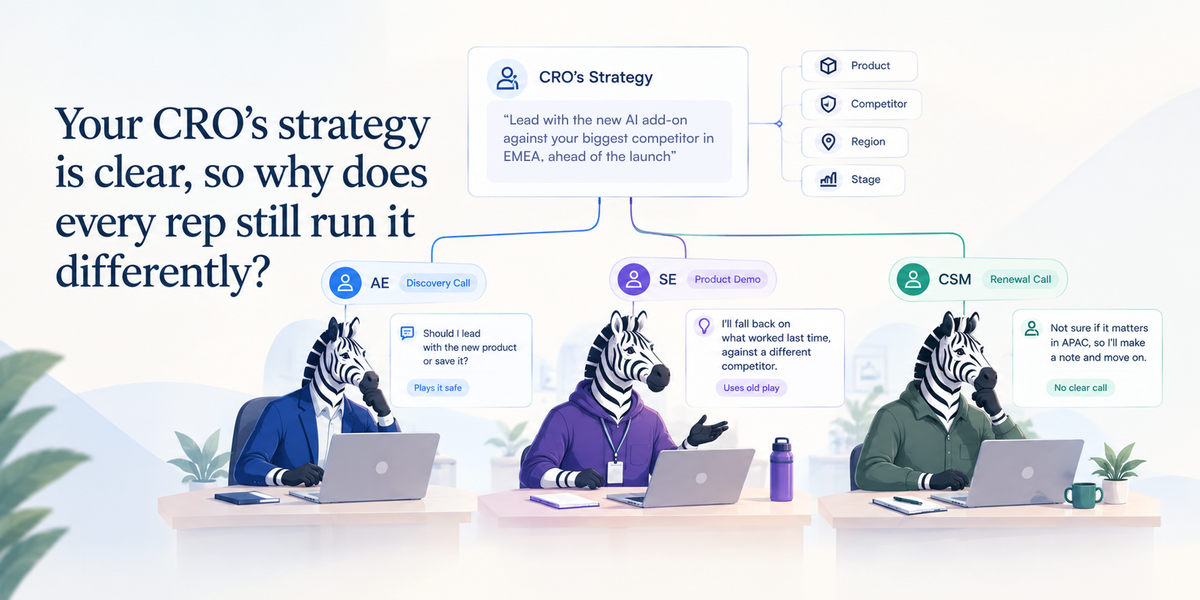
This quarter, your CRO made a call: lead with the new AI add-on against your biggest competitor in EMEA, ahead of the launch. It's one line in the QBR deck.
On Monday, an AE is on an EMEA discovery call. The buyer asks about the new product. Should he lead with it or save it? He isn't sure, so he saves it.
On Wednesday, an SE is mid-demo when the buyer brings up that competitor. She doesn't have the CRO's EMEA positioning handy, so she falls back on what worked last time, against a different one.
On Friday, a CSM in APAC hears the same competitor's name on a renewal call. In EMEA, that's the CRO's fight this quarter. In APAC, it isn't. He can't tell whether it matters, so he makes a note and moves on.
One sentence from the CRO. Three reps, three guesses, and none of them is what the CRO meant.
Here's the frustrating part. The agent gave all three the right competitor profile. It just never told them what the company wanted from their role, in their region, that week. So none of them acted on it.
Chitresh Yadav, VP and Global Head of Sales Engineering at Versa Networks, described what his SEs actually need:
"As our portfolio gets broader, we have more products, more technologies. SEs should know... I'm going for a call, I'm up against Fortinet. "
Chitresh Yadav, VP and Global Head of Sales Engineering, Versa Networks
So what went wrong?
Not the answer. The agent pulled the right facts, and they were accurate, even a little "insighty."
That's why your usage dashboard looks fine. It tracks the top of this list. The strategy only shows up at the bottom.
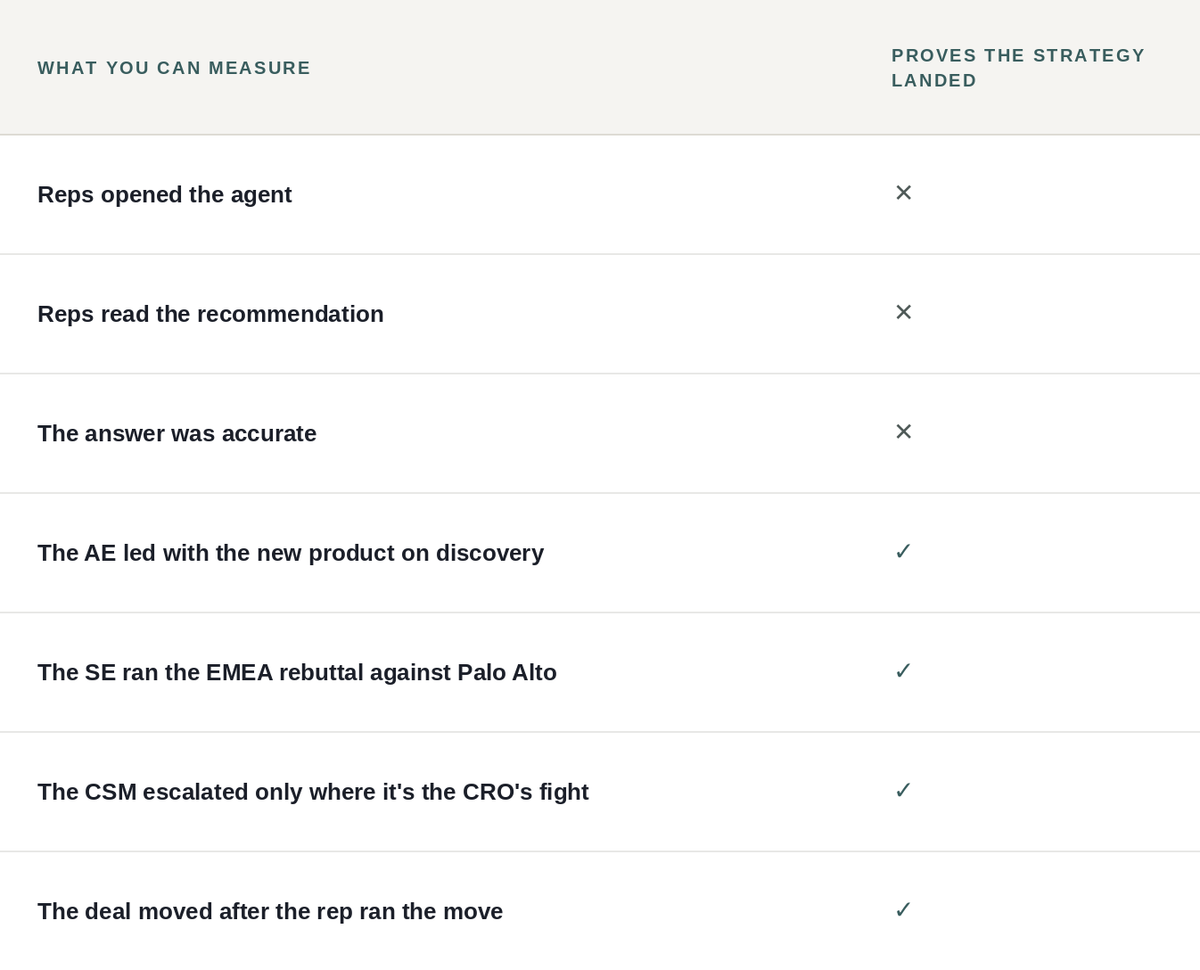
The problem is one step later, when the rep decides what to do. Each of them needed the move for their role, against this competitor, in this region, this quarter. Nobody had written that down, so no past call could teach it.
The real reason: nobody broke the CRO's sentence down into behaviors
Three things never made it into the data.
- The same fact means different things to different roles. A competitor mention is a pitch moment for an AE, a technical fight for an SE, and a renewal risk for a CSM. The CRO's read on that competitor also changes by region.
- Some deals look like nothing you've won before. There's no past pattern to copy. Your best reps handle them on instinct, and nobody has asked them how.
- This quarter's strategy is new. The CRO knows the priority, but nobody has sold it long enough to leave a trail of calls.
Mickey Singh, who leads sales enablement at Versa, put the role gap bluntly:
"SEs are not very business savvy. They're hardcore technical people, and they don't want to get into a selling motion at all."
Mickey Singh, Sales Enablement Lead, Versa Networks
So the SE can't get the AE's move. Nobody spelled out either one, so there was nothing for the agent to find.
The fix: turn the strategy into a move for every rep
That's the job of Zime's Behavior Graph. It encodes three things you never had:
- How your best reps actually win, captured through FDE-run interviews.
- Your CRO's current, approved strategy.
- The context of your past deals.
For each rep, it works out the right move for their role, product, competitor, region, and stage. We call that move a Behavior. When a rep trusts the Behavior, they run it, and that's where adoption comes from.
Both systems recommend a next step. The difference is where the recommendation comes from. Here's how that plays out across your reps' week.
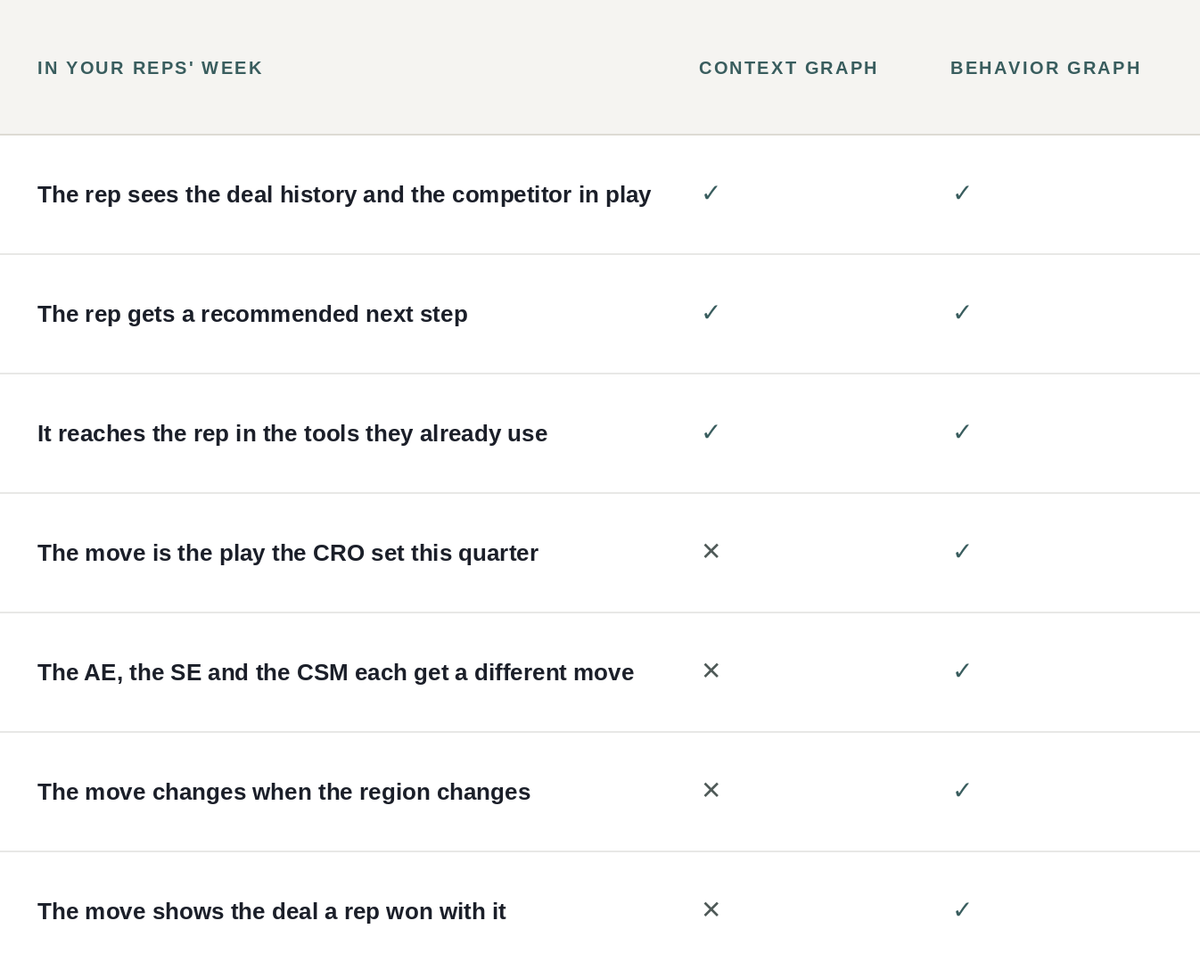
The top three rows are table stakes, and your context graph already does them. The bottom four are where the CRO's sentence finally reaches the rep.
Gartner sees the same shift. In its April 2026 prediction, VP Analyst Shayne Jackson said enablement "must become an AI-driven function that orchestrates seller behavior in real time."
Now replay the week. On Monday, the AE leads with the new add-on, because that's the play. On Wednesday, the SE gets the EMEA rebuttal for that competitor, with the deal a top rep won with it. On Friday, the CSM in APAC gets a clear answer: note it, don't escalate; it isn't the fight there yet. Three reps, three different moves, each one right.
Here's what shows up in the tool she already has open.
Top competitor · technical validation · AI add-on · show the integration before price comes up.
Underneath is the proof: the rep who ran it last quarter, the deal, and the fact that it closed.
She reads it in the pause after the buyer names the competitor. It's a move she trusts enough to run, not a battlecard she has to go hunt for.
Why not map it by hand?
You could, for one sentence in one quarter. Sit in on three calls and brief the reps.
Versa sells multiple product lines against ten named competitors across four regions. Take three roles, four product lines, ten competitors, five stages, and four regions, and you get 2,400 combinations to map.
First, it takes a long time. Chitresh scoped building it in-house. He already used Claude for follow-ups and prep notes, and his agents gave him visibility, not adoption. Closing that gap looked like a 12- to-24-month build and around a million dollars of GTM engineering.
Second, and worse, the strategy moves before you finish. Gartner's survey behind that prediction, covering 227 CSOs, found an average of four sales transformations in 12 months. A competitor shows up. The CRO changes priorities. Your map is out of date the day after you finish it.
If you sell one product to one kind of rep against the same few competitors, a hand-built map can hold. Past that, it's the part worth buying. The full math is in Should you build GTM agents in-house on Claude, or buy a platform?
What changes when reps get the right move
At Versa Networks, CRO Martin Mackay had a clear priority: move early-stage deals through the pipeline, or qualify them out. Zime turned that into Behaviors, alongside what Versa's best SEs already knew, and delivered them in Teams and Salesforce.
When they started, 20% of Versa's SEs ran technical discovery the right way. Three months later, 79% did. Technical wins went up 12%, and leakage from the committed pipeline dropped 24%.
"Zime helped our sales team qualify deals more accurately and move them through the pipeline."
Martin Mackay, CRO, Versa Networks
HFS Research cited Versa's 10% increase in win rates in its July 2026 profile of Zime. At Bureau, new product releases reached the sales team just in time, and ARR grew 10%.
Get the right move to every rep.
Zime turns your CRO's strategy into Behaviors for every role, product, competitor, region, and stage, each one backed by the deal it won. You're live in 7 days on your own deals, with 80% of eligible reps within 90 days. Want to try it on your trickiest deal first?
Book a demo →
FAQ
How do I keep rep behavior consistent when winning complex deals across new products, competitors, and regions? Break the CRO's strategy into behaviors for each role, product, competitor, region, and stage. That mapping isn't in your context graph's data, so it has to come from your best reps and your CRO, then reach reps where they already work.
What's the best way to close the gap between our CRO's strategy and what reps actually do on calls? Treat it as a mapping problem, not a training problem. Each priority becomes a Behavior for each role and situation, updated when the strategy changes and delivered inside the rep's workflow.
Doesn't my context graph already tell reps what to do? Yes. Both recommend a next step. One ranks what worked in past deals. The other uses your best reps' judgment and your CRO's current strategy. More in Is a context graph enough for your GTM agents?
I'm an engineer, not a salesperson. Isn't encoding the mapping still on me? No. Capturing how your best reps sell is interview-and-scoring work, and Zime's FDEs run it with your reps and your CRO.