You built the sales AI on Claude, and the build is good. Claude Code, MCP, your harness. It helps with prep notes, deal Q&A, etc. That part is real engineering, and it holds up.
But the job quietly changed. Adoption never came, and requests stopped being about the system and started being about not having the real selling principles. You became the person expected to encode how your company wins.
You can’t engineer your way to that. The judgment that wins lives in your CRO's and best reps' heads, not in your data. More context or tuning does not conjure it.
And by the time you extract it, it's stale. The surface resets every three to six months, so you become its permanent maintainer, always a step behind.
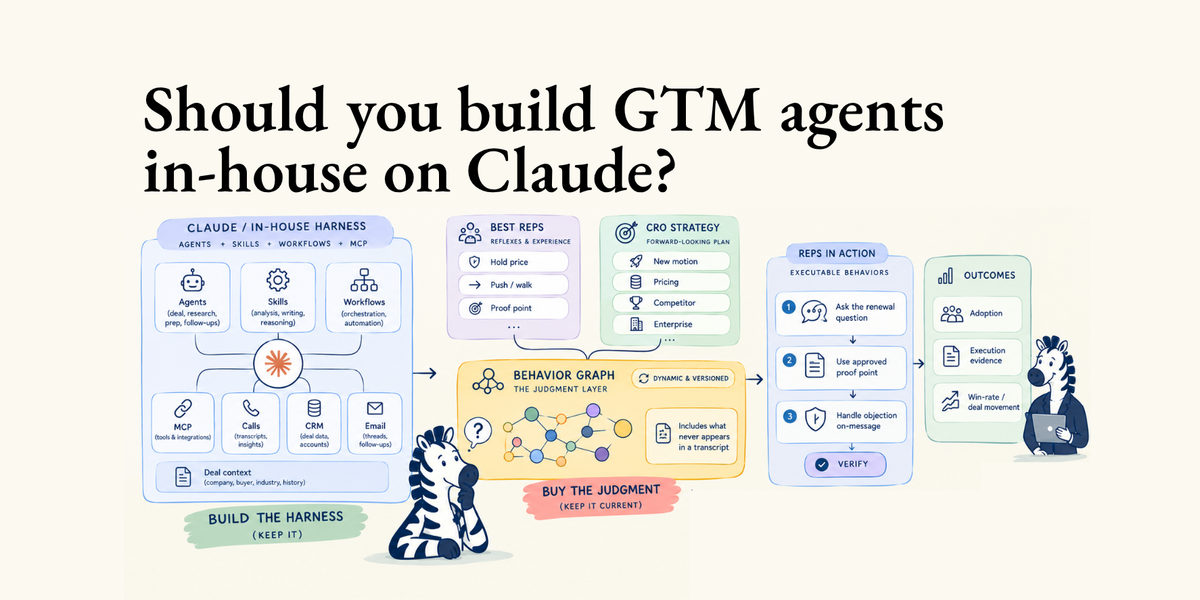
Keep the harness, hand back the judgment. Own the system you built. Buy the judgment layer, a behavior graph, that elicits it from your best reps and your CRO's strategy and keeps it current.
You are an AI engineer. Some months ago, someone asked you to build sales AI on Claude, and you did. It reconstructs the deal from calls, CRM, and email. It drafts follow-ups and writes a prep note before every call. You wired it into the stack over MCP. It is good work, and it holds up.
Then the tickets start to change.
"Why did it tell the rep to discount?" "It doesn't handle the new competitor." "Can you update it for the Q3 pricing motion?" "The demo guidance is wrong for enterprise."
None of these is an engineering problem. Each one is a question about how your company sells. Somewhere between the first build and now, your job stopped being to build the system and became to own how we sell. Nobody announced it. It arrived one ticket at a time.
The problem: you can't engineer sales judgment
Here is the uncomfortable part, and it is not about your ability. You can build any system that ships. You can’t encode sales judgment you don't carry. That is the whole problem.
Whether to hold price against this competitor at this stage, when to walk, which proof point moves this buyer. That knowledge lives in your CRO's head. It lives in the reflexes of your best reps. Nobody wrote it down, because nobody needs to write down a reflex to use it.
Chitresh Yadav at Versa Networks put one such reflex into words:
"If I hear something like our competitors, Fortinet or Palo Alto or Zscaler, I'm thinking whether my rebuttal to those were inline to our strategy."Chitresh Yadav, Versa Networks
That check runs in his head, live, on the call. It is not in a transcript. You can’t retrieve it, because it was never logged.
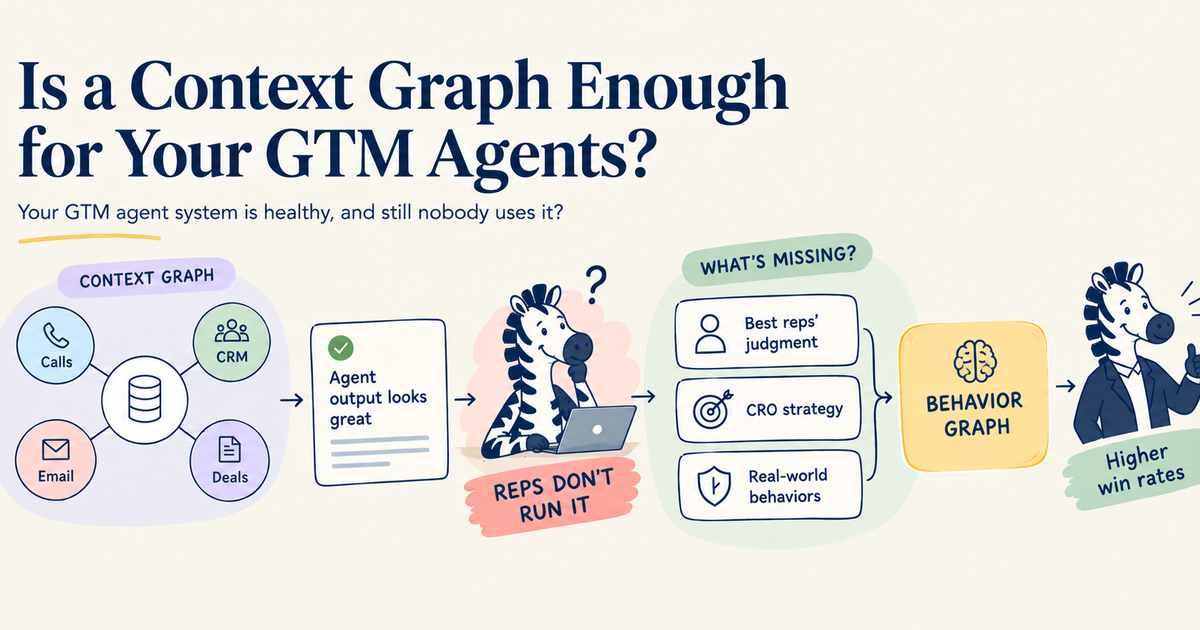
So you do what you are best at. You add context, wire in Gong, tune the prompt, stand up an evals suite. The output gets more fluent without getting more trusted, because you are optimizing the delivery of content you do not have.
The harness was never the bottleneck. The judgment meant to flow through it was. Without the right judgment, the agents become something sellers don’t trust, and adoption suffers. Ameeth Dubey at Atomicwork watched the same thing on an earlier attempt:
"This is what we tried to build internally with ChatGPT. The only problem is adoption."Ameeth Dubey, Atomicwork
So what is this sales judgment?
Strip the word down. Sales judgment is a decision: hold price or discount, push forward or walk, which proof point to lead with, for this buyer, at this stage, against this competitor. Not a vibe. A specific call a rep makes in the room.
It comes from exactly two places.
Your best reps, who have made that call enough times correctly that it is now reflex.
Your CRO, who set the strategy this quarter's calls are meant to serve.
Neither writes it down, because neither has to.
HFS Research profiled Zime in July 2026 and named the same gap: the CRO's plan does not convert to execution, so reps revert and win rates stall.
How can you encode the judgment in your agents?
The build-versus-buy is not about engineering difficulty. You could build the agent harness. It is about what you sign up to own afterward. You need to encode the right judgment layer, which should have
Your best reps' reflexes, elicited through FDE-run interviews and RLHF, including what never shows up in a transcript
Your CRO's forward-looking, authorized strategy
The entity context of your past deals
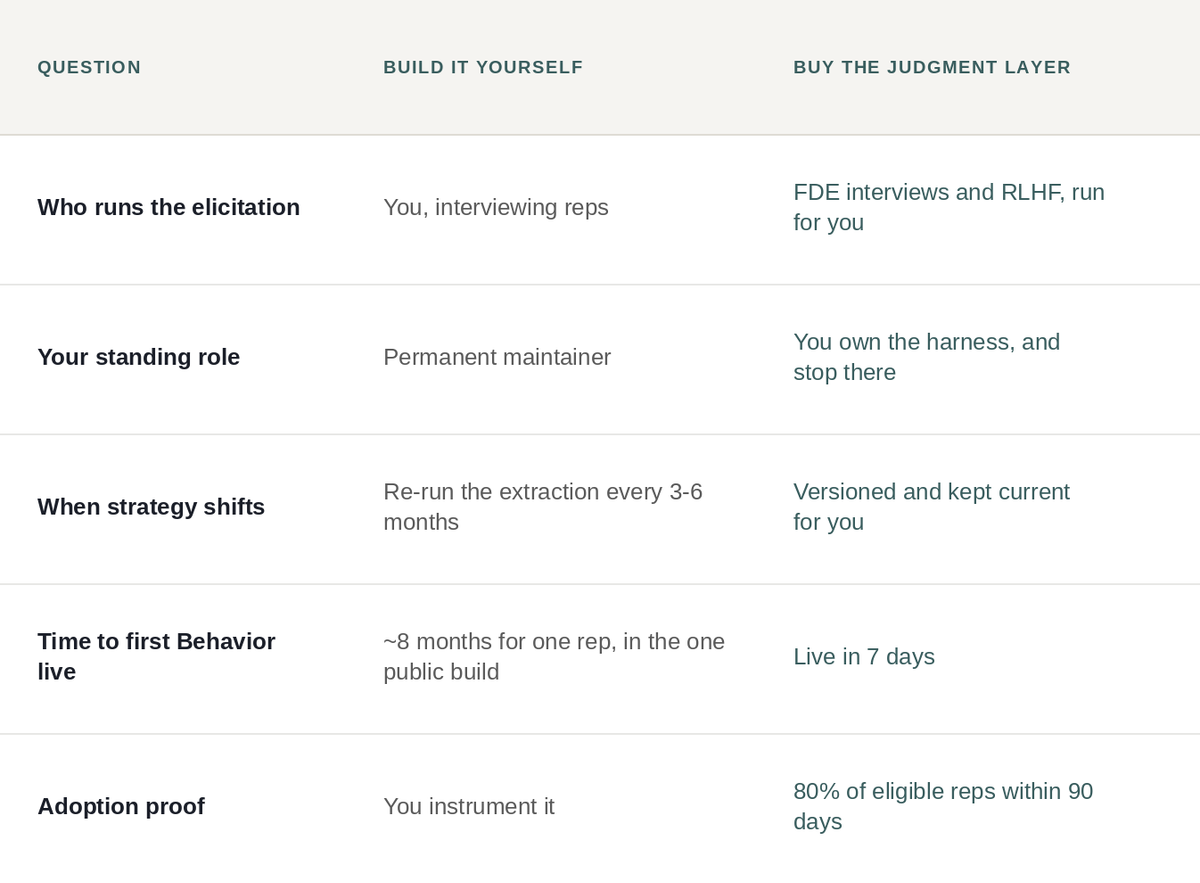
This is what building vs buying the judgment layer looks like:
The metric that actually decides it
Start with the effort. Time to ship the first agent was never the challenge. The one that decides whether this pays off is time to embed the right judgment.
Someone does try to build this layer themselves, and it is worth seeing what that costs. The Signal profiled a CRO who runs his revenue org from Claude Code: Tim Geisenheimer at Hatch. His 39,000-line forecasting cockpit shipped in a weekend. The judgment took the rest of eight months.
What he did by hand is the part worth studying. A Sales Bible distilled from 409 calls of his single best rep, on top of 18 context files and 43 memory files. He did not mine it. He sat with the rep and wrote it down.
Do the calculation. A career sales operator spent eight months encoding one rep. The code was the weekend; the judgment was everything after. The frontier model commoditized the analysis. It did not commoditize the judgment underneath it, which is why he became the system instead of building one.
This is not just engineering. It is interview-and-scoring work, a sales discipline. And 409 calls are one rep. Say four roles, six competitors, five stages. That is already well over a hundred cells. Before a single product line changes.
Moreover, it resets every three to six months, whenever you launch a new product, a competitor launches, or makes pricing moves. An eight-month build for one rep is stale before it reaches the rep. So you are always running behind the curve, and adoption of your agents never comes.
"The danger with Claude is that inadvertently, you've become a builder. That's a dangerous place to be, because you're going to spend a ton of ops cycle time on that."Peter Kim, Head of GTM, WestBridge Capital Management
Own the harness. Don't build the judgment.
The fix pulls apart two things:
One is the harness: agents, skills, workflows, MCP plumbing, carrying guidance to where reps work. That is engineering. It is yours.
The other is the judgment library: how your company sells, elicited, scored, authorized, kept current. A discipline and a moving target.
Merge the two, and you inherit both jobs forever: the agents you shipped once and the sales content that never stops changing. Split them, and each goes to whoever should actually carry it.
Own the first. Buy the second.
Where Zime fits
That judgment layer is what a behavior graph brings, and it is what Zime is.
Zime runs on Claude, so nothing in your stack gets ripped out.
It elicits judgment from your best reps through FDE-run interviews and RLHF, including what never reaches a transcript.
It ties that to your CRO's authorized strategy, versioned as it moves.
It ships as Behaviors: the move to run for this motion, this role, this product, this competitor, delivered through the harness you already built.
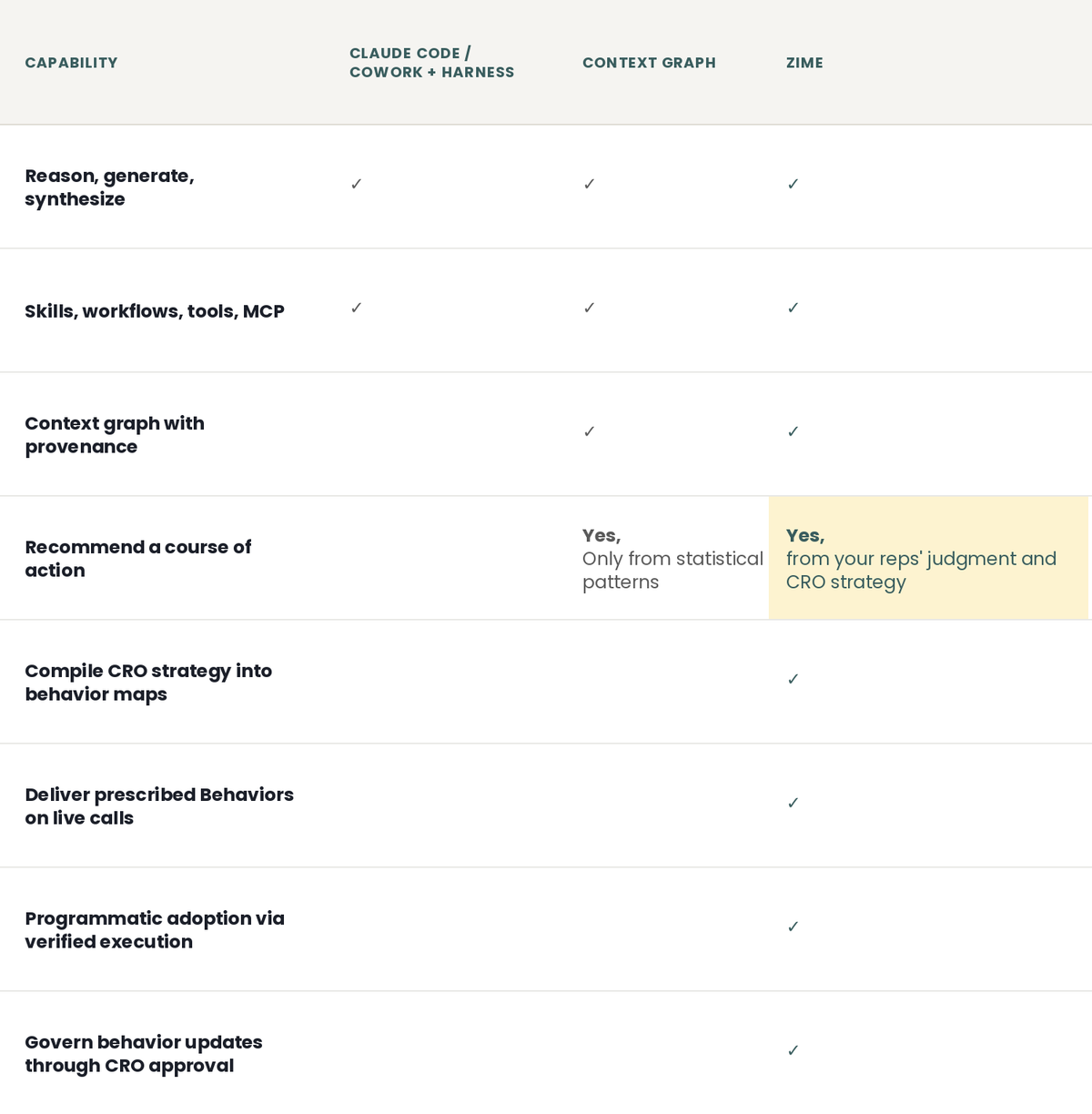
Line up everything you are assembling on Claude. Every column here is something you can engineer. The last one is the discipline you cannot.
What changes once you add the judgment layer
Martin Mackay, CRO at Versa Networks, described what he wanted, in his own words:
"I wanted Zime to understand my playbooks and help reps with the right move. No other tool does this."Martin Mackay, CRO, Versa Networks
Versa reported a 10% increase in win rates, an outcome HFS Research cited in its July 2026 profile. The engineer kept the harness. What changed was who owned the judgment.
Keep what you built on Claude. Add the judgment it's missing.
The agents, skills, and workflows you built stay yours; nothing gets ripped out. Zime adds the layer underneath: judgment elicited from your best reps and your CRO's authorized strategy, delivered as Behaviors, each one carrying a receipt from the deal it won. Live in 7 days on your own data, enough to prove one Behavior before you scale it.
Should you build GTM agents in-house on Claude, or buy a platform? Build the harness and keep it, but buy the judgment layer. A build on Claude summarizes or reconstructs deals well. What it can’t do is turn your CRO's strategy and your best reps' judgment into executable behavior, because those inputs live in people's heads, not your data. Encoding them by hand runs on the calendar of one person, and the metric that matters is time to embed, not time to ship, which is why buying it is the cleaner call.
I'm an engineer, not a salesperson. Isn't encoding the playbook still on me? That is exactly the mismatch. The elicitation is interview-and-scoring work that belongs to a sales-judgment discipline, not to your system pipeline. You own the harness that delivers guidance; the judgment that fills it should come from a system built to elicit and maintain it.
Doesn't my Claude agent already tell reps what to do? Yes. Both systems recommend a course of action. The difference is upstream: one reasons from patterns in past data, the other from your reps' judgment and your CRO's authorized strategy.
Will buying Zime mean throwing away what I built on Claude? No. The harness stays yours, and Zime runs on Claude. It supplies the judgment layer underneath what you built, so reps trust the guidance enough to run it.
Author
Sanchit Garg
Cofounder & CEO
In this Blog
Have industry-leading sales tips sent straight to your inbox.
Sign up for our newsletter to stay updated on how modern technologies are revolutionizing sales methodologies.