Can Gong attribute a multi-account partner call to the right deals?

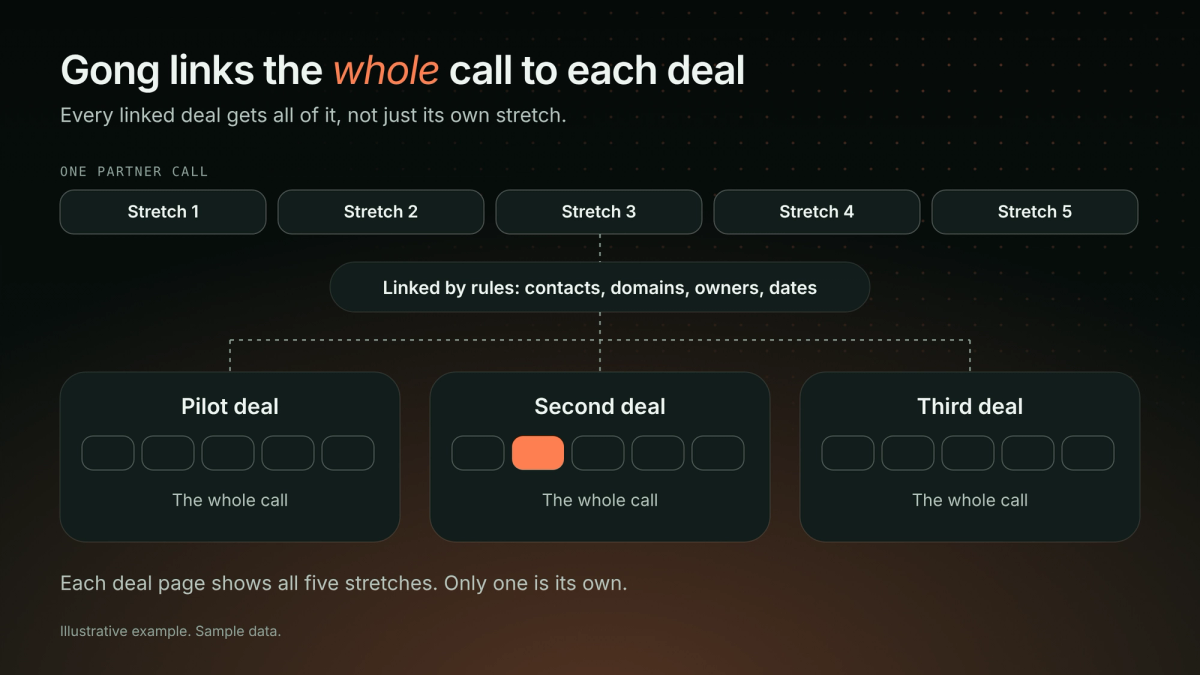
- Gong records the call and links it to deals well. Keep it. Its help centre describes that link at the level of the whole call, chosen by rules over contacts, email domains, owners and dates.
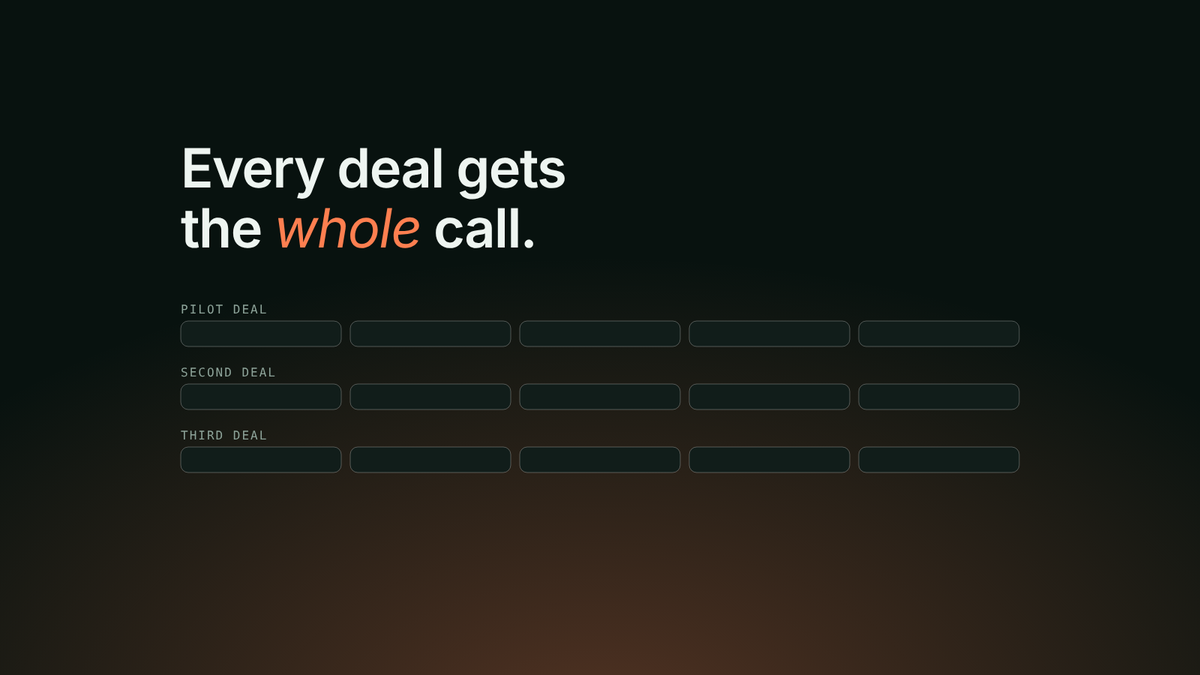
- A partner call can cover ten deals, and then the rules cannot choose. The same people attend for all of them, so every rule fits every deal. Each linked deal gets the whole half hour, and nobody can see which minutes are theirs.
- More filters and manual tags will not fix that. Gong's own pages tie the link to CRM hygiene, and a manual link is also set per call. The deal lives in what was said.
- Split the call at the deal, and keep Gong. Add Zime: it separates the insights by the deal each stretch names, sends unnamed stretches to a person, and shows which partner behaviors your strategy asks for actually ran. Run the ten-call test first.
A RevOps lead opens last Tuesday's partner call in Gong. The transcript is clean and the summary is fair. Say Gong linked the call to three of the ten deals it covered. She opens one of those deal pages and finds the whole half hour. Four minutes of it are about that deal.
One Chief Growth Officer described the shape of it to us. His company sells through a large hardware vendor's specialist sales team. Those reps cover many accounts at once.
“they're going to cover 10 different accounts in the same call.”
Chief Growth Officer A software company that sells through a large hardware vendor's specialist sales team
So the call is not missing. Every minute is there. What is missing is the answer to a plainer question. Which minute belongs to which deal?
What Gong does with a call that covers many deals
Gong works out the link in three steps. It matches attendees to CRM contacts, then picks accounts, then picks deals. It uses contact matches, email domains, account and deal owners, and how close a deal's dates are to the call. An admin can let one call link to up to 10 accounts and 20 deals. A person can also link a call by hand, and that link overrides the automatic one.
Gong gives your team recorded, searchable calls and a deal link. For a call about one deal, that works. Keep all of it.
What the pages do not describe is a way to split one call by deal. The link is set on the whole call, and we found no setting that gives a deal only its own stretch. That comes from Gong's public documentation, read on 17 November 2026, not from testing your instance. Your Gong admin can confirm it in a few minutes.
| What Gong's documentation says | What it means on a ten-deal call |
|---|---|
| It links a call to deals by rules over contacts, domains, owners and dates ([source](https://help.gong.io/docs/configure-crm-entity-association)) | The same people attend for all ten deals, so every rule fits every deal. |
| One call can link to up to 10 accounts and 20 deals (same page) | Each linked deal shows the whole call, never only its own minutes. |
| A manual link is set per call and overrides the automatic one ([source](https://help.gong.io/docs/associate-a-call-to-an-account-or-opportunity)) | Fixing it by hand means tagging each call, deal by deal. |
| One account is written to the CRM activity record ([Gong Community answer](https://visioneers.gong.io/configuring-gong-76/multiple-account-associations-to-1-task-1542)) | The other accounts show only as related context. |
| Wrong links can still occur when CRM hygiene lapses (configure page) | Stale close dates and messy contact roles make the wrong deals look right. |
One buyer put it from the Gong side. He works at an enterprise software company that was weighing Zime:
“I think one of the things that we still need to prove out, because this is a core use case for us, is will this work in a multi-account conversation? Because that's where Gong fell down for us before.”
A buyer at an enterprise software company Speaking about the recorder his team used before
That is one team's experience, not a measurement of Gong. It points to the same spot as the Chief Growth Officer: the multi-account call.
Why a better rule will not fix it
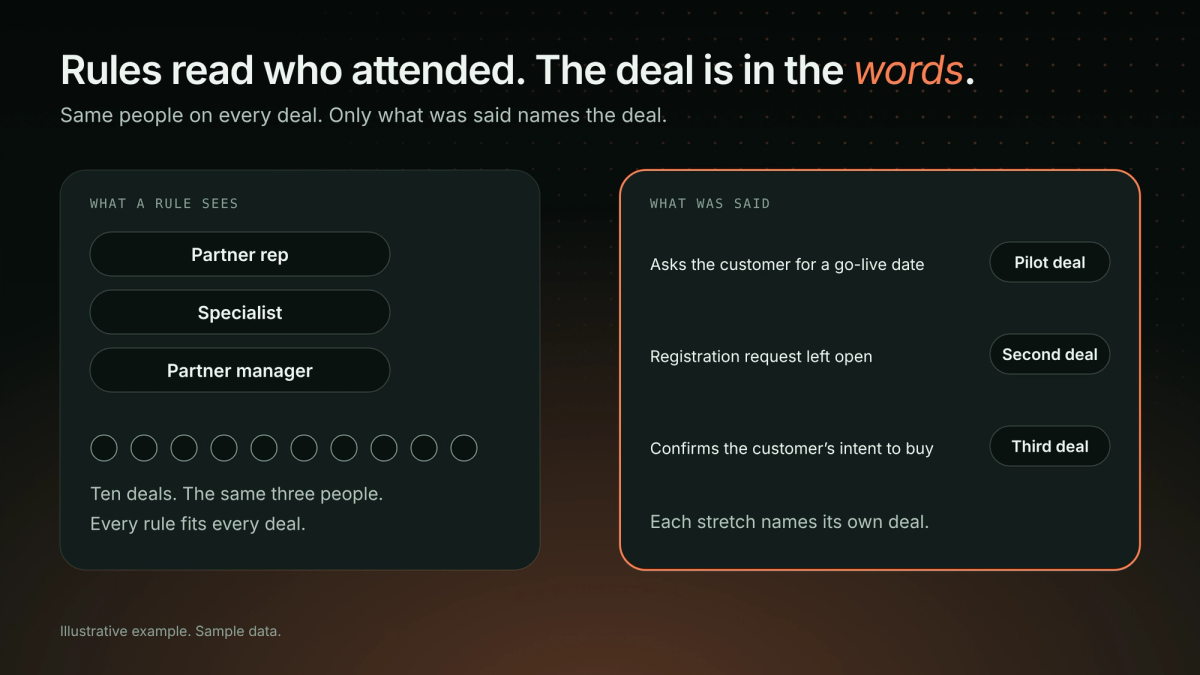
Rules are good at one thing. They read who was in the room: the email domain, the contact role, the deal owner. For a call about one deal, that is enough.
A partner call breaks the shortcut. Every rule fits every deal. The deal lives only in the words: a customer name, a quarter-end date, a request to register.
The Chief Growth Officer made the same point about the recorder his team had used before:
“it might capture the conversation properly, but it doesn't feed any of that information into the right places.”
Chief Growth Officer, same company
So capture works. Routing does not. A filter reads who was in the room. The deal is in what they said. Take the deal from the words, and use the CRM only to confirm it.
The cost lands in the weekly review. Nobody can say which part of the call a manager's question is about, so the rep answers from memory and the forecast moves on it. The same speaker, about his own team:
“we don't know and can't accurately measure how are we doing with any particular rep.”
Chief Growth Officer, same company
You can test this alone. Ask your best partner manager to read the links for ten recent multi-account calls and mark each yes or no. The share of no is the size of your gap. If nearly all pass, keep what you have.
Four ways to split the call, and what each misses
Leave it to Gong's rules. The tell is a deal page that shows the whole call, not its own part.
Tag it by hand after the call. For one call, this works. The tell is the count. Say ten calls a week, six deals each. That is sixty tags, each from memory.
Ask a model to assign each stretch from the transcript. This is the strongest of the four, and the one most teams build next. The tell is a rep who names two deals in one sentence. No model is exact there. What matters is whether it says so.
Here is one sample call, cut to five stretches. Whole-call linking gives each linked deal all five. The manager finds three deals, one stretch with no deal and one that needs a person.
| Stretch | What the partner said | What a linked deal page gets | Partner manager signs off |
|---|---|---|---|
| 1 | Greetings and agenda | The whole call | No deal |
| 2 | Asks the customer for a go-live date | The whole call | Pilot deal |
| 3 | Registration request left open | The whole call | Second deal |
| 4 | “Same issue as the last one,” about two deals | The whole call | A person decides |
| 5 | Confirms the customer's intent to buy | The whole call | Third deal |
Illustrative example. Sample data.
The row where one sentence names two deals is the one that matters. It goes to a person, never to a guess.
Split the call at the deal, and keep Gong
Your partner strategy is a set of behaviors: a clear deal intent, a registered deal, a qualified partner rep. Strategy does not get adopted. Behaviors do. And you can only see whether they ran if each stretch of the call is tied to its deal.
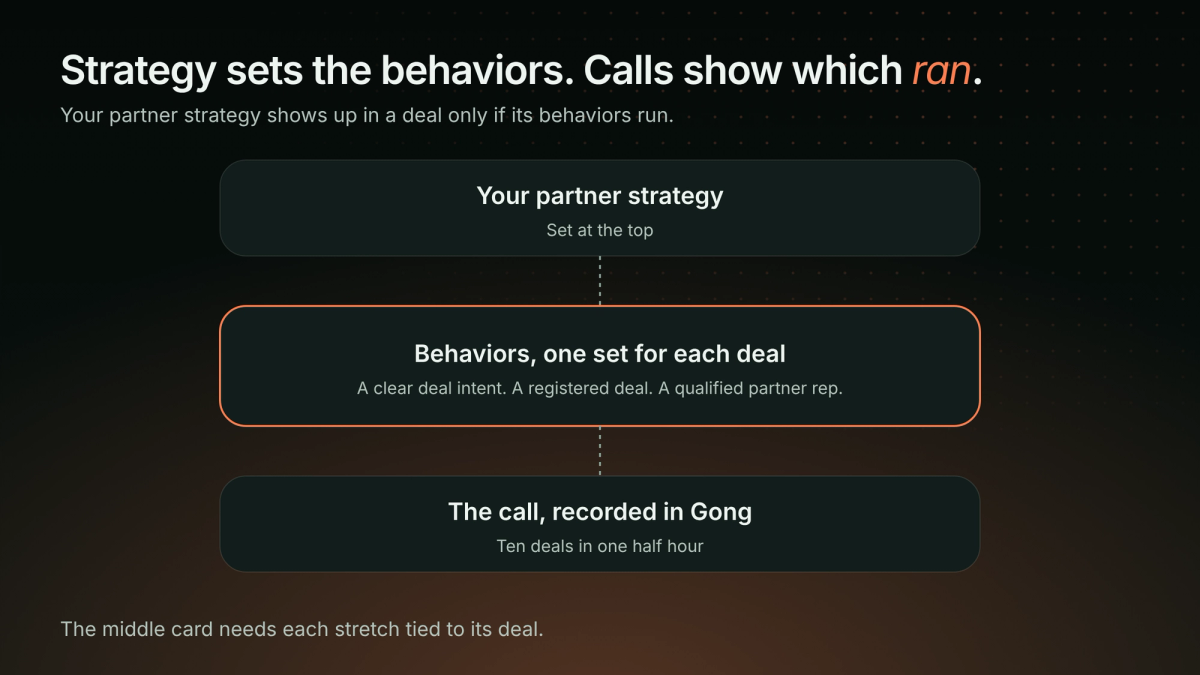
So for each stretch, a partner manager asks three things. Which deal does it name? What did our rep say or ask on it? Did the partner behavior for that deal run?
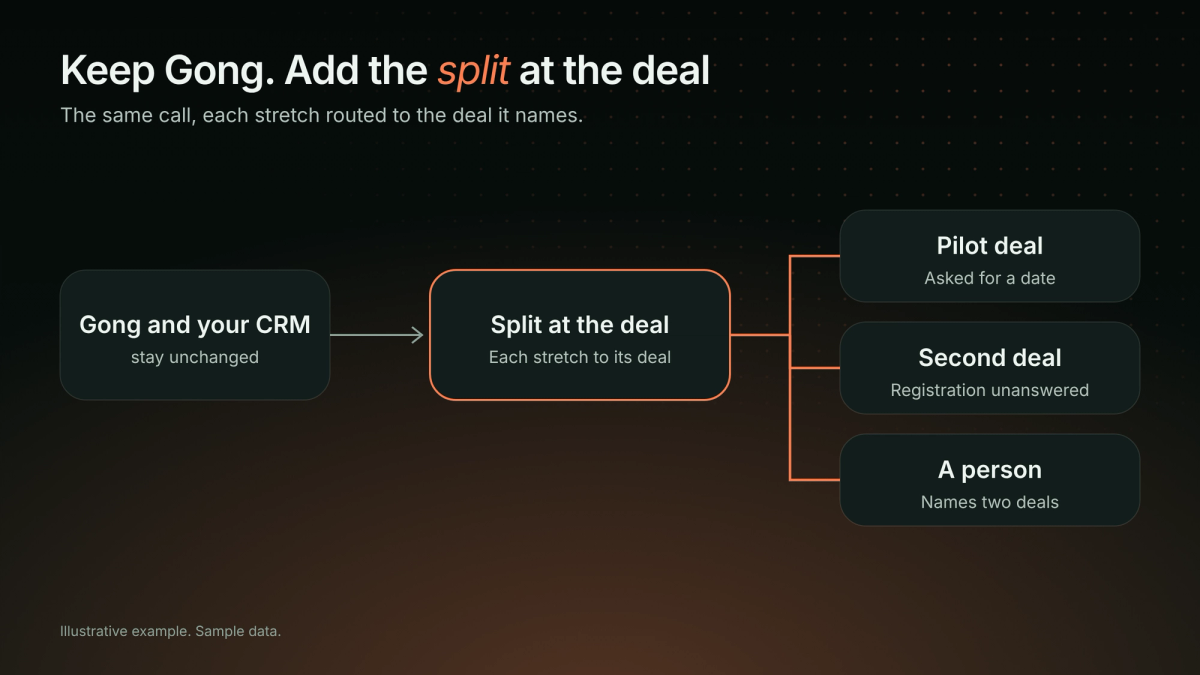
Gong records the call. Zime checks the behavior. Zime works from your Gong recordings, or from its own notetaker if you are not on Gong. It reads the deal or account each stretch names and separates the insights by deal. Where nobody names the deal, no tool can know, so Zime flags the stretch for a person to review. We have not cleared a figure for how often a split is right, so this post gives none. Ask any vendor, us included, for the agreement rate on a sample of your own calls.
Zime calls the model that holds this judgment the Behavior Graph. It encodes your best people's judgment, your CRO's authorized strategy and the entity context of past deals. Its output is Behaviors: the specific move for this deal. That judgment is elicited through FDE-run interviews and RLHF, including what never shows up in a transcript. FDE means a forward-deployed engineer at Zime. RLHF means those engineers score and correct the moves until your managers would run them.
Replay the call. Stretch two lands on the pilot deal. Stretch three lands on the second deal, with the registration request unanswered. The sentence about two deals waits for a person.
Once every stretch has a deal, the question changes. It is no longer what was recorded. It is what ran. For three deals from the same call, one behavior ran, one was asked but not confirmed, and one never came up.
| Deal | Partner behavior | What the call shows |
|---|---|---|
| Pilot deal | A clear deal intent | Ran: the rep asked for a date |
| Second deal | A registered deal | Asked, not confirmed: no answer on the registration |
| Third deal | A qualified partner rep | Did not come up on the call |
Illustrative example. Sample data.
The second deal is the one a weekly review needs.
That is adoption counted as behaviors run on live deals, not logins, and the review has an answer that does not come from memory.
Run the ten-call test this week. Then pick one partner rep, list what you told them about each deal, and check whether you asked for the registered deal. If the gap is small, keep what you have. If it is not, you know what to add.
Keep Gong. Add Zime.
Gong and your CRM stay as they are. Zime ties each stretch of a partner call to its deal and shows which partner behaviors ran. Bring ten of your own multi-account calls and see them split by deal. Book a demo →
FAQ
Can Gong attribute a multi-account partner call to the right deals?
Not by splitting the call. Gong's help centre describes linking a call to accounts and deals by rules, on the whole call, and we found no feature that gives each deal only its own stretch. Keep Gong for recording, and split the call at the deal with a layer that reads what was said.
Can Gong link one call to more than one deal?
Yes. Its help centre says an admin can allow up to 10 accounts and 20 deals on one call. Each linked deal still gets the whole call, not its own minutes.
Can any tool split one call across ten deals without errors?
No tool is exact when a rep names two deals in one sentence. Ask any vendor for its agreement rate on your own calls.