Sales Strategy to Field Execution


Why the gap between strategy and the deal is a CEO problem, a training problem, and a visibility problem
A conversation with John Milburn, CEO, Clear Skye, and Shekhar Gupta, Chief Growth Officer, Zime AI, moderated by Robert Adams, Founder, Kerta Consulting.
Every revenue team has a sales strategy. Most have documented it, rolled it out at kickoff, and built a dashboard to track it. What very few can answer is whether reps actually ran it in last week’s deals.
That gap, between the strategy leaders set and what happens in the field, is where quarters get lost. It often isn’t visible until two or three quarters later, by which point the momentum behind the initiative is gone.
In this roundtable, John Milburn and Shekhar Gupta join Robert Adams to talk through where strategy breaks down on its way to the field, why the usual fixes fade, and what it takes for a leader to see the strategy running in live deals.
Where strategy gets lost
For John, the most common gap has nothing to do with the strategy itself.
“The thing I see most often is where your sales strategy and your comp plan don’t match. That’s not the sales leader’s fault. That’s not the salespeople’s fault. That’s the CEO’s fault.”
— John Milburn, CEO, Clear Skye
If reps get paid more for their old behavior, the new strategy never stands a chance.
He saw a version of this firsthand at Clear Skye. With sales cycles running nine to twelve months, the team broke its large product into modules that buyers could adopt faster and see value from sooner. It was the right strategy. Two months in, only about 10% of the pipeline was modules.
Telling is not practicing
Looking back, John found two causes. The comp plan was one. The other was who got trained.
“Telling is not practicing, is not enablement.”
— John Milburn
The team had prepared the reps, but not the SEs, who in a technical sale carry as much of the deal as the rep does. Nobody had taught them how to move a buyer from one module to the next.
Shekhar sees the same pattern across revenue teams. Enablement tends to stop at the sales team, even when SEs, customer success, and often marketing and product all need to recognize the same signals in the moment of the deal. “The more complex you have in terms of deal motion and products, the harder this becomes.”
Why the usual fixes fade
After an execution miss, most companies reach for the same fixes: more enablement, a new hire, a new CRO, a new tool. John has stopped running big kickoffs altogether. What works for him is aligning comp to the behavior he wants, then war-rooming the next five or ten deals step by step to see whether the strategy holds.
Go-to-market in two-week sprints
He now runs go-to-market the way product teams run development: in two-week sprints, with sales, customer success, marketing, and product reviewing shared metrics together.
“Salespeople are more likely to follow a strategy that they feel part of and they’ve seen at least a piece working.”
— John Milburn
Insights are not execution
Shekhar’s view is that AI has already solved one half of the problem. Every team now has the same tools and the same depth of insight into what happened on calls and in the CRM. But that visibility comes only from what the tools ingest, and they don’t know the strategy or the initiative leadership is trying to run. As he puts it, insights are not execution. That’s why adoption of new initiatives so often stalls with a small core of the field while everyone else lags.
Build, buy, or both
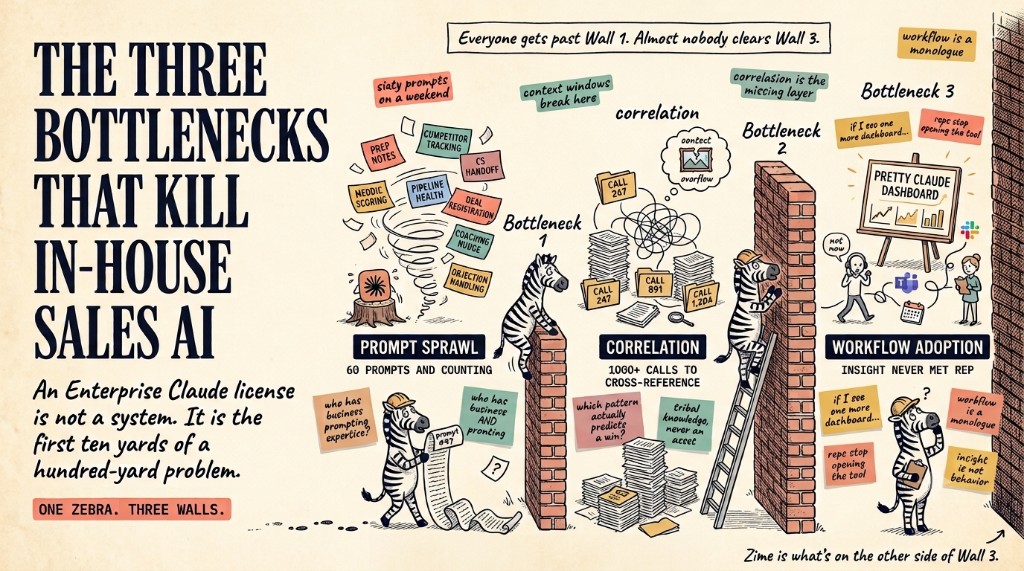
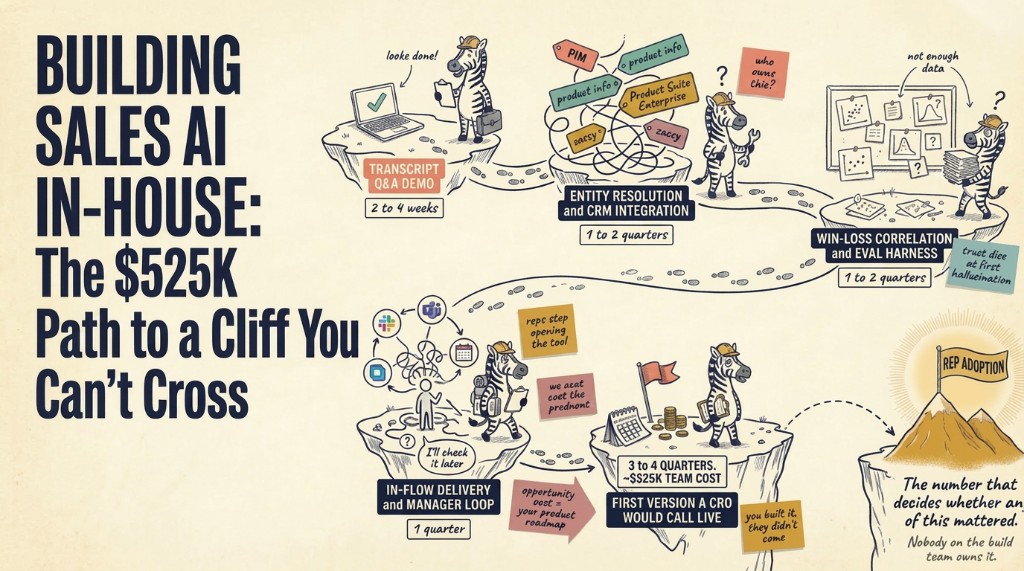
Both speakers hear the same question from their own customers: why not just build it on Claude or ChatGPT?
Shekhar’s answer is to build and learn from it, but not to stay in the business of building. Teams that want ROI in the field need to own their context layer, stay model agnostic, and keep their go-to-market intelligence from sitting inside a single frontier model.
John puts it in terms of expertise. “The difference is expertise and specificity,” he says, along with knowing the difference between a product and a pilot. For a security company in particular, the security and compliance overhead of a home-built tool is a risk he won’t take.
The tribal knowledge problem
Asked how much of what his best sellers know is written down, John doesn’t hesitate. His team records deal reviews and uses AI to summarize best practices, but the most successful reps aren’t sharing their real secrets.
“Tribal knowledge is almost half of the sales process of every company I’ve worked for.”
— John Milburn
His current workaround is expensive. New reps are paired with an experienced rep for two quarters, and he pays both. “That’s the only way I found... that I could solve that problem with consistency.”
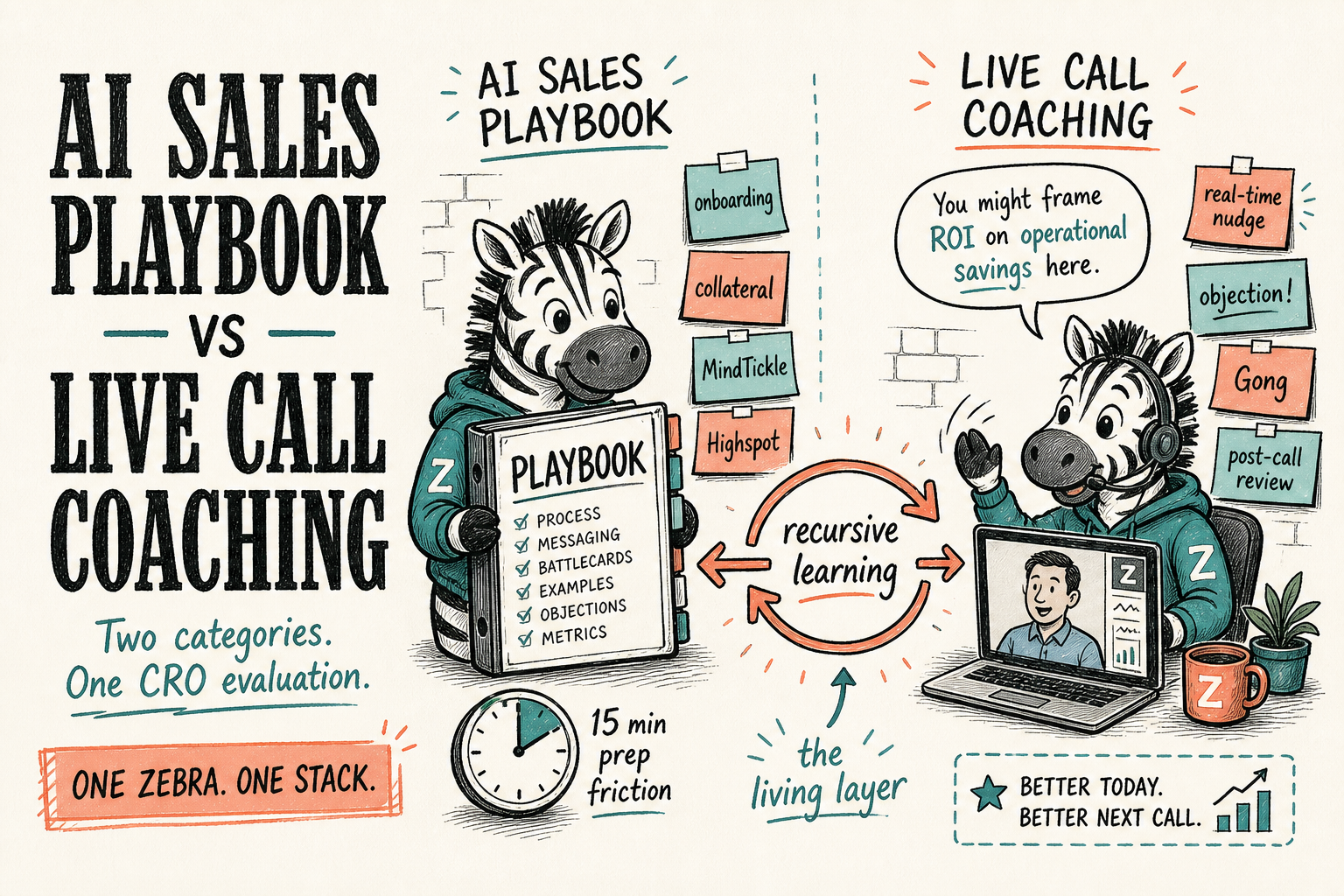
Shekhar suggests flipping the question. Instead of worrying about what happens when the best rep leaves, focus on how fast a new rep learns how the organization wins. Zime AI interviews leadership on the initiatives they want to drive, interviews reps on the behaviors that never show up in a deal motion, and puts that judgment in front of reps before their next conversation, inside the workflow they already use.
What the conversation surfaced
- 9–12 month sales cycles, the pressure behind Clear Skye’s move to a modular motion
- ~10% of pipeline running the new motion two months after launch
- 2-week go-to-market sprints, with sales, customer success, marketing, and product reviewing shared metrics
- 2 quarters of paired, double-paid ramp for every new rep, John’s workaround for tribal knowledge
- 20–30% of the field, where Shekhar sees adoption of new initiatives typically stall
Closing the gap
To help a leader tell whether a strategy was wrong or simply never executed, Shekhar describes starting small. The team takes one initiative at a time, often early-stage discovery and qualification. They encode it in the company’s own version of its framework rather than a generic one. Leaders then see which deals and which reps need attention, and the team moves to the next initiative the following quarter.
Robert, who has used Zime AI as a CRO, adds one practical benefit: weekly late-stage deal updates that arrived without waiting on a rep, which made it easier to judge what really belonged in the forecast.
He closed with the question every sales leader now faces: how long will it take to evaluate, test, and run a tool you build, versus one you buy?
The takeaway
The broader lesson holds for any revenue team: documenting the strategy is the easy part. The hard part is knowing, week to week, whether the field is running it.
The strategy was rarely the problem. Seeing whether it showed up in the deal was.