From Strategy to Execution: How Versa Networks closed the Early-Stage Visibility Gap with 79% Rep Adoption
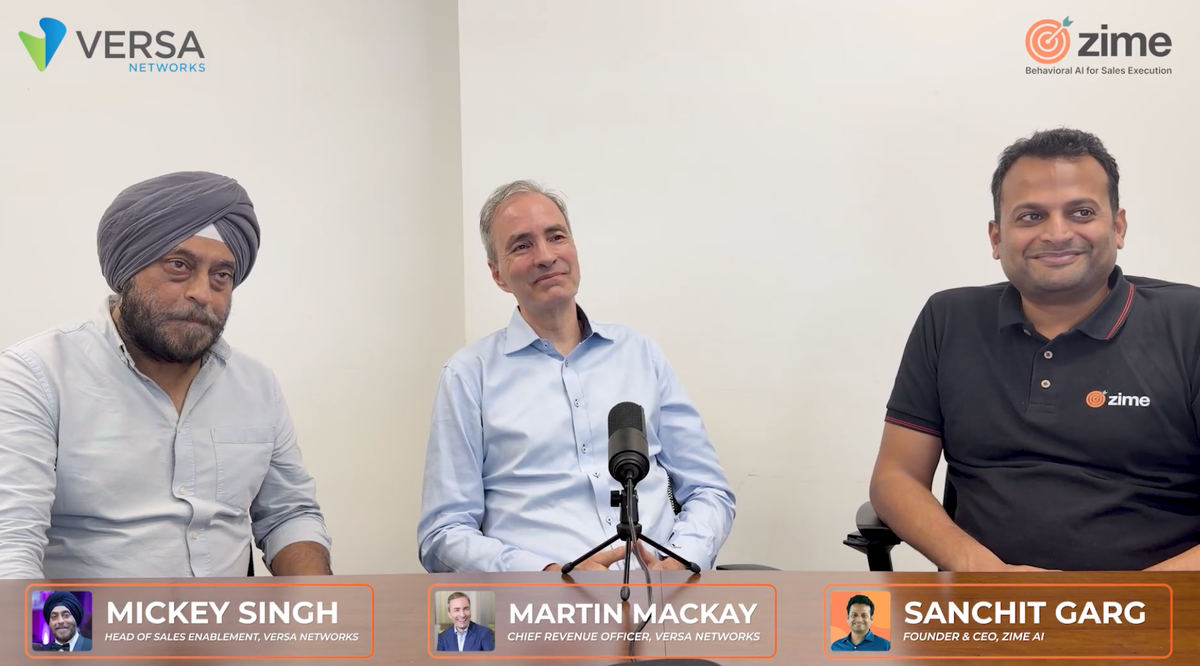

A conversation with Martin Mackay, CRO, and Mickey Singh, Head of Sales Enablement, Versa Networks, with Shekhar Gupta, Chief Growth Officer, and Sanchit Garg, CEO, Zime AI.
For years, Versa Networks had a defined sales process, MEDDPIC in Salesforce, and experienced sales leaders. But one question remained difficult to answer: was the sales process actually being executed in the field, or did it simply exist on paper?
In this conversation, Martin Mackay and Mickey Singh share how Versa moved from relying on individual rep instinct to building a more measurable, repeatable sales motion.
When the process exists, but execution is invisible
Mackay breaks sales productivity down into three questions: Are reps consistently following the sales process? Are they articulating the value proposition effectively? And is sales coaching producing enough value for the time managers invest in it?
For Versa, the process existed. The visibility didn't.
A manager could ask how a call went and hear that it went well, followed by an optimistic answer about next steps. But without visibility into the actual conversation, it was difficult to know what had happened, what was missing, or where coaching was needed.
The challenge wasn't a lack of talent. It was the absence of a mechanism to turn individual judgment into organizational capability.
Moving beyond the "lone wolf" model
Versa's early growth was driven in part by a small group of highly effective reps who developed their own instincts around the product, customers, and buying process.
They were the proverbial "lone wolves." They knew how to win, but what worked for them wasn't necessarily visible or repeatable across the broader sales organization.
As the business grew and buyer behavior changed, Versa needed to capture what worked and make it accessible to the entire field.
That meant moving from individual sales instinct to a repeatable sales motion.
Redefining what qualifies as a deal
One of the most important changes wasn't about AI at all. It was about getting the fundamentals of qualification right.
Two to three years ago, Versa could turn an early, moderately positive conversation into a formal opportunity, only to later question why that opportunity hadn't closed.
Mackay describes that approach as fundamentally flawed. One encouraging conversation doesn't make a qualified deal.
Versa began redefining what qualification meant much earlier in the funnel, creating a clearer connection between what happened in customer conversations and what ultimately entered the pipeline.
The team also developed a different perspective on objections. An objection isn't necessarily a warning sign. It can be evidence that the customer is engaged. The question becomes whether the rep can respond effectively and continue moving the conversation forward.
Beyond call recording
For Versa, call recording was only the starting point.
The bigger opportunity was creating an AI layer grounded in Versa's own sales motion: its products, qualification methodology, buyer questions, competitive landscape, and definition of a good sales conversation.
Working with the Versa team, Zime mapped how discovery and qualification actually happen across the organization rather than applying a generic sales model to the company's calls.
That work ultimately created what the team refers to as "Ask Me Anything": a Revenue Brain built from more than 14,000 recorded customer conversations alongside Versa's product marketing knowledge.
Reps can use it before a call to prepare, during conversations to respond to unexpected questions, and after calls to understand what happened and what should happen next.
Instead of relying on assumed talking points, reps can draw on what customers have actually said across thousands of conversations.
The impact on the field
The shift has made sales execution more visible and measurable.
~79% MEDDPIC adoption across the field
~30% of coaching time returned to sales managers
14,000+ customer conversations informing the organization's sales intelligence
For Mackay, the value isn't simply the numbers. Managers can spend less time reconstructing what happened in a deal and more time coaching against what actually happened in the customer conversation.
What's next
The next step is bringing the same visibility to the deal and the forecast.
With deeper insight into customer conversations, Versa can move beyond optimistic pipeline assessments and identify where a deal is genuinely healthy, where risk is emerging, and where coaching can have the greatest impact.
The broader lesson from Versa's experience is straightforward: a sales process only creates value when it shows up consistently in live customer conversations.
The challenge isn't defining the playbook. It's knowing whether the field is actually running it.