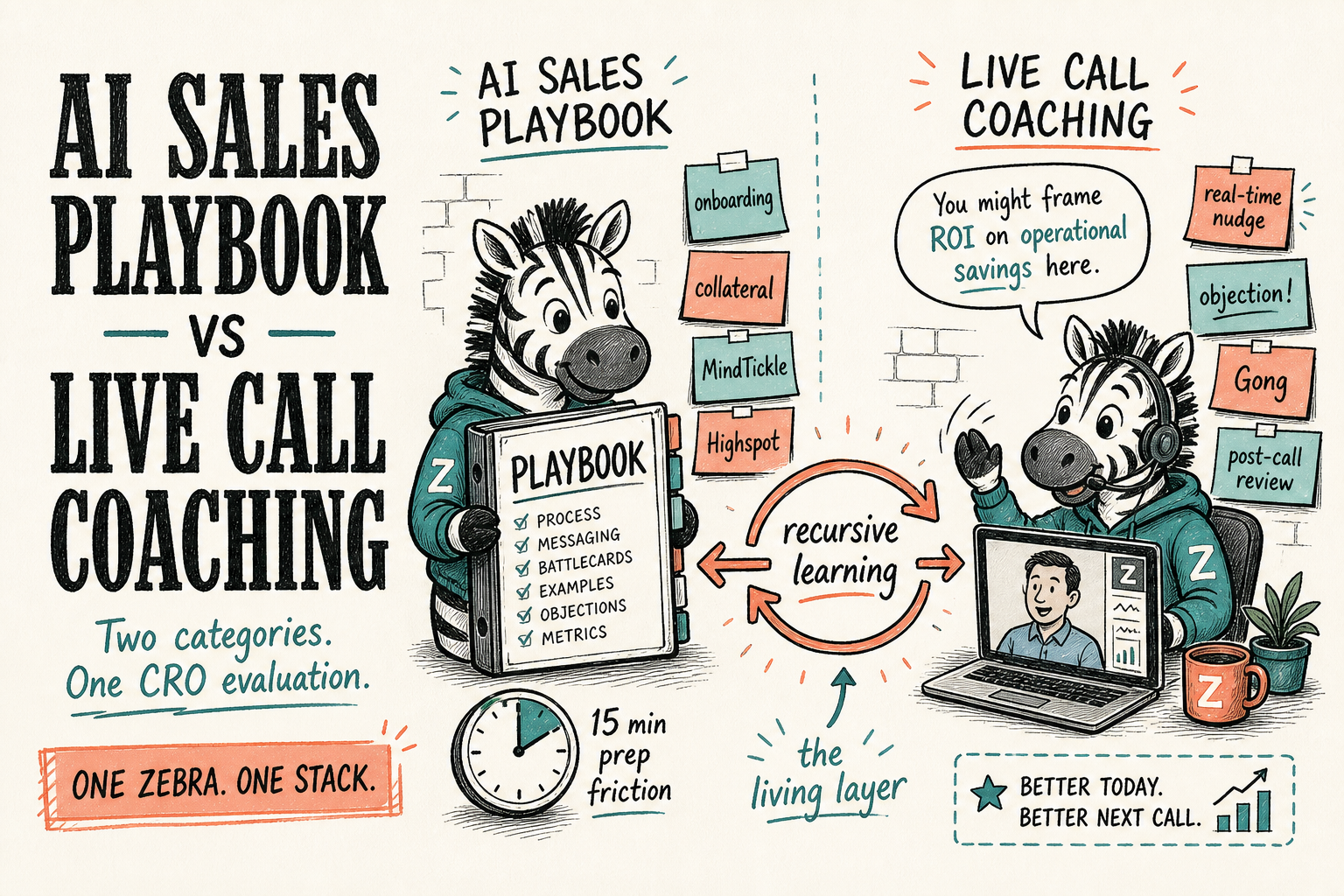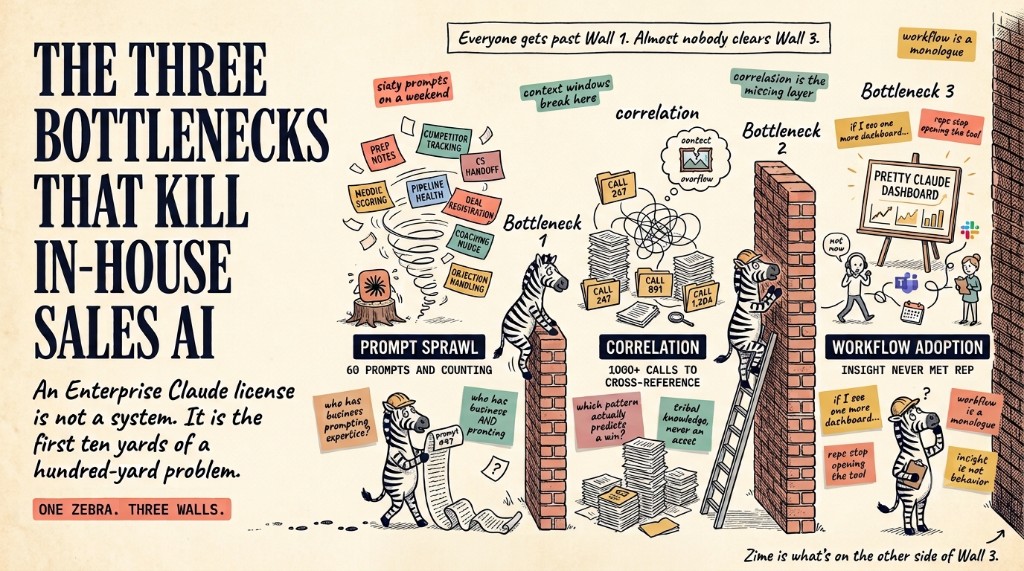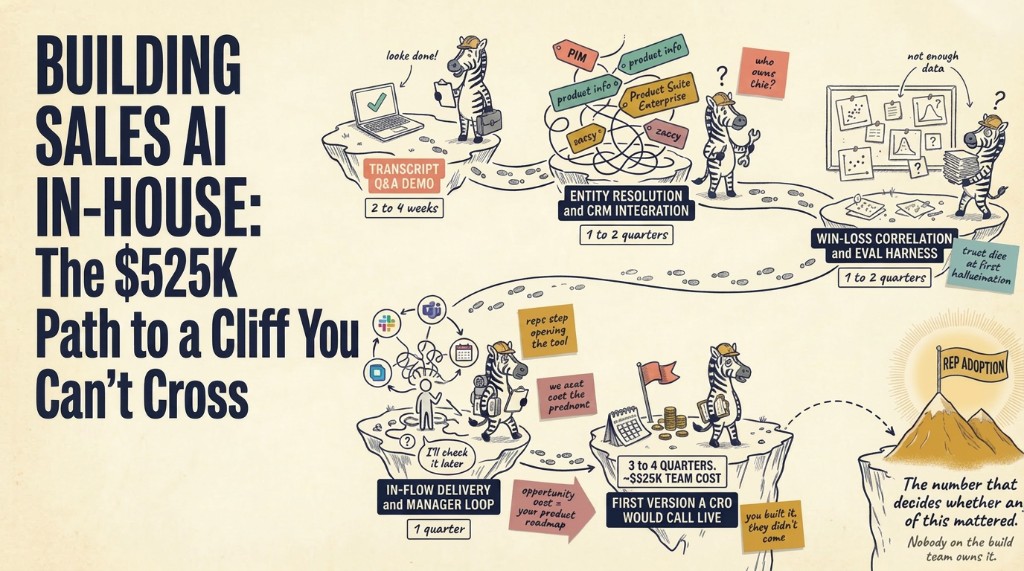
AI sales coaching vs workflow-embedded real-world guidance that reps love & adopt.
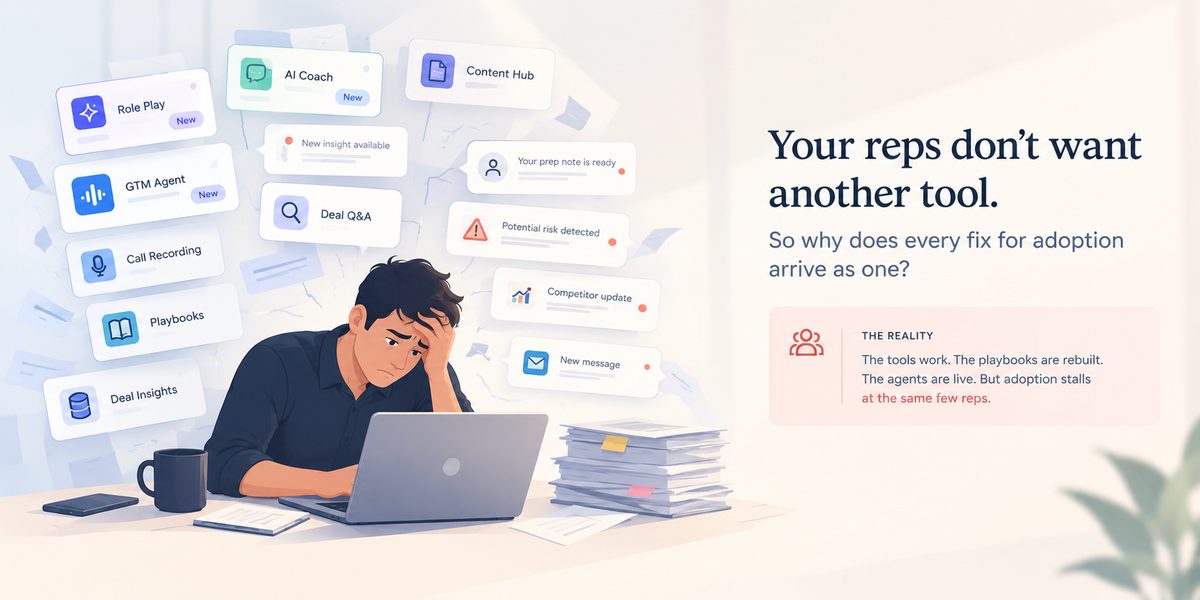

- The tools you bought work. The role plays run. The coaching scores are real. If you shipped a GTM agent, it writes a decent prep note. Nothing's broken, and nothing needs to go.
- But adoption stalls at the same few reps. Your champions use it. Everyone else goes back to asking a colleague. And every fix shows up as one more tool, when reps already have too many.
- Another tool won't fix it, because the tool was never the problem. On a live deal, the rep needs the move that wins this situation. Nobody ever wrote that move down, so no tool has it to give.
- That missing move is what a behavior graph captures. It pulls out your best reps' judgment through FDE-run interviews and modules of Zime. It adds your CRO's strategy and your deal history. What comes out are behaviors: the move to run on this deal, backed by your tribal knowledge and by winning patterns & anti-patterns.
- So judge your next purchase on behaviors run, not tokens or features. Put the move where reps already work. Coach and review deals on the same behaviors. Adoption follows the judgment, not the app.
Let's say you run enablement. This year you bought an AI role-play tool, and the scores look great. Your team rebuilt the playbook after SKO. Maybe your company even shipped a GTM agent. Or it's on the roadmap.
Every rep has a login. Every rep passed certification. Then you pull the usage report, and it's the same handful of names every week. Sound familiar?
So adoption didn't fail. It stalled. Your champions love it. Nobody else touches it.
A few weeks ago I sat in a roundtable with enterprise enablement leaders. Nobody in that room was short of tools. Role plays, coaching, content hubs, call recording: they'd bought it all. The words I kept hearing were "tool fatigue" and "yet another tool." On live calls, adoption still barely moved. And some of them were already shopping for the next one.
Mike Brophy at Neo4j put it better than I could:
"Every additional tool you roll out is just kind of like, more fatigue."
Mike Brophy, Chief of Staff, Neo4j
And it's not just leaders who feel it. Gartner surveyed 1,026 B2B sellers in early 2024. Half said the technology their job needs overwhelms them. Sellers who felt that way were 45% less likely to hit quota. And saving them time doesn't change how they sell, either.
Watch a rep on one deal
Picture a rep who passed the role play on pricing pushback three weeks ago. Now it's the real thing.
The buyer's CFO joins the second call. A competitor showed up in the account last week, and they've quoted lower. The script never covered that.
So what does he do? He doesn't open the role-play app. He doesn't open the playbook. He pings your top rep on Slack and hopes she's free. Then he wings it.
He's not lazy. The training wasn't bad. He just didn't have a move he trusted that decides the deal.
His company had bought every tool in the stack. None of them showed up when it counted.
Why every new tool stalls
That's not a failure of effort, by the way. The reflex makes sense. Usage is low, so you buy the next tool that looks more promising.
Mickey Singh leads sales enablement at Versa Networks. He described the loop like this:
"...we are very tech tool heavy... somebody likes it. Let's get that tool. Let's get that tool, and over time it becomes cumbersome."
Mickey Singh, Sales Enablement Lead, Versa Networks
So why does the next tool stall too? Usually for one of two reasons. It lives outside the deal, or it carries no judgment. Most of the time, both.
What won't work, and how to spot it
You've probably tried a few of these. Each one feels like progress at launch. None of them changes what the rep does on the deal.
1. Spray-and-pray insights. You know the drill. Every call ends with a summary, some risk flags, and a few coaching tips. Then the agent starts pinging in Slack. By Friday, your rep has more alerts than deals, and he's reading none of them. More insight just means more noise.
Why it fails: look at it from his side. He can act on one clear move before a call. Hand him a pile of insights, and now he has to do the sorting himself. But the sorting is exactly the judgment he was missing. The tell: if your reps have muted the channel and managers have stopped forwarding the alerts, you're already there.
2. Generic AI. Your rep asks a chatbot how to handle the CFO's price pushback. He gets the textbook answer: acknowledge, reframe on value, ask a question. That's true at every company, which is exactly why it doesn't help at yours. It's never seen how your best rep beats this competitor.
"AI can reach some level, but not to the human level, because there is a context that you need to build in."
Chitresh Yadav, VP and Global Head of Sales Engineering, Versa Networks
Why it fails: the model knows sales in general, not your deals. It can't know which proof lands with your buyers, or what your CRO decided last month. The tell: reps try it once, get an answer they could've guessed, and stop asking.
3. Anything outside the flow of work. A role play on Tuesday for a call on Thursday. A playbook sitting in some tab. A prompt that pops up while the buyer is mid-sentence. Every one of them asks the rep to stop selling for a minute. Guess what? He doesn't.
Why it fails: Your rep's head is on the buyer and the next call. Anything that needs its own moment is competing with selling, and selling wins every time. Practice still builds skill. But the move has to be there, on the deal, when he needs it. The tell: your completion rates look great, and the live calls sound exactly like they did before.
4. A new UI. One more app, one more login, one more place to check. Your reps already live in the CRM, email, Slack, and the call tool. A new screen loses to the ones already open.
Why it fails: every new screen is a new habit, and reps feel burdened to adopt new habits. Remember, half of sellers already feel buried by the tech they have. The tell: logins spike at launch, then fade.
"...not burden them with, hey, now go log into one more tool and listen to all your ten call recordings."
Swati Shah, AVP WW Revenue Operations, Versa Networks
Five conditions that make reps adopt, not just log in
Think about Google Maps for a second. Nobody took a training course on it. It sits where you already are. It answers the one question you have right now: how do I get there from here? And you trust it because the route is right. That's the bar, and it gives you five conditions.
1. It answers the question the rep has on this deal.
Your rep doesn't want a module on objection handling. He wants to know what to do with this buyer, at this stage, against this competitor, in this region. So when he asks "what do I do with this CFO?", give him an answer about this CFO. Not CFOs in general.
Chitresh Yadav, who led sales engineering at Versa Networks, described that question from inside a live call:
"If I hear something like our competitors, Fortinet or Palo Alto or Zscaler, I'm thinking whether my rebuttal to those were inline to our battle card."
Chitresh Yadav, VP and Global Head of Sales Engineering, Versa Networks
2. It shows up where the rep already works.
No new login. Slack, Teams, Claude, the CRM. If it needs a new tab, it's already lost. Mike Brophy cut his field down to two tools. His rule for everything else is blunt:
"...if it's not in those two tools where rep works, it's not going to the field because you lose them."
Mike Brophy, Chief of Staff, Neo4j
3. It carries the judgment that wins.
A map in the flow of work with the wrong roads is still a map nobody opens. Getting in front of the rep is the easy part. Being right is what gets the move run.
That's what a behavior graph is for. It pulls together three things:
- Your best reps' judgment, elicited through FDE-run interviews.
- Your CRO's forward-looking, authorized strategy
- The entity context of your past deals.
Zime builds that Behavior Graph for your company. Out of it come behaviors: the move for this motion, this role, this product, this competitor. Each one comes with a receipt: the deal a best rep won with it. So reps aren't guessing. They're running a move the company backs. And that's what adoption really is.
"I wanted Zime to understand my strategy and coach reps. No other tool does this."
Martin Mackay, CRO, Versa Networks
HFS Research profiled Zime in July 2026 and spotted the same gap. The CRO's plan never turns into sales execution, so reps slide back to old habits and win rates stall. Their fix: learn from how deals were won, turn that into scoreable behaviors, and ship them where reps already work.
Now, if you have a GTM agent, it recommends a move too. Both do. The real difference is where that recommendation comes from:
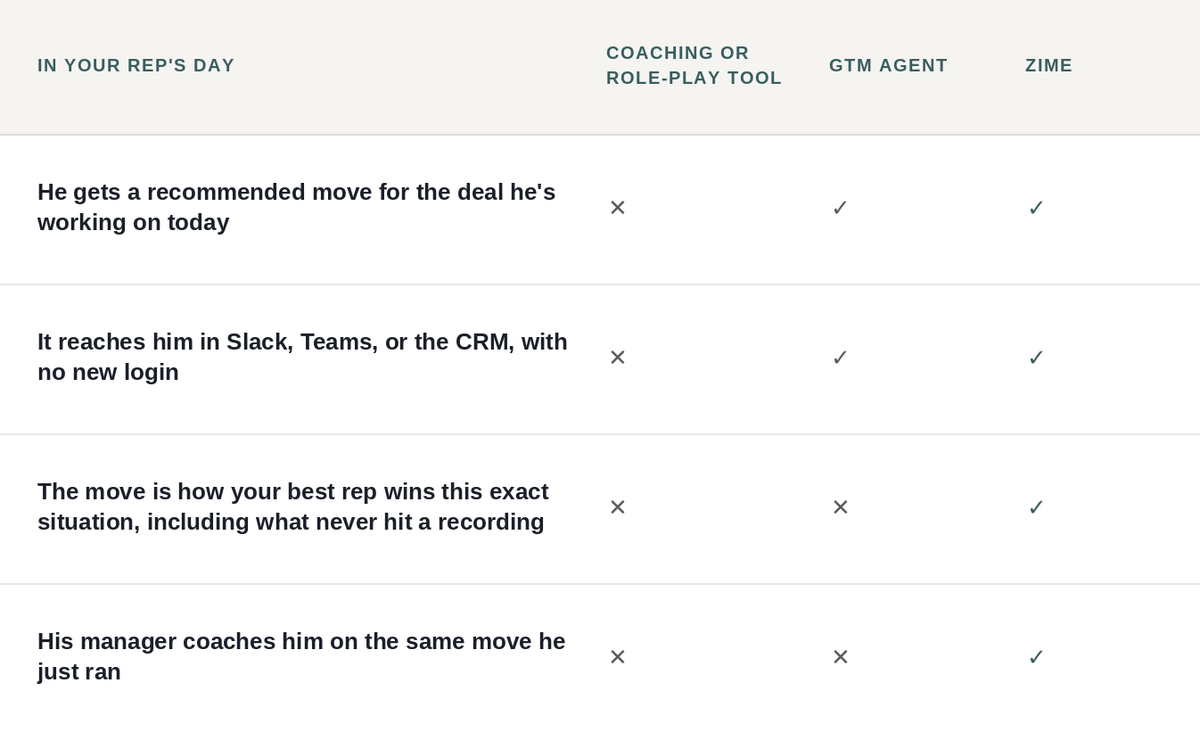
4. It measures behaviors run, not logins.
A usage dashboard counts opens. A call scorecard can tell you if a rep hit a methodology step. But neither knows which move your company authorized for this deal. So neither can tell you if your strategy actually ran.
Zime measures behaviors run, tied to the strategy behind them and the deals they moved. The bar we hold ourselves to: 80% of eligible reps within 90 days.
So before you buy the next tool, skip the demo and ask for these numbers:
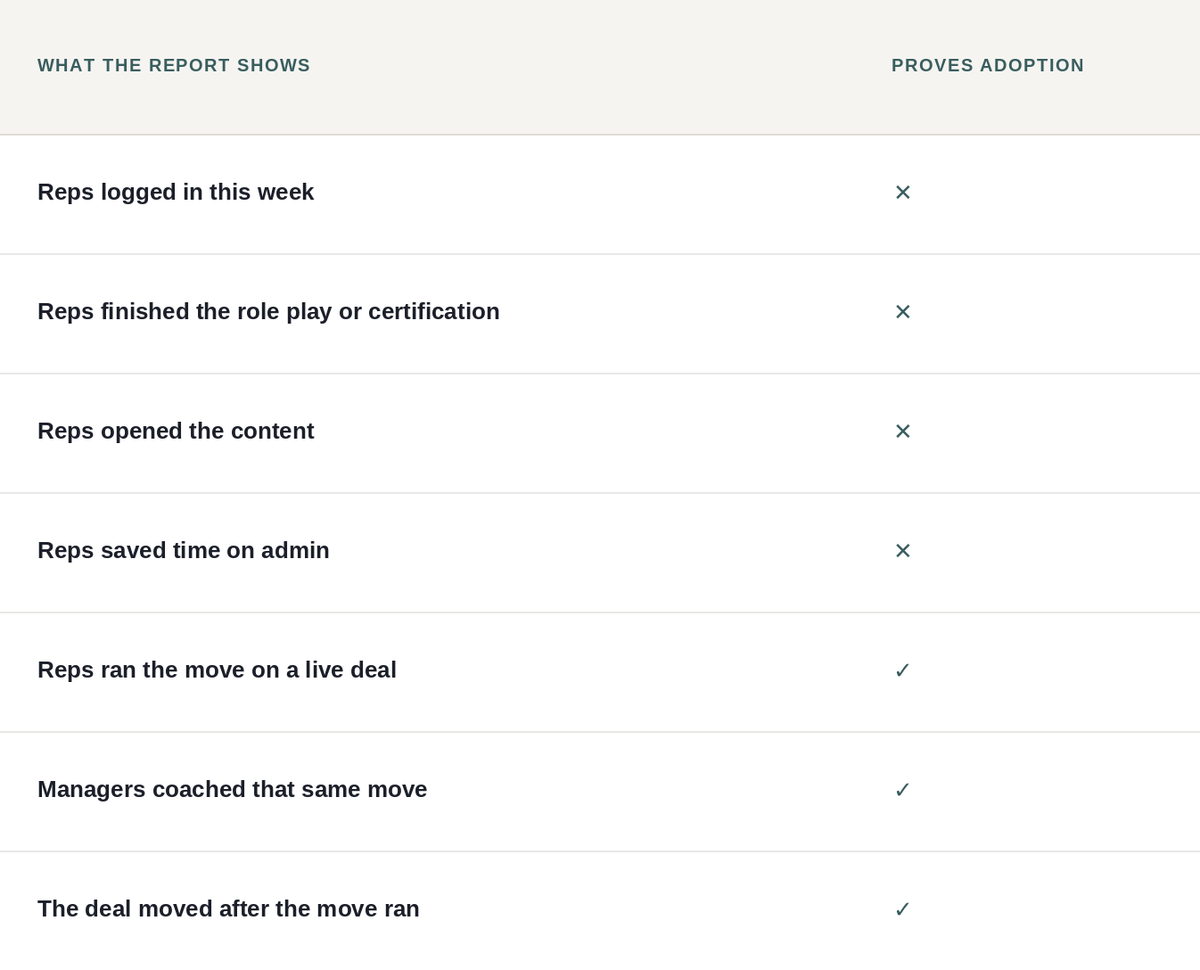
5. The whole org runs the same standard.
Managers coach on the same behaviors reps get. Deal reviews check the same behaviors. If your managers coach one version of good and the deal review checks another, reps learn to ignore both. This is also where coaching fits. Zime does AI rep coaching, and the difference is what it coaches on.
Coaching in a separate app is one more tool. Coaching on the behavior a rep just ran, on his own deal, is the same move, twice.
Now replay the call
Same CFO. Same competitor. Same price gap. This time, before the call, a behavior lands in the rep's Slack. It's how your best rep reframed on total cost against this competitor last quarter, with the deal she won attached. And it matches the pricing stance your CRO set. The rep runs it. Nobody opened a new tool.
How Zime drives adoption
Zime builds a Behavior Graph for your team. It puts the winning judgment in front of reps, in the tools they already use, with a receipt from the deal it won. Reps run it because they trust it. That's where adoption comes from. Here's how the graph gets built:
- Elicit it. Our forward-deployed engineers sit down with your best reps, sales leaders, and CRO. They dig for the nuance that never made it into a deck, including this quarter's priority.
- Ground it. Then we check that judgment against your real deals: stage exit criteria, battle cards, CRM history, and the calls you won and lost.
- Encode it. Zime modules encode each behavior until your best reps would run it themselves. The stuff that never shows up in a transcript still makes it in, because it came from the interviews.
- Keep it current. When your CRO moves a priority, the behaviors move with it. New lessons from the field get folded in, so v1 becomes v2, then v10. We track which ones ran and what moved, and that shapes the next version.
And it stays in your control. Your team decides what reaches reps. We do the digging, encoding, and upkeep the day job never leaves time for.
Can you build the judgment yourself?
Doing it yourself sounds simple. You interview your top reps. You write up the CRO's new strategy. You update the playbook and script new role plays. Then you do it all again for every product, region, and role. That's months of work.
One CRO really did it. The Signal profiled Tim Geisenheimer at Hatch. He built his own revenue operating system in Claude Code, by himself: 8 internal apps and 20 skills.
His forecasting cockpit went live after one weekend. Four months on, it's about 39,000 lines. But eight months in, the judgment is still hand-built: a Sales Bible pulled from 409 calls of his single best rep. His estimate of the effort? "Hundreds of hours, probably more."
That's one rep's judgment, captured by a CRO who taught himself to build. Most enablement teams don't have those hours. The judgment still has to come out of people's heads. It just doesn't have to be done by hand.
If you build it yourself, you own four jobs. Get the judgment out of your best reps' heads. Ground it in real deals. Turn it into moves a rep can run. Keep it current every time the strategy shifts. The first job alone is why playbooks read so generic. Top reps can't write down a reflex, and nobody has time to interview them properly.
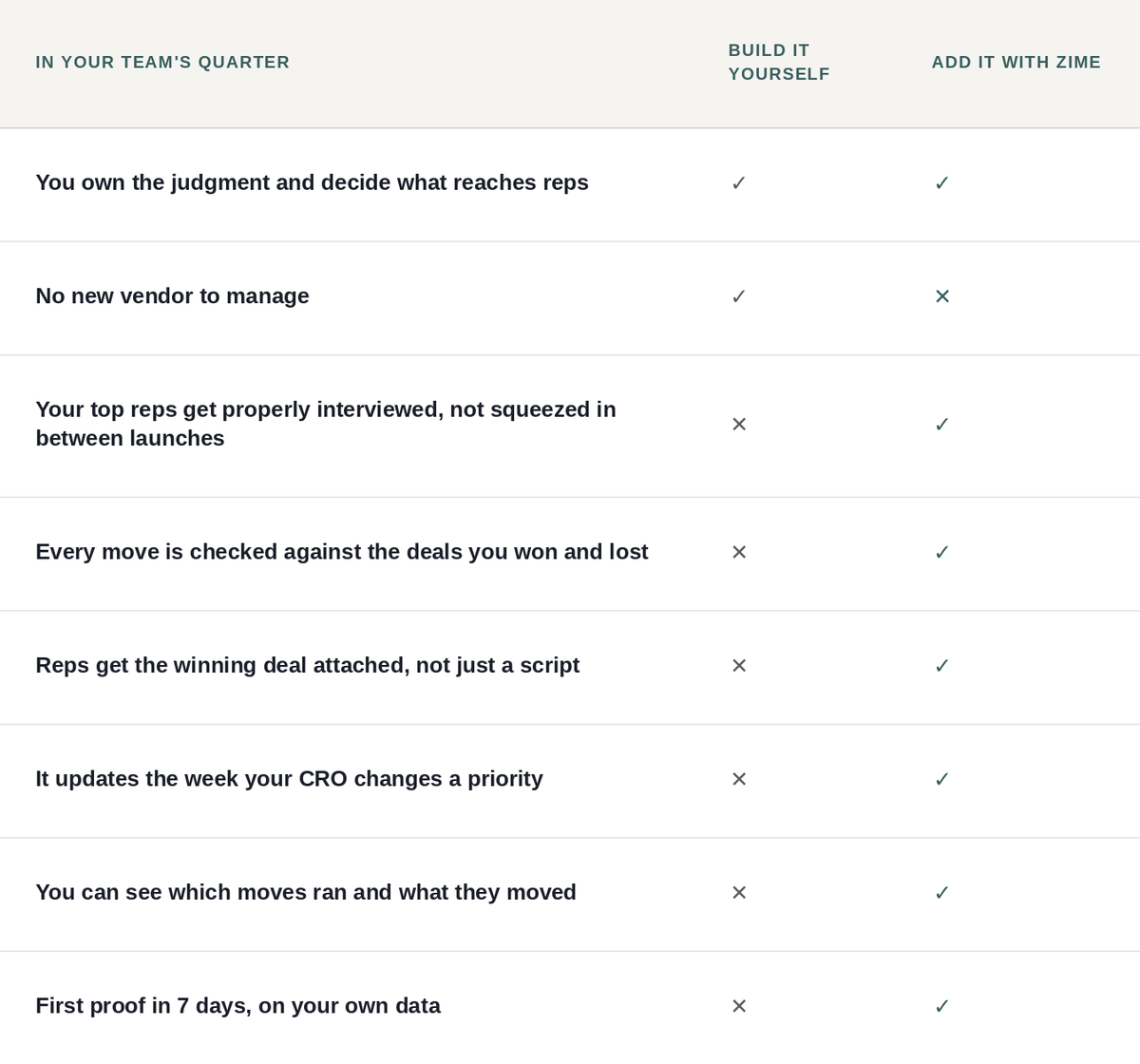
And by the time it ships, the CRO has moved the priority. A new competitor is in your deals. The playbook's stale by week six. So you refresh it, and buy one more tool to push the refresh.
Keep what you bought. Stop hand-writing the judgment.
What changes once the move reaches the deal
At MyAdvice, checklist adoption rose from 66% to 87%, and fatal objections fell from 38% to 4%. At SonicWall, reps making a clear ask at the end of the call rose from 30% to 40%. Versa Networks reported a 12% increase in win rates, an outcome HFS Research cited in its July 2026 profile.
At Bureau, new messaging reached reps on the deal, not in a training session:
"We improved our ARR by 10% with Zime seamlessly getting our product releases to our sales team in the form of just-in-time Actions."
Ranjan R Reddy, Founder & CEO, Bureau Inc.
At Versa, reps used it for themselves. The enablement lead who named the tool-buying reflex saw the difference:
"Zime is a useful tool for the account executives themselves and not just managers. It's a self-help tool for AEs."
Mickey Singh, Sales Enablement Lead, Versa Networks
None of those reps got another tool. They got the move, right where they already were. Nobody had to train them on it. Same as Google Maps.
Add the move reps run.
New tools won't get your strategy adopted. Judgment will. Zime encodes what your best reps and your CRO know, and delivers it as behaviors where reps already work. Keep everything you've bought. Go live in 7 days on your own data.
Bring your usage numbers. We'll show you the first behavior to encode, and how you'll know it ran.
FAQ
AI sales coaching vs workflow-embedded execution guidance: which changes rep behavior more?
Guidance in the flow of work, as long as it carries judgment. Coaching builds skill, and it still matters when it coaches on the same moves. But what a rep does on a live deal changes when the move shows up where he already works, fits this deal, and comes from how your best reps won. Flow without judgment? That's just one more notification to skip.
Our reps already have too many tools. Isn't Zime one more?
No new app needed. Behaviors show up in Slack, Teams, Claude, or the CRM before the call, on the deal the rep is working. Managers coach on the same behaviors, in the places they already review deals. The whole point is to take a login away, not add one.
Doesn't our GTM agent already tell reps what to do?
Yes, and that's fine. Both recommend a course of action. The difference is where it comes from: one reasons from patterns in past data, the other from your reps' judgment and your CRO's authorized strategy.
We already bought a coaching tool. Should we drop it?
Not if it works for ramp. Keep it for new hires and pitch practice. What changes is what coaching runs on once reps hit live deals: the behaviors your best reps won with, on the rep's own deals, reviewed by their manager against the same standard.