Two companies built. One made it stick. Here's what their reps do on a live deal now.
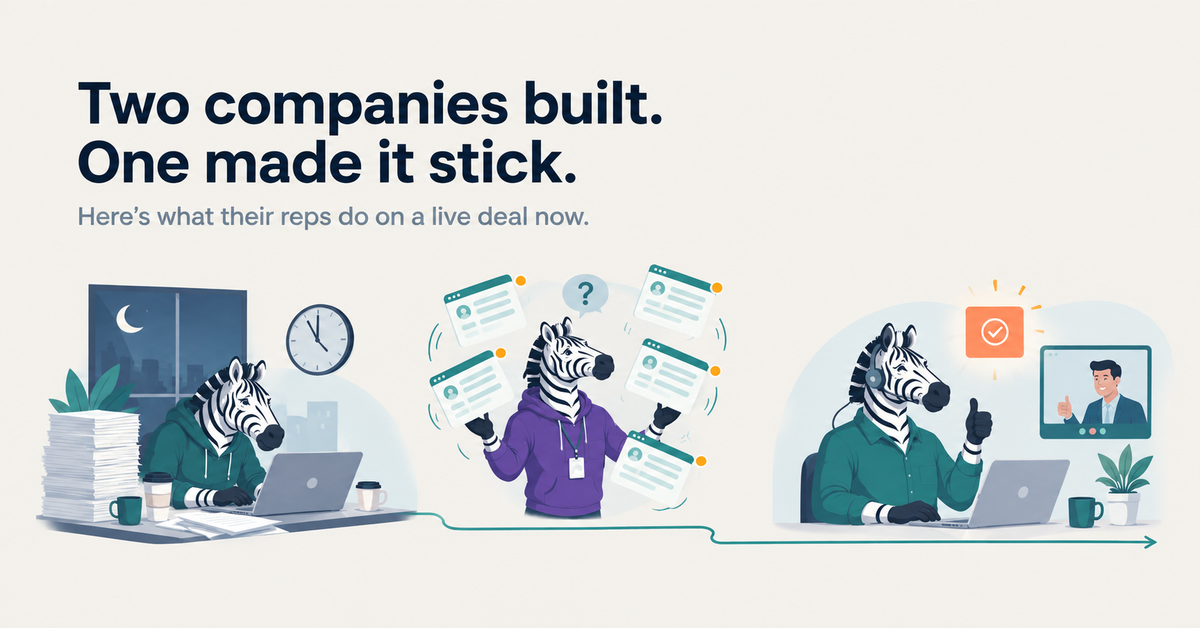

- The builds are real, and so is the board story. CROs are opening terminals, shipping agents, and hiring GTM engineers. That is real engineering.
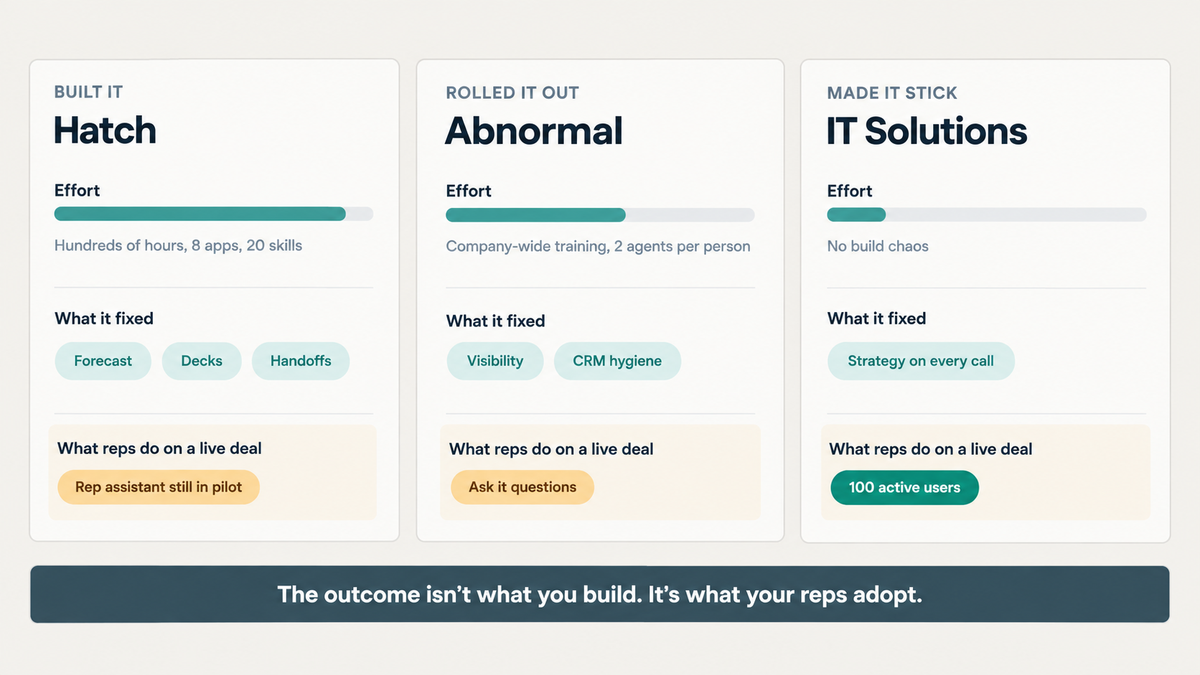
- But teaching reps what to do costs a CRO his nights. At Hatch, eight months in, it is a Sales Bible built from one rep's calls. One rep, one context.
- And rolling it out doesn't make reps use it. At Abnormal, the build fixed visibility and efficiency. Sellers still use it to ask questions. Nobody gets help on pricing or on when to walk away.
- That is a behavior problem, and behavioral science explains it. Nothing prompts the right move at the right moment, from a source reps trust. The winning move was never in the data.
- So put the science in the product. At IT Solutions, Robert Adams got adoption without the chaos. His team grew from about 30 reps to 100 active users, and the business paid to expand it.
Every CRO we talk to this year has an AI slide in the board deck. A lot of them built what's on it.
A forecast agent built in Claude Code. A Slack bot that answers deal questions. Prep notes that write themselves before every call. CRM fields that fill in after it.
Some went further and hired a head of GTM engineering to own it. For a board asking what sales is doing about AI, that is a strong answer. It shows the CRO can ship.
We hear the story on stage at SaaS conferences. We hear it on our podcast. We hear it in interviews with CROs, and with the teams working inside AI-native tools. The details change. The shape doesn't.
The CRO builds. The build works. Then someone asks what reps do differently on a live deal, and the room goes quiet.
We picked three stories that cover the whole arc. From the first terminal to the last rep.
Here's what we cover:
- Hatch, as covered in The Signal: what it actually takes to build the GTM engine yourself
- Abnormal: what happens when a build meets a whole sales org
- Why adoption didn't come, according to behavioral science
- IT Solutions: how one CRO got adoption without the chaos
- Three takeaways, outcome first
Alright, let's get into it.
Story 1: what it takes to build
In September, The Signal profiled Tim Geisenheimer, CRO at Hatch. It is one of the best builds we have seen.
Tim opened a terminal for the first time eight months ago. Today his 100-person revenue org runs on what he built in Claude Code. He didn't hand the job to an engineering team. He built it himself, and by his own estimate it took "hundreds of hours, probably more."
Read the inventory slowly. 8 internal apps. 20 skills. 18 context files and 43 memory files. A forecasting cockpit of roughly 39,000 lines and 188 commits. A Sales Bible distilled from 409 calls of his top rep. All of it is wired into HubSpot, ChartMogul, and BigQuery.
And a lot of it works. The cockpit is now the screen leadership opens first.
But look at the one piece meant to help reps in a live deal: the Sales Bible. It is a single document, built from one rep's calls and written by the CRO. It captures how one person wins, in one context.
Now size it the way your own org sells. Say 4 buyer personas, 6 competitors, 5 deal stages, and 3 regions. That is 360 situations, each with its own winning move.
Put hours on it. Say each situation takes ten hours to get right: pull the calls, sit with the rep who wins it, write it up, test it. That is a modest guess. It still comes to 3,600 hours, close to two years of one person's full working time.
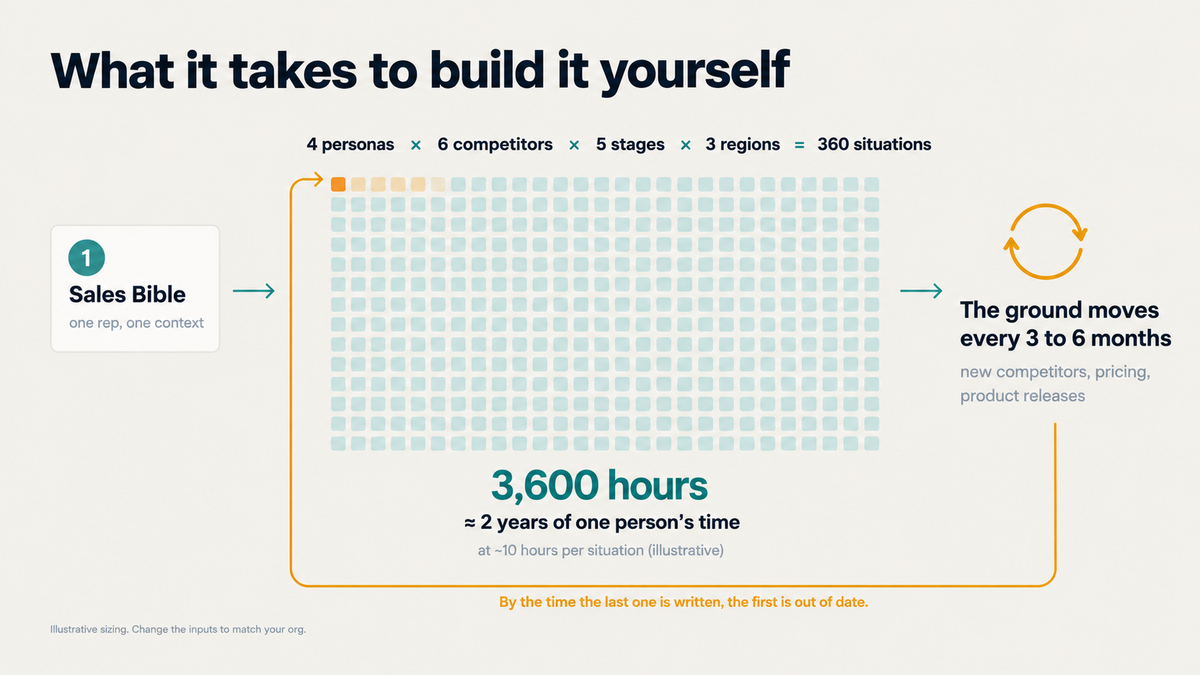
And the ground moves while you write. A new competitor lands. Pricing changes. A product ships. By estimates, the selling surface resets every three to six months. By the time the last situation is written, the first one is out of date.
Similarly, back at Hatch, the rep-facing assistant is still in pilot. Eight months in, the build serves leadership well. It hasn't reached reps at scale. The reps are selling tonight either way. No knock on Tim. He built more in eight months than most teams ship in two years. The math of the job is the problem, and it gets harder as you grow.
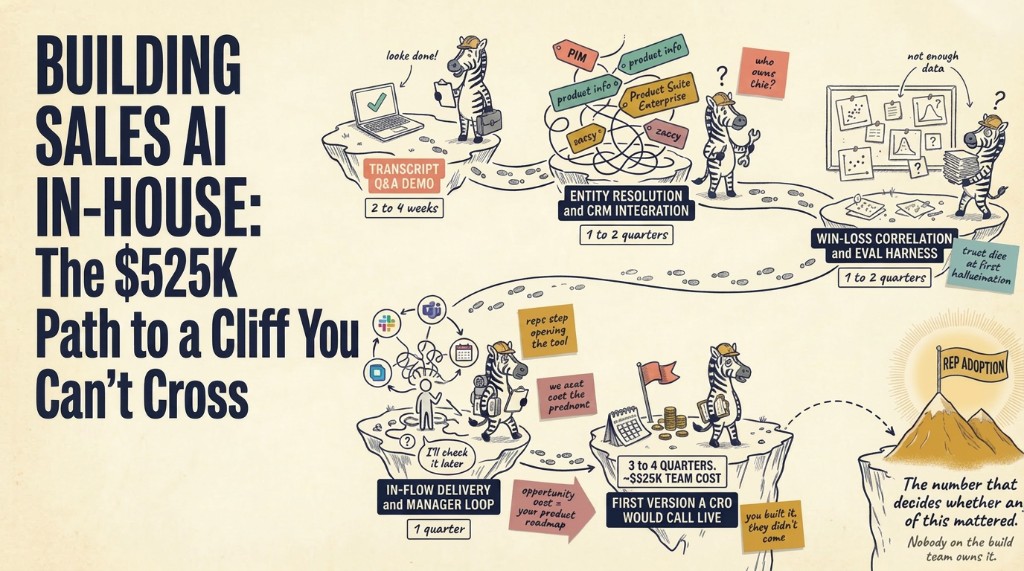
So you do what a serious CRO does. You stop doing it alone and staff a GTM engineer team. By our modelling, that's about 11 people, 9 months of work, and roughly $4 million over three years. That is a lot of board goodwill to spend before a rep sees a single move.
And say you do get there. All 360 situations built, staffed, and current. Now comes the hard part: getting 2,000 people to use it.
Story 2: what happens at rollout
To find out, we talked to sales leaders we met this year at Abnormal.
Abnormal grew from about 300 people to more than 2,000 in four years. New regions. New verticals. People join every week, and some leave.
The leaders were clear that the build paid off where it was aimed. Call data now flows to product teams, so objections and feature requests don't die in a recording. CRM fields fill themselves. The stated AI strategy is efficiency: keep deals in motion, generate pipeline. On visibility and efficiency, the build delivers.
Meanwhile, the tools stacked up. Gong. Spinach. Claude. As one leader put it, "five tools that can do the same thing." Each came with its own learning curve.
"It just doesn't scale… because there are too many bits and pieces."
So, the company built agents and made AI mandatory. Everyone had to complete Cowork 101 and 201. AI literacy went up across the company. That was the point, and it worked.
And yet the adoption of a CRO never came. Sellers use the agents the way they use search. They ask a question, read the answer, and go back to what they were doing.
"Everybody still uses it for question responses… It's still sort of at that IQ level. Yes, no answers."
Picture a seller in round three of a pricing negotiation. The buyer wants 20% off and a longer term. Five tools are open, and none of them says what to do. So the seller does what sellers do. Discounts a little and hopes.
That is exactly where the leaders said the gap sits: pricing, and knowing when to walk away. No agent helps with either. Everyone knows it. It is a priority from the founders down.
"They're getting stuck on hope, hoping that deal is gonna move forward."
We heard the same pattern elsewhere. At one company, reps didn't trust Claude's feedback on their calls, because it missed context they knew mattered. At another, a leader running Claude on top of Gong wasn't convinced rep behavior had changed at all. At a third, an in-house Claude integration couldn't make reps consistent from one deal to the next.
Different stacks. Same place the build stops.
Why adoption never came: what behavioral science says
This isn't a tooling problem, and more tools made it worse. It is a behavior problem, and behavior change is one of the most studied subjects in psychology. Five findings explain almost everything above.
No prompt at the moment of action. BJ Fogg's behavior model says a behavior happens when motivation, ability, and a prompt meet at the same moment. Reps have the motivation. The agent gives them ability. But a question-and-answer agent waits to be asked. In round three of a pricing call, nobody is asking.
Intention is not action. Reps agree with the strategy at kickoff. Then Tuesday happens. Research on the intention-behavior gap finds that intentions explain a surprisingly small share of what people do. What closes the gap is a specific plan: when this happens, I'll do that. Psychologists call it an implementation intention.
Too many choices, so none. In a well-known study, shoppers offered 24 jams were far less likely to buy than shoppers offered six. Five tools that do the same thing work the same way. Reps pick none and fall back on the default: winging it.
Training decays. Ebbinghaus measured the forgetting curve in the 1880s, and it still replicates. Most of what you learn fades within days unless you use it again. A 101 course happens once. The pricing call happens next quarter.
People act on advice from someone who won. Source credibility shapes whether people use advice. The same message lands differently depending on who says it. Reps who don't trust an AI's read of their call ask a colleague instead. They want the move from someone who has closed that deal.
Put the five together, and they point at one root cause. The winning move was never in the data. It lives in your best reps' heads and in your CRO's strategy. So no tool can serve it at the right moment, with the right authority.
To be fair to every system here: they all recommend it. A good agent on a good context graph will suggest the next step. The difference is where the suggestion comes from. One reason is from patterns in past data. The other reasons are from your reps' judgment and your CRO's strategy.
How Zime puts the science in the product
We built Zime on those five findings. Each one maps to a design choice.
- A prompt at the moment. Behaviors reach reps before and after calls, in Slack, Teams, and Claude. Nobody has to remember to ask.
- A plan, not a principle. Each Behavior is one specific move for one situation. When the buyer pushes on price at this stage, do this.
- One tool, not five. There is nothing new to learn. Zime runs inside the stack reps already use, including agents your team has built.
- Reinforcement, not a course. The move comes back on the next deal where it applies, and Zime checks that it was run.
- From someone who won. Behaviors come from your own best reps and your CRO's strategy. Zime's forward-deployed engineers elicit them through interviews and RLHF, including judgment that never shows up in a transcript. Each Behavior links back to the deal it won.
Here's what that looked like at IT Solutions.
Story 3: adoption without the chaos
Robert Adams was CRO at IT Solutions for three and a half years. Around 2024, with about 30 reps, he went looking for AI.
He tried note-takers first. Several of them. They summarized calls well, and they all looked the same. What he wanted was different: reps coached on his strategy, on every deal.
His verdict, as he put it to us:
"Zime is the only company that understands my sales strategy and coaches my reps."Robert Adams, former CRO, IT Solutions
Robert wasn't against building. He just knew where a CRO's hours should go. "We want you to be revenue generating, not some task admin," he told us. On staffing an in-house build, he was blunter: "I don't need the five people."
That math matters more for a CRO than for anyone. Average CRO tenure is just 25 months, among the shortest in the C-suite, according to HBR. A build that takes a year to reach reps spends half of it.
Here is what that looks like across one rep's week.
Before a call, the rep gets a prep note with the moves for this deal, checked against MEDDPICC. If the champion is thin. It says so and says what to ask.
At the end of the week, managers open the coaching report. DeAnne Anderson, VP of Sales Operations, said it made one struggling rep's pattern "very telling." In between, reps ask Zime their deal questions directly.
Walk the five findings through that week. The prompt arrives in the workflow, before and after the call. It is one place, not five. It comes back on every call, so nothing decays. The move comes from Robert's strategy and the reps who were already winning.
The team started with about 30 reps. By August 2026, IT Solutions had 100 active users across AEs, Strategic Advisors, and an ISR team. The ISR team was an expansion the business paid for. A second expansion is being scoped now.
A senior AE on the healthcare team said it plainly:
"...come to rely on Zime for all of our meetings and help train other people on it."John Degen, Senior AE, IT Solutions
The CRO kept his hours. The reps kept using it.
Three takeaways
1. The outcome isn't what you build. It is what your reps adopt, the revenue it drives, and how fast the business moves. Count those, not apps and skills.
2. Adoption is a behavior problem. More tools and more training made it worse at the companies we talked to. What works is the prompt, the moment, and the source.
3. Keep building, and add the layer that makes it stick. The build is a real story for the board. Keep telling it.
Where Zime fits
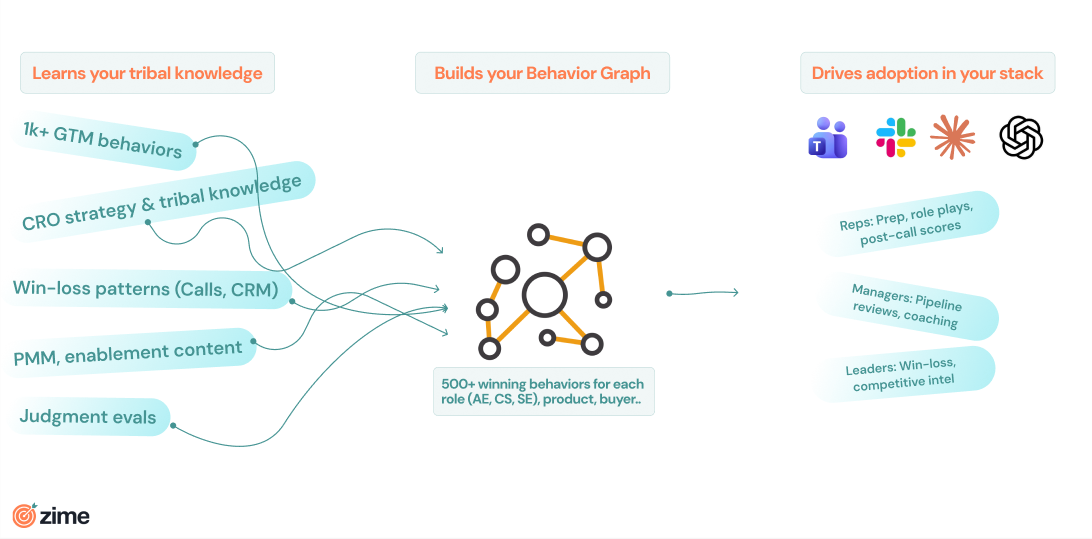
Zime is Behavioral AI for Sales Execution. It runs on your Claude, Teams, Slack, email, etc., so nothing gets ripped out, including the agents you have built.
- The Behavior Graph holds judgment elicited from your best people, plus your CRO's strategy.
- Behaviors reach reps where they already work.
- Live in 7 days.
- Adopt by 80% of eligible reps within 90 days.
HFS Research cited Versa Networks' 12% increase in win rates. Versa's CRO put the ask simply:
"I wanted Zime to understand my playbooks and coach reps. No other tool does this."Martin Mackay, CRO, Versa Networks
At Bureau, the gain showed up in deal size:
"Average deal size increased by 30% on the back of improved discovery."Kapil Bhagat, AVP, Sales Strategy, Bureau Inc.
Add the layer reps adopt.
Building proves you can ship. It doesn't make reps change. The right move, at the right moment, does. Keep your build; Zime adds that layer where reps already work.
The way forward is small. Pick one moment your reps get wrong today, like the pricing push or the walk-away call. Prove one Behavior on your own deals, live in 7 days, then scale it. If you're a CRO, we'd like to hear what your reps do with it.
FAQ
How are revenue teams at mid-market tech companies using agents built on Claude or ChatGPT for deal guidance?
Mostly for efficiency and visibility. The builds we looked at handle forecasting, decks, CRM updates, and call data for product teams. Deal guidance for reps lags. In one build, it is still in pilot. In another, reps use it to ask questions, with no help on pricing or on when to walk away.
Should our GTM engineering team build a sales execution agent in-house or buy a platform?
Build the efficiency work: forecasting, decks, routing, and CRM hygiene. Encoding what your best reps know is different, because it multiplies with every rep, product, and market. By our modelling, a department-sized build takes about 11 people, nine months, and roughly $4 million over three years. Many teams keep their build and add a layer that makes it stick.
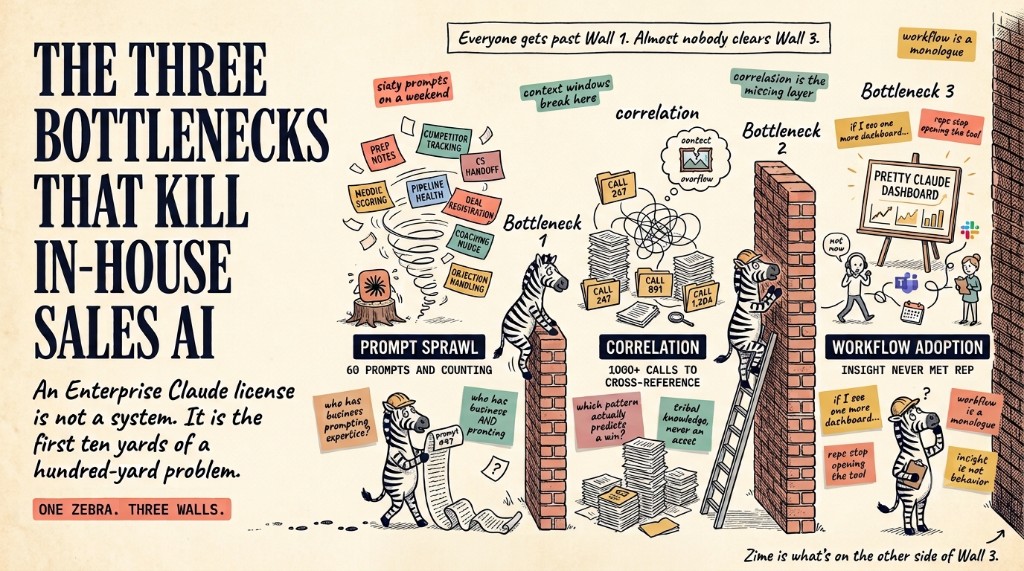
Why don't sales reps adopt in-house AI agents?
Behavioral science points to five reasons. Nothing prompts the move at the moment of action. Intentions don't turn into action without a specific plan. Too many tools push reps back to winging it. One-time training fades. And reps act on advice from someone who has won, not from a generic answer.
Does Zime replace the agents we've already built?
No. Zime runs on Claude and works inside the stack your reps already use, including agents your team has built. It adds the judgment your best reps carry and your CRO's strategy, delivered as Behaviors before and after calls.
How long does it take to see adoption?
Zime is live in 7 days on your own deals. Teams typically reach 80% of eligible reps within 90 days.