Why doesn't a context graph or RAG make sales agent recommendations trustworthy to reps?
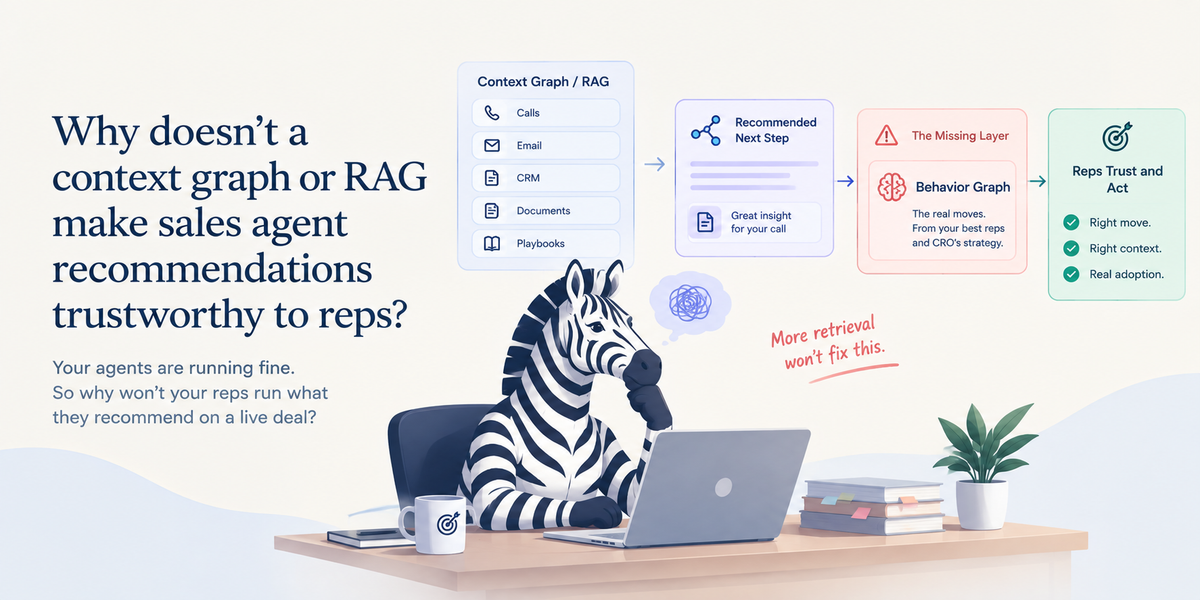

- Your context graph or RAG layer already recommends a next step. It retrieves the closest past deals and surfaces what usually won from there.
- But reps never use it in real conversations. A rep runs a recommendation only when it fits his deal, it is what his CRO wants, and he can see another rep win with it.
- And more retrieval won't give him that. Frequency is not fit, the CRO's latest play never reaches the system, and the judgment behind the winning move was never written down.
- That judgment is what a Behavior Graph adds. It is elicited from your best reps through FDE-run interviews and Zime modules, including what never shows up in a transcript, tied to your CRO's current strategy, and delivered with proof from the deal it won.
- So keep the harness and the retrieval. Buy the judgment. One finds precedent. The other gives the rep a reason to run it.
You built agents on Claude. They index every call and deal into your context graph over MCP, and they recommend a next step to your reps. When a rep opens one mid-deal, it retrieves the closest historical matches and surfaces what usually won from there. It is fast and accurate.
Then you check adoption, not accuracy. The recommendation is defensible almost every time you spot-check it. Reps still skip it on the calls that actually decide the quarter.
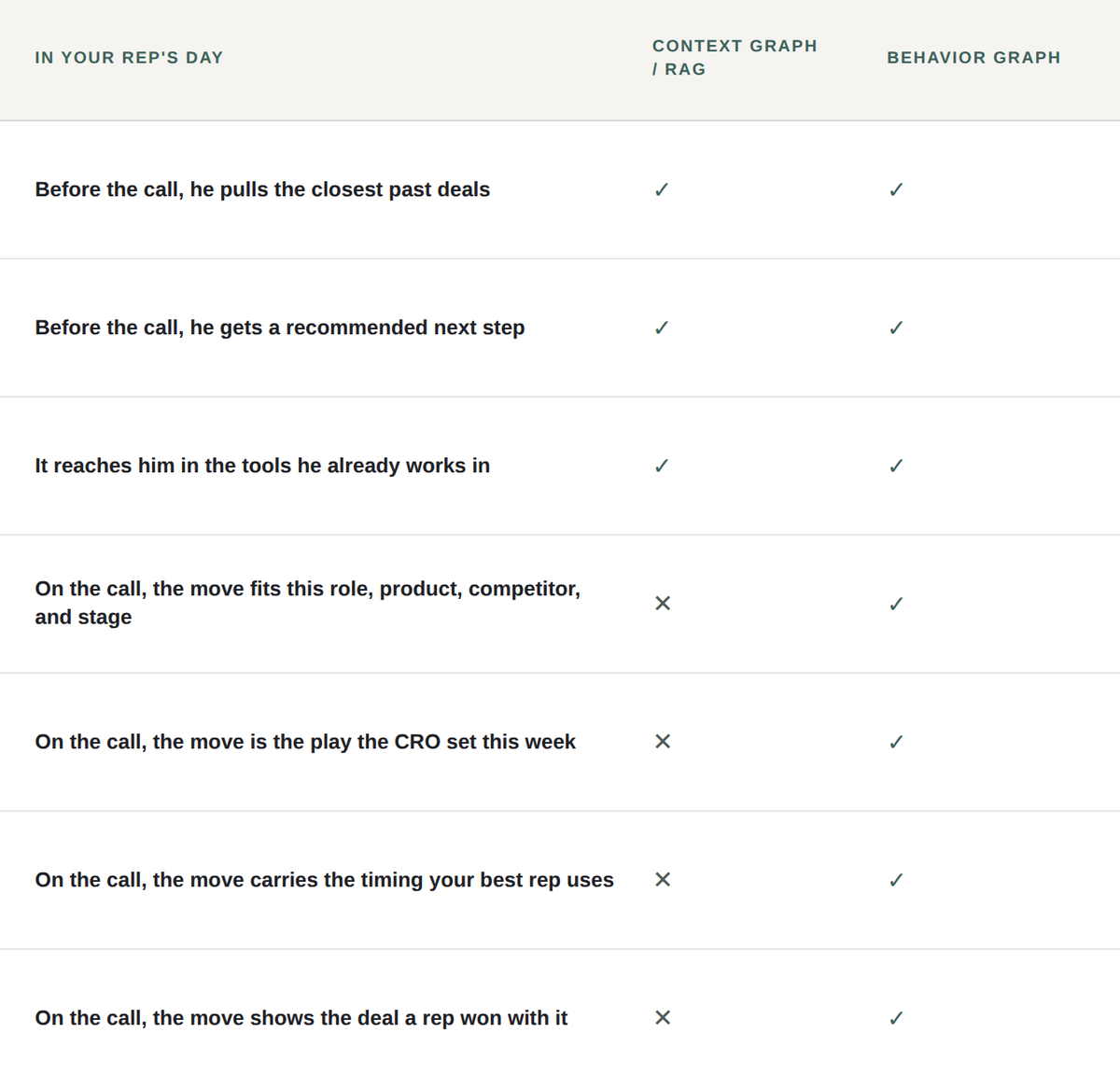
A rep runs a recommendation when three things are true. It fits his deal. It is what his CRO wants right now. And he can see a rep who already won with it. Miss any one, and it reads as generic, out of date, or unsourced.
None of this is a generation problem. Foundation Capital called context graphs AI's trillion-dollar opportunity in December 2025, and retrieving the closest precedent is a real, necessary capability. The problem sits one layer deeper.
Watch the pattern fail on a live call
A rep is mid-call against a competitor your company has fought a hundred times. The retrieval layer has plenty of precedent: the rebuttal that won most often over the last eighteen months. Two weeks ago, your best rep beat this same competitor a different way, leading with one proof point before the buyer could even object. Nobody asked her why it worked. The CRO liked it enough to make it the new play anyway. Neither fact ever reached the system, not the CRO's call and not the rep's timing. So the agent hands this rep the old rebuttal. This buyer has already heard it from two other vendors. It was the wrong move for this moment.
Retrieval isn't what breaks
Nothing failed at retrieval. It found the closest neighbors correctly, and there were plenty of them. Nothing failed at ranking, either. It surfaced the move that won most often across eighteen months of real history. The break is upstream of both steps. Winning most often across history was never the same test as what the CRO authorized two weeks ago, and nothing in the system knows a decision was made at all.
Root cause: the winning move was never in the data
Each of the three trust conditions breaks for its own reason. None of them is a retrieval problem.
- Frequency is not fit. Ranking tells you what won often, not what fits this role, product, competitor, and stage.
- Strategy changes, but the system never hears about it. The CRO changes the play, and nothing turns that change into what a rep should do on the next call.
- Judgment nobody wrote down. Your best rep's timing lives in her head, not in a document or a transcript.
Chitresh Yadav runs sales engineering at Versa Networks. He put that third kind of judgment plainly:
"There's no silver bullet to handling the objection."
Chitresh Yadav, VP and Global Head of Sales Engineering, Versa Networks
How his best reps handle it lives in their heads, call by call. No transcript holds it, so no ranking can surface it.
The fix: encode the judgment, align it with CRO strategy
The layer that carries this is a Behavior Graph. It sits on top of the context graph you already built and encodes three inputs into one model unique to your company. It produces Behaviors: the specific move to run for this motion, this role, this product, this competitor. The three inputs are:
- Your best reps' judgment, elicited through FDE-run interviews.
- Your CRO's authorized strategy: your tribal knowledge, winning patterns & anti-patterns.
- The entity context of your past deals.
Instead of ranking by frequency, it asks a narrower question: what does your company authorize for this exact role, product, competitor, and stage, right now?
HFS Research profiled Zime in July 2026 and named the same gap from the outcome side. The CRO's plan does not convert to execution, so reps revert and win rates stall. Their prescription matches: learn from how deals were actually won, and ship it where reps already work.
Now replay the call. Same rep, same competitor. This time the card in his workflow fits his deal, carries the play the CRO authorized two weeks ago, and shows the deal his best rep won with it. All three conditions hold. He runs it.
Both systems recommend a course of action. The difference is where the recommendation comes from.
How do you get a Behavior Graph for your agents?
Getting one takes three pieces of work. None of them is a model call.
- Elicit the judgment. Sit with your best reps, role by role, and get the moves they run by reflex into words. Then score real calls against those moves. That is what FDE-run interviews and RLHF do.
- Bind it to your CRO's strategy. Every move needs someone who authorized it and a version, so this quarter's play replaces last quarter's instead of sitting next to it.
- Resolve it against your data. Map each move to the entities in your context graph, so the system knows a competitor from a partner and fires the right move in the right deal.
Then it has to reach the rep where they already work, before the call or during it. You can do all of this in-house, or you can buy it.
Should you build or buy the Behavior Graph?
You could build the Behavior Graph yourself. It is not harder engineering work than the retrieval you already shipped. It is a different job: interview-and-scoring work, a sales discipline.
The Signal profiled a CRO at Hatch who runs his revenue org from Claude Code. Eight months in, his judgment is still hand-built: a Sales Bible from 409 calls of his single best rep, on top of 18 context files and 43 memory files. That is one rep, elicited by hand.
Now calculate it across every role, product, and competitor. That is months, not weekends. And by our estimate, the surface resets every three to six months, whenever a product launches or a competitor moves. So the library ships behind the strategy, and you become its permanent maintainer, always catching up instead of compounding return.
"The danger with Claude is that inadvertently, you've become a builder. That's a dangerous place to be, because you're going to spend a ton of ops cycle time on that."
Peter Kim, Head of GTM, WestBridge Capital Management
Chitresh did this math at Versa. He was already running AI in his own Claude for follow-ups and prep notes, and his in-house agents gave him visibility. They did not give him adoption across the field. He scoped closing that gap as a 12-to-24-month build and roughly a million dollars of GTM engineering, with tribal knowledge encoded into hundreds of skills and kept current by hand. He chose to get the judgment running with Zime instead. The Versa case study has the full story.
Honestly, for one product and a short competitor list, a hand-maintained rules file on top of retrieval can hold up. Past that, split the two jobs. The harness, the agents, the MCP plumbing: that is engineering, and it stays yours. The judgment layer is the piece worth buying, because it moves faster than you can rebuild it. Zime runs on Claude, so nothing you built gets ripped out. The fuller build-versus-buy math is in Should you build GTM agents in-house on Claude, or buy a platform?
What changes once reps trust the move
At Versa Networks, only 20% of sales engineers ran technical discovery the right way at the start. Three months after the Behaviors reached them in Teams and Salesforce, 79% did. Technical wins rose 12%, and leakage from committed deals fell 24%.
"As I look at my team, the adoption rate has improved... People were skeptical at first."
Brent Bair, Regional Sales Leader, Versa Networks
At Bureau, the same shift showed up around new product launches:
"We improved our ARR by 10% with Zime seamlessly getting our product releases to our sales team in the form of just-in-time Actions."
Ranjan R Reddy, Founder & CEO, Bureau Inc.
Give your reps a reason to run it
Zime adds the judgment layer on top of the agents you built on Claude: your best reps' moves and your CRO's current strategy, delivered as Behaviors, each one carrying a receipt from the deal it won. Live in 7 days on your own pipeline, enough to prove one Behavior before you scale it. Book a demo →
FAQ
Why don't context graphs or RAG make sales agent recommendations trustworthy to reps? Because it can only rank what was logged. It surfaces the move that won most often across your history, not the move your company authorizes for this exact role, product, competitor, and stage. The judgment behind that move lives in your best reps' reflexes and your CRO's head, never in the corpus. Reps can tell, which is why accurate output and low adoption can both be true at once.
Isn't the most common winning move a safe default? It looks safe, which is the problem. It passes every spot-check because it is plausible, but a rep can hear that it is the average of past deals, not the move for this one. And it goes wrong the moment your CRO changes the play.
Doesn't my context graph or RAG layer already recommend a next step? Yes. Both systems recommend a course of action. The difference is upstream: one ranks from historical correlation, the other from your reps' elicited judgment and your CRO's authorized strategy for this exact situation. The fuller argument for why that gap breaks trust is in: Is a context graph enough for your GTM agents?
Will this replace the recommendation layer I already built? No. The harness and the retrieval stay yours, and Zime runs on Claude. Zime adds the judgment layer underneath, so what reaches the rep is the move your company actually stands behind.