Which context graph or knowledge-layer product is best for a sales team, and what will none of them hold?

- Any product on your shortlist is a fine context layer. Knowledge layers, GTM data graphs, revenue context built from calls and enablement engines all connect your sources and answer with citations. If you have one, keep it. If you are adding one, add it.
- But the hard part is getting reps to run what the agent returns. A rep asks what to say when the incumbent is cheaper. Each product can find the calls where price came up. None can find what your best AE does next, because nobody wrote it down.
- And connecting more sources will not find it. How your best reps win and what your CRO decided this quarter live in people. They sit in no call, doc or CRM field. So test each product on your own rep tickets before you pick one.
- That missing input is what a Behavior Graph holds. It is a model of your best reps' moves, your CRO's current strategy and your past deals, taught by your best people, including what never shows up in a transcript. It returns the move for this deal, with the won deal behind it.
- So keep your graph and your agents, and add the layer underneath. Zime runs on Claude, so nothing you built is replaced. You know it worked when you can see, rep by rep and call by call, that the move ran.
Your ticket queue already says what the agent is missing. Marcus, an AE, sends one on Monday: the incumbent is cheaper, what do we say? Priya, an SE, asks how the team wins a POC against your biggest competitor. Neither is an engineering question. Both are about how your company sells.
So you open the shortlist. Three demos, three graphs of accounts, contacts and calls. You paste Marcus's ticket into each. Each answer comes back accurate and cited. It lists the calls where price came up.
You built the agents and the skills, and they work. But no demo shows the one thing that decides it. Will Marcus run the answer on his next call?
What the shortlist actually compares
Foundation Capital has called context graphs AI's trillion-dollar opportunity. An agent cannot reason about a deal it cannot see.
Knowledge layers search docs, wikis and chat with permissions intact. GTM data graphs resolve accounts and contacts and add buying signals. Revenue context from calls captures every conversation and ranks what correlated with wins. Enablement engines serve approved messaging to agents. Your own graph on Claude gives you control of every source.
All of them recommend a next step. What differs is where the recommendation comes from.
The table below scores the five classes on what a sales agent needs. Every class covers most of the first four jobs, and none holds the last three by connecting one more source.
| What the agent needs | Knowledge layer | GTM data graph | Revenue context from calls | Enablement engine | Your own graph on Claude |
|---|---|---|---|---|---|
| Connect docs, CRM, email and calls | ✓ | Partial | ✓ | Partial | ✓ |
| Resolve accounts, contacts and deals | Partial | ✓ | ✓ | ✗ | ✓ |
| Answer with sources cited | ✓ | ✓ | ✓ | ✓ | ✓ |
| Recommend a next step | ✓ | ✓ | ✓ | ✓ | ✓ |
| Hold how your best reps win each moment | Partial | ✗ | Partial | Partial | Partial |
| Hold this quarter's CRO strategy as moves per role | Partial | ✗ | ✗ | Partial | Partial |
| Show whether the rep ran the move on the call | ✗ | ✗ | Partial | ✗ | Partial |
The deciding row is how your best reps win each moment. Wherever it reads Partial, the reason is the same. The product holds it only if someone wrote it down.
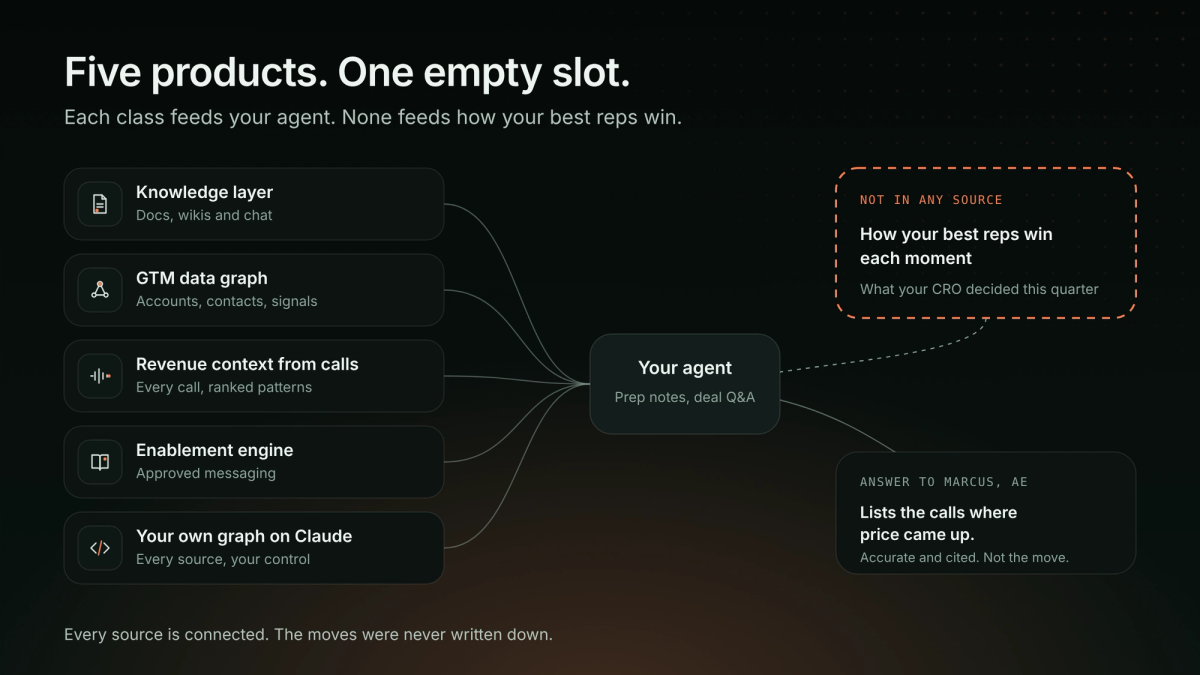
That empty slot is why a graph alone stalls, as is a context graph enough for your GTM agents? explains.
Why no connector can reach it
Go back to Marcus's ticket. The answer he needs is in how your best AE handles a cheaper incumbent. She stops defending price and walks the buyer through total cost. She has never written that down. Nobody writes down a reflex.
The CRO's half is the same. This quarter's priority lives in a kickoff deck. Reps meet it nowhere else.
Martin Mackay is CRO of Versa Networks. Versa sells SASE against ten named competitors, in deals from $100K to $3M. On a win-loss call with Zime, he named the first thing he wanted to know:
"...what do the most effective reps do in terms of moving a deal forward and then eventually closing it?"
Martin Mackay, CRO, Versa Networks
No record holds that answer. His best reps do.
Chitresh Yadav runs Versa's 100+ SEs across four regions, and he had already built prep notes in Claude. On a competitive call, his question was whether the rep matched what the company had decided:
"...whether my rebuttal to those were inline to our battle card."
Chitresh Yadav, VP and Global Head of Sales Engineering, Versa Networks
A context product can find the rebuttal. Only the people who wrote the battle card can say it was right.
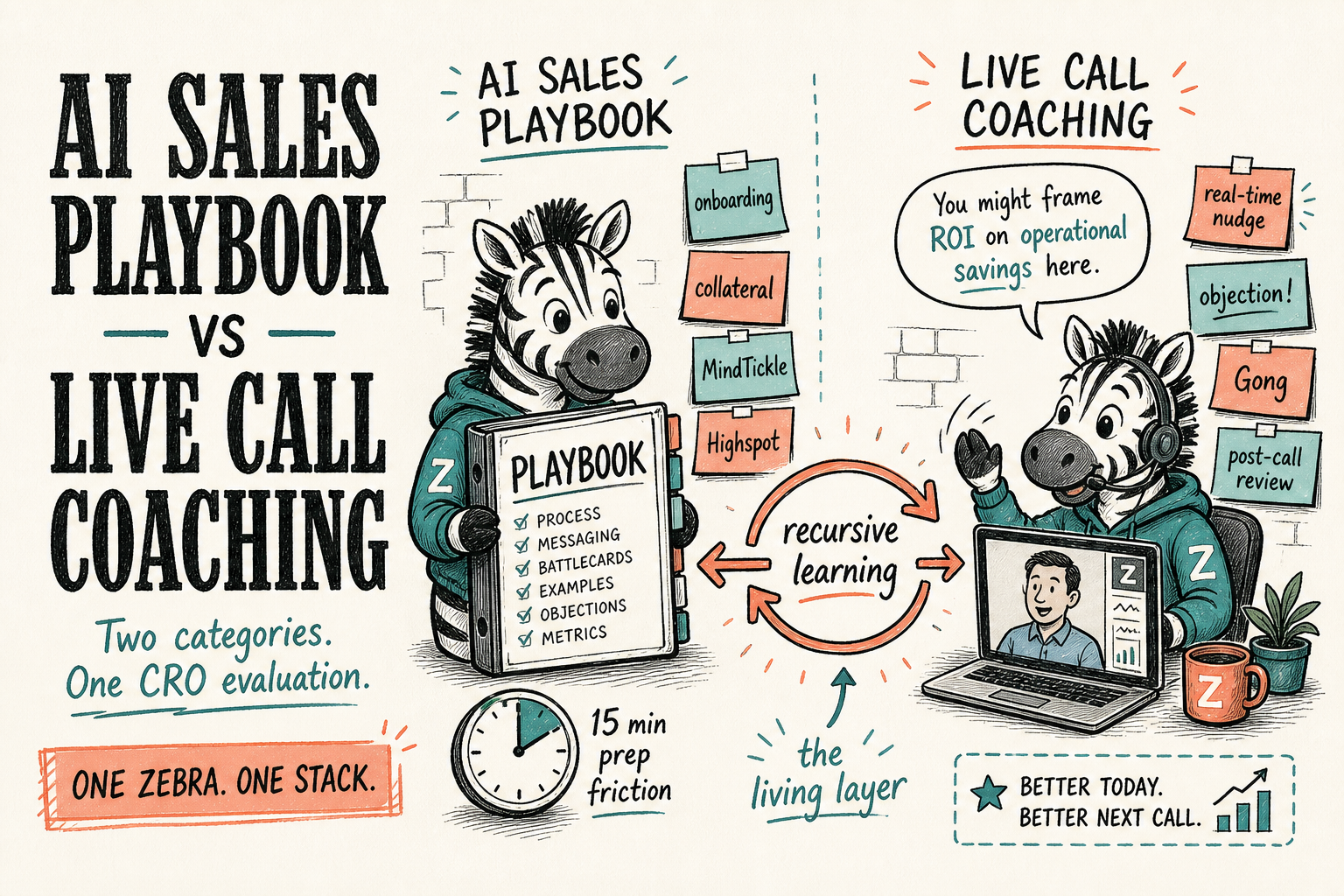
Zime's sales deck sizes it: your strategy runs on 1,000+ behaviors. Nobody has written them down, tested them or kept them current. A behavior here means one specific move, for a given role, moment, product and competitor.
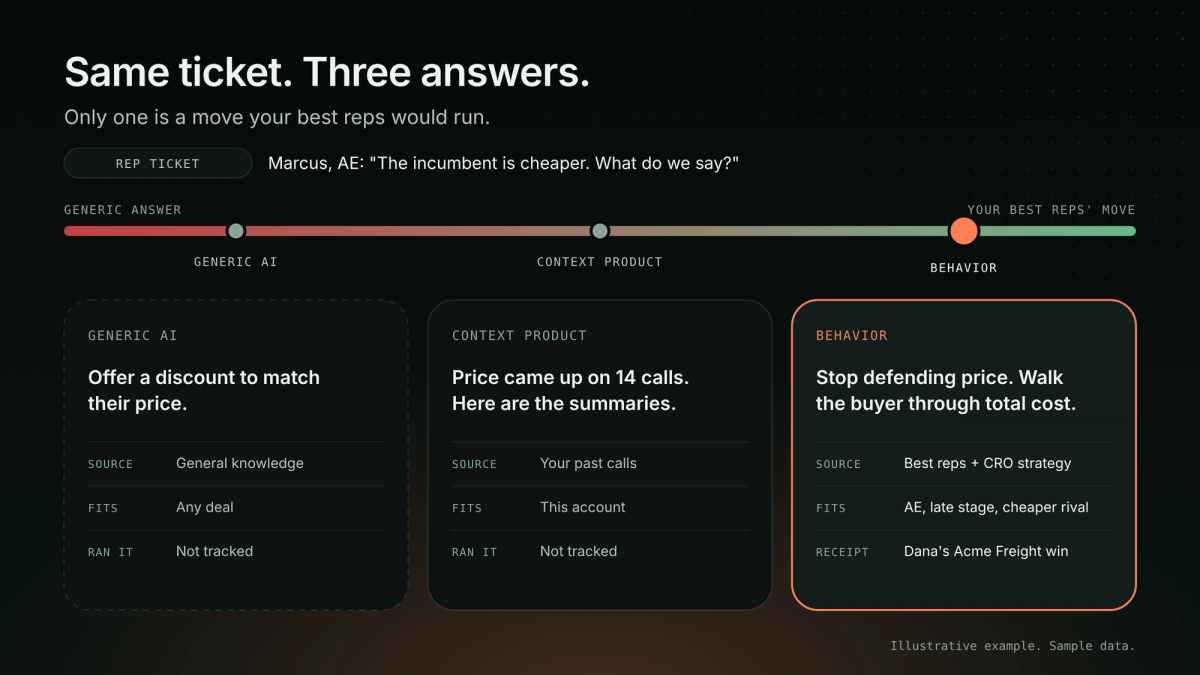
You can check this before you talk to any vendor. Test for the moves, not the connectors.
The ticket test. Pull twenty rep tickets that ask how to sell. Ask your two best reps what they would do. Run all twenty through each product and have those reps score the answers blind. Pass: the answer names their move and a deal where it worked. Fail: it lists the calls where the topic came up.
The priority test. Pick one thing your CRO changed this quarter. Ask each product about it next Monday. Pass: the answer reflects the change with nobody rewriting a doc. Fail: it repeats last quarter.
Twenty tickets give direction. They are not proof. The table below runs the ticket test on illustrative sample numbers, and it shows the usual result: every product answers, and few answers get run.
| Shortlisted class | Tickets answered with sources | Answers your best reps would run | Priority test | Verdict |
|---|---|---|---|---|
| Knowledge layer | 20 of 20 | 3 of 20 | Fail | Strong search, few moves |
| Revenue context from calls | 20 of 20 | 5 of 20 | Fail | Patterns without the move |
| Your own graph on Claude | 18 of 20 | 7 of 20 | Partial | Moves only where someone wrote them |
Read the answers your best reps would run. The hand-fed build scores best, and only where someone encoded the move.
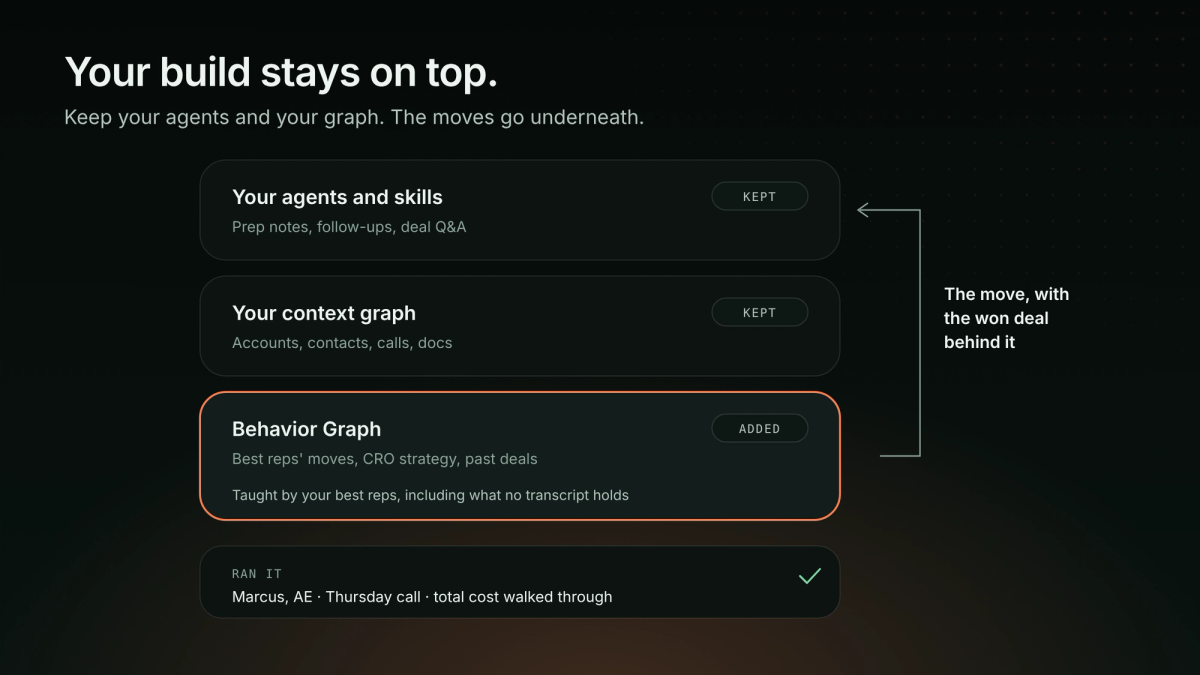
Keep your graph and add what goes underneath
If you have a context graph, keep it. If you are adding one, add it. The moves need their own layer under it.
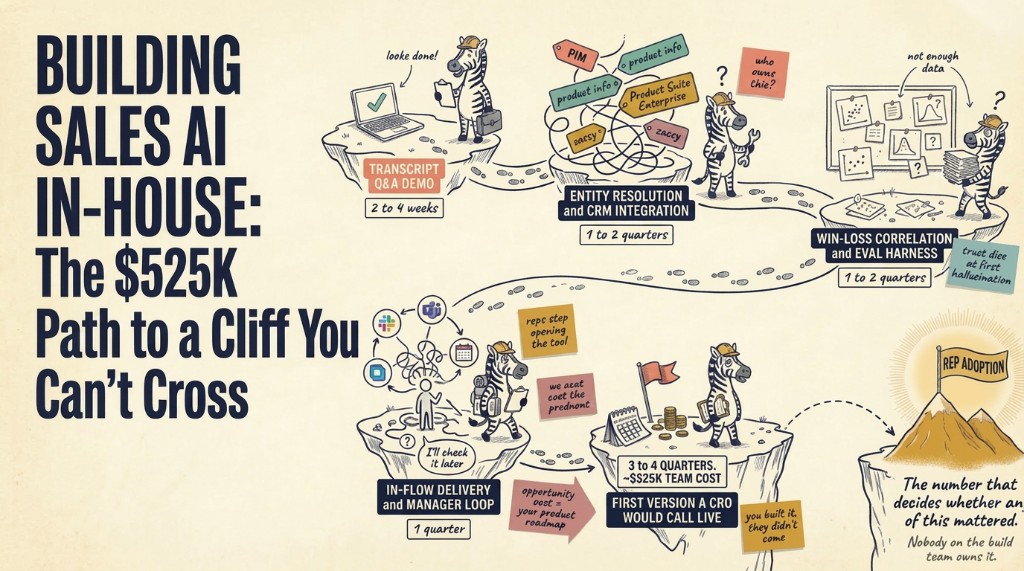
You could encode the moves yourself. The Signal profiled a CRO who built his revenue system in Claude Code. Eight months in, the judgment is still hand-built: a Sales Bible from 409 calls of one rep.
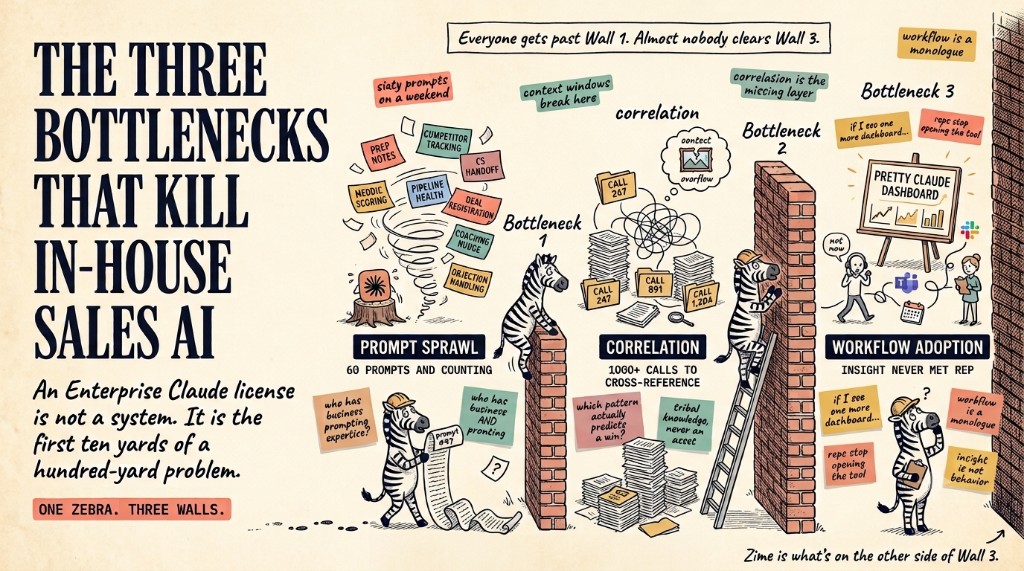
That work stalls for reasons outside engineering. The input lives in people, so collecting it means interviews. It also moves. By the time one role is encoded, the CRO has changed the quarter. When Versa scoped the build, it came to 12 to 24 months and about $1M of GTM engineering. Chitresh chose Zime and was live in a month.
Peter Kim, Head of GTM at WestBridge Capital Management, named the cost for a team on Claude:
"...inadvertently, you've become a builder."
Peter Kim, Head of GTM, WestBridge Capital Management
He meant ops time. The upkeep of how the company sells lands on whoever built the agent. Should you build GTM agents in-house on Claude or buy a platform? weighs that trade.
That layer holds how your best reps win each moment, what your CRO decided this quarter, and your past deals. Zime calls it the Behavior Graph. It is elicited from your best people through FDE-run interviews and RLHF, including what never shows up in a transcript. Put plainly, Zime's forward-deployed engineers interview your best reps. Then they score each move until those reps would run it.
Zime starts from a library of 1,200+ GTM behaviors. Strategy Studio tests your strategy against your won and lost deals, to show which behaviors win. Each move carries its source, the strategy and evidence behind it. A rep sees the move, never another rep's deal details.
Zime runs on Claude, so your agents, skills and graph stay. They return the move instead of a recap. The page for GTM and AI engineers shows the setup.
How you know reps ran it
Marcus asks again. This time he gets a move: stop defending price, and walk the buyer through three-year total cost. Behind it sits the deal Dana won that way last quarter. Priya gets the POC plan your best SE runs against that competitor. Marcus runs the move on Thursday's call, and you can see that he did. When the CRO asks if the agent works, you answer with moves run, not logins.
The ran-it test. Ask each product to show, for one rep and one call, whether the move ran. Pass: a named call and moment. Fail: a usage chart of logins.
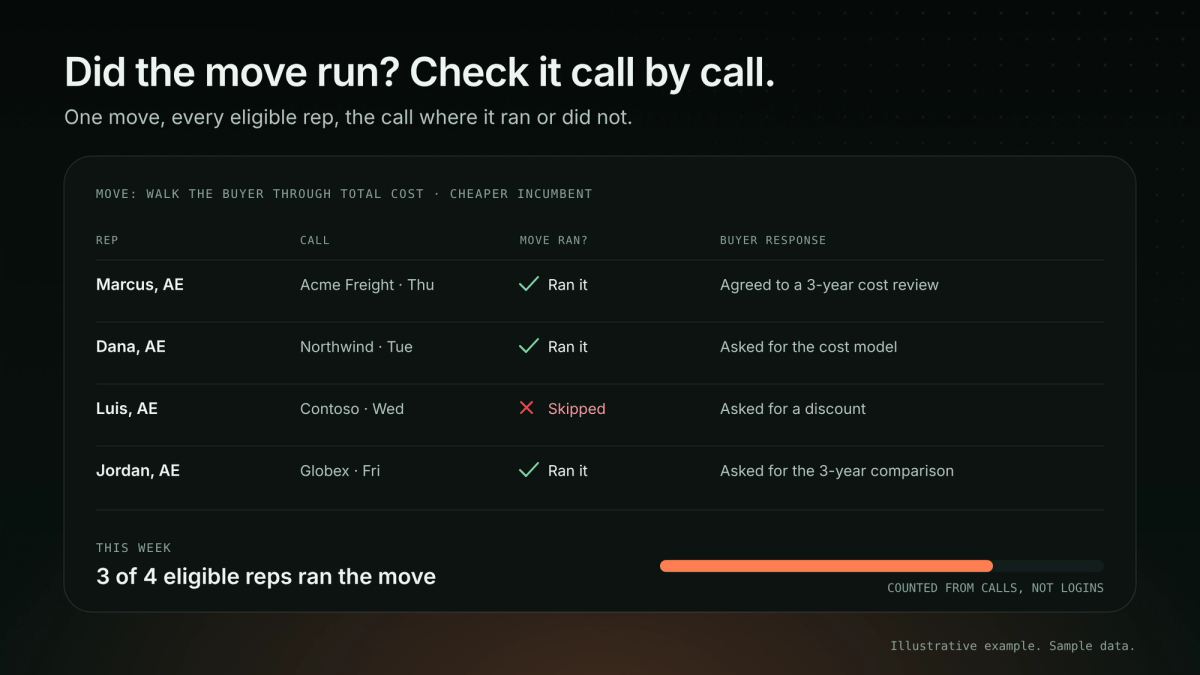
Adoption is the number that slips. G2's enterprise review data found the average share of users who fully adopted an AI agent fell from 68% in 2024 to 55% in 2026. Zime counts it as Programmatic Adoption: behaviors run on live calls, tied to the strategy behind them. Zime's benchmark is 80% of eligible reps within 90 days.
At Versa, 79% of SEs were running the right technical discovery within three months, up from 20% at the start. Brent Bair, a regional sales leader there, saw it on his team:
"As I look at my team, the adoption rate has improved."
Brent Bair, Regional Sales Leader, Versa Networks
That count is moves run on live deals.
Bureau sells identity decisioning to banks and fintechs in multi-product deals. Kapil Bhagat runs sales strategy there. He saw what changed once discovery was checked call by call:
"So this monitoring led to execution ... Having a dashboard where non adherence is called out improves execution."
Kapil Bhagat, AVP, Sales Strategy, Bureau Inc.
Seeing that the move ran is what made it run. Ask every vendor one more thing: what does a useful answer cost at full rep volume?
Bring five tickets your reps sent this month.
See the move each one gets, and how you would know it ran. Book a demo
FAQ
What is the best context graph or knowledge-layer product for a sales team?
Match the class to your sources: a knowledge layer for docs, a GTM data graph for accounts and signals, revenue context for calls, an enablement engine for approved content. All connect data and cite it. None holds how your best reps win or what your CRO decided this quarter, because nobody wrote it down. Zime adds that as a Behavior Graph, taught by your best reps, under the graph you pick.
Should we build our own sales context graph or buy a platform like Zime?
Build or buy the graph to suit your stack. The harder part is the moves your best reps run, which must be collected from people and kept current. Versa scoped that build at 12 to 24 months and about $1M. Zime runs on Claude and adds that layer under your build.
Do I need a context graph before adding a Behavior Graph?
No. A Behavior Graph is Zime's model of your best reps' moves and your CRO's strategy. Zime ships Execution Context, its own context layer, so you are not blocked.
How do I know the agent's answer was right?
Reps trust it enough to run it on live calls, which you see call by call. Then the deals where it ran move.
Will adding this replace the agents I built?
No. Zime runs on Claude, so your agents, skills and graph stay, and you keep control.