My notetaker gives me the recording. Which tool tells me the next step on this deal?

- Your notetaker is doing its job. It records the call, writes a clean summary and lists the steps both sides agreed. Some now suggest a next step too. That is real time back after every call.
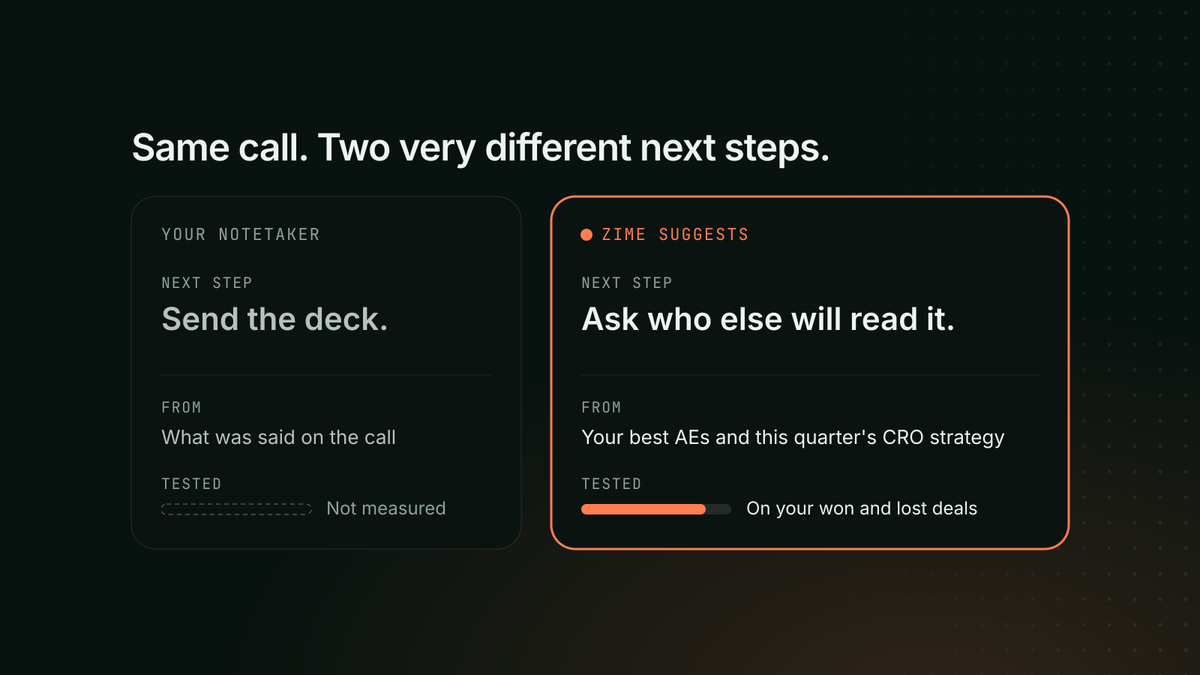
- But the notes only know what was said. "Send the deck" is what was said. Whether your best reps would take that step with this buyer, at this stage, is not in the recording. So you still decide alone before the next call.
- And a smarter summary won't close that. A suggested step comes from what was said or from a generic framework. How your best reps move a deal at this moment was never written down. No transcript holds it.
- That move is what Behaviors add. A Behavior is the specific step your best reps take in this situation, for your role, product and buyer, with a deal it won behind it. It is learned from your best reps, including what never shows up in a transcript, and carries your CRO's strategy for this quarter.
- So you run the step, and you can see it worked. It reaches you in Slack or Teams before the next call, with no new tool to open. On that call, check two things: did you run it, and did the buyer do what it asked? That is adoption you can see.
You're an account executive, and your second call with Dana just ended. She runs operations at a mid-market company. She liked the demo. Two minutes later, the notetaker's summary lands in Slack. It's clean.
Next steps: send the deck. Dana shares it with her team. Reconnect in two weeks.
All true. This deal is in your number, so one question sits there before you hit send. Is "send the deck" the step that moves this deal, or just the step that got said?
What the notes actually tell you
Start with what works. The recording is complete, the summary accurate, the CRM filled. Some notetakers now suggest a step, checked against a framework like MEDDIC. Call-recording suites, CRM assistants, deal agents and live coaches suggest steps too, and some do it well. Enablement tools teach the playbook. Keep all of it.
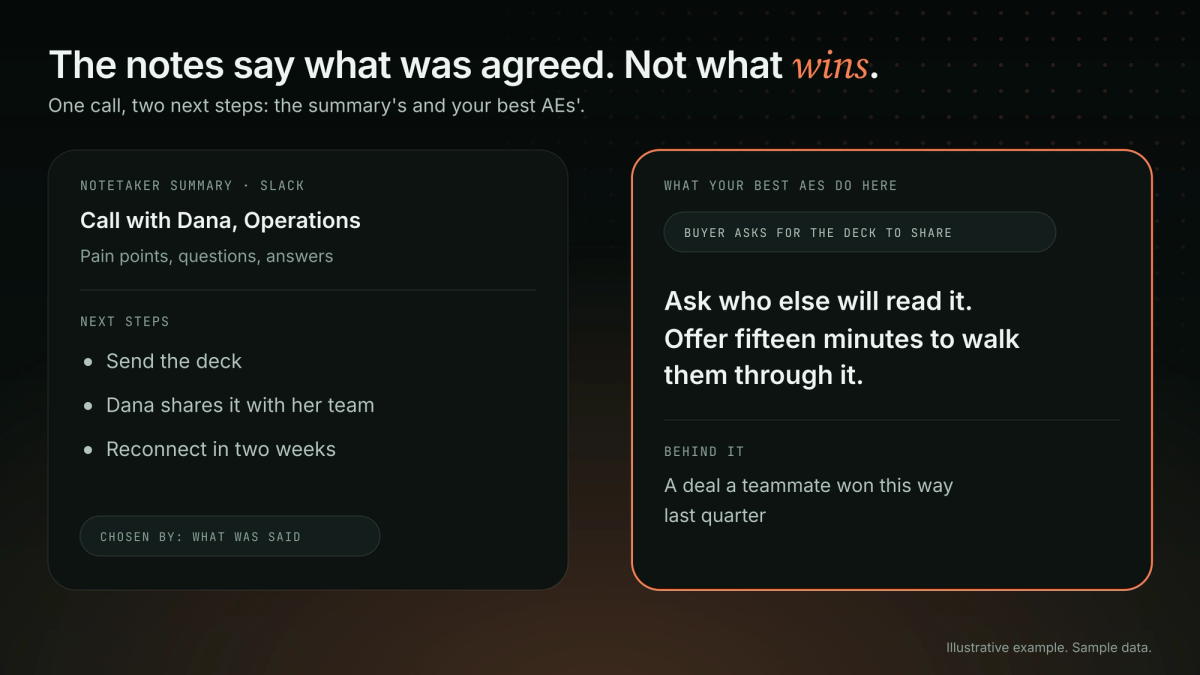
Now look at where each step comes from. The summary repeats what was said. The tell: it sounds like the last two minutes of your call. A framework suggestion fills whatever box is empty. The tell: it reads the same on every deal at that stage. Your own AI chat sounds sensible. The tell: a rep at another company gets the same answer. A colleague helps when someone is free.
Every one of these recommends a step. None starts from what your best AEs do when a buyer asks for the deck.
Ranjan R Reddy runs Bureau, which sells identity decisioning to banks and fintechs across several products and buyers. He heard this gap on his own team's calls:
"I pitch this, I pitch this, I pitch that and the next step is they will test this ... I'm like no, but what is the problem? What is the use case?"
Ranjan R Reddy, Founder & CEO, Bureau
The next step was written down. It was the wrong one. The notes kept the pitch and missed that discovery never happened.
Why no recording holds the step
Nobody ever wrote the step down. How your best AEs move a deal at this moment lives in their heads. They ask who else will read the deck. Nobody writes down a reflex.
CROs ask the same question. Martin Mackay runs sales at Versa Networks, which sells networking and security against ten named competitors. In a June win-loss review, he asked:
"...what do the most effective reps do in terms of moving a deal forward and then eventually closing it?"
Martin Mackay, CRO, Versa Networks
If the CRO has to ask, no transcript holds the answer. Your strategy runs on 1,000+ behaviors. Nobody has written them down, tested them or kept them current.
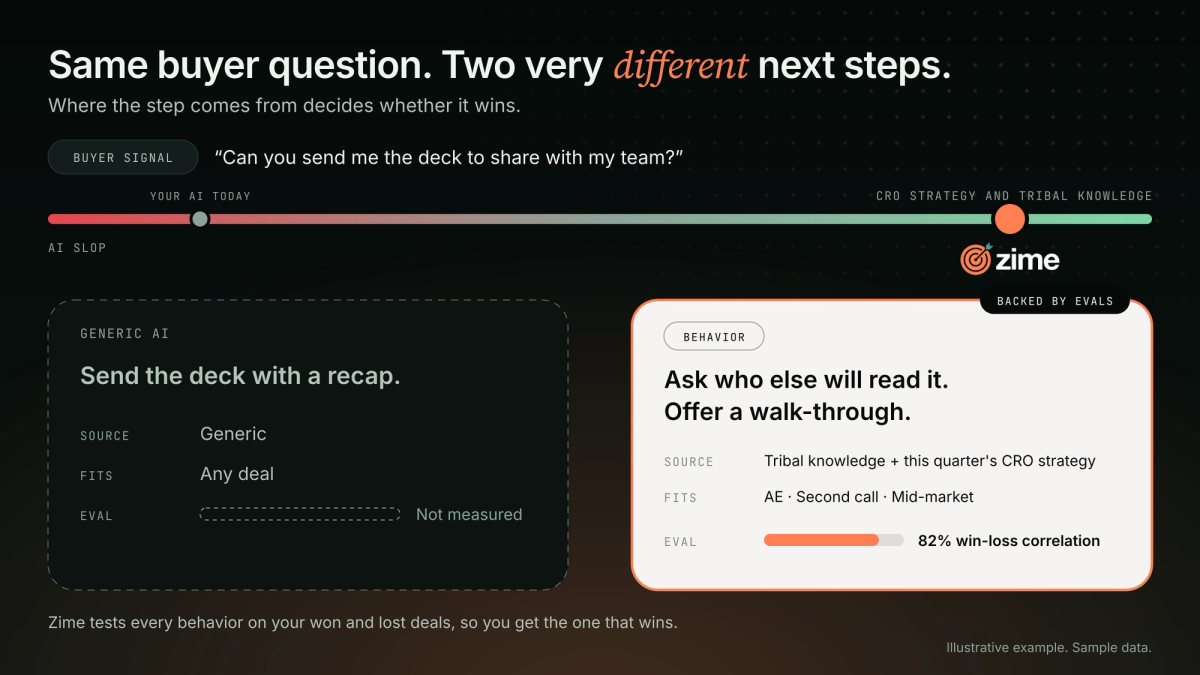
HFS Research sees the same break from the top: the CRO's plan doesn't convert into what reps do, so reps revert and win rates stall. G2's enterprise review data found the average share of users who fully adopted an AI agent fell from 68% in 2024 to 55% in 2026.
Find the missing step yourself, with no new tool. Pull your last five call summaries and run two checks.
- Who chose the step? Mark each one as the buyer's, yours or the tool's. Pass: the buyer named it, with a date. Fail: a default like "send a recap".
- Would your best rep take it? Describe the moment to two of your best AEs. Ask what they'd do next. Pass: they name your step. Fail: they name another. That one is the step nobody wrote down.
The table below runs both checks on five sample deals (illustrative). The two steps buyers chose were the two that moved.
| Deal (illustrative) | Next step in the notes | Who chose it | Your best AEs' step | Buyer moved by the next call? |
|---|---|---|---|---|
| A, second call | Send the deck | You | Ask who else reads it; offer a walk-through | No reply in two weeks |
| B, demo | Security review Tuesday, set by IT | Buyer | Same | Yes, review held |
| C, discovery | Send a recap | Tool | Confirm the problem's cost with the budget owner | No |
| D, pricing | Pricing to finance by Friday | Buyer | Same | Yes, finance joined |
| E, second call | Follow up next week | You | Book the next call before hanging up | No |
| Verdict | 3 of 5 defaults | 2 buyer, 3 not | 3 of 5 differ | 2 moved, both buyer-chosen |
Every default stalled. Five deals only point a direction, so wait for three on each side. To keep it fair, run your best reps' step on every deal at that moment for two weeks, not only the warm ones.
The step your best rep would take
As our post on why reps trust some agent recommendations and not others argues, a step you'll run has three things behind it. Your best reps take it here. It fits this quarter's strategy. And it shows a deal it won.
That is what Zime builds for sales teams. Its forward-deployed engineers interview your CRO and a few best reps, then score the moves until those reps would run them. In Zime's terms, that is know-how elicited from your best people through FDE-run interviews and RLHF, including what never shows up in a transcript. Each move becomes a Behavior: the step for your role, product, buyer and stage, with its winning deal. The Behavior Graph holds them, and each is tested on your won and lost deals first.
The table below shows where each approach stops. Every one recommends a step; only one starts from how your best reps win.
| Capability | Notetaker summary | Notetaker with suggested steps | Your own AI chat | Behaviors from your best reps |
|---|---|---|---|---|
| Records and summarizes the call | ✓ | ✓ | Partial | ✓ |
| Lists the steps both sides agreed | ✓ | ✓ | Partial | ✓ |
| Recommends a next step | ✗ | ✓ | ✓ | ✓ |
| Step comes from how your best reps win | ✗ | ✗ | ✗ | ✓ |
| Carries this quarter's CRO strategy | ✗ | ✗ | ✗ | ✓ |
| Shows a deal the step won | ✗ | ✗ | ✗ | ✓ |
| Checks it ran and the buyer moved | Partial | Partial | ✗ | ✓ |
Read the row on where the step comes from.
Here is the same Thursday. Before you reply to Dana, a prep note lands in Slack. It names the moment: buyer asks for the deck to share. Then the move: ask who else will read it, and offer fifteen minutes to walk them through. Under it sits the deal a teammate won that way last quarter.
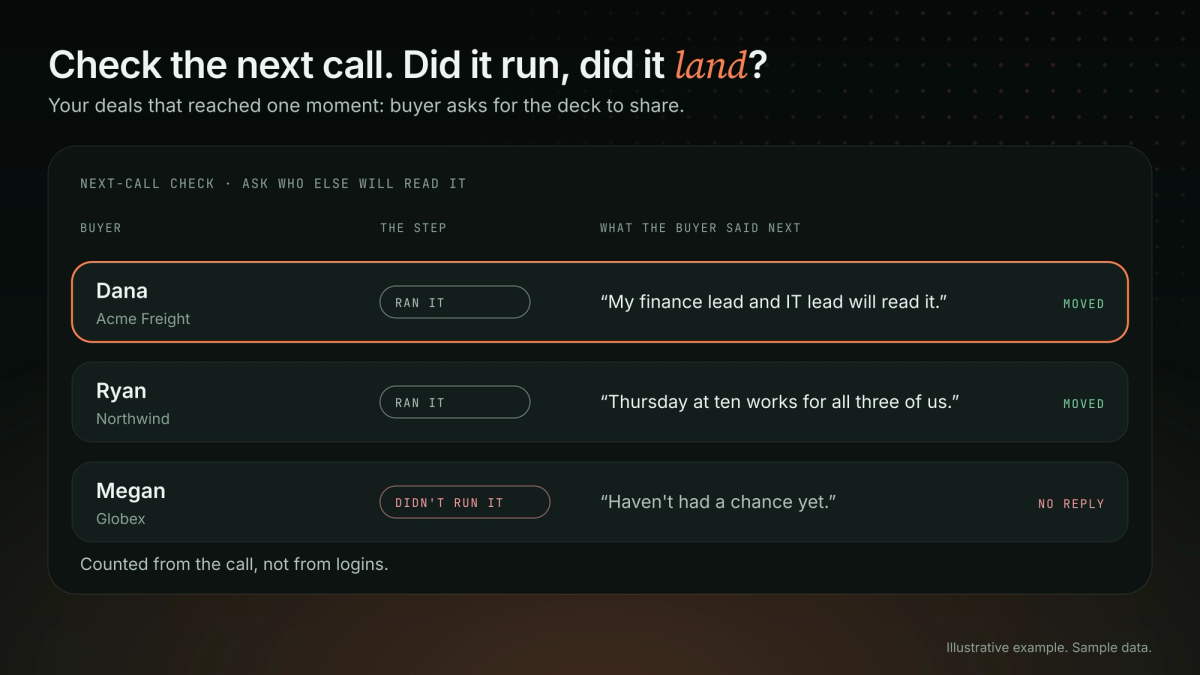
You send the deck with one line added. Dana replies within the hour. Her finance lead and IT lead will read it. Thursday at ten works.
Then check the next call. Did you run the step, and did the buyer do it, in her own words? Dana naming her finance lead counts. "Haven't had a chance yet" does not. Zime reads that call and counts it. That is Programmatic Adoption: Behaviors run on live deals, not logins. A step that arrives where you already work gets run, as our post on coaching versus guidance in the workflow explains. And Zime has its own notetaker, so your summaries stay.
What changes when you run it
At Versa, SEs run technical deals worth $100K to $3M across four regions. Within three months, 79% of SEs were running the right technical discovery, up from 20% at the start. Brent Bair, a regional sales leader, saw it on his team:
"As I look at my team, the adoption rate has improved. I think it's become ingrained in our sales DNA now..."
Brent Bair, Regional Sales Leader, Versa Networks
Those are moves run on live deals, counted call by call.
Bureau put its work into the gap Ranjan heard: consistent discovery. Kapil Bhagat runs sales strategy there:
"Average deal size increased by 30% on the back of improved discovery."
Kapil Bhagat, AVP, Sales Strategy, Bureau Inc.
The step the notes had skipped is where the larger deals came from.
MyAdvice sells a growth platform to medical, dental and legal practices. Its checklist adoption rose from 66% to 87%. Chad Erickson leads sales and strategy:
"When the volume increases, we see Zime as a critical part of the equation to allow them to be more efficient."
Chad Erickson, VP of Sales & Strategy, MyAdvice
More calls means more steps nobody has time to work out alone.
Zime's own benchmark is 80% of eligible reps within 90 days, resulting in 20% uplift in deals won.
One honest limit. If the buyer named the step and a date, your notes did the job. Nobody has published how often a notetaker's step is wrong; your two checks will show you.
Your notetaker keeps writing down what was agreed. With your best reps' move beside it, you stop guessing.
Keep your notes. Get the step that wins.
Your notetaker and your CRM stay. Zime adds the move your best reps make at each moment, with the deal it won, in Slack or Teams before your next call. Bring the summaries from your last five calls and see the step each would have become.
FAQ
My notetaker gives me the recording. Which tool tells me the next step on this deal?
Notetakers suggest a step from what was said or a framework. The step your best reps take here has to come from them. Zime turns their moves into Behaviors, specific steps for your role, product, buyer and stage, learned from your best reps, including what never shows up in a transcript, with your CRO's current strategy.
Why should I trust a suggested step over my own read of the deal?
A Behavior, the specific move with its winning deal, carries your CRO's strategy and what your best reps do here. It adds to your read; it doesn't replace it.
Will it add noise to a deal I already understand?
It never assumes you don't know your deal. It adds one step from your best reps and this quarter's strategy, before the call.
Will my manager use it to check up on me?
Ask any vendor: do you see the same evidence your manager sees, from the same call? If so, a check is something you answer with the buyer's own words.
Is the step the same for every rep?
No. It shifts with role, product, buyer, segment and stage, and changes when your CRO's strategy does.