We rolled out Claude to the sales team and almost nobody uses it. What did teams that got real usage do differently?

- Your rollout was real work, and the usual fixes help. The agent is live. Put it where reps already work, push answers to them, keep it simple. Nothing you built gets replaced.
- But a nicer interface will not settle it alone. Your usage count is low and reps skip the agent. You can see that much. The question is what the rollouts reps do run have that yours lacks.
- And the move for each deal usually was never written down. What a best rep does when a buyer calls the incumbent cheaper is reflex, and nobody wrote down why. Strategy usually sits in a deck. Take one live deal, ask your agent for the next move, and ask your CRO to write theirs, then compare.
- That is what a Behavior Graph adds. It is the model that holds what your CRO approved this quarter, what past deals show, and what your best reps know. Those reps teach it, including what never shows up in a transcript. Each rep then gets the move for that deal.
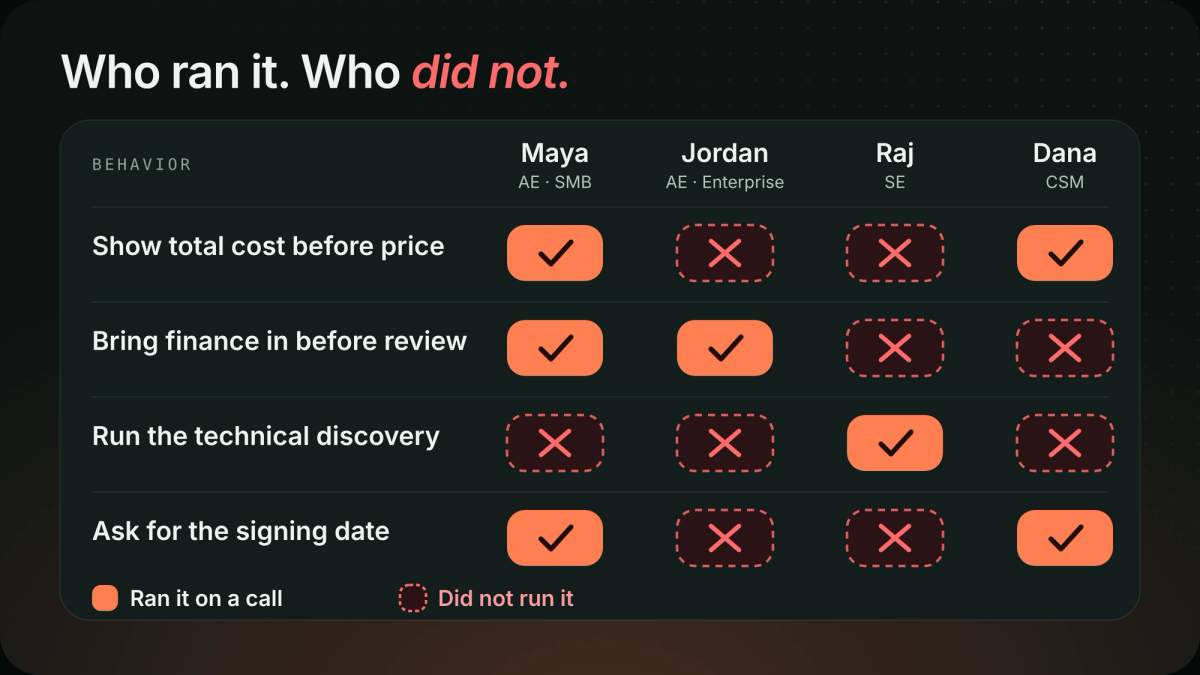
- So adoption means moves run on live calls, not logins. Reps run the move their CRO and best reps would make. You can see who ran it, on which call, and whether the buyer moved. At Versa Networks, 79% of SEs were running the right technical discovery within three months, up from 20%.
It is Monday, and you, the CRO, are in the pipeline review. You ask which reps used the agent on the biggest deal on the list. Nobody did.
What you built is great. The agent is live, prep notes go out in Slack, and your team pushed reps to use them.
Still, adoption stopped at a few top sellers. Reps do not pull it, because it is one more step. Leaders do not push it, because nothing tells them what to push. With so little usage, nobody can say whether the answers are right.
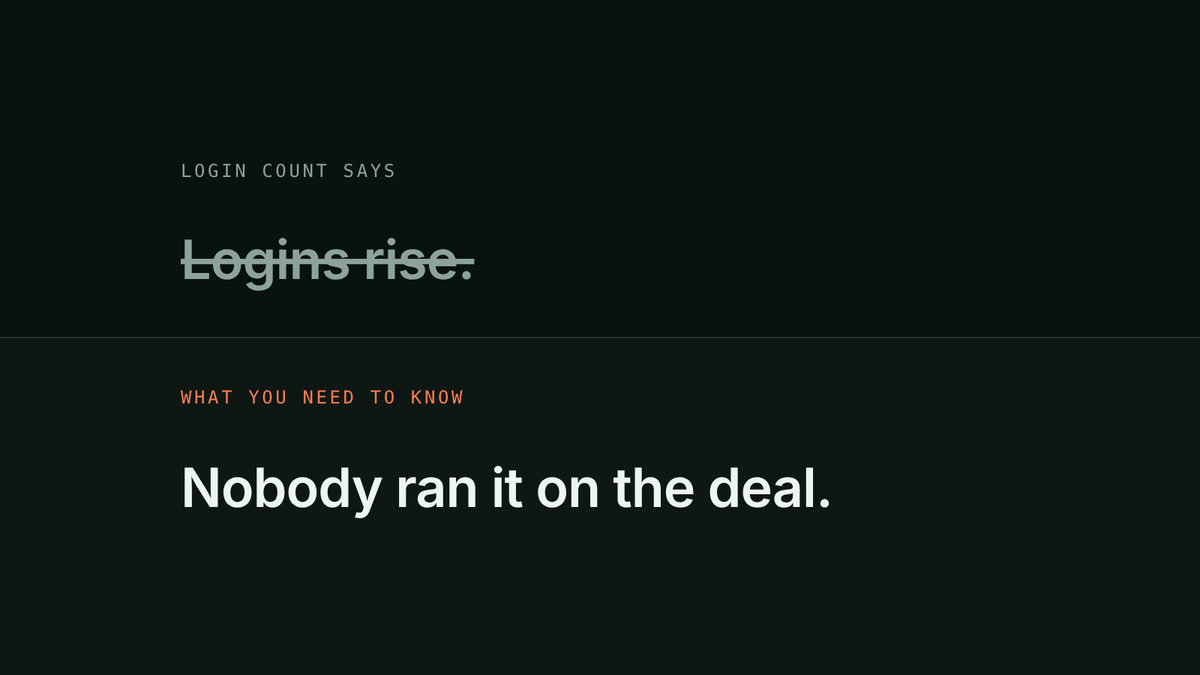
Then the question lands in your own words. Are reps following the playbook? A login count cannot answer it. So what do the rollouts that reps do run have in them that yours does not?
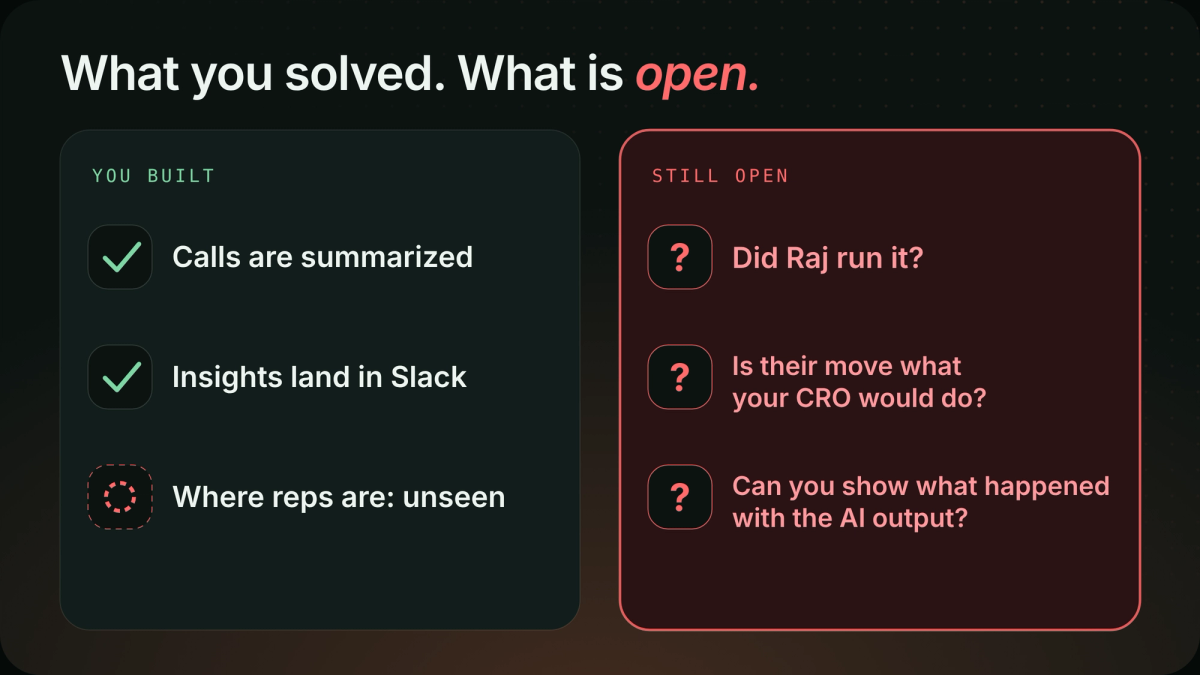
What the rollouts that stick have
Strategy does not get adopted. The moves under it do.
Say a buyer tells your rep the incumbent is cheaper. A general agent says to offer a discount. Your CRO would never say that.
Your best reps know the right move by reflex: show total cost of ownership before price. Nobody wrote the reasoning down, and the strategy sits in slides.
Call each of those moves a behavior: the specific move for this deal, with the winning deal behind it. It changes with seller role, product, buyer, segment and deal stage. Your strategy runs on 1,000+ behaviors, and most teams have a few written down.
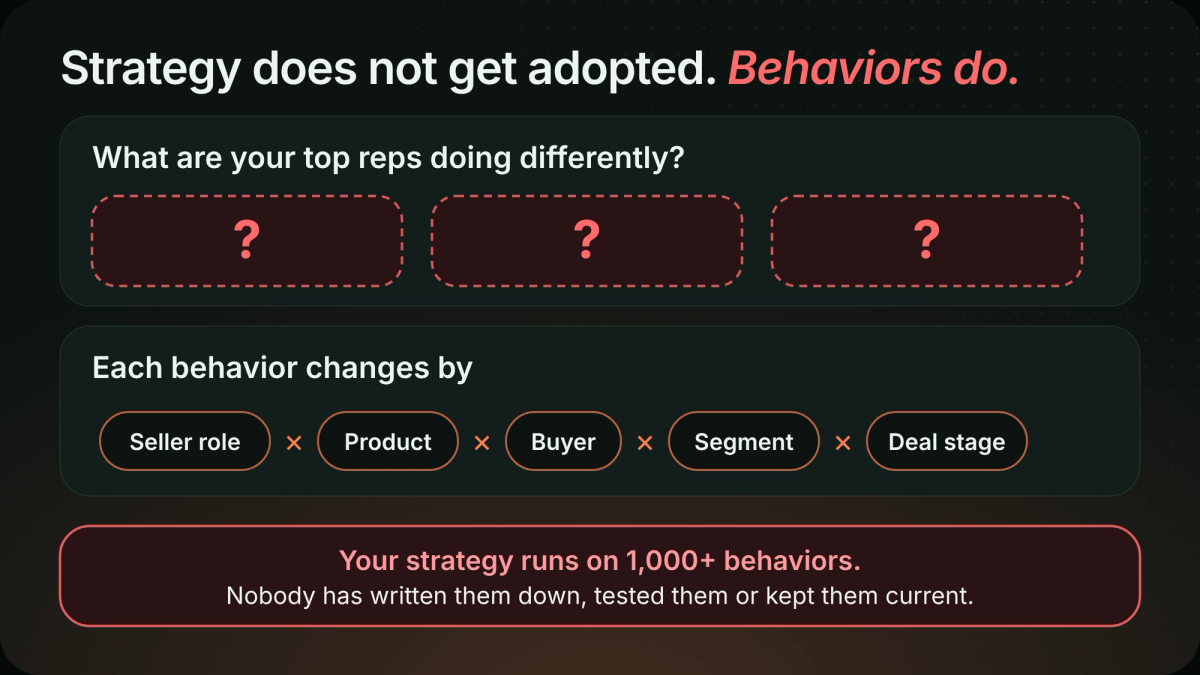
Without them, the agent answers well about the past and generically about what comes next. So reps wing the call.
And you become the system. You chase reps on Slack to learn what happened. "Did you handle the incumbent’s price?" "I think so." Nobody checked the call.
Run one test. On a live deal, let the agent write its next move, and have your CRO write one blind. If they match, the agent holds the play. If they differ, you have found the gap.
The usual fixes miss it. Embed the agent, and logins rise while behaviors run stay flat. Push answers, and reps open the alert and close it. Simplify, and reps get a shorter generic move.
G2’s enterprise review data found the average share of users who fully adopted an AI agent fell from 68% in 2024 to 55% in 2026.
Can you write the behaviors yourself?
You can, for a few deals. Pull ten live deals, write the behavior for each with your CRO, and compare them with the agent’s answers. That takes an afternoon.
With a handful of reps, one product and one motion, hand-written behaviors can hold. Past that, the agent took a week and the behaviors take months. Zime’s estimate is that encoding the judgment takes 6 to 12 months: 200+ .md files, then a rollout across reps via 20+ workflows. The judgment here is how your best reps decide, and what your CRO decided this quarter.
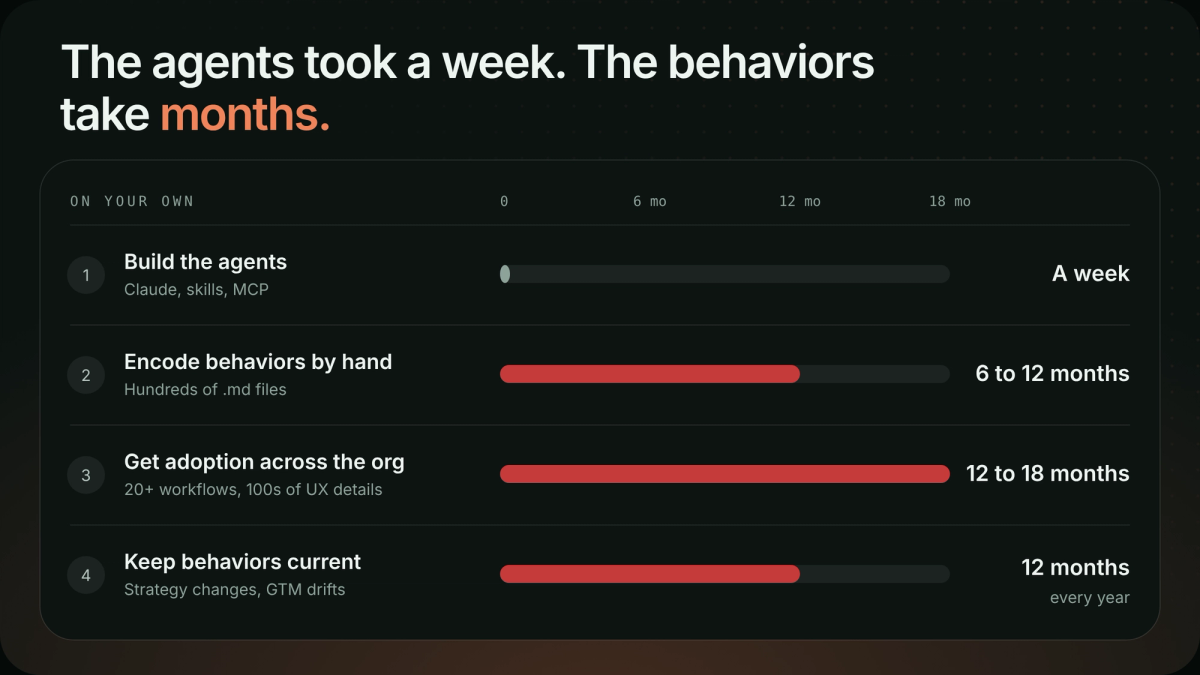
Chitresh Yadav had agents for follow-ups and prep notes live at Versa Networks. They gave him visibility, and he scoped closing the adoption gap in-house at 12 to 24 months and about $1M.
"AI can reach ... but not to the human level ... because there is a context that you need to build in."
Chitresh Yadav, VP and Global Head of Sales Engineering, Versa Networks
The missing input is context. Someone has to build it.
Peter Kim, Head of GTM at WestBridge Capital Management, described what that build does to a team.
"...inadvertently, you’ve become a builder ... a dangerous place to be, because you’re ... spend a ton of ops cycle time on that."
Peter Kim, Head of GTM, WestBridge Capital Management
The work turns into maintaining the build, whoever the builder is.
What Zime adds to your build
Zime builds that layer and calls it a Behavior Graph. It turns your strategy and your tribal knowledge into behaviors, proven on won deals, and every rep runs them with no new tool. Its behaviors are elicited from your best people through FDE-run interviews and RLHF, including what never shows up in a transcript.
FDE means Zime’s forward-deployed engineers, who interview your best reps. RLHF means scoring and correcting each behavior until those reps would run it. You start from a library of 1,200+ GTM behaviors.
Zime encodes the behaviors from your CRO’s strategy and your best reps. It delivers each to the rep before the call. It measures who ran it, on which call, and whether the buyer moved. That is programmatic adoption.
Your agent stays on top. Zime sits underneath and plugs in through MCP, so your skills call the behaviors.
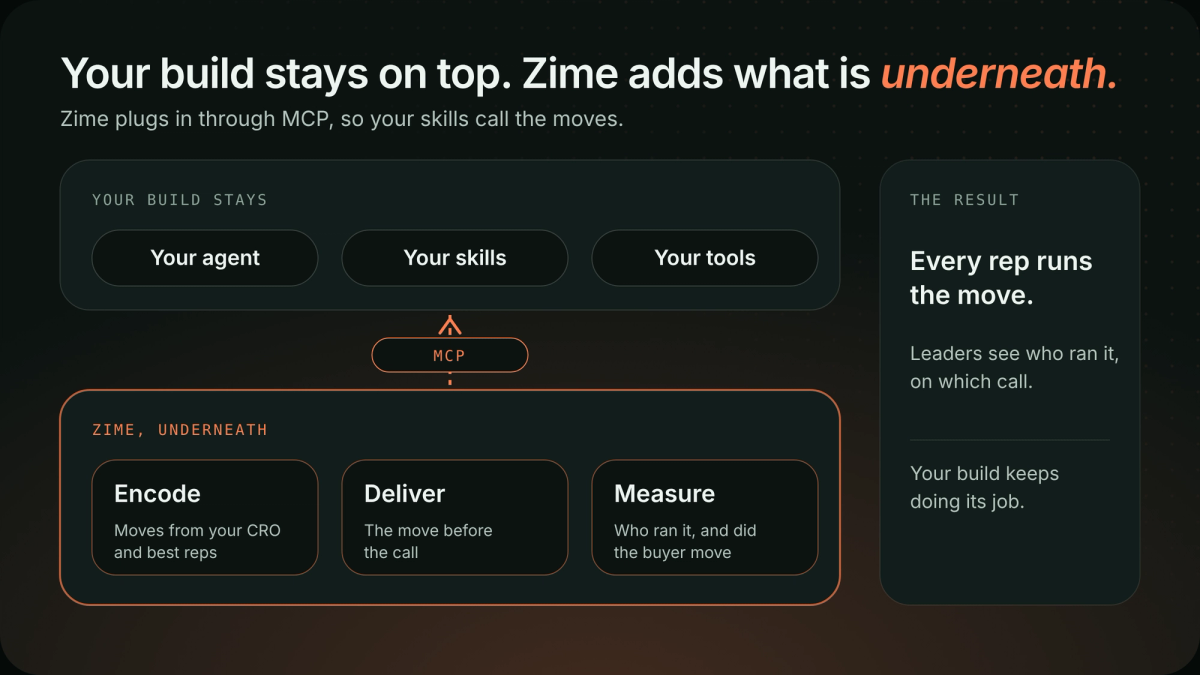
If you have a context graph, keep it. If you are adding one, add it. Both systems recommend a next step. The difference is upstream: one ranks what worked before, and the other starts from what your best reps and your CRO say to do.
HFS Research’s July 2026 profile of Zime says the CRO’s plan does not convert into execution, so reps revert and win rates stall. The full math is in Should you build GTM agents in-house on Claude, or buy a platform?
The table below sorts what each class of tool does. Only a Behavior Graph holds this quarter’s CRO strategy as a behavior for each role and deal.
| Capability | Delivery fixes (embed, push, simplify) | Context graph or call library | Behavior Graph |
|---|---|---|---|
| Reaches reps in the tools they use | ✓ | ✓ | ✓ |
| Reconstructs the deal and what happened | ✗ | ✓ | ✓ |
| Recommends a next step | ✗ | ✓ | ✓ |
| Holds this quarter’s CRO strategy as a behavior for each role and deal | ✗ | ✗ | ✓ |
| Shows who ran the behavior on which call | ✗ | Partial | ✓ |
Holding the CRO’s strategy as a behavior for each role and deal is what the stuck rollouts lack.
Check it on your own deals. Check one: count the reps who used the agent on a live deal last month. Logins do not count. Pass is the share your CRO sets, on deals where the behavior applied.
Check two is the blind test above. Check three: take ten calls and find the behavior at a named call and minute. Pass: you find it on most. Fail: you cannot say.
Kapil Bhagat of Bureau wanted reps to follow its pre-call and post-call plays.
"So this monitoring led to execution ... Having a dashboard where non adherence is called out improves execution."
Kapil Bhagat, AVP, Sales Strategy, Bureau
Seeing who ran each play was what made reps run it.
Kenny Cao of Skan AI was checking how a new value proposition landed.
"I want to understand how the team is delivering against the deck ... It is more of an enablement understanding versus whether they’ve done it."
Kenny Cao, Senior Director, Head of Go-To-Market Strategy and Operations, Skan AI
Training shows who understood the new pitch. Only the call shows who said it.
Run any fix as a staggered rollout, so a random half of reps gets it first.
What changes when reps run it
Now replay Monday. This time the rep’s prep note held the behavior for the deal, with the winning deal behind it.
She ran it on Thursday’s call. You can name the minute. The review names the rep, the call and how the buyer reacted.
When your board asks whether reps are following the playbook, you point to the call. The engineer who built the agent finally has a number to show: behaviors run on live deals. Your CRO’s strategy reaches the field through the agent you built.
Versa Networks counted adoption this way for its sales engineers. When it started, 20% of SEs ran the right technical discovery. Within three months, 79% did.
Brent Bair of Versa Networks, on his team:
"As I look at my team, the adoption rate has improved. I think it’s become ingrained in our sales DNA now that this is incredibly valuable as we’re progressing through deals."
Brent Bair, Regional Sales Leader, Versa Networks
Adoption showed up as habit once the behavior proved itself on live deals.
What is not yet published is a figure for a rollout like yours. What is published is Versa’s, from a sales engineering team. Why reps run guidance has its own post.
The GTM Agent Ghost Town covers what GTM leaders said about getting AI used in live deals.
Start with the staggered half. By the next Monday review you will know which rollout you have.
See which reps run the behaviors. The agent you built stays yours. Zime adds the behaviors your CRO and best reps would use, and shows who ran each one on a named call. Live in 7 days on your own data. Bring one live deal and your CRO’s move for it, and see the behavior it becomes. Book a demo →
FAQ
We rolled out Claude to the sales team and almost nobody uses it. What did teams that got real usage do differently?
They gave each rep the behavior for the deal in front of them, and they counted usage as behaviors run on live calls, not logins. Zime builds those behaviors, elicited from your best people, including what never shows up in a transcript. A behavior is the specific move for this deal, with the winning deal behind it.
Do I have to replace the agent I built?
No. Zime runs on Claude, so the agent you built stays. Zime plugs in underneath through MCP, adds the behaviors your agent hands to reps, and shows who ran each one. Your tools and your context graph keep doing their jobs.
What share of reps counts as good usage?
Count reps on the deals where the behavior applied. Have your CRO name the share that is enough. Zime’s own figure is 80% of eligible reps within 90 days. It is a vendor benchmark, so test it on your deals.
Why not rely on my conversation tool?
Keep it. A call recorder captures what happened on each call, and both systems can recommend a next step. The difference is upstream: it ranks what worked in past deals, while a behavior starts from your best reps and your CRO.