How do you sell a commodity product when the buyer says the incumbent works?
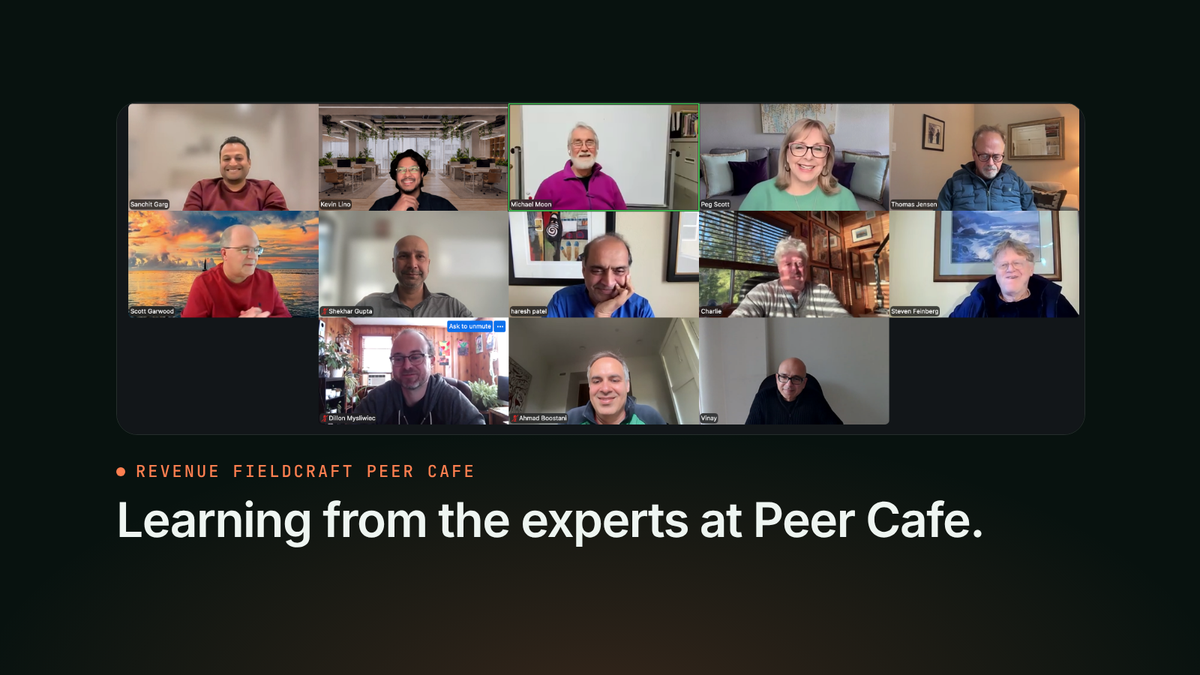

- Most products sell like a commodity now, and the room said so first. At the Revenue Fieldcraft Peer Cafe in Palo Alto on 19 November 2026, a former VP of worldwide sales, a neurostrategist, founders and partners agreed. Uniqueness is thin, attention is thin, and buyers default to the vendor they have.
- But the hard part is not the strategy. The leaders converged fast on what wins: give the buyer a meaning they cannot ignore. Top reps already do it, with moves like running beside the incumbent and proving the migration. The hard part is getting every rep to run those moves in live deals, and knowing they did.
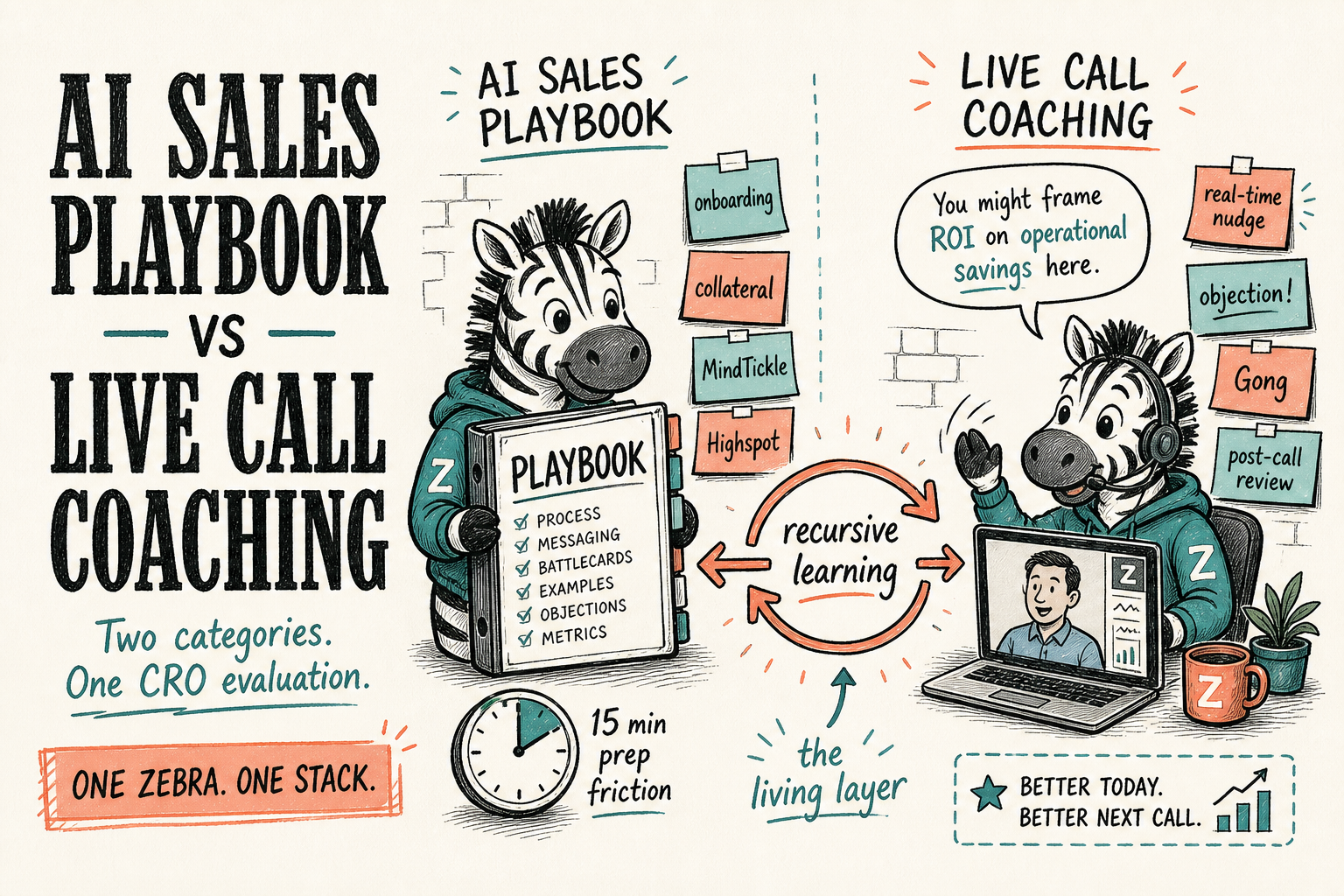
- And neither a playbook nor a general AI spreads them. As the host put it, the tribal knowledge of how a company sells lives in stories, not in call data. A playbook goes stale once published, and a generic assistant answers "the incumbent is cheaper" with a discount.
- That is the work a Behavior Graph does: it holds the moves your best reps and your CRO's strategy call for in each situation. Zime builds it from your best people, elicited through FDE-run interviews (Zime's forward-deployed engineers) and RLHF, including what never shows up in a transcript. Each move is checked against won and lost deals.
- So count moves run, not logins. After each call, check whether the rep ran the move and whether the buyer committed to something dated. Versa Networks, an SD-WAN vendor, got 79% of SEs running the right technical discovery within three months, up from 20% at the start.
On 12 November, Eric Siano brought a friend's problem to a Peer Cafe of revenue leaders. Eric is a fractional CMO with Blue Leopard and a former VP of product marketing at Infor. His friend is a CRO whose company does what Adobe does, for far less money. Eric described what happens when they pitch a Fortune 500 technology chief:
"you go to the chief technology officer of any Fortune 500 companies and say, could do what Adobe does but cheaper, and they're like, yeah. I'm not talking to you."
Eric Siano, fractional CMO, Blue Leopard, Revenue Fieldcraft Peer Cafe, 12 November 2026
Cheaper was the whole pitch. It ended the call. The buyer already had a vendor that works. A week later the series gave Eric's question a full session: founders, a former head of worldwide sales, a neurostrategist who advises tech CEOs, and partners who build sales systems. The table below sums up where the room landed.
| Who said it | What they said | What it means for a CRO |
|---|---|---|
| Haresh Patel, founder of Mercatus, former VP of worldwide sales at PMC-Sierra, Agilent and WJ Communications | "there's nothing unique anymore in today's world" | Feature comparisons will not move the buyer |
| Ahmad Boostani, founder of an EdTech startup | "there are, like, 10 solution for everything that you need to do" | The buyer's real problem is noise |
| Michael Jay Moon, founder of GISTICS and host of Revenue Fieldcraft | "whatever you have now is probably a commodity product or will soon be" | Plan the sale as a commodity sale |
| Steven Feinberg, neurostrategist and author of the forthcoming book Undeniable | "what's upstream of both of those is meaning" | Win the meaning before the decision |
| Kevin Lino, head of sales, Zime | "the instinct is to jump on differentiation" | Start from the value this buyer seeks |
| Sanchit Garg, founder and CEO, Zime | "One is strategy, one is execution." | The strategy is the easy half |
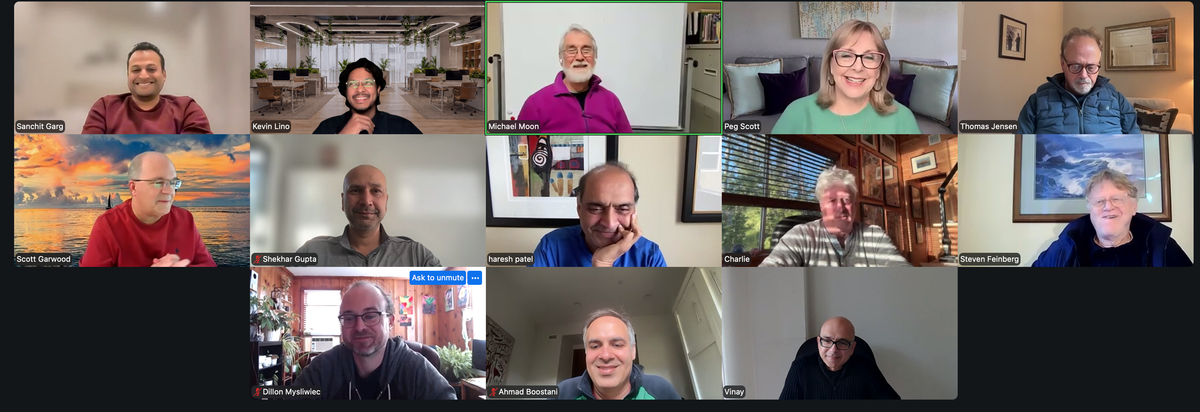
The room: the Revenue Fieldcraft Peer Cafe on 19 November 2026.
They started from the same place, and they ended there too. So if price ends the call, what do your best reps do differently in that moment? And how many of the rest do the same?
Everything sells like a commodity now
Haresh Patel has sold for a living for decades. He ran worldwide sales at three semiconductor companies before founding Mercatus. When the room was asked what makes commodity selling hard today, he did not hedge:
"I think there is no differentiation between commodity and something unique. That margin of uniqueness is so narrow."
Haresh Patel, founder, Mercatus, Revenue Fieldcraft Peer Cafe, 19 November 2026
He had just lived it. His new health-tech venture ran a competitive scan and found "A 164 companies like me already thinking about the same idea". When the product gap is that narrow, he said, "the question to ask is, how do you rise above the noise?"
Ahmad Boostani, who started an EdTech company a year ago, explained where the noise comes from. AI has made building software cheap:
"building solution is becoming so cheap that, like, you are seeing, like, a lot of noise in the market."
Ahmad Boostani, EdTech founder, Revenue Fieldcraft Peer Cafe, 19 November 2026
Every buyer now hears from ten vendors with the same promise. Vinay, a member of Zime's partner program, pushed the point further. If OpenAI and Claude took years of science to build, are they special? "I could argue they could be commodity products," he said. Michael Jay Moon, who founded GISTICS in 1986 and hosts the Zime-sponsored series, answered at once: "They already are." He then gave the room a simple test:
"unless there's a line around the block demanding what you have, you probably have a commodity product."
Michael Jay Moon, founder, GISTICS, Revenue Fieldcraft Peer Cafe, 19 November 2026
By that test, most of what we sell qualifies. An iPhone escapes it, he noted, because "It's a badge of belonging." Most B2B products have no such badge. And the buyer is drowning. As Moon put it, the buyer's first thought is "I have too many good options." And bots now talk to other bots, he noted, with humans coming in later in the game.
The sales canon agrees with the room. In Elite Sales Strategies, Anthony Iannarino names two problems of selling a commodity. First, "every client you call on already has a provider for what you sell". Second, most are "not yet compelled to change". The cost shows up in the pipeline. Challenger says its research found that 40 to 60 percent of lost deals ended in no decision.
Zime brought its own evidence to the session: sales calls from three vendors with more than $500M in revenue each, selling firewalls, SD-WAN and laptops into mid-market and enterprise. The same eight frictions came up again and again.
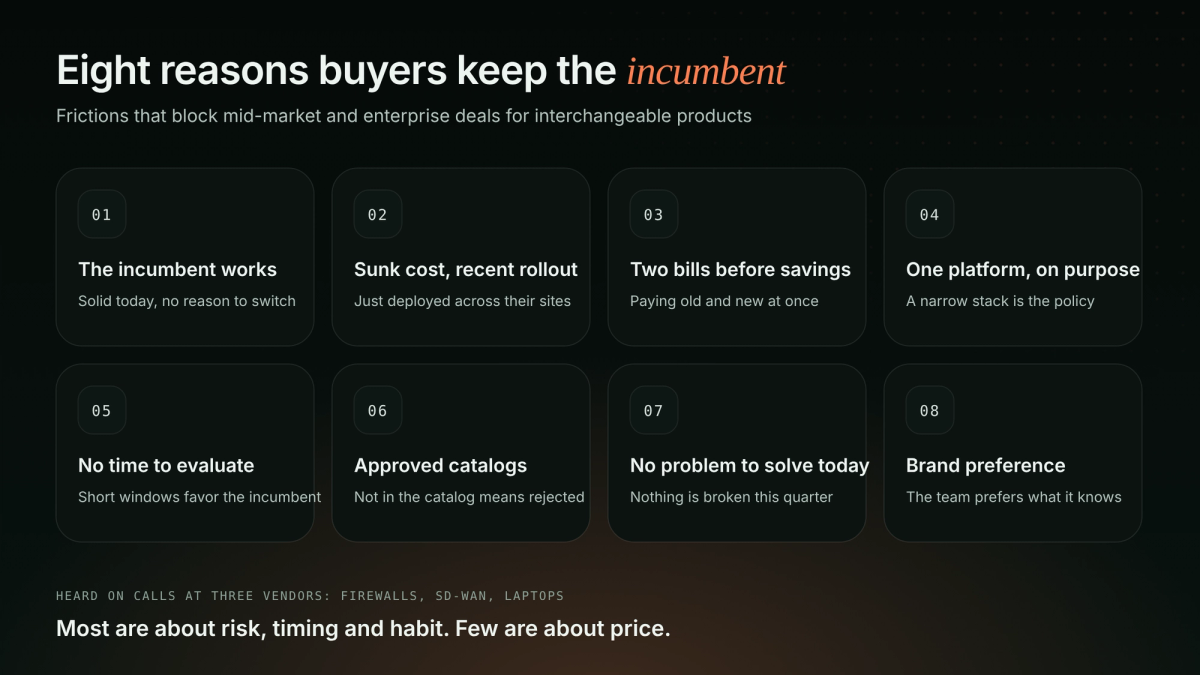
Notice how few of the eight are about price. Most are about risk, timing and habit. That is why a discount rarely works. It answers a question the buyer did not ask.
The buyer decides on meaning, before the pitch
If price is not the lever, what is? Steven Feinberg, a neurostrategist who has advised Silicon Valley CEOs, gave the room its center. He is finishing a book called Undeniable, and he argued that a buying decision is downstream of two things. The brain predicts first, then decides. And above both sits one input:
"what's upstream of both of those is meaning."
Steven Feinberg, neurostrategist and author, Revenue Fieldcraft Peer Cafe, 19 November 2026
For a seller, that changes the job. The buyer is not comparing feature lists. "And what becomes signal is the comparison that you're making, that the audience is making," Feinberg said. Set the meaning, and "you move it from a commodity to a must have". Miss it, and the buyer's answer is short: "it's next next". His book starts from a CRO's frustration after a deal that could have been ten times bigger: "why don't they see what I see?"
Michael Moon translated it into a sales task: "the work of marketing and sales is having a buyer recategorize what it is they're experiencing". Kevin Lino, who leads sales at Zime, put it in a rep's terms. "the instinct is to jump on differentiation," he said, but "it is about delivering the value" this buyer is looking for.
The calls show what that looks like when it is done well. Top reps do not argue features against an incumbent. They change what the switch means. The table below pairs each friction with the stall we saw most and a move top reps run against it.
| Buyer friction | Where reps stall | What top reps do |
|---|---|---|
| The incumbent already works | Accept it and end the call | Sell coexistence first: run beside the incumbent, expand at renewal |
| Sunk cost and a recent rollout | Park the deal for later | Enter through a wedge: one use case, region or problem site |
| Two bills before any savings | Leave the cost of change out | Hand the champion a business case: overlap cost, risk controls, a dated plan |
| One platform, kept on purpose | Probe features, not reasons | Reframe from cheaper to better to run: fewer consoles, fewer seams |
| No time to evaluate | Answer timing with a quote | Prove the migration, not the product: a contained pilot, rollback agreed |
| Approved catalogs and standards | Arrive after the decision forms | Work backward from the renewal or end-of-support date |
| No problem to solve today | Demo before the why | Wait for or create a compelling event: an outage, refresh or renewal |
| Brand preference beats price-performance | Concede the preference | Test what they cannot afford to break: their apps, configs and workflows |
Each move gives the buyer a new meaning for the switch: less risk, a dated plan, a cost of waiting. None of it is a secret. So why do so few reps run it? Sanchit Garg, Zime's founder, named the split the room kept circling:
"I see this is a two step problem. One is strategy, one is execution."
Sanchit Garg, founder and CEO, Zime, Revenue Fieldcraft Peer Cafe, 19 November 2026
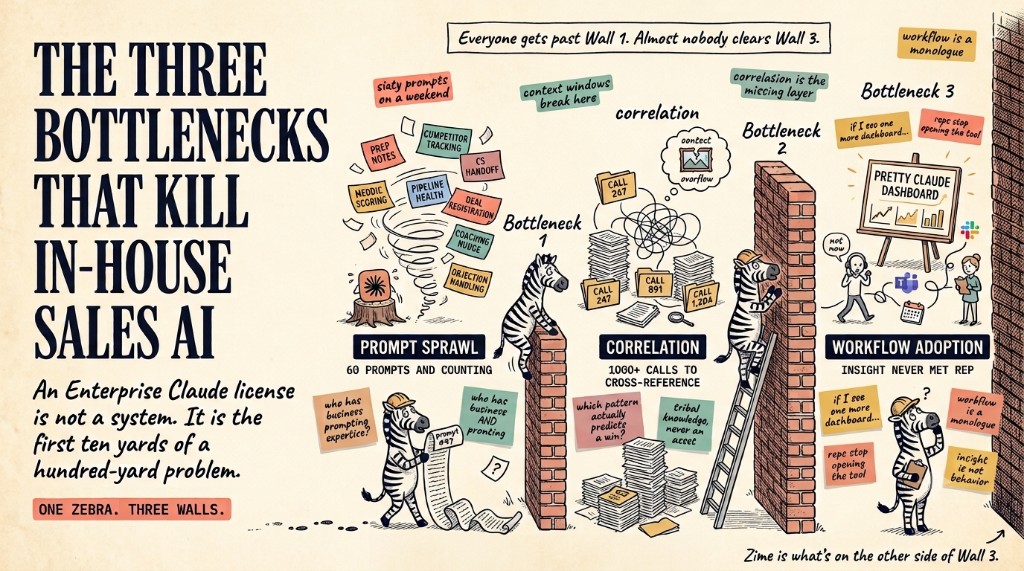
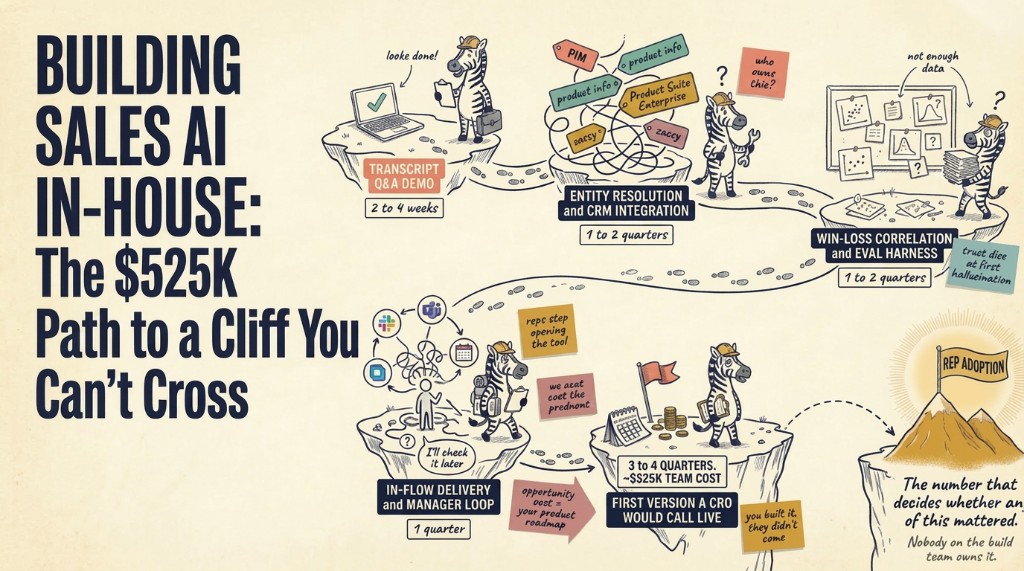
The room agreed on the strategy in an hour. Execution is the hard half. Moon framed it as a CRO would: you have a hundred salespeople, and you need each of them to run your process and deliver the messages you know work. Garg added that "Building the strategy and keeping in your PowerPoint is is only so much useful." Each move changes by seller role, product, buyer, segment and deal stage. Your strategy runs on 1,000+ behaviors. Nobody has written them down, tested them or kept them current.
Why playbooks and AI miss the meaning
Moon has watched companies hire consultants and enablement leaders to build playbooks for months. His verdict on the result: "as soon as they publish it, it's out of date." The CRO's next quarter is missing too. As he put it, the "forward looking strategy of a CRO is almost always missing in the evolution of a playbook."
So reps turn to AI. Moon's critique of today's sales AI was the sharpest line of the session. Most tools read the CRM and call transcripts. What they miss is how the company actually wins:
"what it's missing is the tribal knowledge of how your company sells. And that tribal knowledge largely lives in stories."
Michael Jay Moon, founder, GISTICS, Revenue Fieldcraft Peer Cafe, 19 November 2026
Without those stories, he said, an AI's insight is not situated in this buyer, this stage and this competitor. It gives "highly confident misinformation". Feinberg added the human side. AI tools "lack judgment", he agreed, yet they are always making judgments, and certainty "shuts down thinking". His own habit is to push back and ask the AI what he is missing.
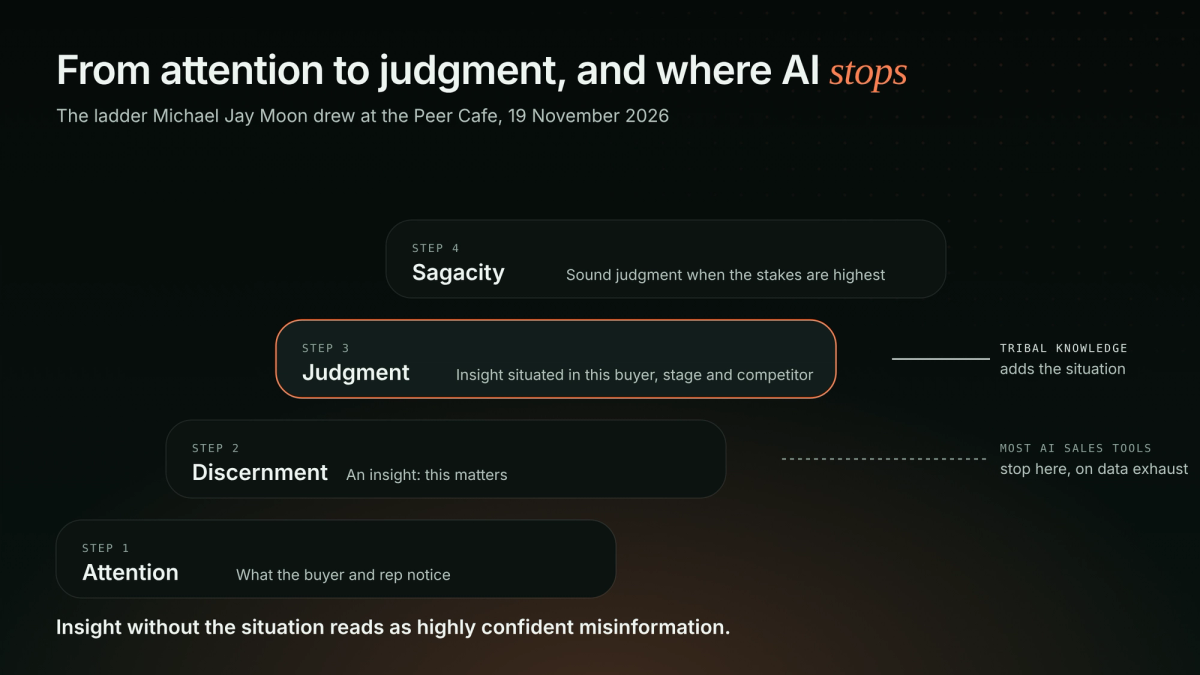
You can see the gap on one rep question. Ask a general assistant "They say the incumbent is cheaper. What do I say?" and the answer is usually a discount. It is accurate about the past and silent on what wins.
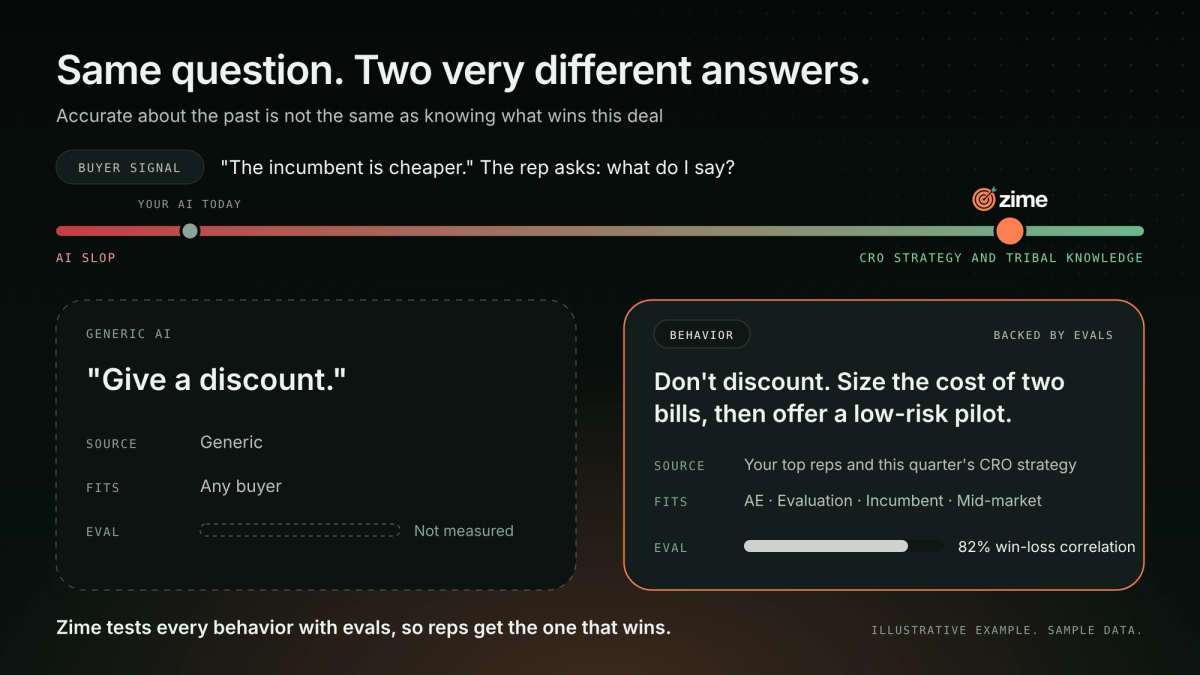
A move from your own strategy reads differently: don't discount, size the cost of two bills, then offer a low-risk pilot. That is Feinberg's meaning, built for this buyer at this stage. And it is the move a discount-first rep never makes.
You can test the gap on your own calls without any tool. Pull 20 recent calls where a buyer said the incumbent works: ten deals still moving and ten lost or parked. For each, mark which of the moves above the rep ran and what the buyer said next. If the moving deals cluster on two or three moves, those are your first behaviors. It takes a manager about a day. It stops scaling at the second product, the second segment and the next quarter.
This is the problem Zime was built for, and it starts where Moon did: with the stories. Zime turns your displacement playbook into behaviors, the specific moves your reps run in a given situation, held in a Behavior Graph. It encodes your best people's judgment and your CRO's strategy, elicited through FDE-run interviews and RLHF, including what never shows up in a transcript. FDEs are Zime's forward-deployed engineers, who interview your CRO and top reps for those stories. Strategy Studio then tests each behavior against won and lost deals. Keep your playbook, battlecards and call recorder. They all recommend a next step. The difference is where the step comes from, and whether anyone can see that it ran.
Adoption without convincing, and how you know it worked
Garg told the room about asking his eight-year-old for a glass of water. The answer: "papa, you can get it by yourself." Experienced reps hear new messaging the same way. That is why, he said, "Behavior is not just a technology problem. It's also a people problem."
Moon's answer was the most practical idea of the day. Give a rep three things to try on the next call. No mandate. The rep tries them, the deal moves, and the rep tries them again:
"So there's no convincing. It's just all a matter of personal evidence."
Michael Jay Moon, founder, GISTICS, Revenue Fieldcraft Peer Cafe, 19 November 2026
His condition was strict: it has to work with minimum effort, inside the systems reps already use. That is how Programmatic Adoption works. Before the call, the rep's prep note carries three moves for this buyer and stage. When the buyer says the incumbent is cheaper, Live Coach sends a live prompt. After the call, Zime checks whether the rep ran each move and how the buyer responded. Managers see each deal's gaps in their pipeline review. It all lands in Slack, the CRM and your own agents, with no new tool.
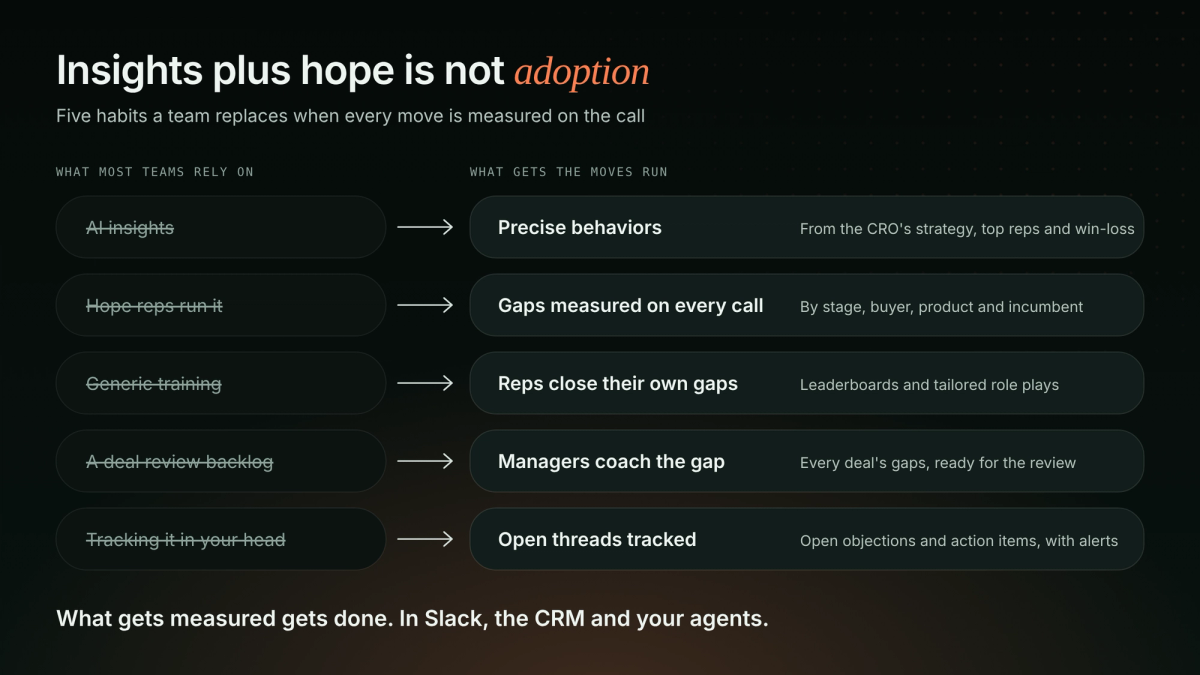
Here is one Tuesday, as an illustrative example. Dana, a mid-market rep, has a call with Acme Freight, whose network team renewed with its incumbent last spring. Her prep note says: ask what would still stop the switch, size the cost of two bills, and offer one pilot site with rollback agreed. After the call, Zime marks two of three moves run and a dated pilot site agreed. Her manager coaches the third move on Thursday.
To know it is working, run two checks on your own deals. First, coverage: in deals where a buyer said the incumbent works, did the rep run at least one top-rep move? Pass means most deals, across most reps. Fail means the same few names. Second, the buyer's answer. Did the buyer commit to something dated, such as a pilot site or a meeting with the approver? Pass is a date. Fail is "let me come back to you".
To see whether the moves cause the change, stagger the rollout. Give half the team the moves first, and everyone gets them inside the quarter. The table below runs that comparison on illustrative sample numbers.
| Measure (illustrative sample) | Moves from week 1 | Moves from week 7 |
|---|---|---|
| Deals where the buyer said the incumbent works | 40 | 38 |
| Deals where a top-rep move ran | 28 (70%) | 9 (24%) |
| Deals with a dated buyer commitment | 17 (43%) | 6 (16%) |
In this sample, the early group ran the moves nearly three times as often, and dated commitments followed. Both groups face the same buyers in the same weeks, so the difference sits with the moves.
Versa Networks shows the pattern on real deals. Versa sells SD-WAN and SASE, a category where buyers compare vendors line by line and SEs carry the technical discovery. Within three months, 79% of Versa's SEs were running the right technical discovery, up from 20% at the start. Versa also saw a 12% increase in technical wins. Its CRO, Martin Mackay, summed up the change:
"Zime helped our sales team qualify deals more accurately and move them through the pipeline."
Martin Mackay, CRO, Versa Networks (read the Versa story)
Qualifying accurately is the commodity sale's first move: knowing which deals have a real reason to switch. Zime's benchmark is 80% of eligible reps within 90 days.
The room in Palo Alto agreed on the strategy quickly: win the meaning, not the price war. What nobody had was a way to get a hundred reps to run it. That is the part worth building first. Book a demo and see your own displacement moves running in live deals.
Join the next conversation. The Revenue Fieldcraft Peer Cafe meets again on 5 December 2026 at 11 am PT. CROs, founders, and partners bring a live problem, and the room works it together. Want to talk through your own commodity sale first? Talk to us.
FAQ
What counts as a commodity product in B2B sales?
A product buyers treat as interchangeable and choose on price. Michael Jay Moon's test: unless buyers line up demanding what you have, you probably sell a commodity. Firewalls, SD-WAN, laptops and much of software fit.
Should reps discount to beat an incumbent?
Usually not first. Most buyers who keep an incumbent cite risk, timing or habit, not price. Top reps size the cost of switching, offer a contained pilot and tie the plan to the renewal date.
How do you sell against an incumbent the buyer is happy with?
Change what the switch means. Run beside the incumbent before replacing it, enter through one use case or site, prove the migration with rollback agreed, and give the champion a dated business case.
How long does it take to get most reps running these moves?
Zime is live in 7 days. Versa got 79% of SEs running the right technical discovery within three months, up from 20%. Zime's benchmark is 80% of eligible reps within 90 days.