How to Coach a Rep Who Follows the Process but Still Loses Deals
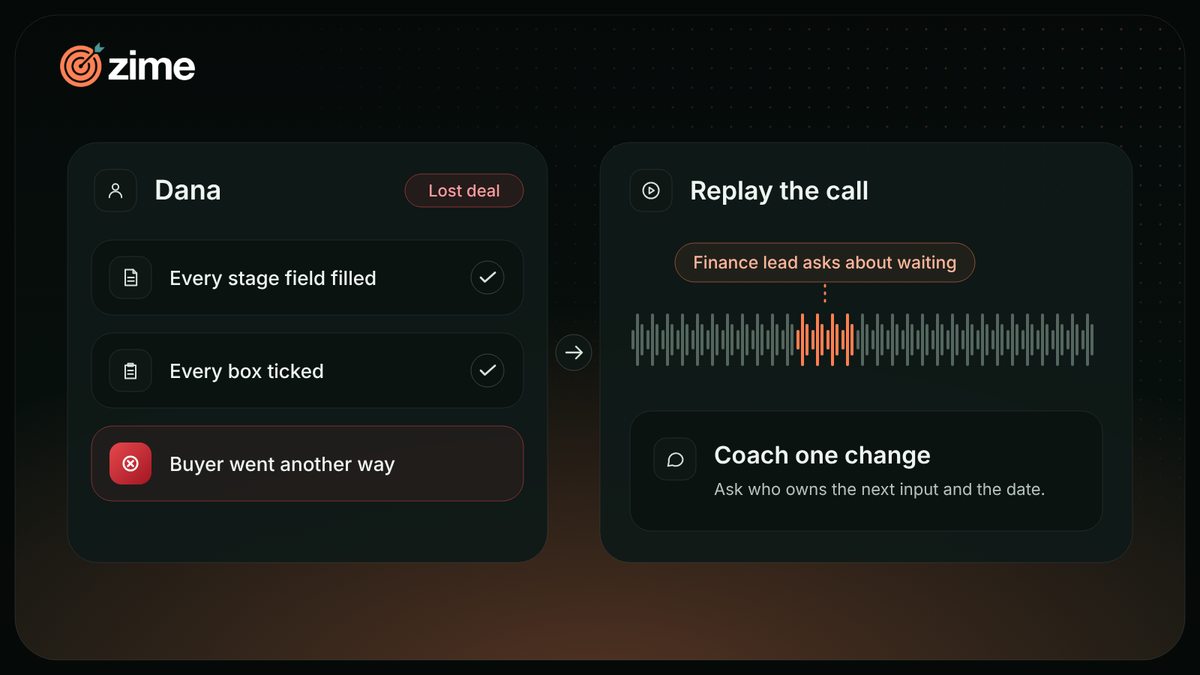

- Your rep follows the process. That is real discipline. The checklist is green. Training did its job.
- But the hard part is finding the moment the deal turned. The same training gives every rep the same steps, and the checklist records that each step happened. It cannot show how the step was run. Coaching the steps again leaves that moment untouched, so she runs it the same way next time.
- And the answer is already in your own deals. Call-recording tools and good managers already compare a loss with wins. Do it on one deal, beside two or three similar wins, and find the move the winners ran at that moment. If they did the same, it may have been unwinnable.
- That move is what Zime's Behavior Graph supplies. It is the model that holds your best reps' know-how, your CRO's strategy and your past deals. It hands a rep the specific move for a deal. Your best people teach it, including what never shows up in a transcript.
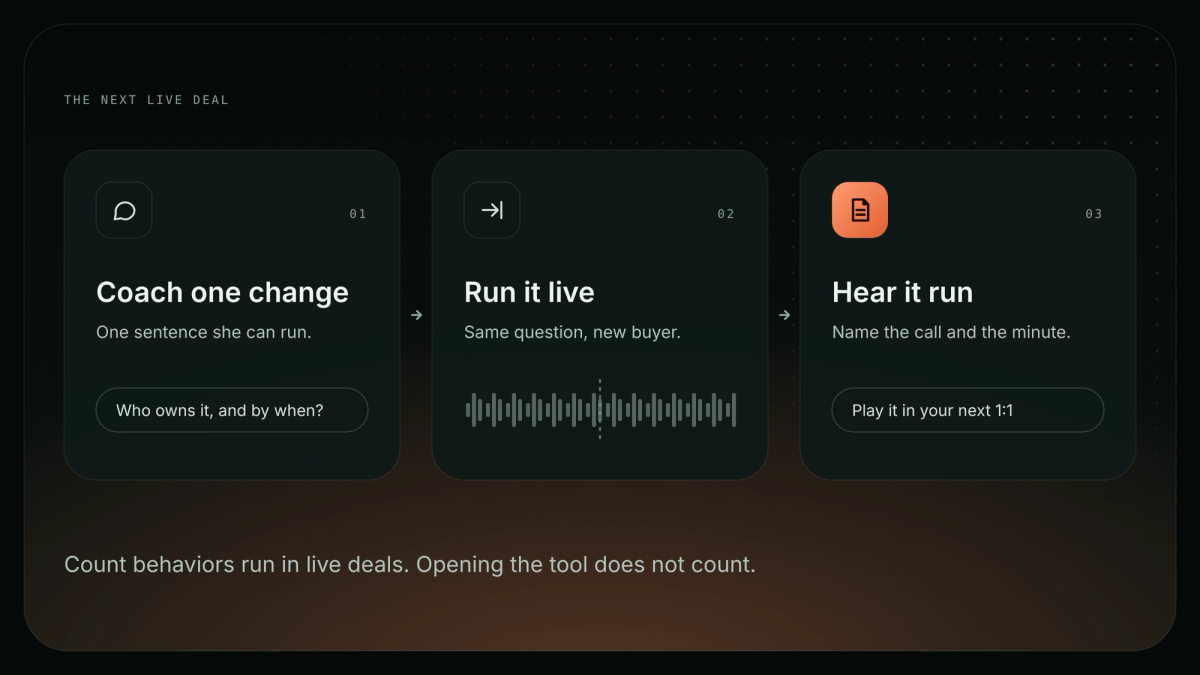
- So coach one change, then check that it ran. Write it as one sentence the rep can run on her next live deal. Find that moment on the call. Count the reps who ran it in a live deal; logins do not count.
It is Thursday, and you are in a 1:1 with Dana, who lost a deal last week. Every stage field is filled in. Every checklist box is ticked. The CRM loss reason says the buyer went another way.
You ask for a walk-through. Each step was done. Two similar deals closed on your team last quarter. The record does not say what they had that this one lacked.
You could coach the steps again. But the record holds only steps. The question is different. Where did this deal turn, and what did the similar wins do at that point?
Where did this deal turn?
You have tried answering that before.
First, another round on the steps. Training works. Dana has had it. The tell: she can recite every step and still lost.
A longer checklist comes second. The tell: she ticks the new box and you cannot say how she ran it.
Call listening and ride-alongs come next. The tell: you finish with notes on style and no single moment, or she says "got it" and you cannot check what she took away.
Role-play tools help her practise the steps.
That is why trained reps run the same steps so differently. The difference sits inside a step, in the one minute where she chose what to say. What you can change is what you coach and what you can see.
Four things must be true before a review helps. You can name the moment in one sentence. You can hear it beside similar wins.
You can coach one change. And you can see her run it next time.
Replay it beside the wins
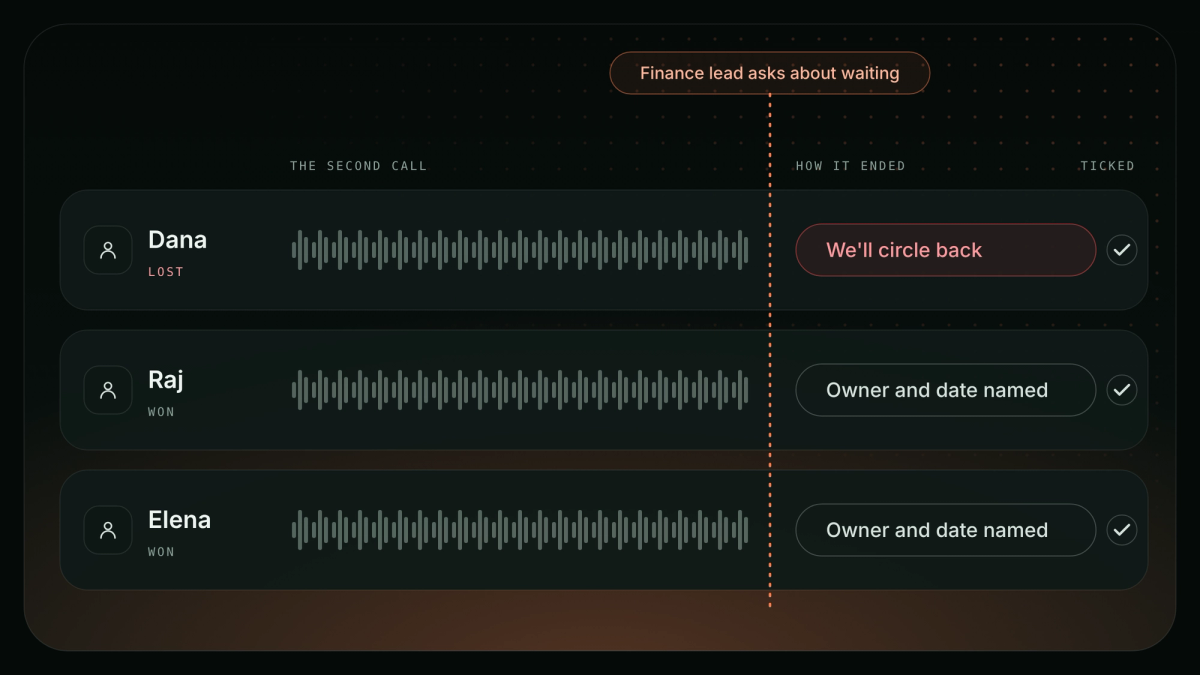
Start with the moment. Open the recording and listen for where the buyer stopped moving. Say it is the second call, and the buyer's finance lead asks what happens if they wait a quarter.
Dana answers well. The call ends with "we'll circle back," and the next-step box gets ticked.
That is your moment. The finance lead asked about waiting, and she answered but left the next step open. If all you can say is "discovery was weak," keep listening.
Now hear that point in two or three similar wins. Match on segment, size band, stage and kind of competitor. Raj and Elena heard the same question.
Both ended with the buyer naming an owner and a date for the next input. The same box was ticked in all three deals.
If the wins show nothing different, the deal may have been unwinnable, or lost on price or timing.
Others do this too: managers, and call tools. Buyer interviews add why the buyer went another way.
Do it with her. At Versa Networks, deals run from $100K to $3M, and almost every one turns on a technical evaluation. John Volkering, Director of Systems Engineering, ran the European SE team, where managers could not simply sit in. He explained why:
"My team doesn't like their managers to be on their calls and get micromanaged."
John Volkering, Director of Systems Engineering, Versa Networks
Replay one minute of the recording with the rep beside you.
One change, from your best people
A difference is not coaching until it is one change. Write one sentence Dana can run on her next live deal. Before the second call ends, ask who owns the next input and the date it lands.
Where does that change come from? Not from the deals you remember. It comes from what your best people know about winning and never wrote down.
That is tribal knowledge. Nobody says a reflex out loud.
Zime turns that into a Behavior Graph, the model that holds your best people's know-how, your CRO's strategy and your past deals. It produces Behaviors: the specific move to run in a situation, with the winning deal behind it. The know-how is elicited from your best people through FDE-run interviews and RLHF, including what never shows up in a transcript.
FDE-run interviews are Zime's forward-deployed engineers interviewing your best reps. RLHF is scoring and correcting each move until your best reps would run it.
Here is how the approaches compare. Most can recommend a next move, and the source is what differs.
The table below compares the checklist and CRM, manager listening, call tools and Zime.
| What it does | Checklist and CRM | Manager listening | Call tools | Zime |
|---|---|---|---|---|
| Records that a step happened | Yes | Partial | Yes | Yes |
| Shows how a step was run | No | Partial | Yes | Yes |
| Compares a loss with similar wins | No | Partial | Yes | Yes |
| Recommends a next move | No | Yes | Yes | Yes |
| Carries what was never said aloud | No | Partial | No | Yes |
| Checks the move ran on the next deal | Partial | Partial | Partial | Yes |
The row on recommending a move carries the point.
In Dana's deal, the checklist shows a next step agreed. A call tool matches her answer to the wins. The Behavior Graph adds the move your best reps run there, and you stay the coach.
Zime has not published a result showing that comparing a lost deal with similar wins raises win rate. What it has published are customer results on behaviors run and on coaching time.
Coaching time first. Martin Mackay is CRO at Versa Networks, where more than 200 reps sell against ten named competitors. He said:
"Zime is a huge win for all stakeholders; saves half of my time on coaching AEs."
Martin Mackay, CRO, Versa Networks
That is a time result: a 50% reduction in pipeline-review and coaching time. It says nothing about win rate. In Zime's view, a hand-written list of winners' moves ages as the strategy moves.
What changes on the next deal
A change you coach is only a plan until it runs. You will know it ran when you can name the call and the moment. "She says she did" proves nothing.
Count it the way Zime does: behaviors run in live deals, tied to the strategy that authorized them. Opening the tool does not count. Zime's own benchmark is 80% of eligible reps within 90 days.
Now replay Dana's next deal. It is a new buyer and another second call. The finance lead asks about waiting a quarter.
Dana answers. Then she asks who will own the next input and the date it lands. The buyer names an owner and a date.
You hear it on the recording, at the moment you coached. You note the call and the minute. In your next 1:1 you play her that minute.
Dana knows the change came from a deal a best rep won, so it is not your hunch. She runs it because she trusts it.
If you manage a small team and hear most calls yourself, do the comparison by hand.
Each of these four tests ends in something you can point to.
The table below gives each test, what passes it and what fails it.
| Test | Pass | Fail |
|---|---|---|
| Name the moment | A moment on a call, in one sentence | "Discovery was weak" |
| Compare with wins | A difference in what was asked, said or done | "They built better rapport" |
| Coach one change | One sentence she can run next time | A list of steps to revisit |
| See it run | A named call and moment on the next deal | "She says she did" |
The test on seeing it run is the easiest to skip.
Coach the moment that decided the deal.
Keep the training and call tools you have. Zime adds the Behaviors your best people run, each with the winning deal behind it. Live in 7 days on your own data. Bring one lost deal. We'll show you the first behavior to encode, and how you'll know it ran. Book a demo →
Frequently asked questions
Why do trained reps execute the same sales methodology so differently?
Because a process confirms that a step happened. It does not show how it was run at the moment the deal turned. Tools and managers can find that moment but cannot supply tribal knowledge, what your best people never wrote down. Zime's Behavior Graph is built from it, elicited from your best people through FDE-run interviews and RLHF, including what never shows up in a transcript. FDE-run interviews are forward-deployed engineers questioning your best reps. RLHF is scoring and correcting each move until they would run it.
Is inconsistent execution a training, management or workflow problem?
For a rep who passed training and still loses, it is rarely training. The gap is what gets coached and what the manager can see: how a step was run when the deal turned. A process that records only that steps happened keeps missing it.
How do I pick similar wins without fooling myself?
Pick wins from the same segment, size band, stage and kind of competitor. Take two or three wins. One lucky call should not set the standard. If a tool picks the wins for you, ask any vendor, us included, how it chooses them.
Will my reps feel watched if I replay their calls?
Some will, so replay one minute with the rep beside you. That is a shared review, and nobody is listening in. A Versa director said his team dislikes managers on their calls. Coaching should also never assume she does not understand her own deal.
Why not use the call tool I already have?
Keep it. A call tool finds the moment and compares it with wins, and both it and Zime recommend a next move. A general AI model or context provider can recommend a move too. The difference is the source: past calls, or your best people's know-how and your CRO's strategy. Ask any tool, ours included, how it tells a lost deal that turned from one that was unwinnable.