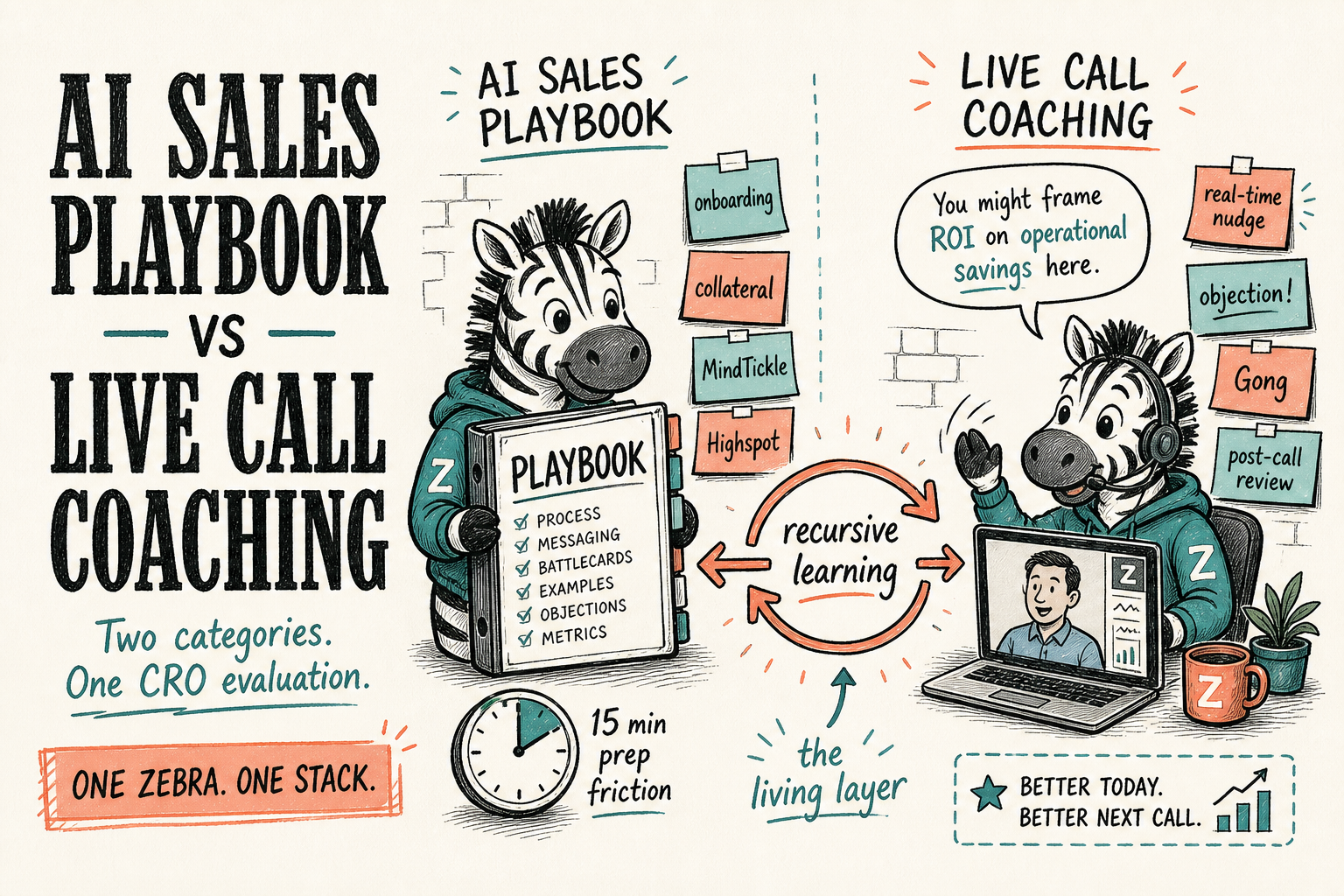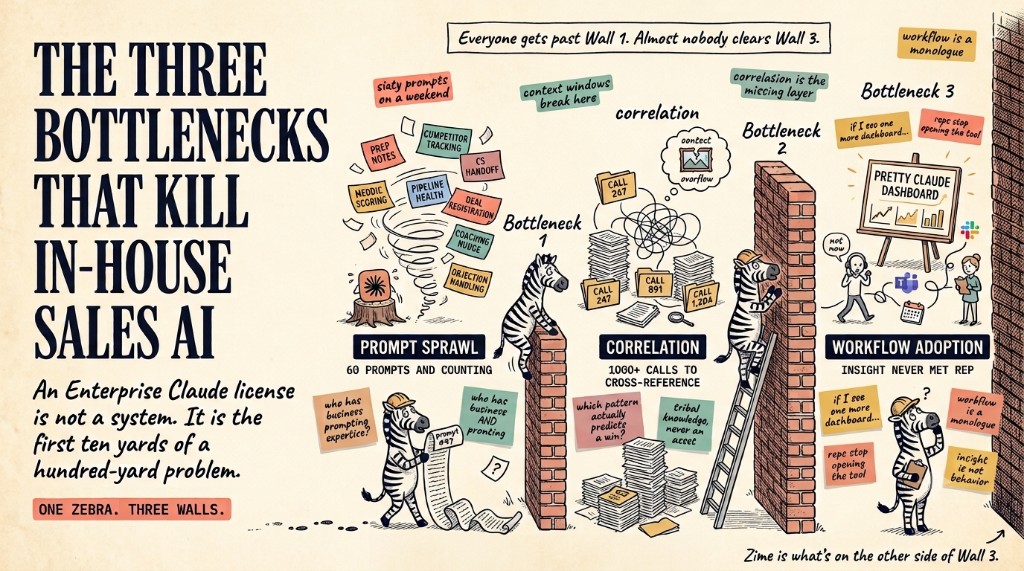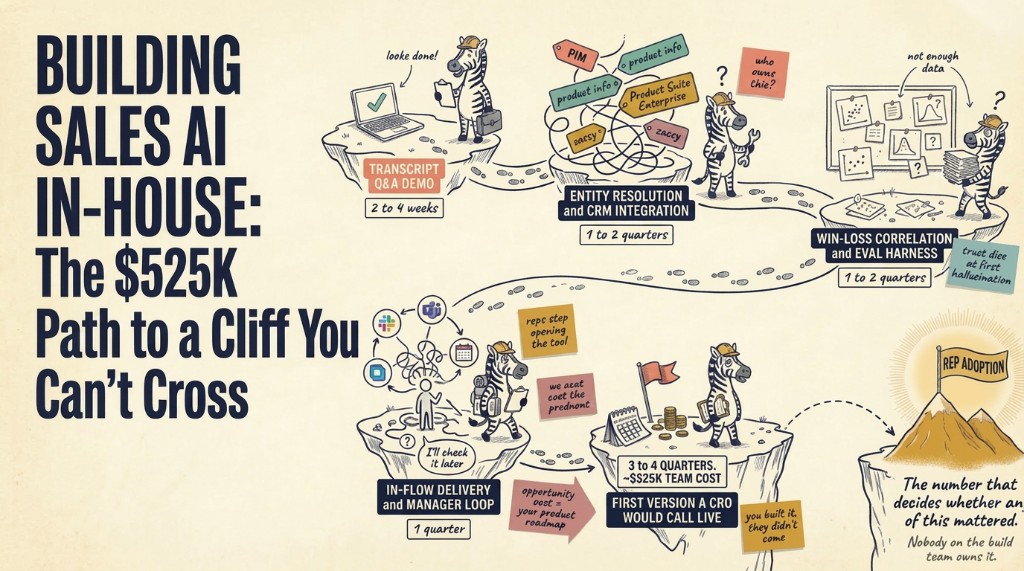
Are your reps delivering the new messaging? How PMMs find out

- Training shows the message reached reps, not buyers. Only the sales call shows that.
- A weak message and an unused one look the same. A flat win rate cannot tell you which to fix.
- PMMs, sales leaders and research report the same gap. "How do I know if it's working?"
- Zime closes the gap on every call. It turns your message into behaviors (the line a rep says at a given moment), delivers them before and during calls, and counts who ran them, by segment.
- Each call answers three questions. Is it said (sales), is it winning (PMM), are the deals qualified (marketing)?
The launch went by the book. New deck, new battlecard, a talk track for the top three objections, and every rep certified by the end of week two. Thirty days later, in the pipeline meeting, the CRO asks the product marketing lead one question: is the new message working?
Win rate in the target segment has not moved. That leaves two readings and no way to choose. The message might be wrong for these buyers, or reps might not be saying it. Rewrite the deck when the problem was delivery and you lose a quarter. Push enablement harder when the message was the problem and you drill reps on something buyers do not want. You cannot tell a weak message from one nobody used.
This post is about closing that gap: how a PMM finds out, from evidence, whether reps are delivering the new messaging on calls, and whether it wins when they do. It is also about how Zime, Behavioral AI for Sales Execution, closes that gap on every call.
Every PMM we talk to asks the same question
We hear this on almost every call with a product marketing leader. In October, a VP of Product Marketing at a telecom infrastructure services company walked us through how he builds messaging: as close to the buyer as he can get, so it never comes out generic. Then he named the half of the job he cannot see.
"My sales teams are driving their message forward. How do I know if it's working? ... unless dollars are coming in the door, I don't know."
VP of Product Marketing, telecom infrastructure services company
Revenue is his only signal, and it arrives a quarter late without saying whether the message or the delivery moved it. In between, he told us, he relies on what reps type into the CRM.
The same question comes from the sales side. Skan AI, a Zime customer, had just rolled out a new sales deck with new pitches tied to it. Kenny Cao, who runs go-to-market strategy and operations there, was clear that finishing the training was not what he needed to know.
"I want to understand how the team is delivering against the deck and against the new value proposition, right?"
Kenny Cao, Senior Director, Head of Go-To-Market Strategy and Operations, Skan AI
Completion is a checkbox. How well the new value proposition comes across on a live call is the thing he wants to see.
When we asked a marketing leader at an IT management software company what success would look like for a new message, he did not name a win rate. He named a share of reps.
"From a marketing standpoint, adoption would be a good percentage, if I can… tell me 80% of reps are adopted the new message. That's a win."
Marketing leader, IT management software company
Notice what he asked for: the share of reps saying the message on calls, not the share who passed the training. He then asked a second question: how much of the battlecard actually shows up in reps' talk tracks.
Outside our calls, the pattern is old and well documented. Writing for the Product Marketing Alliance in September 2025, Aircall's Stefano Perrotta and Lorenza Pugliese described spending weeks on positioning for a new feature "only to hear five different versions of it on sales calls", and finding that only 48% of their product marketing content was even being viewed by go-to-market teams. In a 2013 Corporate Visions survey of about 400 B2B salespeople and marketers, nearly 60% of companies believed fewer than half of their salespeople delivered new product messages as intended, and only 22% required salespeople to show they could deliver it. The survey is thirteen years old. The question on our calls this year is the same one.
It matters because this is the job product marketers own. In the Product Marketing Alliance's 2025 State of Product Marketing report, positioning and messaging is a core responsibility for 91% of product marketers. The work almost every PMM owns is the work that is hardest to measure once it leaves the deck.
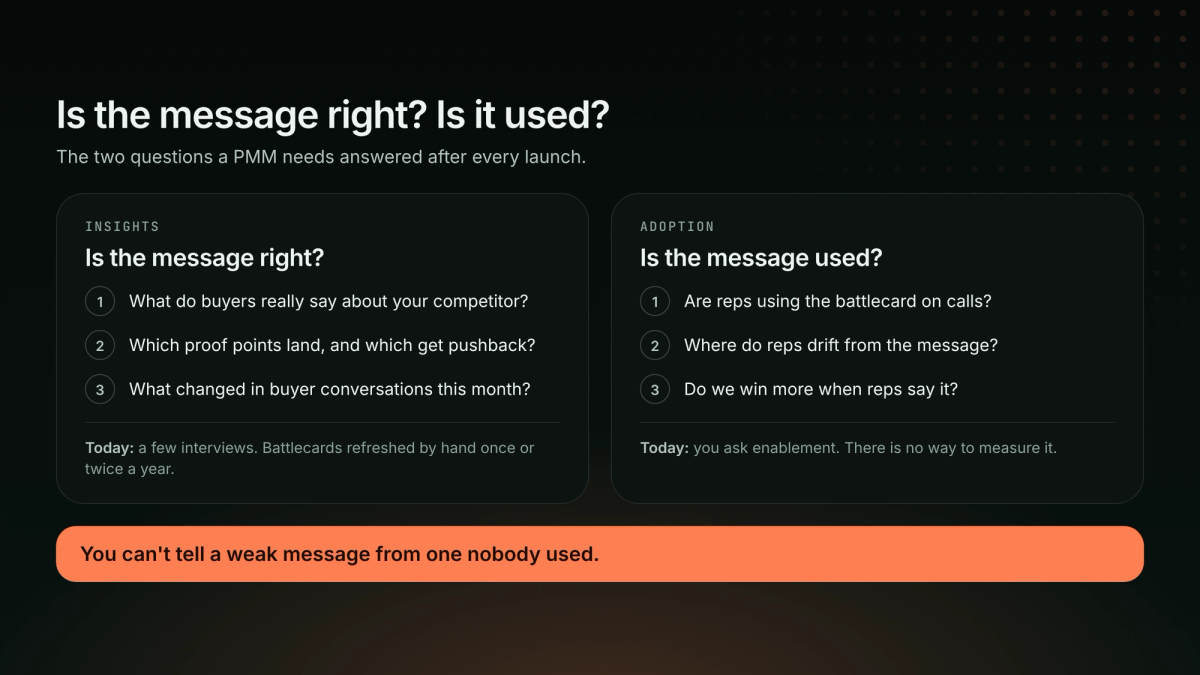
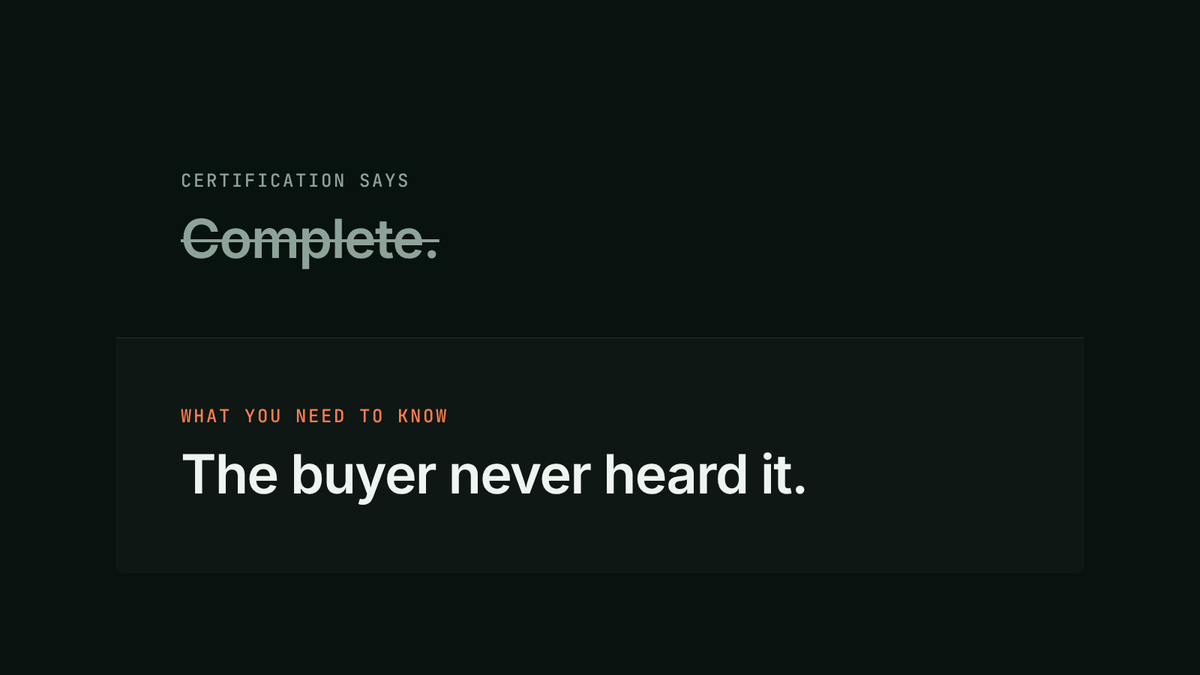
The picture above splits the problem in two. Whether the message is right is a question about buyers. Whether it is used is a question about reps. Both answers live in the same place, the call, and most PMMs see neither.
Why certification and content views cannot answer it
Every signal a PMM has today measures something before the call or after it. The table below shows what each one can and cannot tell you.
| Signal | What it shows | Shows the rep said it on a call | Shows it won | Shows it by segment |
|---|---|---|---|---|
| Certification and role-play scores | The rep can say it in practice | ✗ | ✗ | ✗ |
| Content and battlecard views | The rep opened the asset | ✗ | ✗ | Partial |
| CRM notes and fields | What the rep typed after the call | Partial | ✗ | Partial |
| Win-loss interviews | Why a handful of buyers chose | ✗ | Partial | Partial |
| Keyword tracking on recorded calls | A phrase came up | Partial | ✗ | ✓ |
| Message lines checked on every call | The right line at the right moment, and what happened next | ✓ | ✓ | ✓ |
Picture it in one deal. Certification says complete. The battlecard shows twelve opens. Your call recorder already captured every word the rep said, and a keyword tracker flags that "total cost" came up. What none of them tells you is whether the rep used the new line at the moment the buyer said the incumbent is cheaper, or fell back to last quarter's discount pitch. The call says the buyer never heard the new line.
The root cause is that a message lives as a deck and a battlecard, but on a call it becomes dozens of small moves. Each one changes by seller role, product, buyer, segment and deal stage. Nobody wrote those moves down moment by moment, so there is nothing to check a call against. Zime calls each of those moves a behavior: one specific thing a rep says or does at a given moment, for a given buyer.
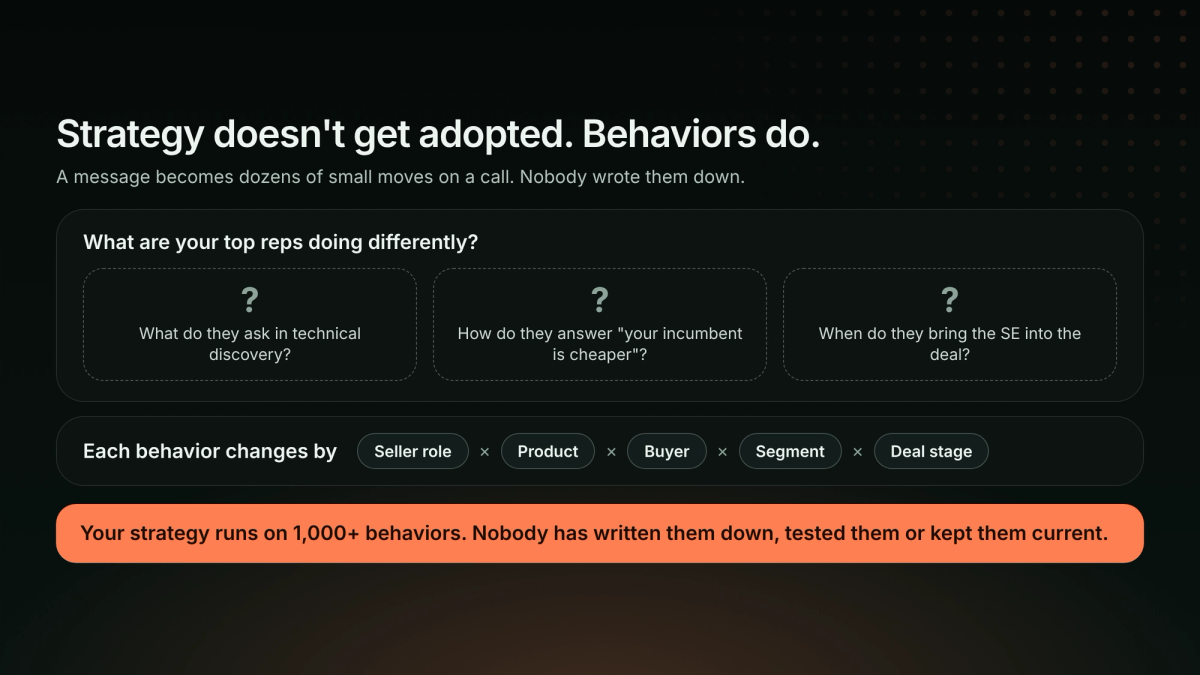
The best leaders already run the right test by ear. Chitresh Yadav is VP and Global Head of Sales Engineering at Versa Networks, where more than 100 SEs across four regions sell against ten named competitors. When he hears Fortinet, Palo Alto or Zscaler come up on a call, he checks one thing:
"whether my rebuttal to those were inline to our battle card."
Chitresh Yadav, VP and Global Head of Sales Engineering, Versa Networks
That is exactly the right test: a specific line, at a specific moment, against a named competitor. Done by one leader listening in, it covers a few calls a week. Product marketing needs it on every call.
Close the loop: three questions, three owners
Every recorded call can answer three questions, and each answer belongs to a different team.
- Are reps delivering the message? Feedback to sales and enablement: which reps, at which moments, and where they drift back to last quarter's pitch.
- Is the message working, segment by segment? Feedback to product marketing: which lines win in which segment, and what to change in the battlecard.
- Are the deals it brings in qualified? Feedback to marketing: whether the buyers the new message attracts are the ones who go on to buy.
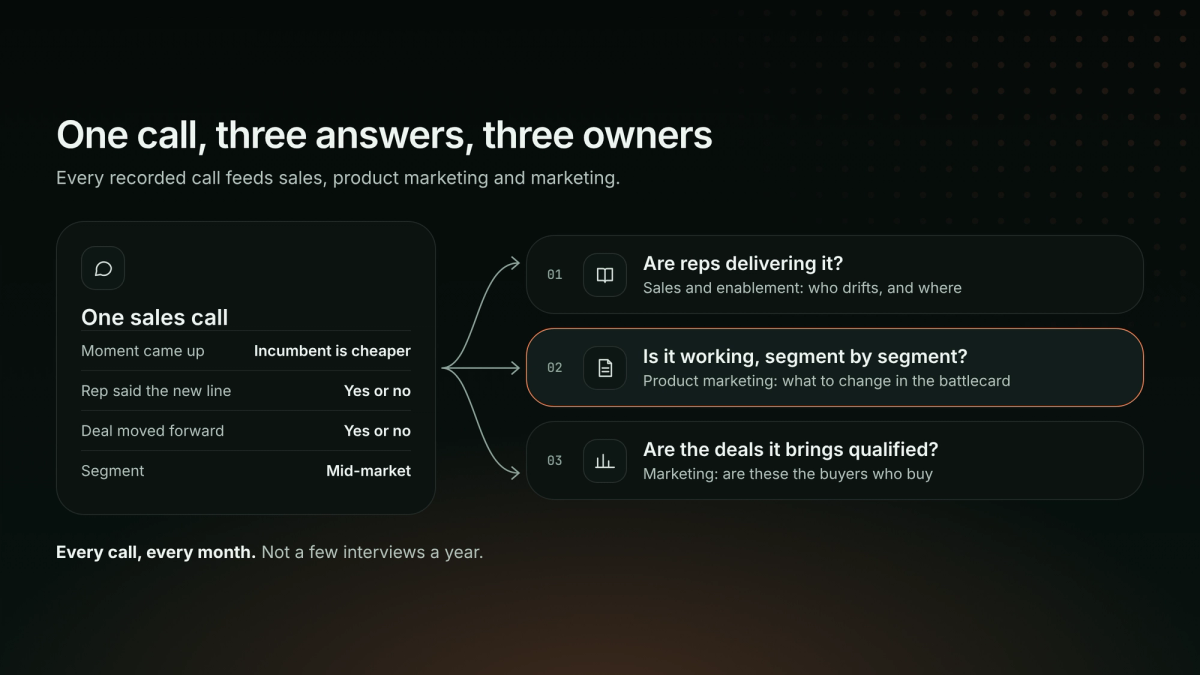
You can run the first two questions by hand before buying anything. Pull 30 recorded calls from the last two weeks in the segments the message targets, all past the first meeting. Write the message as three to five lines, each tied to a moment (for example, what the rep says when the buyer raises the incumbent's price). For every call, mark three things: did the moment come up, did the rep say the new line, and did the deal move to its next stage.
The table below runs that test on sample numbers. Illustrative example. Sample data.
| Segment | Calls where the moment came up | Rep said the new line | Moved forward when said | Moved forward when not said | Read |
|---|---|---|---|---|---|
| Mid-market | 12 | 9 of 12 | 6 of 9 | 1 of 3 | Used and working: keep it |
| Enterprise | 10 | 3 of 10 | 2 of 3 | 2 of 7 | Works when said, rarely said: a delivery problem for enablement |
| Public sector | 8 | 7 of 8 | 2 of 7 | 0 of 1 | Said and not landing: a message problem for PMM |
Averaged together, those 30 calls look like a flat message. Split by segment, they give three different answers. In mid-market the message works. In enterprise it works when reps use it, and most do not, so the fix is enablement, not a rewrite. In public sector reps say it and buyers do not move, so the line itself needs work.
Two tests tell you whether your read is real. First, every segment should end in one of those three reads; if most say "too few calls", widen the window to four weeks. Second, treat any side with fewer than three calls as direction only. Where a clean comparison matters, release the new battlecard to a random half of reps two weeks before the rest, and compare the halves.
By hand, this stops scaling quickly. Thirty calls is a day or two of listening (our estimate), and the read goes stale as soon as the competitor or the price changes. You would need it every month, per segment, per competitor.
How Zime closes the loop on every call
Zime solves this problem. It turns your new message into behaviors, delivers them to reps in the flow of work, and measures which ones reps run on live calls, segment by segment, every month. It works in four steps.
- Encode. Zime's forward-deployed engineers interview your top reps and you, then encode the message as behaviors for each role, segment and moment in the Behavior Graph.
- Deliver. Reps get the right line in the prep note before a call and as a live prompt during it.
- Measure. Programmatic Adoption counts which behaviors reps ran on live calls, by rep and segment, not who logged in. Strategy Studio tests a line against won and lost deals, to show which behaviors win.
- Update. The battlecard proposes changes every month from what buyers say on calls, and you approve or reject each one.
The table below shows how Zime answers each of the three questions, and who acts on it.
| Question | What Zime shows | Who acts |
|---|---|---|
| Are reps delivering the message? | Which reps ran the new behavior at the moment it applied, and where they fell back to last quarter's pitch | Sales managers and enablement |
| Is the message working, segment by segment? | Which lines move deals forward in each segment, and buyer pushback by competitor | Product marketing, through battlecard updates |
| Are the deals it brings in qualified? | Whether deals in the message's target segment pass your qualification criteria on the call | Marketing |
Seeing who skipped it is what changes delivery. Kapil Bhagat, AVP of Sales Strategy at Bureau, runs a multi-product sale of identity decisioning to banks and fintechs, where product updates and objection guidance used to sit across Jira, Confluence and spreadsheets. He put it this way:
"So this monitoring led to execution ... Having a dashboard where non adherence is called out improves execution."
Kapil Bhagat, AVP, Sales Strategy, Bureau
A dashboard that names the gap gives managers a reason to coach to it, and reps a reason to close it.
What changes when the loop runs every month
Today most battlecards are refreshed by hand once or twice a year, from a few interviews. With Zime running the loop, product marketing gets proof points from every call, every month, and sees the gap between what reps say today and what it wants said.
For Bureau, every product release is new messaging. Ranjan R Reddy, Bureau's founder and CEO, tied the result to getting those releases to reps as moves they could run:
"We improved our ARR by 10% with Zime seamlessly getting our product releases to our sales team in the form of just-in-time Actions."
Ranjan R Reddy, Founder & CEO, Bureau
A release only pays off once reps say it to buyers at the moment it fits. The same counting works on other moves: at Versa, 79% of SEs were running the right technical discovery within three months, up from 20% at the start, measured as behaviors run on live deals, not logins or training. Zime has not yet published a messaging-specific adoption figure for a product marketing team; when we do, it will be counted the same way.
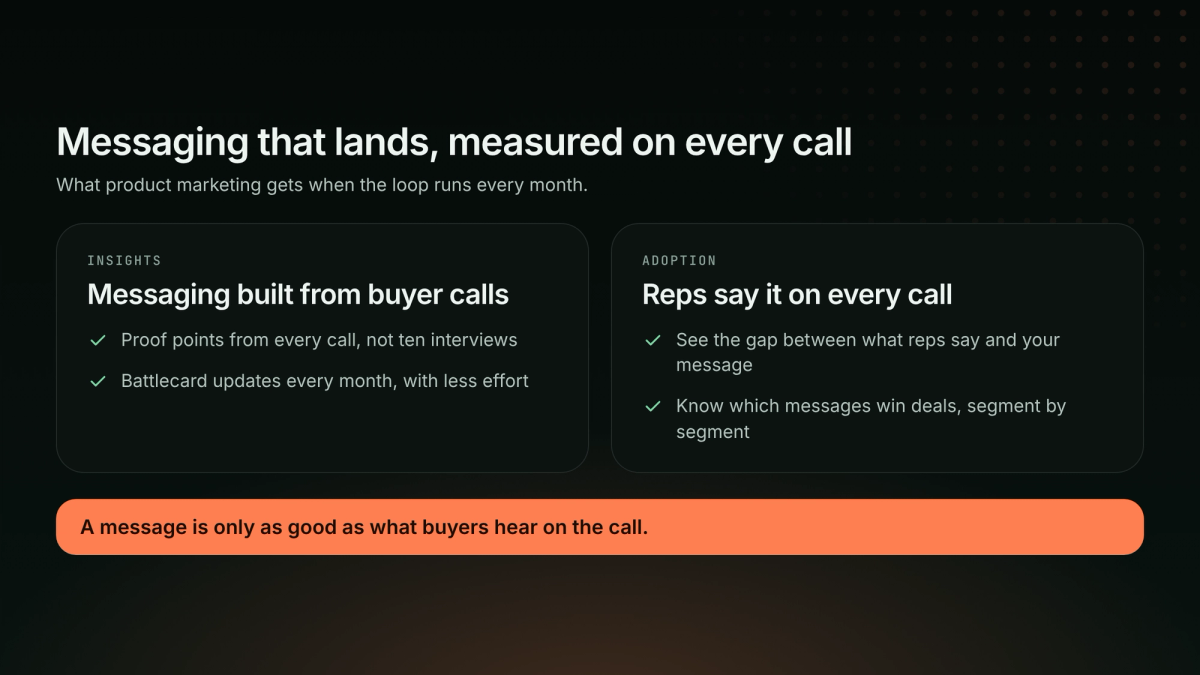
The next time the CRO asks whether the new message is working, the answer is not "win rate is flat". It is: in mid-market it is working; in enterprise reps are not saying it, and here is who; in public sector we are rewriting one line, and here is the buyer pushback behind it.
If you want to see that read on your own calls, book a demo and we will start with your battlecard.
FAQ
What does Zime do for product marketing teams?
Zime, Behavioral AI for Sales Execution, shows a PMM whether reps deliver new messaging on calls and whether it wins, by segment. It encodes the message as behaviors, delivers them before and during calls, counts which ones reps run, and proposes battlecard updates every month from what buyers say.
How do I measure whether reps actually adopt new sales messaging?
Count it on recorded calls. For each moment the message applies to, check whether the rep said the new line, then split by segment and rep. Certification and content views show the message reached reps, not that buyers heard it.
How do I reinforce new messaging so reps actually use it in calls?
Deliver it as the line for a specific moment, in the prep note before the call and as a live prompt during it. Then show managers who skipped it, and refresh the lines monthly from what buyers say.
Isn't a keyword tracker enough?
It shows that a phrase came up. It does not show whether it came at the right moment, to the right buyer, or whether the deal moved after it.
How many calls do I need before I trust the result?
Read it segment by segment and rep by rep, never pooled. Treat any side with fewer than three calls as direction only, and stagger the rollout when you need a clean comparison.