How to Get New Reps Productive Faster Using Real Calls From Your Own Top Performers

- Your top reps' calls are the right raw material. A library of them beats generic training slides. Hand it over on day one and keep it.
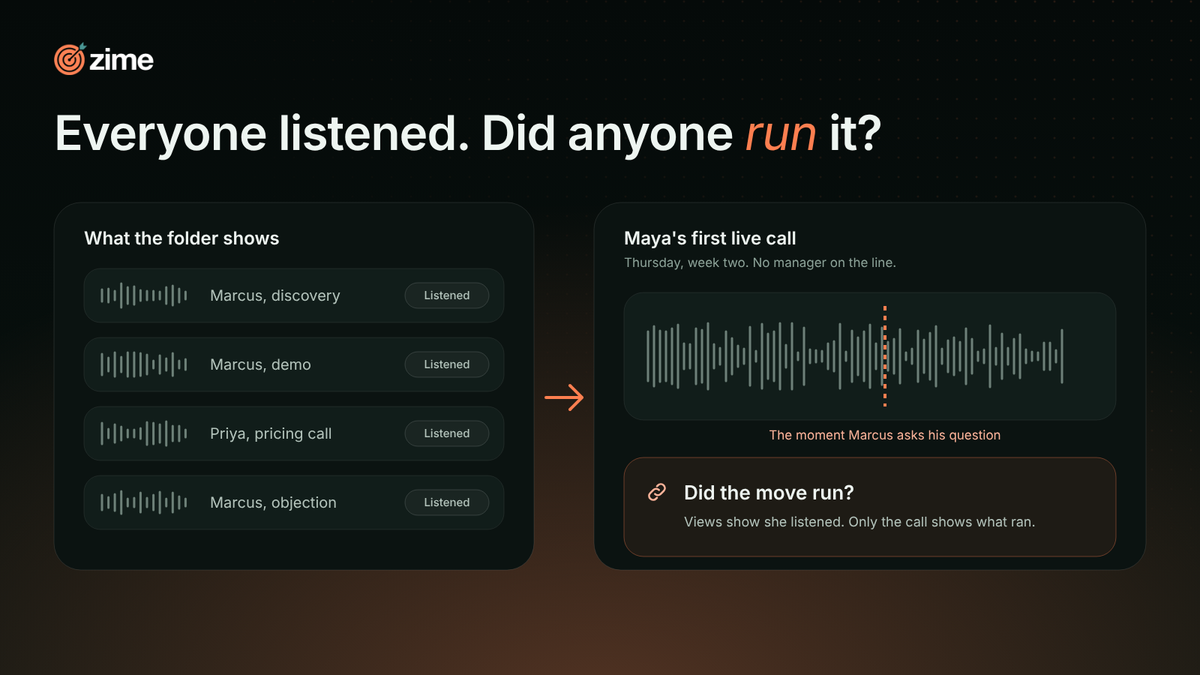
- But listening is not running. A new rep can finish every call in the folder and still wing the first live deal. That deal is the hard part of ramp. Day 30 shows views and call counts, not whether the move ran.
- And your best calls may not be the winning ones. A top rep's best call carries habits that never decided a deal. Pick calls by what tracks with wins in your own deals. Hand each over when the rep needs it in a live deal: first discovery, first demo, first pricing push.
- That is the job of a Behavior Graph. It is the model of your best reps' moves, taught by those reps, including what never shows up in a transcript. It adds your CRO's current strategy. Each new rep gets the move for their deal, and you see which moves ran.
- So build it, then count what ran. Keep the library and the plan you have. Map the calls to your first ninety days, then each week check which moments ran on live deals. That count tells you a new rep is ramping before quota does.
Maya starts on Monday. You send her the shared folder of top calls and a 30/60/90 plan.
Both are good. Marcus, your best rep, is in the folder. By Friday, Maya has listened to twelve calls.
None of this is wrong. A plan gives a map. Shadowing shows the work. A library beats a slide deck. Role play lets her fail in private.
Her first discovery call is Thursday of week two. You are in a pipeline review. Your dashboard will show twelve views and one recorded call. It will not show whether she asked Marcus's opening question.
Why listening is not running it
A rep can hear Marcus open twelve times and still open her own call with a product tour. By day 30 you can count views and call minutes. Those show she did the homework. They do not show whether she ran any of it live.
That gap costs. The Bridge Group's 2024 report put average AE ramp at 5.7 months, up from 5.3 in 2022 and 4.3 in 2020.
Sitting in will not fix it. John Volkering ran the European SE team at Versa Networks, where almost every deal turns on a technical evaluation. His engineers take those calls without a manager. He was blunt:
"My team doesn't like their manager to be on their calls and … micromanage them."
John Volkering, Director of Systems Engineering, Versa Networks
If a manager cannot sit in, the check has to come from the call itself.
The table below sets four ways teams ramp new reps against five jobs. Every approach teaches, and only a check on the live call shows whether the pattern ran.
| Job | Plan | Shadowing | Call library | AI role play | Check on the live call |
|---|---|---|---|---|---|
| Shows what good sounds like | Partial | ✓ | ✓ | Partial | Partial |
| Lets a rep practice first | ✗ | ✗ | ✗ | ✓ | ✗ |
| Works without a manager's calendar | ✓ | ✗ | ✓ | ✓ | ✓ |
| Shows a pattern ran on a live deal | ✗ | Partial | ✗ | ✗ | ✓ |
| Ties it to the strategy that authorized it | Partial | ✗ | ✗ | ✗ | Partial |
Read the job that shows a pattern ran on a live deal. Only a check on the live call shows whether Maya ran Marcus's move.
Which calls belong in the folder?
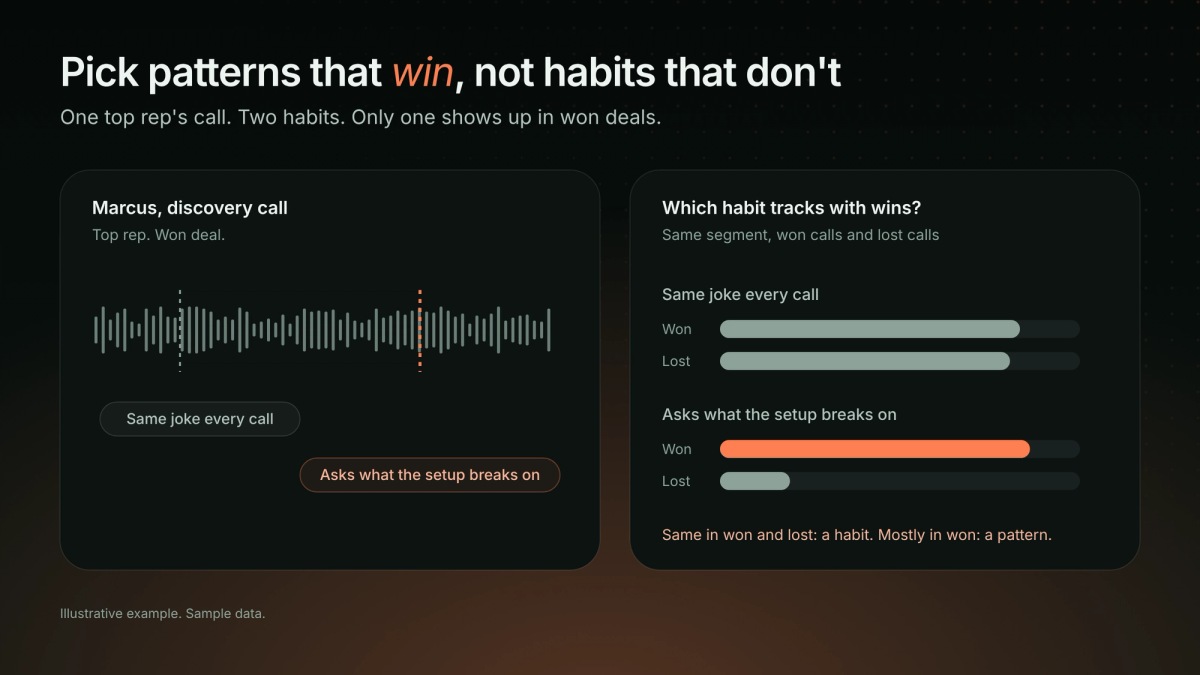
Start with what wins, not who wins. Marcus is your top rep, so his calls are in the folder. But top reps carry habits that decided nothing. Marcus opens every call with the same joke. It may do nothing.
Run two tests before a call goes in. The first is the habit test. Take one segment and, say, its last twenty closed deals. Mark each call for the pattern, as you would in a win-loss by segment. It passes if the pattern shows up in most won calls and few lost ones, across more than one rep. It fails if it shows up in won and lost alike, or under one rep's name. The tell is a single name on every example.
The second is the moment test. Name the point in a live call where the pattern applies, and the buyer cue that triggers it. It passes with a cue, such as the buyer saying they already own a tool. It fails with "be curious." The tell is a pattern with no trigger.
A transcript has a limit. It holds what Marcus said. It does not hold what he chose not to say, or why.
Hand them out by moment, then check
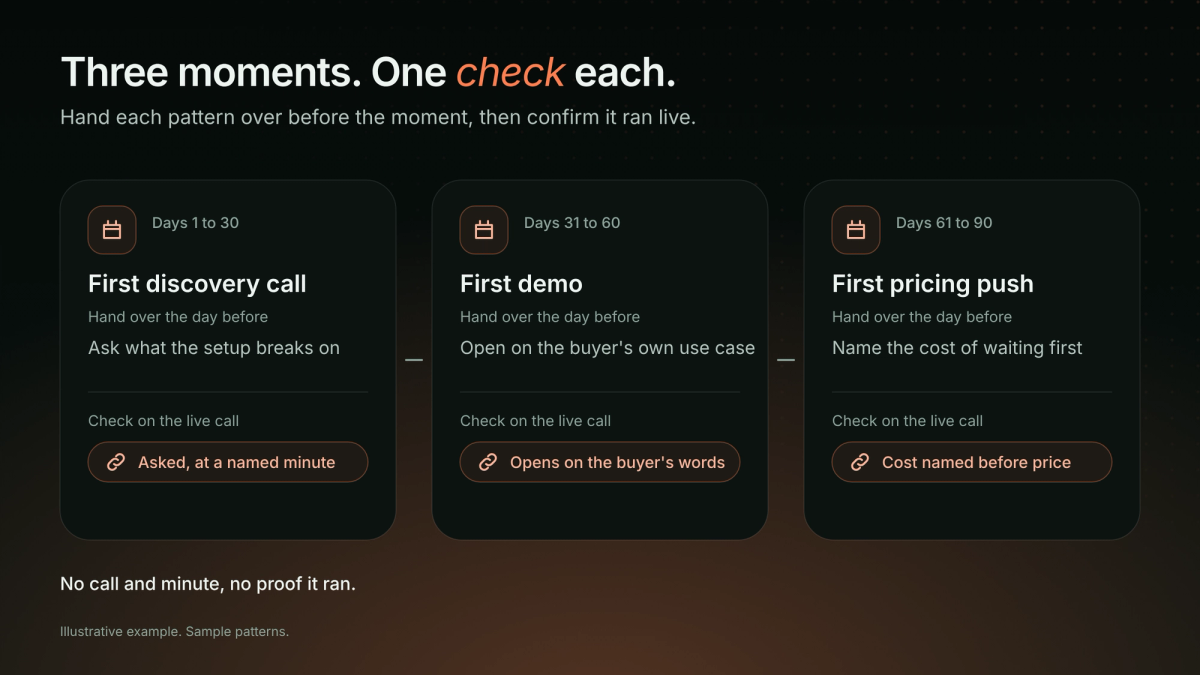
Hand each pattern over the day before its moment.
The table below is a sample map for a technical product. Swap in the patterns your two tests passed. Each moment gets one pattern and one check on the live call.
| Moment | Pattern to hand over | Comes from | Check on the live call |
|---|---|---|---|
| Days 1 to 30: first discovery call | Ask what the buyer's setup breaks on, before any demo | Won discovery calls from more than one rep | Asked, at a named minute |
| Days 31 to 60: first demo | Open on the use case the buyer named | Won demos in the same segment | Opens on the buyer's words |
| Days 61 to 90: first pricing push | Name the cost of waiting before the number | Won deals where price came up | Cost named before price |
Read the check column. If you cannot point to a call and a minute, the pattern did not run.
By hand, this works for a few hires a year. Past that, you need something that holds the patterns, keeps them current and records which ran. Zime builds that, and calls it a Behavior Graph. It is the model of how your best reps decide what to do in a live deal, plus what your CRO decided this quarter. It is elicited from your best people through FDE-run interviews and RLHF, including what never shows up in a transcript. In plain words, Zime's forward-deployed engineers interview your best reps, then score and correct the moves until those reps would run them.
Each result is a Behavior: the next move in the deal, with a receipt, the deal where one of your best reps ran that move and won. Zime's Behavior Graph for Sales holds them. Its Strategy Studio tests a strategy against won and lost deals, to show which behaviors win.
Conversation intelligence recommends too. The difference is the source: patterns ranked from past calls, or moves your best reps and your CRO stand behind.
A pattern is not a script. It never assumes Maya misreads her deal. Each is tied to the strategy that authorized it, so it changes when the priority does.
What is proven, and what is not
Replay Thursday. Maya opens the brief before her first discovery call. It holds one move: ask what the buyer's setup breaks on, before any demo. Under it sits the call where Marcus asked it and won. She trusts it because a rep she respects won with it.
She asks it at minute eight. On Friday you open the call and find it there. You did not sit in. Marcus ran no lunch-and-learn. His winning call is the receipt. You coach the demo next.
Maya did not guess. She had the move and the deal behind it. Marcus got his pattern used without a meeting. You got your answer without hunting through a transcript.
HFS Research's July 2026 profile of Zime describes the payoff as "a day-one starter can sell like a five-year veteran."
At Versa Networks, 79% of SEs were running the right technical discovery within three months, up from 20% at the start. Those were existing SEs, not new hires, but it shows live calls can be counted. Zime also cut Versa's pipeline-review and coaching time by 50%. Its CRO, Martin Mackay, put it his way:
"Zime is a huge win for all stakeholders; saves half of my time on coaching AEs."
Martin Mackay, CRO, Versa Networks
A time result, not a win rate: the hour a manager gets back when the call shows what ran.
MyAdvice came to Zime to ramp new reps faster. Its checklist adoption rose from 66% to 87%. Chad Erickson explained why volume mattered:
"…when the volume increases, we see Zime as a critical … part of the equation to allow them to be more efficient."
Chad Erickson, MyAdvice
More hires means more first calls to run the pattern or skip it.
Zime's own benchmark is 80% of eligible reps within 90 days. Zime has not published a ramp-time result. What it has published is how often reps run the checks.
See which new reps run the winning moves. Keep your plan, your folder and your recordings. Zime adds the moves your best reps run, tied to the strategy that authorized them, and shows which ran on live deals. Live in 7 days on your own data. Bring one segment's won and lost calls, and see which behaviors win. Book a demo →
FAQ
How do I cut new-hire sales ramp time using calls from my own top performers? Choose calls by what your own won deals show. Hand each pattern over before its moment in the first ninety days. Then check the live call for it: you need a call and a minute. Zime adds what a transcript cannot hold, how your best reps decide what to do, and records which moves ran.
Which top-rep calls should go in a new-hire library? Those that pass two tests: the pattern shows up in most won calls and few lost ones for one segment, across more than one rep, and it has a named moment and buyer cue.
What should a new rep run in each of the first ninety days? One pattern per moment. A sample map: a discovery question in days one to thirty, a demo built on the buyer's words in days thirty-one to sixty, the cost of waiting before price in days sixty-one to ninety. If you lack won calls for a segment, ask any vendor how it copes.
How do I know a new rep ran a pattern without sitting on the call? Ask for a call and a minute. A view count or a self-report is not proof. A tool that records the moves run, tied to the strategy that authorized them, does this for every call.
Do I need a new tool to do this? Not always. A few hires a year on one product can run on a shared folder, the two tests and a spreadsheet. It gets hard as roles, products and regions multiply. Then ask any vendor how many manager hours a week it takes to keep patterns current.