How to Run a Win-Loss Analysis That Goes Beyond Rep Surveys and CRM Loss Reasons
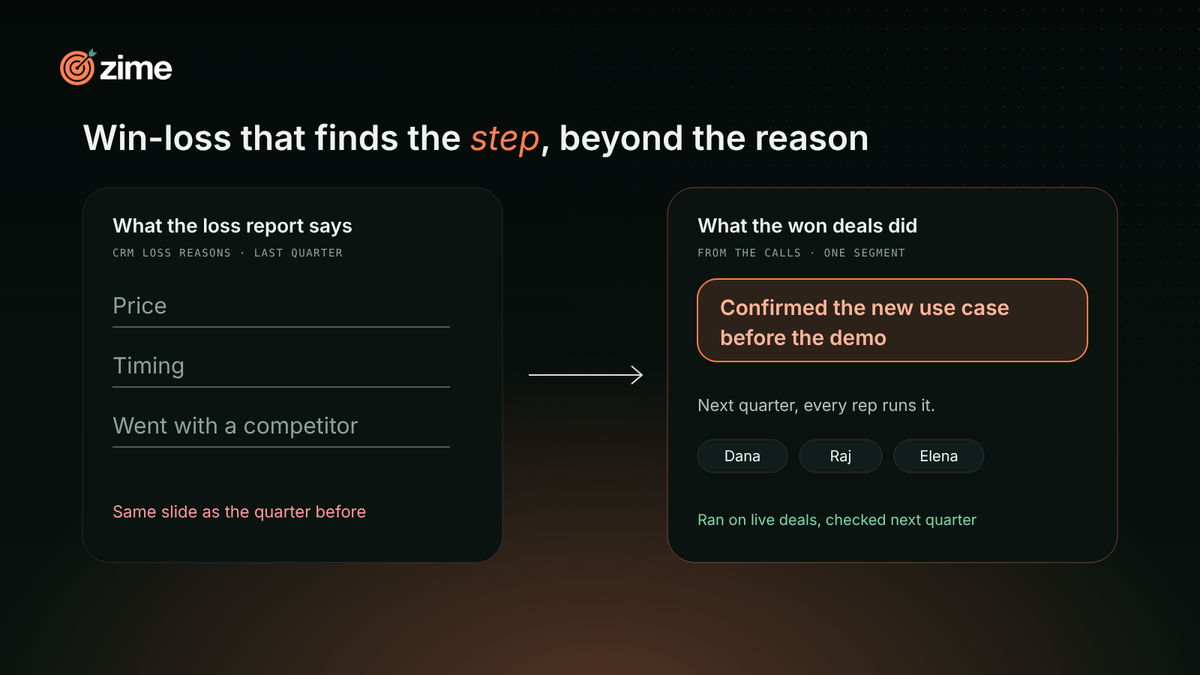

- Keep the win-loss program you run. Buyer interviews tell you why a buyer chose. Your CRM shows win rate by segment, and your calls hold what was said. All three stay.
- But reasons do not tell you what your reps did differently. The loss field says price, and sellers' reasons often differ from buyers'. Neither shows the step the reps who won a segment took and the reps who lost skipped. Finding that step, and getting every rep to run it, is the hard part.
- And that step lives in your calls and in your best reps. Compare won and lost calls inside one segment and one strategy, not across the quarter. Then ask the reps who won why they made the move. When a segment has few deals, their answer carries the read.
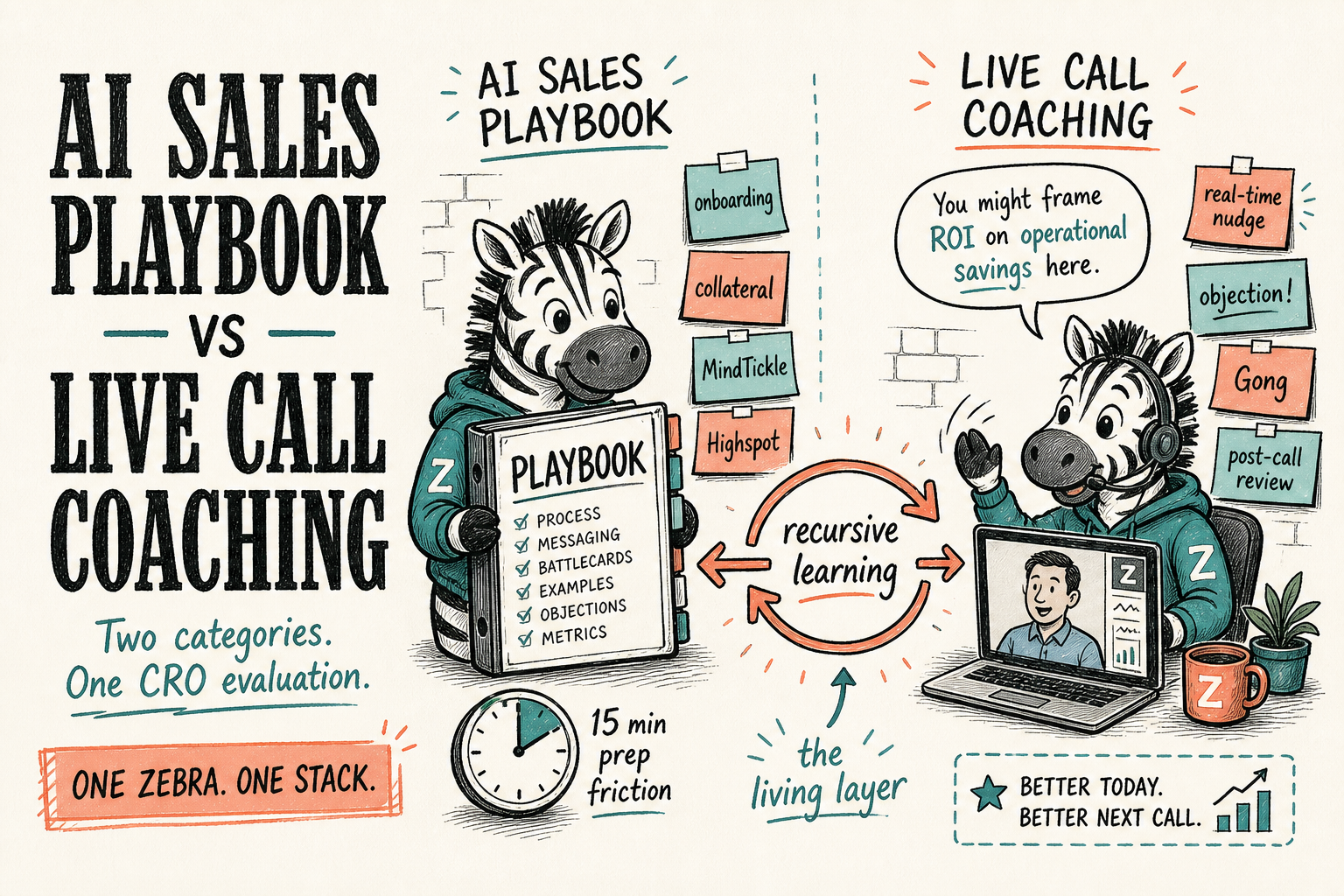
- That is what Zime's Behavior Graph turns into a move. It is the model that holds how your best reps decide, including what never shows up in a transcript, and this quarter's strategy. The finding reaches every rep in that segment as the step to run, before the call.
- So next quarter's win-loss checks whether reps ran it. You see who ran the step, on which deal, and whether those deals moved. Then you can answer the board: was the strategy wrong, or never executed? Zime's benchmark is 80% of eligible reps within 90 days.
You are the CRO, in the quarter-close review. RevOps puts up the win-loss slide for your mid-market segment. Lost to price. Lost on timing. Went with a competitor. Same order as last quarter.
Buyer interviews agree, more politely. Enablement books a pricing refresher. A quarter later the slide is back.
The slide is not wrong. It records why buyers say they left. It cannot show what your reps did. In this segment, what did the reps who won do that the reps who lost did not?
Why the usual fixes repeat the slide
Most programs run three fixes. Each is worth keeping. Each stops short of that question.
The CRM loss field. A rep picks a reason from a dropdown after the deal is gone. It covers every deal. The tell: price leads in every segment, every quarter. Martin Mackay is CRO at Versa Networks, which sells SASE against ten named competitors in deals that run from $100K to $3M. When he scoped a win-loss analysis, he asked about the source:
"Is it taking from Rep notes from Salesforce, or is it taken from calls?"
Martin Mackay, CRO, Versa Networks
The source decides whether the read can be trusted.
The rep debrief. Ask the rep, or read the notes. You get memory, written after the outcome. Ranjan R Reddy, Founder and CEO of Bureau, sells identity decisioning to banks and fintechs. He read his team's meeting notes:
"I pitch this, I pitch this, I pitch that ... I'm like no, but what is the problem? What is the use case?"
Ranjan R Reddy, Founder & CEO, Bureau
The notes recorded the pitch. The discovery was missing. The tell: notes full of product names and empty of the buyer's problem.
Buyer interviews alone. They are the best source for why a buyer chose. Forrester says it plainly: "Sellers' interpretations often differ from buyers' actual reasons." But a buyer cannot tell you what your rep skipped. The tell: findings about product and price, rarely a step your reps control.
All three stop before a change any rep can run.
Read wins against losses, one segment at a time
Pick one segment and one strategy, say cross-sell into existing accounts. Pull two quarters of won and lost deals. For each, line up the deal data, the buyer's reasons and the calls. Find the stage where wins and losses part, and the step only the wins have.
Mackay set two questions:
"what do the most effective reps do in terms of moving a deal forward ... And the second is why do we win versus lose?"
Martin Mackay, CRO, Versa Networks
He wanted his read backed by data, split by product line.
The table below shows that only the calls and your winning reps reach the step.
| What the source can show | CRM loss field | Rep debrief | Buyer interviews | Call evidence | Calls, winning reps, and the step sent to reps |
|---|---|---|---|---|---|
| Why the buyer chose | ✗ | Partial | ✓ | Partial | ✓ |
| What reps did at each stage | ✗ | Partial | ✗ | ✓ | ✓ |
| A split by segment and strategy | ✓ | Partial | ✓ | ✓ | ✓ |
| Why the winning rep took the step | ✗ | Partial | ✗ | ✗ | ✓ |
| Whether reps ran the fix next quarter | ✗ | ✗ | ✗ | Partial | ✓ |
Read the row on why the winning rep took the step. Only the reps who won can supply it, because nobody wrote the reason down. So ask them.
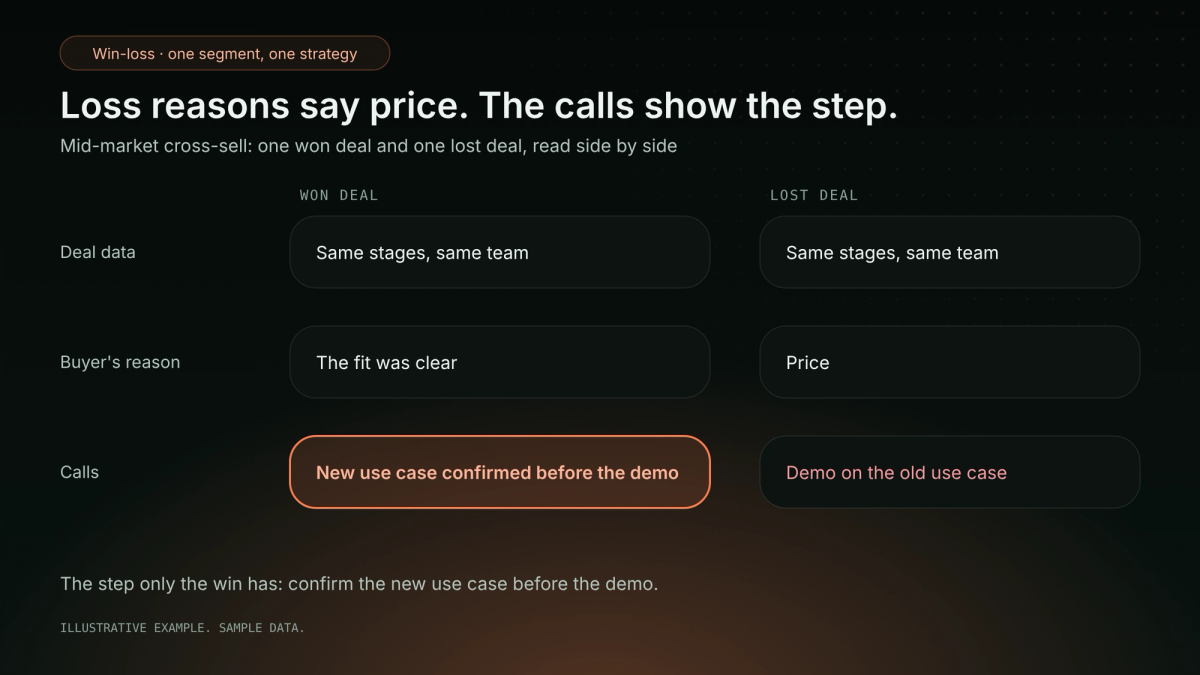
Run it once yourself. Take five won and five lost deals from one segment. Mark where they part. Pass: you name a step a rep controls. Fail: only price or timing. Few deals in a segment? Ask any vendor how many its method needs before a difference is more than noise.
The step is the finding. Getting it run is the harder half.
Turn the finding into a step every rep runs
A finding nobody runs is next quarter's slide. HFS Research names the gap: the CRO's plan does not convert to execution, so reps revert and win rates stall. Its fix: learn from how deals were won, turn that into behaviors you can score, and ship them where reps work.
Call-analysis tools, and a frontier model reading your transcripts, find win-loss patterns. They recommend, too. The difference is upstream. Zime's Behavior Graph is a model of how your best reps decide. It adds the strategy you set this quarter and the context of your past deals. That judgment is elicited from your best people through FDE-run interviews and RLHF, including what never shows up in a transcript. In plain terms, Zime's engineers interview the reps who win, then score each move until those reps would run it.
Strategy Studio tests a strategy against your won and lost deals, to show which behaviors win. The step you found becomes a Behavior: the move for that segment, with the winning deal behind it. It reaches every rep in the segment in the prep note before the call, tied to your quarterly initiative.
At Bureau, discovery was the step. Bureau gave reps a discovery checklist and published who followed it. Kapil Bhagat, AVP of Sales Strategy:
"So this monitoring led to execution ... Having a dashboard where non adherence is called out improves execution."
Kapil Bhagat, AVP, Sales Strategy, Bureau
Bureau saw a 30% increase in deal conversions. Separately, its average deal size grew by 30%. Zime has not yet published a per-segment win-loss study from a customer. What is published is the result after the step ran.
Next quarter, check it ran
Back in the review, the slide has changed. Under the segment sits the step, who ran it, on which deals, and how they closed. RevOps pulls it from the calls this time. Each manager sees who skipped it. Each rep sees it in the next prep note. That is your strategy, running in every rep's workflow. Now you can answer the board. Was the strategy wrong, or never executed?
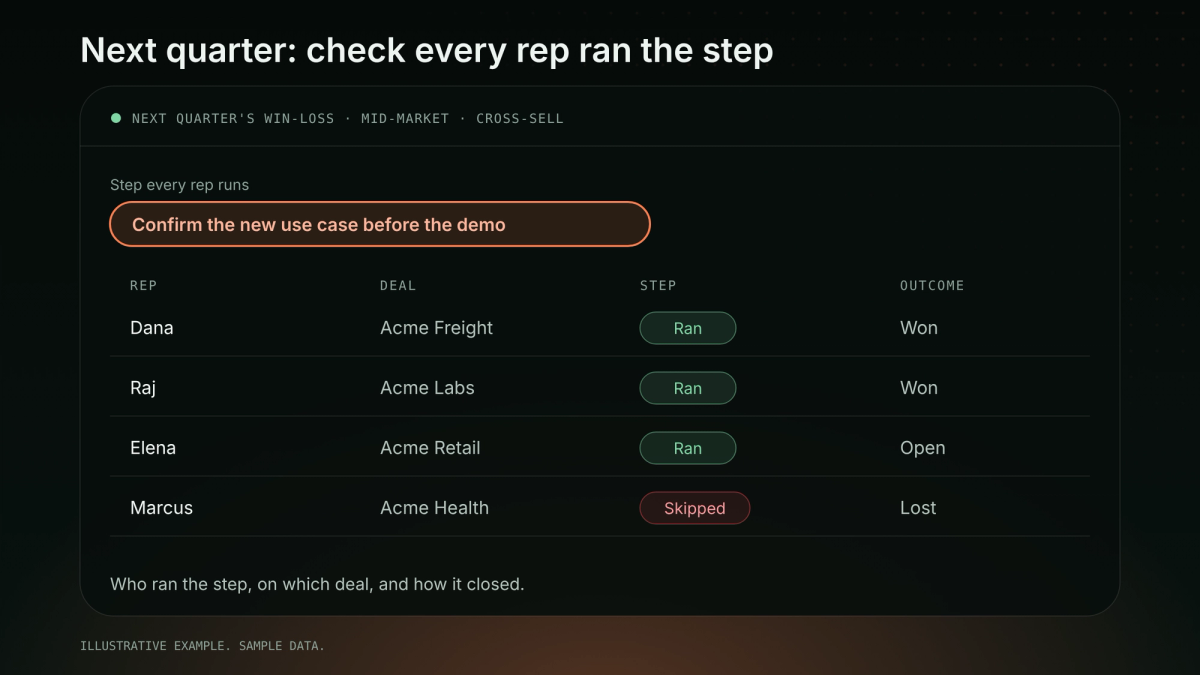
Adoption here means Behaviors run, not logins. Chad Erickson, VP of Sales and Strategy at MyAdvice, runs an outcome-led sale with many handoffs. On what Zime surfaced:
"Incredibly encouraging to me is that the Zime technology picked up on it… a needle in a haystack… it recognized there's something weird going on here."
Chad Erickson, VP of Sales & Strategy, MyAdvice
Calls catch what a loss field never records. At MyAdvice, fatal objections fell from 38% of calls to 4%. Checklist adoption rose from 66% to 87%. Zime's benchmark is 80% of eligible reps within 90 days.
Test last quarter's fix. Pass: for each rep, a deal where the step ran. Fail: a training completion rate. If you have a handful of reps, one product and one motion, a spreadsheet and your own call reviews may be enough.
The table below is a worksheet for one segment, one row per strategy.
| Segment | Strategy | Step in won deals | Missing in lost deals | Step every rep runs next quarter | How you check it ran |
|---|---|---|---|---|---|
| Mid-market | Cross-sell | Rep confirmed the new use case before the demo | Demo ran on the old use case | Confirm the new use case before the demo | Calls where it ran, by rep and deal |
Illustrative example.
Related: how one strategy reaches every role in complex deals and why reps adopt guidance in their workflow.
Make next quarter's win-loss answer the question. Keep your win-loss program and your tools. Zime turns a finding into Behaviors every rep in that segment runs, each tied to the strategy that authorized it. Live in 7 days on your own data. Bring last quarter's won and lost deals from one segment, and see the step that separated them. Book a demo →
FAQ
How do I run a win-loss analysis that goes beyond rep surveys and CRM loss reasons?
Work one segment and one strategy at a time. Line up each deal's data, buyer reasons and calls, and find the step only wins have. Ask the reps who won why. Then get every rep in the segment to run it, and check who did. Zime turns the step into a Behavior, the move with the winning deal behind it, tied to your strategy, and counts who ran it.
How many closed deals do I need per segment?
Ask any vendor how many closed deals its method needs per segment before a difference is more than noise. When volume is thin, lean on the reps who won, and let next quarter's calls test the step.
Should a third party run the buyer interviews?
Keep them. Buyers are the best source for why they chose. Surveys and AI interviews widen that coverage. Interviews cannot show the step your reps took or skipped. Pair them with the calls, which show what reps did.
Who should own win-loss, product marketing or sales?
Product marketing often runs it, which suits messaging and product gaps. The step that separated wins from losses is a sales change. The CRO owns getting every rep to run it, and checking next quarter that they did.
What happens when my strategy changes mid-quarter?
The step changes with it. Zime's forward-deployed engineers encode the new strategy into the Behavior Graph, the model of how your best reps decide plus your current strategy.