Living playbooks: how do you stop your sales playbook going stale?
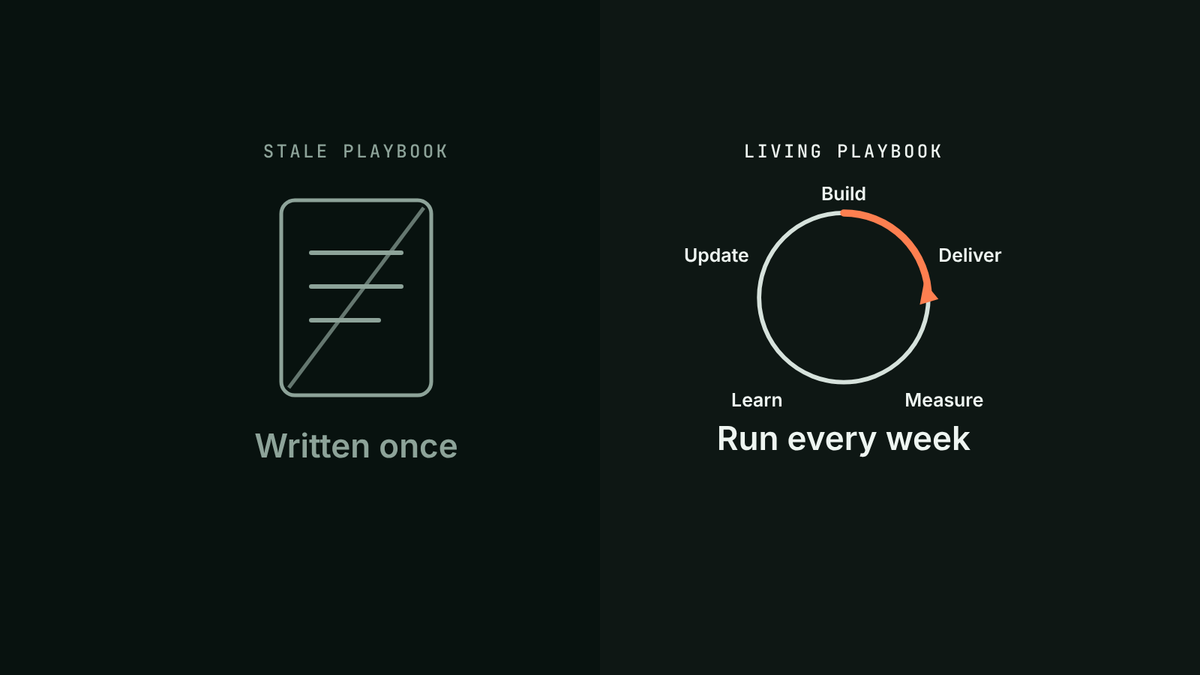

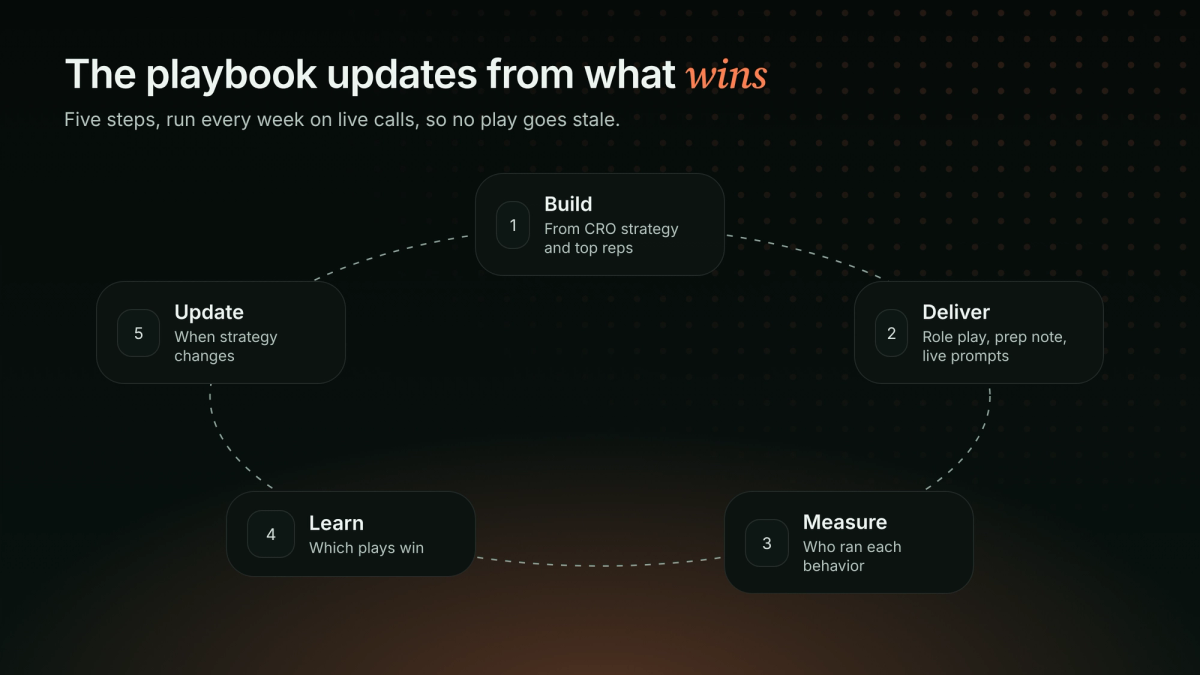
- Run the playbook as a weekly loop, not a document. Build, deliver, measure, learn and update each play, every week, on live calls.
- The hard part is seeing which play reps actually ran. Completion and quiz scores prove training happened. They miss what a rep did in a live deal.
- Each failure needs its own fix. Out of date: update the play. Not run: coach the rep. Run but losing: change the play.
- Zime runs the loop from top reps and CRO strategy. It turns both into behaviors, the specific moves per stage and buyer, and carries each change to every role.
- You know it ran when more reps run the play each week. Count it on live calls.
Dana runs enablement for a 150-person sales team. On Monday her CRO sends a two-line note. The new product missed its number, and three new hires are behind on ramp.
Dana opens her dashboard. Certification is at 100%. Quiz scores are green. The playbook was rewritten at kickoff. Nothing on the screen shows a sales call.
She has three guesses and one forecast meeting. Maybe the playbook is already out of date. Maybe the new hires never ran it. Maybe they ran it and buyers said no. Which one is it?
Here is the answer. A playbook goes stale when it is treated as a document. It stays living when it runs as a weekly loop of five steps: build, deliver, measure, learn, update. The measuring tells Dana which guess is right. When Versa Networks started counting one play on live deals, technical discovery, 20% of its SEs ran it. Within three months, 79% did. Zime, Behavioral AI for Sales Execution, runs that loop on every call.
Why your playbook goes stale
Most teams work hard on this. An owner reviews the playbook quarterly. A content platform holds the latest version. Certification proves reps passed. Call recording catches the right words. Some teams wire an AI assistant to the playbook. All of it treats the playbook as content.
The table below checks each approach against Dana's three questions.
| What it shows | Quarterly review | Content platform with AI updates | Certification | Call keyword tracking | Weekly loop on live calls |
|---|---|---|---|---|---|
| Keeps the play current | ✓ | ✓ | ✗ | ✗ | ✓ |
| Which play each rep ran on a live call | ✗ | ✗ | ✗ | Partial | ✓ |
| Whether the play won with buyers | Partial | Partial | ✗ | Partial | ✓ |
Only a loop on live calls answers all three.
A playbook is a change you ask every rep to make. That makes it a change-management problem. Mickey Singh leads sales enablement at Versa Networks, whose reps sell against ten named competitors in deals up to $3M. On a call with Zime in August 2026, he asked the change-management question:
"...any methodology they look very attractive? But in reality, how much of them are executed in the real customer calls?"
Mickey Singh, Global Head, Sales Enablement, Versa Networks
A methodology says run discovery and handle the competitor. It never says what should happen in this moment. Your best reps work at that level. They know how to answer "the incumbent is cheaper." They know when to bring in the SE.
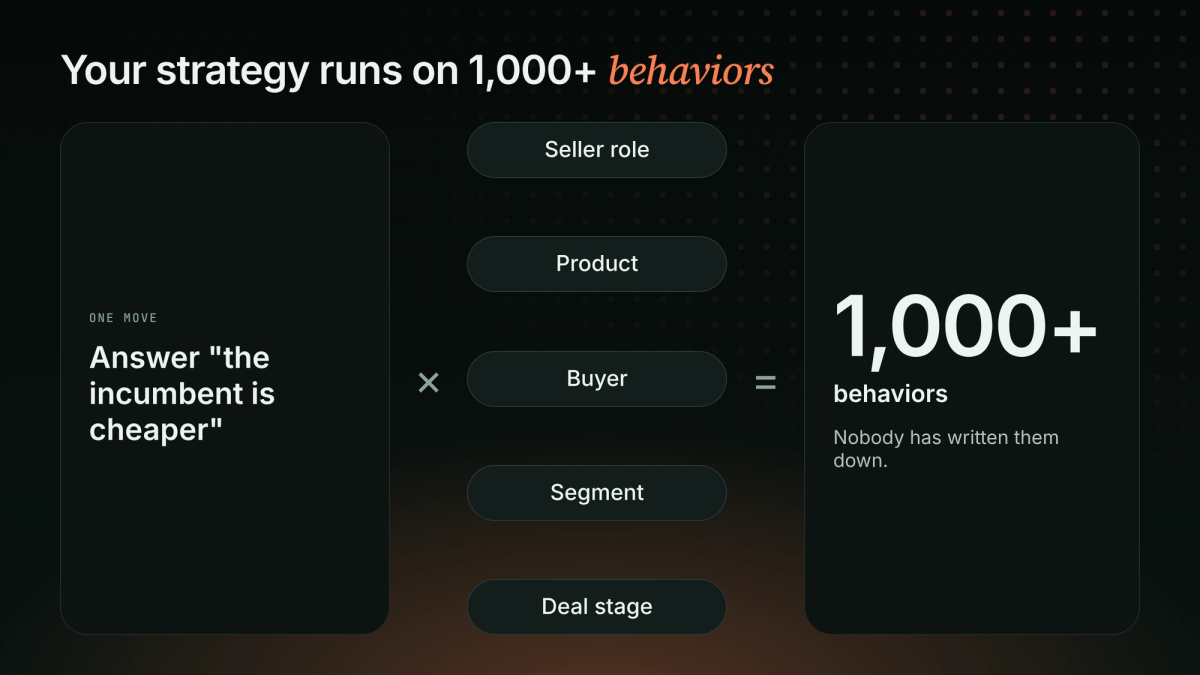
Strategy doesn't get adopted. Behaviors do. We call each of those moves a behavior: the specific step for this deal, with a won deal behind it. Each one changes by seller role, product, buyer, segment and deal stage. Your strategy runs on 1,000+ behaviors. Nobody has written them down, tested them or kept them current.
So the playbook drifts from the field. Training fades too: Hermann Ebbinghaus measured on his own memory, in 1885, how fast new material fades without repetition. A kickoff is one repetition. HFS Research describes the same break in sales: the CRO's plan does not convert into execution, so reps revert and win rates stall.
It drifts in three ways.
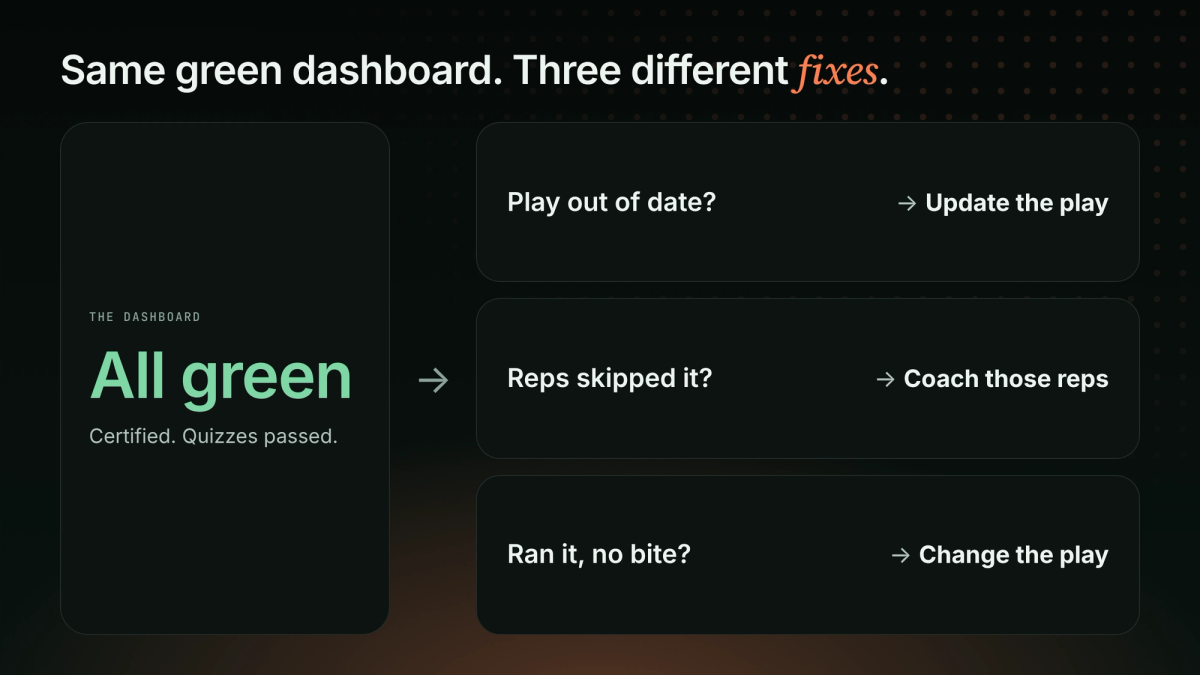
- Out of date. Top reps' won calls do something the playbook does not say. Fix: update the play.
- Not run. Most reps skipped it where it should have run. Fix: coach those reps.
- Run, but buyers don't bite. Deals where it ran move no faster than deals where it did not. Fix: change the play.
A green dashboard fits all three. A rep can be certified while the play never reaches the call.
Five steps that keep a playbook living
The fix is a loop that runs every week. Each step answers one of Dana's questions.
1. Build each play from what top reps do now. A playbook goes out of date the day top reps find a better move. Start from their won calls and this quarter's strategy. Martin Mackay is CRO of Versa Networks, where almost every deal turns on a technical evaluation. On a win-loss call with Zime in June 2026, he named what he wanted from his data:
"...two things that I want to know. Ultimately, one what do the most effective reps do in terms of moving a deal forward and then eventually closing it? And the second is why do we win versus lose?"
Martin Mackay, CRO, Versa Networks
His first question is the build step. His second is step four.
2. Deliver it in the flow of the deal. Reps do not open a playbook mid-deal. Put the play where the decision happens: practice before the call, a brief for this deal, a prompt during it. Every deal becomes a repetition.
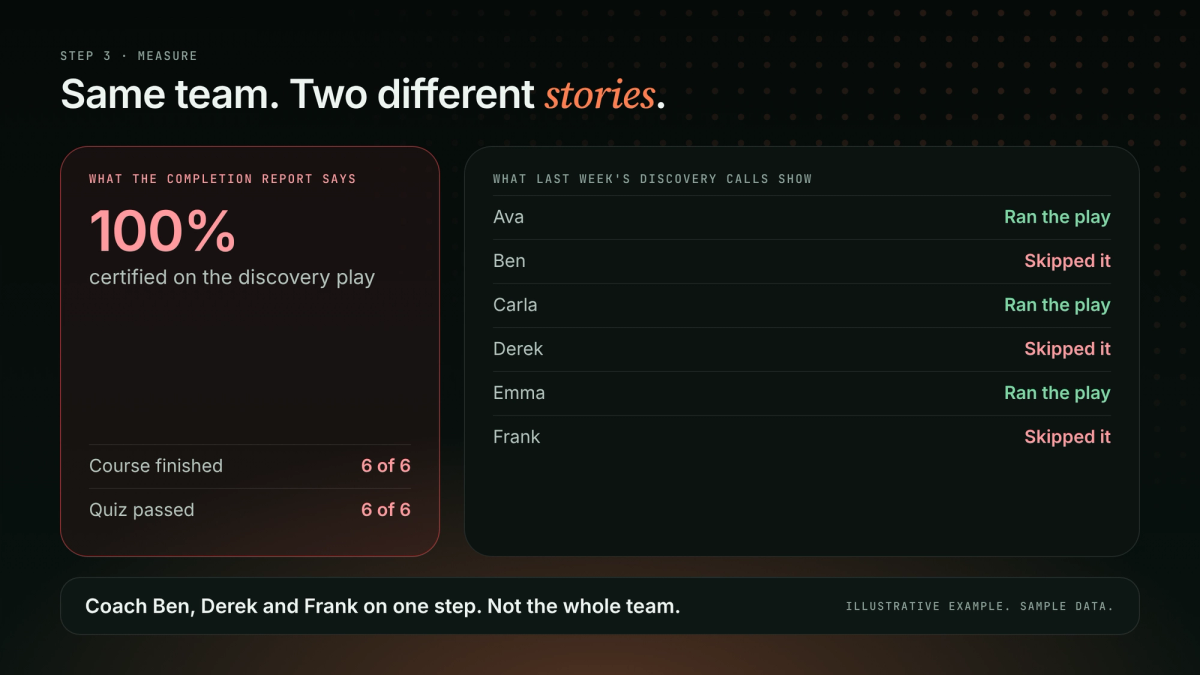
3. Measure who ran it on live calls. This answers "not run." Count the play on calls, never on completions. Kenny Cao leads go-to-market strategy at Skan AI. On a call with Zime in October 2026, he named where enablement usually stops:
"I want to understand how the team is delivering against the deck and against the new value proposition, right? It is more of an enablement understanding versus whether they've done it."
Kenny Cao, Senior Director, Head of Go-To-Market Strategy and Operations, Skan AI
Understanding shows in training. Doing shows only on calls.
4. Learn which plays win. This answers "run, but no bite." Compare deals where the play ran with deals where it did not, rep by rep. Kapil Bhagat runs sales strategy at Bureau, which sells identity and fraud products to risk buyers. Early in Bureau's work with Zime, he named what was missing:
"I did not have the data to present to go back to my team ... But if this is percentage then improvement is possible."
Kapil Bhagat, AVP, Sales Strategy, Bureau
A percentage per play is what lets a team improve it.
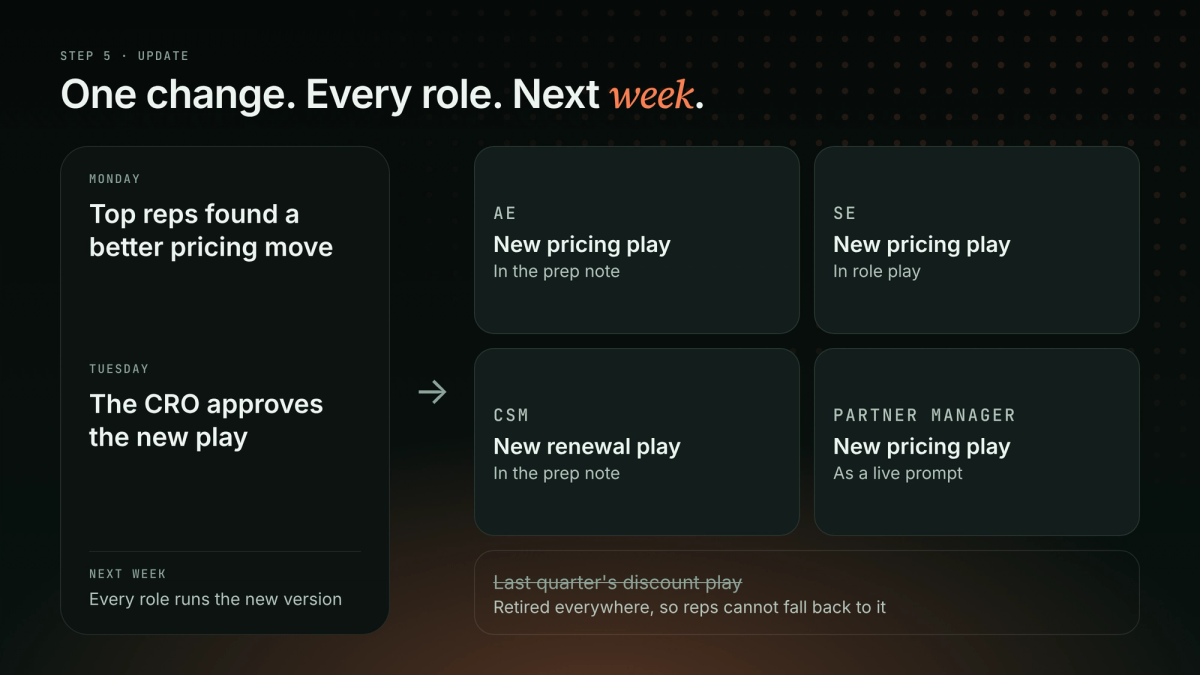
5. Update when strategy or the field moves. This answers "out of date." A new strategy or a better top-rep move goes back to step one. The new version reaches every role next week. The old one is retired.
Measure the loop yourself this week
You need one play, two weeks of calls and an afternoon.
- Pick the play that matters most, such as discovery for the new product.
- Pull 20 calls where it should have run: 10 from top reps' won deals, 10 from everyone else.
- Mark each call. Did the rep run the written play? Did they do something it lacks? Did the buyer agree a next step?
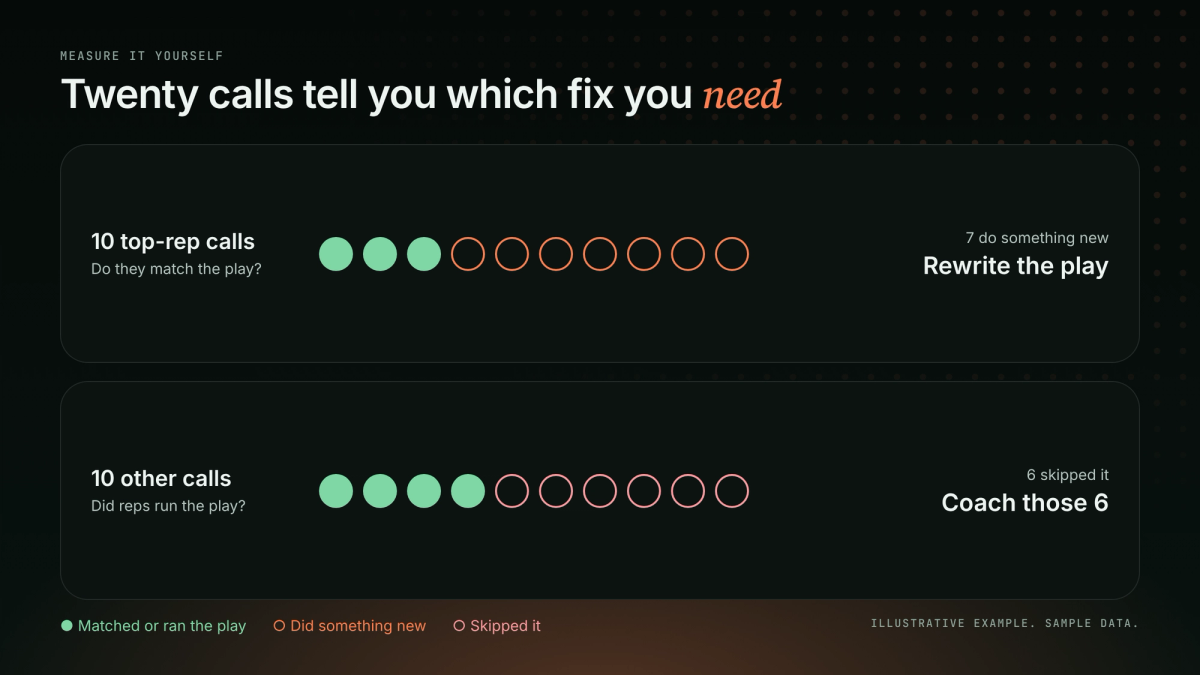
The table below runs the check on sample numbers (illustrative).
| Question | What you count | Sample result | Verdict |
|---|---|---|---|
| Is the play current? | Top reps' won calls matching the play | 3 of 10 | Out of date: rewrite it |
| Did reps run it? | Other reps' calls where it ran | 4 of 10 | Not run: coach the 6 |
| Did it win? | Buyer agreed a next step, ran against skipped | 3 of 4 against 1 of 6 | It helps: keep the core |
In this sample, two fixes are due: rewrite the play, then coach the skippers.
Two rules keep it honest. Compare each rep with themselves, ran against skipped, and treat fewer than three calls a side as direction only. One play by hand is an afternoon. Every play, every week is not.
How Zime runs the five steps
Zime solves this by running the loop on every call. The table below maps each step to what Zime does and who acts.
| Step | Answers | In Zime | Who acts |
|---|---|---|---|
| Build | Is the play current? | Playbook from CRO strategy and top reps' tribal knowledge | Enablement approves |
| Deliver | Did reps run it? | Role play, prep note and live prompts in Slack and Teams | Reps run the behavior |
| Measure | Did reps run it? | Programmatic Adoption: who ran each behavior, by rep and deal | Managers coach the skippers |
| Learn | Did it win? | Strategy Studio: plays tested against won and lost deals | Enablement and the CRO decide |
| Update | Is the play current? | CRO Initiatives carries a new strategy to every role | The CRO approves |
The build step is where Zime differs. Top reps' judgment is elicited from your best people through FDE-run interviews and RLHF, including what never shows up in a transcript. FDEs are Zime's forward-deployed engineers; RLHF means scoring each move until your best reps would run it. The playbook starts from 1,200+ proven behaviors. Reps get role play, a prep note and live prompts; Programmatic Adoption, Strategy Studio and CRO Initiatives close the loop.
Back to Dana's Monday. The discovery play ran on fewer than half of the new hires' calls. Their managers coach that one step by Thursday. The pricing play is running, but not winning. Dana takes the top reps' version to her CRO, who approves it Tuesday. Next week it sits in every rep's prep note. Dana walks into the forecast meeting with an answer, not three guesses.
What changes when the playbook is living
Mickey Singh reviews Versa's methodology checklist report with Zime each week. In June 2026 he read out the trend:
"Last month was 74%. So it's it's going right direction."
Mickey Singh, Global Head, Sales Enablement, Versa Networks
That 74% counts calls. Zime's own benchmark is 80% of eligible reps within 90 days. Zime has no published ramp-time result yet.
The table below lists each customer result and where it is published.
| Company | What it measured | Result | Source |
|---|---|---|---|
| Versa Networks | SEs running the right technical discovery on live deals | 79% within three months, up from 20% | Versa story |
| Versa Networks | Enablement efficacy | 2× | Versa coaching story |
| Bureau | Deal conversions | 30% increase | Bureau story |
Start with the first row: it counts behaviors run on live deals.
Bring one play. See which step of the loop is broken. Bring two weeks of calls and see it on your own deals. Book a demo.
FAQ
How can a sales playbook update itself when strategy changes every quarter?
Run it as a loop: build, deliver, measure, learn, update. A new strategy re-enters at the build step, and the weekly check on live calls shows whether the new version ran and won. Zime encodes it as behaviors, the specific moves per role and stage, and carries each change to every rep.
What is a living sales playbook, and how is it different from a normal playbook?
A normal playbook is a document reviewed on a schedule. A living playbook runs as a weekly loop on live calls, so it knows which plays ran and which won.
We review the playbook every quarter with an owner. Isn't that enough?
A review keeps the document current. It does not show which version ran on a call or won. Keep it and add the weekly loop.
Will reps feel policed?
We have no published customer answer yet. Ask any vendor whether the rep sees the same evidence the manager sees.
What does Zime do for enablement leaders?
Zime, Behavioral AI for Sales Execution, runs the living-playbook loop. It builds the playbook from the CRO's strategy and top reps' tribal knowledge, delivers each behavior (the specific move for this deal) during the deal, and shows who ran it and which plays win.