Should your GTM engineering team build a sales execution agent in-house, or buy a platform?

- You built the sales agent on Claude, and it works. You have Claude, MCP and a harness. Building first was right.
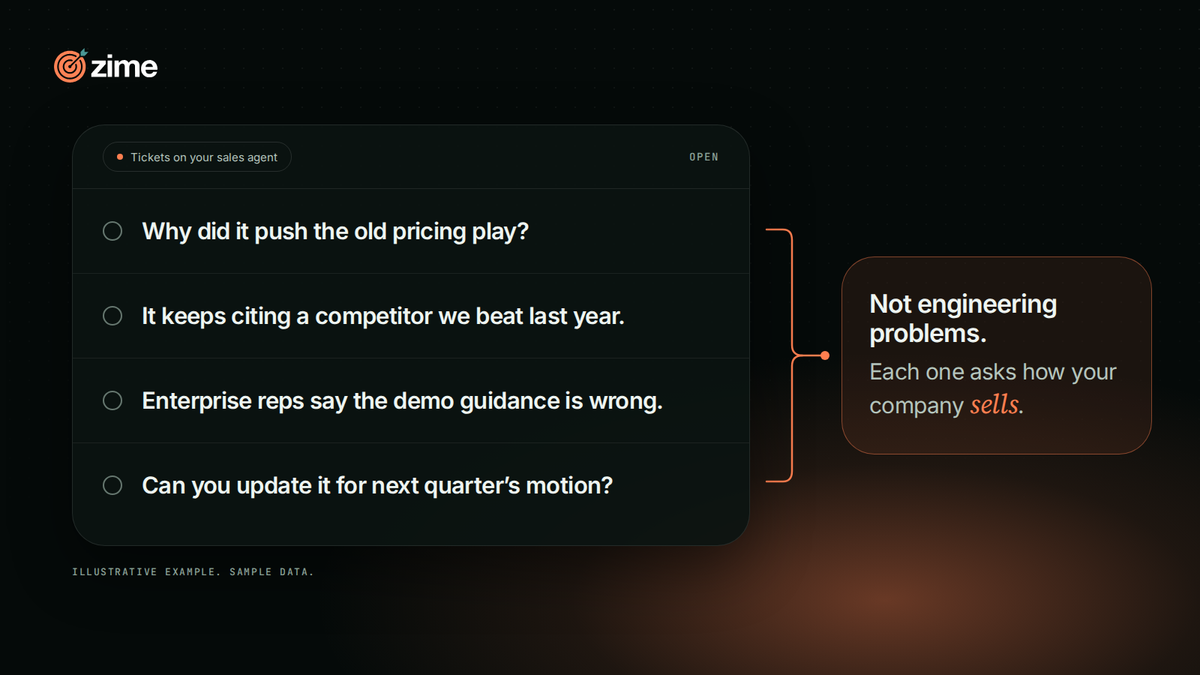
- But adoption never came, and your tickets show it. They ask how your company sells, not how to fix code.
- And no amount of tuning will bring it. Reps run advice that reflects how your best reps decide and what your CRO decided this quarter. Nobody wrote that down.
- That missing piece is what a behavior graph adds. It is a model of how your best reps decide, plus what your CRO wants this quarter and what past deals showed. Zime builds it from interviews with your best reps, including what never shows up in a transcript. Each move carries its winning deal.
- So keep your harness and add the missing piece. Writing it yourself means interviewing your best reps, then rewriting it every time strategy changes. Zime runs on Claude, so nothing gets ripped out, and it keeps up as your CRO's plan moves. Count the moves reps run.
A few months ago, someone asked for sales AI on Claude, and you shipped it. It reconstructs each deal from calls and CRM, drafts the follow-ups, and writes a prep note before every call, all wired in over MCP. It is good work, and it holds up.
Then the tickets change.
- Why did it push the old pricing play?
- It keeps citing a competitor we beat last year.
- Enterprise reps say the demo guidance is wrong.
- Can you update it for next quarter's motion?
None of these is an engineering problem. Each is a question about how your company sells. Reps who trusted the advice would be running it, not filing tickets about it. Adoption never came, and the tickets are how you know.
So the job changed. You built a system. You are now expected to say how your company wins.
The part you cannot engineer
This is not about your ability. You can build any system that ships. You cannot encode what you do not carry.
Call it sales judgment: whether to hold price against this competitor at this stage, when to walk away, which proof point moves this buyer. It is a decision a rep makes in the room. It lives in two places. One is the reflexes of your best reps, who have made the call right so often it no longer feels like a decision. The other is your CRO's head, where this quarter's strategy sits. Nobody wrote either down, because nobody has to write down a reflex.
At Versa Networks, sales engineers run technical evaluations in deals worth $100K to $3M, against ten named competitors across four regions. Head of sales engineering Chitresh Yadav put one such reflex into words:
"If I hear something like our competitors, Fortinet or Palo Alto or Zscaler, I'm thinking whether my rebuttal to those were inline to our battle card."
Chitresh Yadav, VP and Global Head of Sales Engineering, Versa Networks
That check runs in his head, live. No transcript holds it, so retrieval cannot find it.
So you do what engineers do. You add context, tune the prompt, build an evals suite. The answers get more fluent and no more trusted, because you are polishing the delivery of something you do not have. Ameeth Dubey at Atomicwork described an earlier attempt with ChatGPT:
"This is what we tried to do with ChatGPT. The only problem is adoption."
Ameeth Dubey, Atomicwork
Fluency does not fix adoption. HFS Research reached the same diagnosis in July 2026: the CRO's plan does not convert to execution, so reps revert and win rates stall.
Why writing it down is a different job
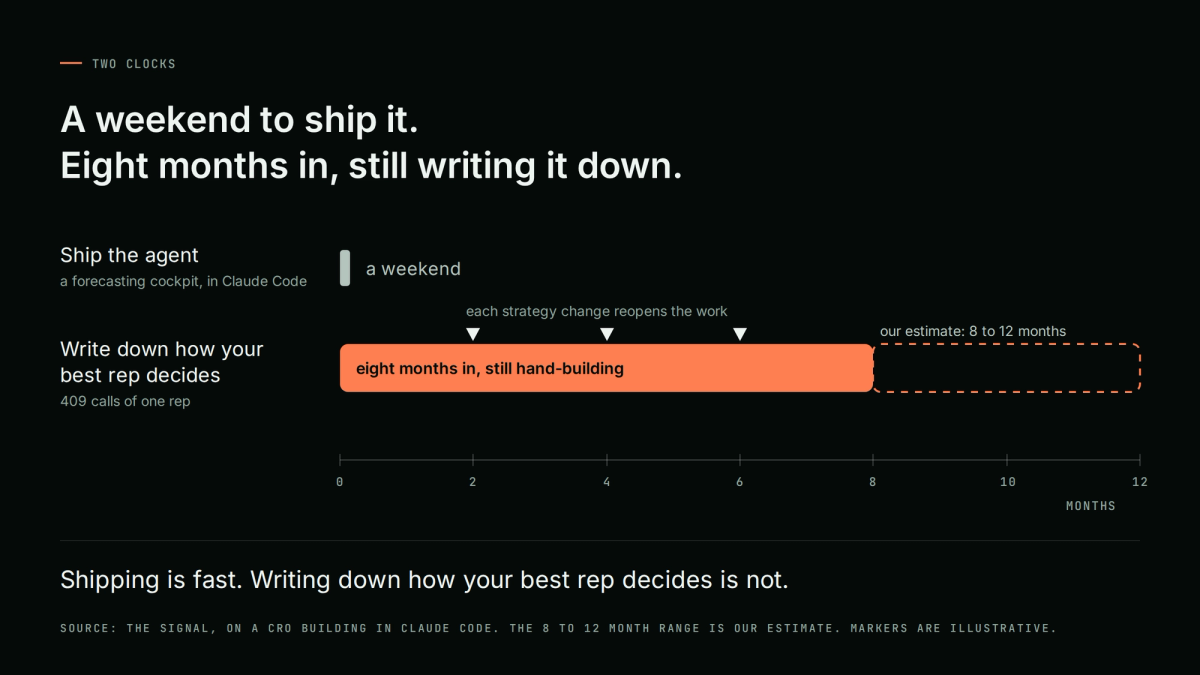
So the obvious next move is to write it down yourself, and people do. The Signal profiled a CRO who built a forecasting cockpit in Claude Code. It shipped in a weekend. Then came eight months of hand-building a Sales Bible from 409 calls of his best rep. The lesson is the gap between two clocks: shipping is fast, and writing down how your best rep decides is not.
And 409 calls cover one rep. Say four roles, six competitors, five stages: over a hundred cells before a product changes. Our estimate, labelled as one: by hand, 8 to 12 months and 200+ .md files. Then they go stale, because the behaviors keep evolving. A new competitor, a price change, or a new CRO priority reopens some of them, and a file nobody reopens keeps giving last quarter's advice. Those are the first two tickets from the opening.
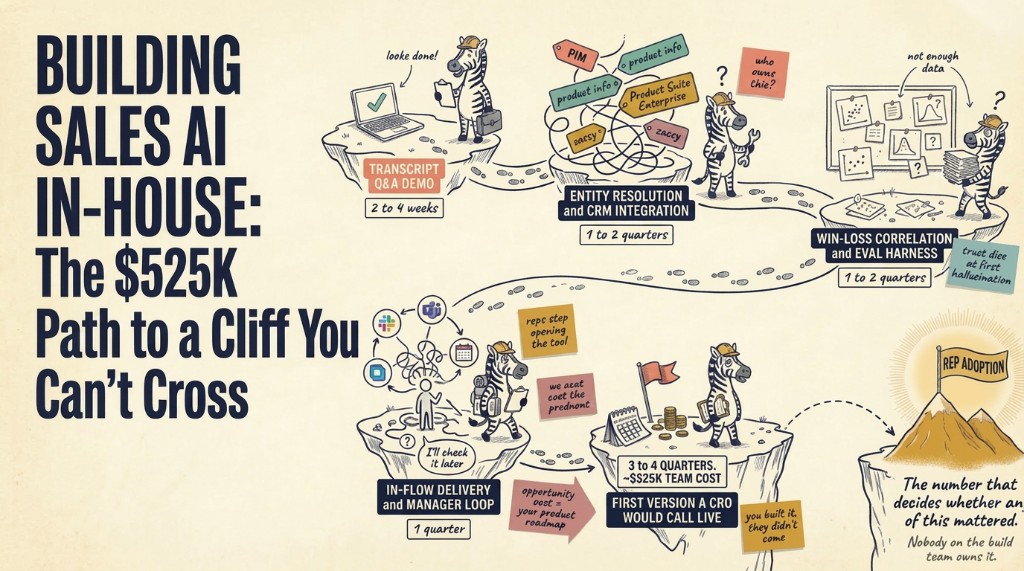
Versa weighed building too and scoped 12 to 24 months and about $1M of engineering. We have not published a year-one cost comparison, so the vendor questions below ask for one. Peter Kim, Head of GTM at WestBridge Capital Management, named what building turns you into:
"The danger with Claude is that inadvertently, you've become a builder."
Peter Kim, Head of GTM, WestBridge Capital Management
That is the job change from the opening, in one sentence.
Most teams try four routes on the way. They keep tuning the agent, buy a platform, buy a data layer and build the rest, or hand-write the playbook as skills. Conversation intelligence, enablement tools, outside engineers and outbound SDR agents each leave this one unwritten. Every route stalls for the same reason. The input is missing, and it keeps moving.
Keep the harness, add the missing piece
So the choice is not to build or buy the whole thing. It is which part. The harness is engineering: agents, skills, workflows, the MCP plumbing that carries guidance to where reps work. It is yours, and you should keep it. The missing piece is a model of how your best reps decide, plus what your CRO wants this quarter and what past deals showed. Zime calls it the Behavior Graph: Behavioral AI for Sales Execution.
Your best reps' judgment is elicited through FDE-run interviews and RLHF, including what never shows up in a transcript. FDE means forward-deployed engineer: Zime's engineers interview your best reps. RLHF means reinforcement learning from human feedback. What comes out is Behaviors. A Behavior is the specific move for this deal, with a receipt: the winning deal it came from. A rep sees why to run it.
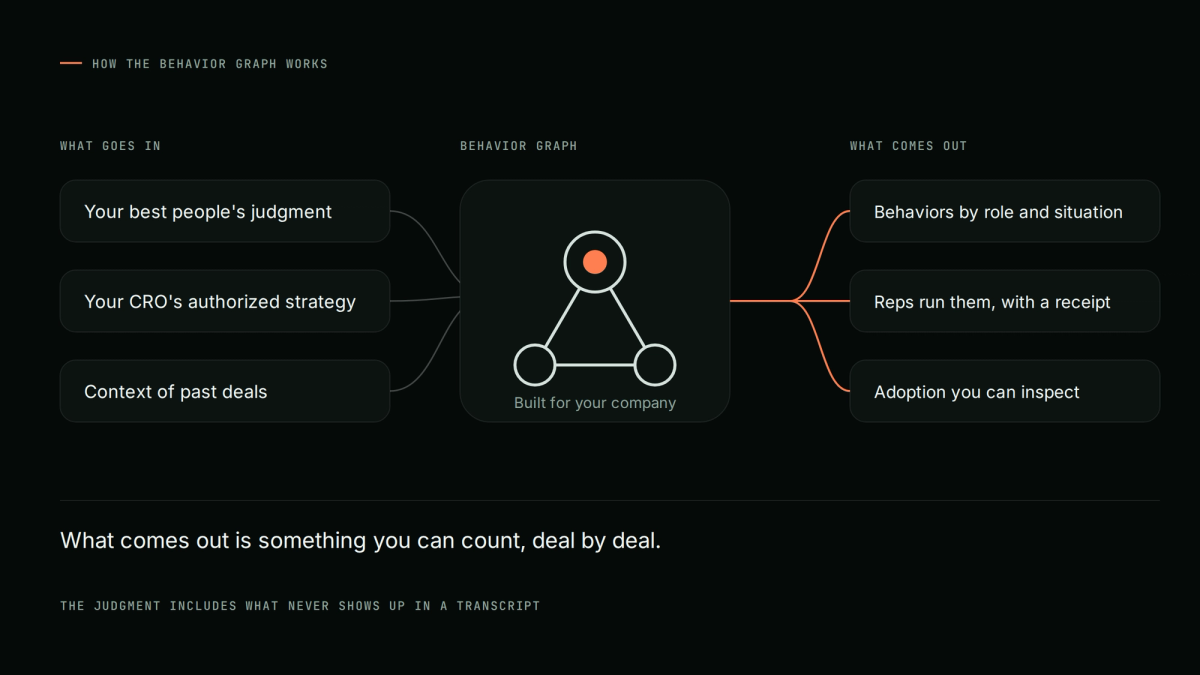
Your context graph recommends a move too, from past data. Keep it. The Behavior Graph reasons from your people's judgment and your CRO's authorized strategy.
Here is how five kinds of tool compare on each capability: frontier models, harnesses, enterprise context providers, GTM context providers and Zime.
- Retrieve context with provenance: partial for frontier models and harnesses; yes for enterprise context providers, GTM context providers, and Zime.
- Recommend a course of action: yes for all five.
- Capture how your best reps decide: no for frontier models, harnesses, enterprise context providers and GTM context providers; yes for Zime.
- Turn the CRO's plan into moves: no for frontier models, harnesses, enterprise context providers and GTM context providers; yes for Zime.
- Show which moves reps ran: no for frontier models, harnesses, enterprise context providers and GTM context providers; yes for Zime.
Read the third item: no other class captures how your best reps decide.
Building all of it is right only for a small team with one product, one motion, a deep AI operator and a steady strategy. With several products or a CRO who moves priorities every quarter, it is not.
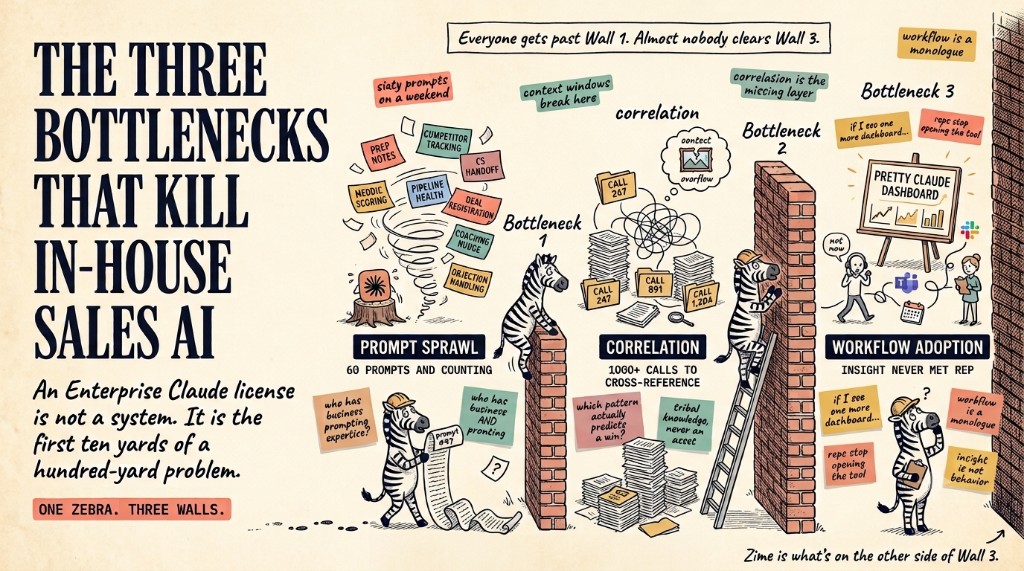
For the wider case, read Build vs Buy Sales AI. For more on building in-house, read about the three bottlenecks of in-house sales AI.
What changes when reps adopt it
For everyone else, picture the tickets a month after the missing piece is in. Nobody asks why it pushed the old pricing play, because every move arrives with the deal a best rep won and the strategy behind it. Your CRO can see which moves reps ran, deal by deal.
Versa shows it at scale. Within three months, 79% of its sales engineers ran the right technical discovery on live deals, up from 20% at the start. Brent Bair, a Regional Sales Leader at Versa, sees it on his team:
"As I look at my team, the adoption rate has improved. I think it's become ingrained in our sales DNA..."
Brent Bair, Regional Sales Leader, Versa Networks
That is adoption, in the words of the person who manages the team.
The strategy owner wanted the same thing. Martin Mackay, Versa's CRO, said what he wanted from the tool:
"I wanted Zime to understand my playbooks and coach reps. No other tool does this."
Martin Mackay, CRO, Versa Networks
That is the missing piece, named by the person who owns the playbook.
HFS Research cited a separate Versa result: a 10% increase in win rates.
Count the moves reps run, then run four tests on your own deals:
- Can you keep what you built? Pass: nothing to remove, because Zime runs on Claude. Fail: a long list.
- Can you say which rep ran what? Pass: each of ten recent deals shows whether the rep ran the move. Fail: you only have opens.
- Does it follow your strategy? Find your CRO's last change. Pass: guidance changed and nobody hand-edited a file. Fail: a ticket opened.
- Can you trace one move? Pass: you can name the winning deal and the strategy behind it. Fail: it traces to a guess.
Four questions to ask any vendor
- What does it cost at real volume? A real answer is a figure at your rep count.
- What is the year-one total, build against buy? A real answer is totals that include upkeep.
- What happens to a move when strategy changes? A real answer is a named owner and visible versions.
- Who owns the data, and how do I leave? A real answer is contract ownership and an export path.
Start with the second question, the year-one total. It is the one number that turns build against buy from an opinion into arithmetic, and a total that leaves out upkeep is only the cost of the first build.
Test one move on your own deals. The agents you built stay yours. Zime adds the missing piece underneath them, with moves that reach a rep carrying the winning deal behind them. Live in 7 days on your own data. Bring one priority and see the move it becomes. Book a demo →
FAQ
Should our GTM engineering team build a sales execution agent in-house, or buy a platform?
Build the agent and keep your harness, and buy the part that gets reps to adopt it: how your best reps decide, plus your CRO's plan. Zime builds it from interviews with your best reps, including what never shows up in a transcript.
Why not the conversation intelligence or CRM tool we already have?
Keep it. Both kinds of tools recommend a next step, so that is not the gap. The gap is the source: they reason from past-data patterns, Zime from how your best reps decide and your CRO's authorized strategy.
How do we trace a recommendation to its evidence and to who authorized it?
Every move carries provenance back to its evidence and the strategy that authorized it. Reps trusting and running it is the first sign guidance is right; deals moving is the second. Neither proves it alone.
Can one rep see another rep's confidential deal?
A rep sees the move and why it worked in a similar situation, never confidential information about the other deal.