Deals go into a POC with no agreed success criteria. How do you stop that before the SE is pulled in?

- Your POC rule is sound, and so is your template. Every guide says the same: the buyer agrees what the POC must prove before an SE starts. Your CRM gate and criteria doc do their jobs. Keep them.
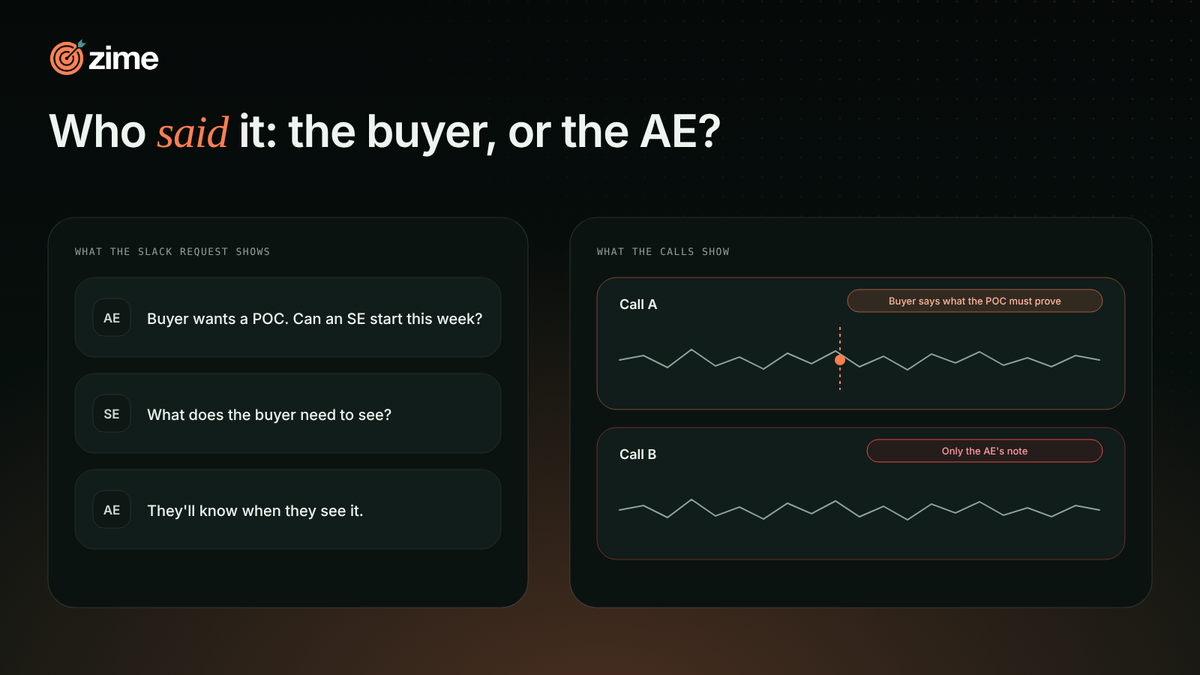
- But the rule only works when AEs run it, and a Slack request does not show whether they did. A POC request lands on Monday. The SE asks what the buyer needs to see. From the request alone you cannot tell if the buyer agreed that out loud or the AE typed a guess.
- And a stricter gate or a better template will not move that. A gate records what was typed, and a template waits to be filled in. Neither gets an AE to ask a hard question on a live call, and that move changes with the buyer, product and stage. Your best people know it, and nobody wrote it down.
- That move was never in your data, so it has to be taught. Zime's Behavior Graph is the model that holds how your best AEs and SEs decide, plus your strategy and past deals. It is built from those people, including what never shows up in a transcript, and hands the AE the move.
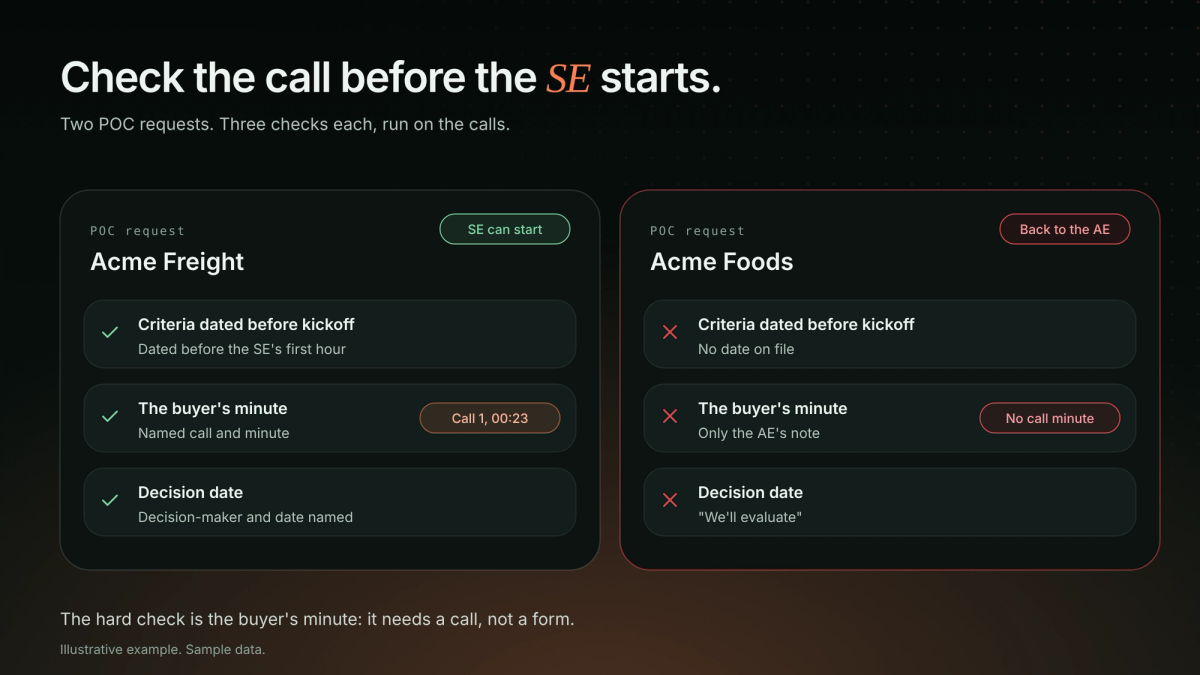
- So keep your gate, your template and your skill, and check the call. Before an SE starts, look for the criteria dated before that day, the minute where the buyer said them, and a named decision date. The share of POCs that pass all three is your adoption: the move run on live deals, not logins.
You lead the SE team. On Monday a Slack message lands. The buyer wants a POC, can an SE start this week?
Your SE asks what the buyer needs to see. The AE answers, "They'll know when they see it."
You are not short of process. You have a POC rule, a success-criteria template and a stage gate in the CRM.
Maybe your team built a skill that drafts the criteria document in one pass. All of it works. The document gets written, the field gets filled, and the SE still starts a POC nobody defined.
So here is the question. Before an SE starts, how would you know the buyer has agreed what the POC must prove? The rule says someone should have asked. It cannot tell you whether anyone did.
What a POC request does not show
The AE types criteria into the form, and they are a guess. The SE starts anyway. You ask in Slack, "Did the buyer agree to this?" The AE writes back, "I think so." Now you are the system, chasing a yes you cannot check.
Guideflow's April 2026 guide says the biggest predictor of whether a POC converts is whether success criteria were agreed before the evaluation began. Challenger says its research found that 40 to 60 percent of lost deals ended in no decision.
A sales leader at Bureau ties her stuck deals to one step. Everyone knows the rule. What is missing is a way to see that it ran.
Why the rule never became a move
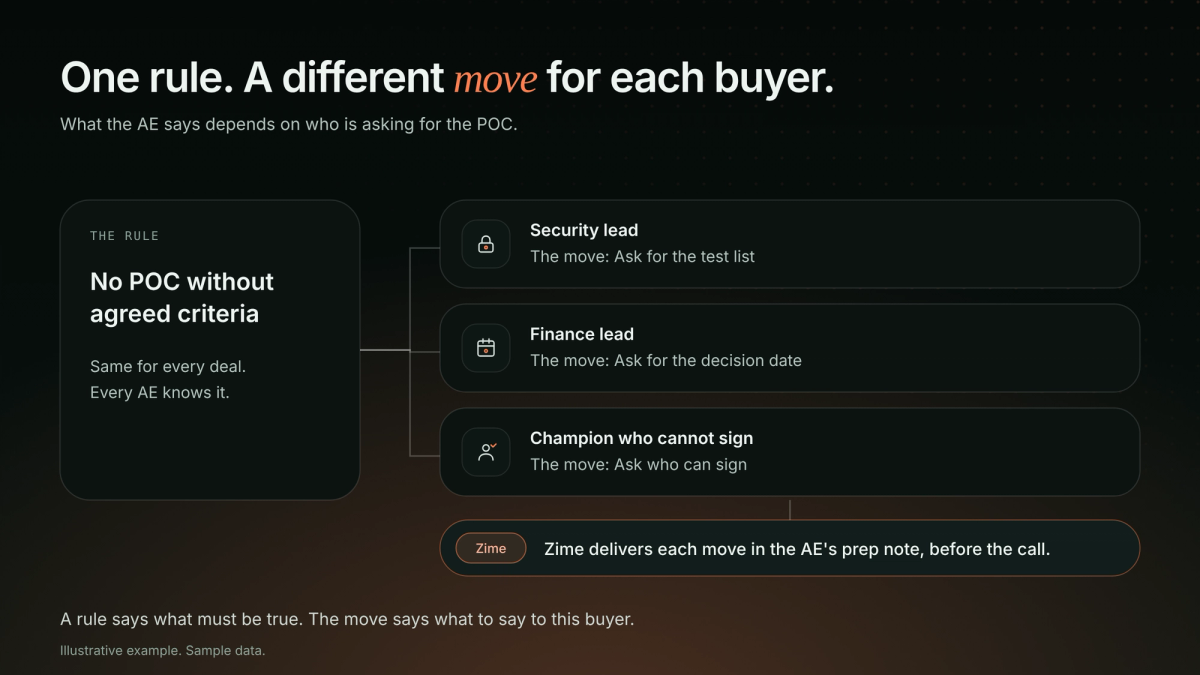
If AEs are not running the rule, look at what they were ever given. A rule says what must be true. It does not say what to say to this buyer.
The right move changes with the seller's role, the product, the buyer, the segment and the stage. A security lead wants a test list. A finance lead wants a decision date.
Your best AEs and SEs handle each in a sentence. Nobody wrote those sentences down. Call data shows what was said, not why it worked.
Ask a general AI assistant what to say and it answers: schedule a technical kickoff. Accurate, and no AE can use it in front of this buyer. A rule does not get run. A move does.
Versa Networks lives this. Almost every Versa deal turns on a technical evaluation, run by more than a hundred SEs across four regions. The handover from AE to SE broke in five places. On an April 2024 call, Mickey Singh listed what a leader should check on a POC.
"Leaders should check if we have agreed on what will be success criteria and keep a tab on it on a regular basis"
Mickey Singh, Sales Enablement Lead at Versa Networks
The move that gets criteria agreed is still the AE's to run.
The table below credits each fix you may already have. The row about the call matters most: none of them shows fully, on the call, that the buyer agreed.
| What it does | Template or action plan | CRM gate | Conversation intelligence | Training | A skill you built |
|---|---|---|---|---|---|
| Writes down the rule and the form | ✓ | ✓ | Partial | ✓ | ✓ |
| Drafts the criteria and the follow-up | Partial | ✗ | Partial | ✗ | ✓ |
| Captures and searches the calls | ✗ | ✗ | ✓ | ✗ | Partial |
| Hands the AE the move for this buyer | ✗ | ✗ | Partial | Partial | Partial |
| Draws on what your best people know | ✗ | ✗ | ✗ | Partial | Partial |
| Shows on the call that the buyer agreed | ✗ | ✗ | Partial | ✗ | Partial |
Zime does the drafting and call capture too. It adds the move for this buyer, what your best people know, and the check on the call.
Each fix has a tell. A template's tell is a date after kickoff. A gate's tell is a filled field with no buyer's minute behind it.
A skill's tell is criteria drafted but never agreed. Your skill does what it was built to do. It cannot make an AE ask.
Teach the move, then check the call
You can test this without buying anything. Pull your last ten POCs. Run three checks.
Ten by hand is fine. A hundred AEs is not, because nobody can listen to that many calls. No manager needs to sit in: the minute is on the recording. The post on pipeline coverage runs the same habit on deal stages.
The table below gives each check and what pass and fail look like. The hard one is the buyer's minute: it needs a call, not a form.
| Check | Look at | Pass | Fail |
|---|---|---|---|
| Kickoff minus one | Criteria date and the SE's first hour | Criteria dated before the SE starts | Dated after, or none |
| The buyer's minute | The call | A named call and minute where the buyer says what the POC must prove | Only the AE's note |
| Decision date | The POC request | A named decision-maker and a date | "We'll evaluate" |
A good criterion is one the buyer can fail: the integration passes three test cases in their environment by week two.
If an AE says asking costs momentum, ask for one criterion and a decision date. Roll it out in halves, with a random half of AEs first, so you can compare.
Checking is half the job. The other half is the move itself. In plain words, a behavior is the specific move for this deal, with the winning deal behind it.
Zime's Behavior Graph is the model that holds how your best AEs and SEs decide, plus your strategy and past deals. It is built from those people, including what never shows up in a transcript.
Zime teaches the move to your sales team, then delivers it in the AE's prep note before the buyer call. The note shows the AE the move, with the winning deal behind it. Strategy does not get adopted. Behaviors do. You keep your gate, your template and your skill.
Taught and done are two different numbers. The call gives you the second.
The same Monday, replayed
Same Slack message, new Monday. Before it was sent, the AE asked the buyer one question on the call. What has to be true for you to buy?
The buyer said it. The AE got a date. The request reaches your SE with a named call and minute. The AE gets no Slack chase.
You skip the Slack thread and open a weekly count: the share of POCs that passed all three checks. That is adoption, the move run on live deals.
Kapil Bhagat of Bureau tied monitoring to execution on a May 2024 call.
"Having a dashboard where non adherence is called out improves execution."
Kapil Bhagat, AVP, Sales Strategy at Bureau
A leader who sees the miss fixes it before the SE starts.
Zime has not published a result for POC success criteria. It has published a different behavior, counted the same way. 79% of Versa's SEs ran the right technical discovery within three months, up from 20% at the start. Brent Bair of Versa described what that count did to his team.
"the adoption rate has improved. I think it's become ingrained in our sales DNA"
Brent Bair, Regional Sales Leader at Versa Networks
Adoption you can count changes what a team does.
The table below runs the comparison on illustrative sample numbers: three AEs, each with their own POCs with and without agreed criteria. Read it AE by AE, never pooled. An AE with fewer than three POCs on a side is direction only.
| AE (sample) | POCs won, criteria agreed first | POCs won, no agreed criteria | Read |
|---|---|---|---|
| Dana | 3 of 4 | 2 of 5 | Enough on both sides |
| Marcus | 3 of 4 | 1 of 4 | Enough on both sides |
| Elena | 2 of 2 | 1 of 3 | Direction only |
All three AEs won more with agreed criteria, and two of the three have enough POCs to count.
Keep your gate. Check the call.
Your gate, template and skill stay yours. Zime adds the move your best AEs and SEs run with each buyer, from your strategy, checked on the call. Bring last quarter's ten POCs, and see which ones had a buyer's minute. Book a demo →
FAQ
Deals go into a POC with no agreed success criteria. How do you stop that before the SE is pulled in?
Get the buyer to say, on a call, what the POC must prove, and make that the condition for starting. The move that gets it said differs by role, product, buyer, segment and stage, and your best AEs never wrote it down. Zime's Behavior Graph, the model that holds how they decide plus your strategy and past deals, teaches it, including what never shows up in a transcript.
What if the buyer will not agree to criteria?
Ask for one criterion and a decision date. A buyer who gives neither is telling you the deal is not ready for SE time, as Guideflow's guide also reads it.
Can some POCs start without criteria?
Yes, as a named exception with a reason and an owner. What you avoid is an exception nobody chose. Run the same three checks afterwards, so the next exception is a decision.
We built a skill that drafts the criteria document. Is that enough?
It does that job, so keep it. A drafted document is not an agreed one: the buyer still has to say yes on a call. Zime runs on Claude, so nothing you built is ripped out.
Will AEs feel policed, and what should I ask any vendor?
Ask any vendor one question: does the AE see the same evidence the leader sees? A check the AE cannot see reads as surveillance.