Why does pipeline coverage look healthy while the quarter still misses?

- Your coverage math is not wrong. Three times the number sits in the pipeline. The CRM is cleaner than it was a year ago, and every call is recorded. Those are real fixes, and you keep them.
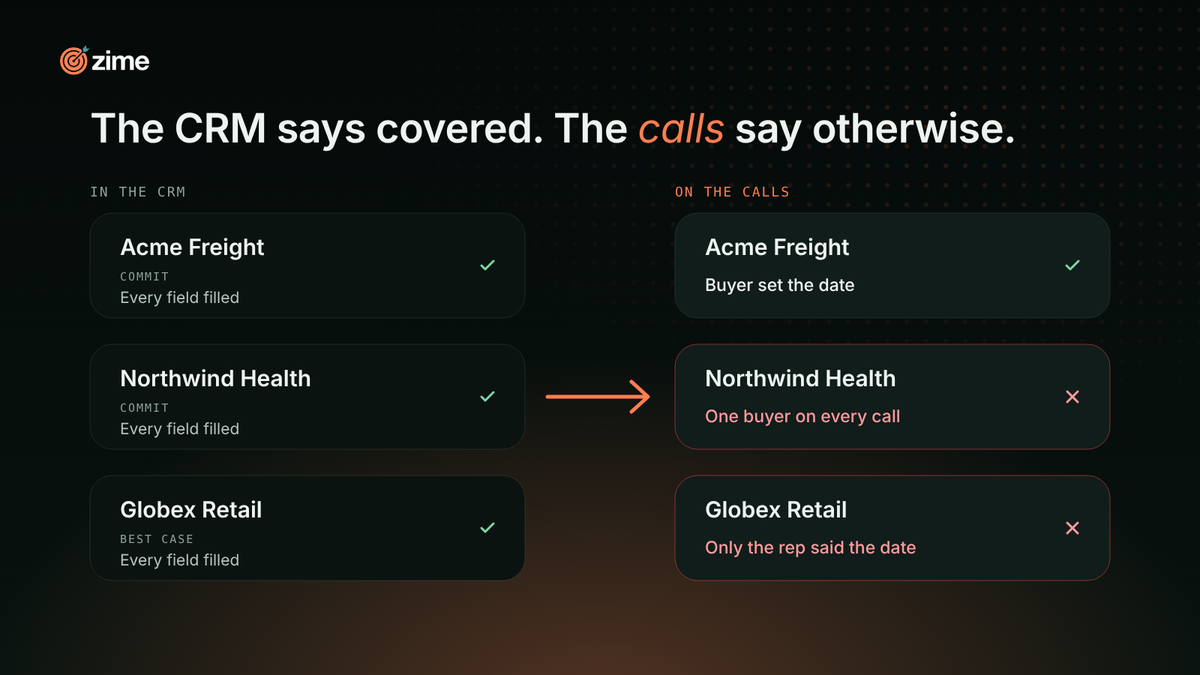
- But coverage counts deals, not the work inside them. A stage, a contact and a next-step date tell you a field was filled. They do not tell you whether a second buyer joined the calls, agreed to that next step or named the impact. That work is what makes a stage real, and the CRM cannot show whether reps ran it.
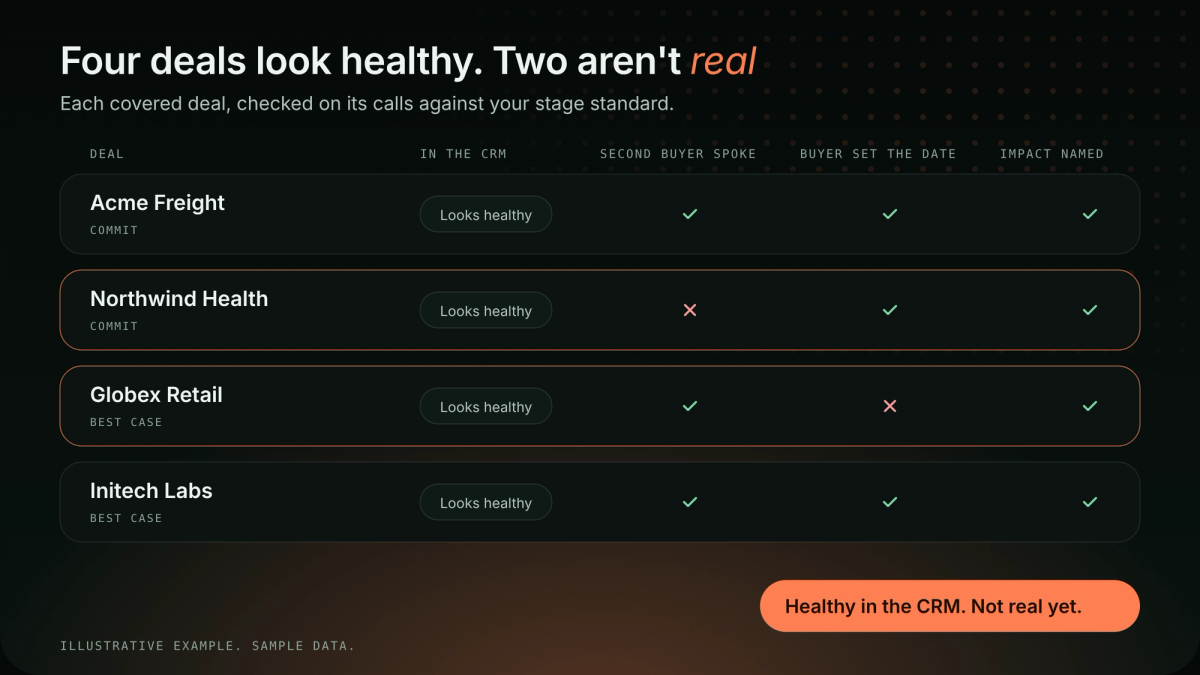
- And the calls already hold the answer. What the buyer said is on the recording. Check each covered deal against the work your stage requires: more than one buyer engaged, a next step the buyer agreed to, impact in the buyer's own words. The deals that fail the check still look healthy in the CRM.
- That check runs on your standard, not a generic risk score. What makes a stage real differs by product, role and competitor, and most of it was never written down. A Behavior Graph is the model that holds it: how your best reps win, including what never shows up in a transcript, plus your current strategy and past deals. It gives each rep the move for the stage they are in.
- So you inspect the work while there is still time to act. Each week you see which reps ran the move, on which deal, and which covered deals skipped it. That is adoption you can inspect, and it answers the board's question: was the strategy wrong, or never executed? Keep the CRM and the recordings you already bought.
It's week nine, and you're the CRO running the forecast call. Coverage sits above three times the number. Fields are filled. Calls are recorded.
By week eleven, two late-stage deals have pushed. Nothing in their records looked wrong.
In a 2020 survey, Gartner found only 45% of sales leaders and sellers had high confidence in their organization's forecasting accuracy.
So the data was clean. How would you have known, deal by deal, whether the work behind each stage had happened, before the forecast moved?
What a clean CRM still can't tell you
CRM hygiene was worth doing. Required fields, activity capture and recorded calls gave you one honest record per deal. Keep all of it.
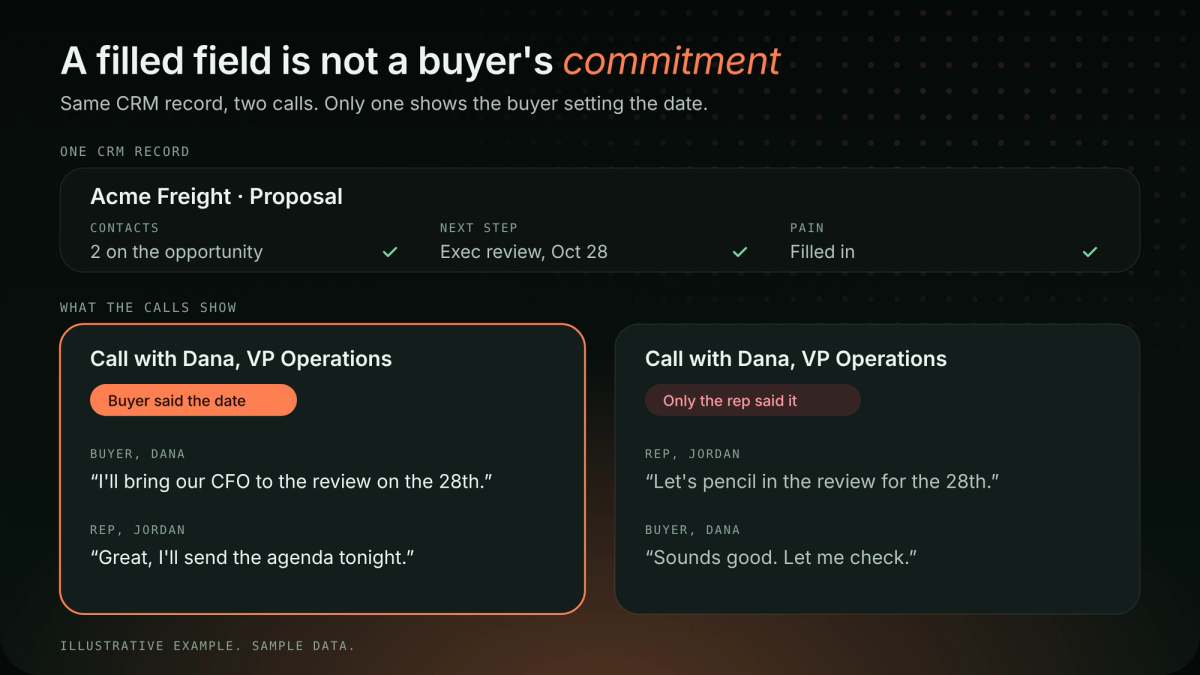
But a record tells you a field was filled. Not that the buyer did anything. A rep can set a next step the buyer never agreed to. The field still looks complete.
That is where coverage hides risk. In four places, a record can be complete while the deal is not, and the table below gives the tell for each.
| Check | What a clean record shows | What the calls must show | The tell |
|---|---|---|---|
| Coverage by stage | Pipeline above three times the number | Late-stage deals with the stage work done | Most of the coverage sits in early stages |
| Contacts | Two or more contacts on the opportunity | A second buyer speaking on a recent call | Only the champion has spoken in the last month |
| Next step | A dated next step | The buyer stating the step and the date | Only the rep said the date |
| Qualification | Pain and budget fields filled | Impact in the buyer's own words | The rep summarized a problem the buyer never named |
The next step decides most quarters. A date in a field is the rep's plan. A date the buyer said out loud is a commitment.
Martin Mackay is CRO of Versa Networks. Versa sells networking and security to technical buyers, in deals from $100K to $3M that each turn on a technical evaluation. Here is how he described his own pipeline:
"Only about a quarter of our pipeline is in the late stage, and the rest of it is various degrees of fiction."
Martin Mackay, CRO, Versa Networks
Coverage counted all of them. Most were not real yet.
Run the check on your own pipeline
You don't need a new tool. Pick ten deals you are counting this quarter. Open the last two calls on each. Run two tests.
The second-voice test. Did anyone other than your champion speak on a call in the last thirty days? Pass: a second buyer spoke about this deal. Fail: the only buyer voice is the champion's, whatever the contact list says.
The buyer-said-it test. Find the moment the next step was set. Pass: the buyer states the step and the date. Fail: the rep proposes a date, and the buyer says "sounds good" or "let me check."
Then read the discovery call for impact. Ranjan R Reddy is Founder and CEO of Bureau. Bureau sells identity and fraud decisioning to banks, fintechs and marketplaces, where one deal holds several products and buyers. He saw this gap in his own team:
"There's not enough discovery done, and therefore, we're unable to establish clear impact with customers."
Ranjan R Reddy, Founder & CEO, Bureau
A deal can move past qualification with no impact the buyer has stated. The CRM still shows it as qualified.
Your conversation intelligence, risk tool or weekly deal review may already flag some of this. Keep them. What they flag is a pattern across past deals. What they don't settle is the standard each deal is checked against: what must be true at this stage, for this product and buyer.
Check every deal against your own standard
Nobody wrote that standard down. A deal against your biggest competitor needs the proof point your CRO picked this quarter.
Your best reps know rules like that by reflex. No field holds them. No past pattern does either.
That is what Zime's Behavior Graph holds. It is a model of how your best reps win, elicited from your best people through FDE-run interviews and RLHF, including what never shows up in a transcript. Zime's engineers interview your top reps and score the moves until those reps would run them.
The model adds your CRO's current strategy and the context of your past deals. Out come Behaviors: the specific move for this stage, role, product and competitor.
Both systems recommend a next step. The difference is upstream: one works from patterns in past deals, the other from your best reps' judgment and your CRO's priorities this quarter. The table below shows which checks each approach can run, and only a check against your own standard shows whether the stage work ran.
| Capability | CRM hygiene | Conversation intelligence and risk flags | A check against your own stage standard |
|---|---|---|---|
| Keeps one clean record per deal | ✓ | ✓ | ✓ |
| Captures what was said on every call | ✗ | ✓ | ✓ |
| Flags single-threaded or quiet deals | Partial | ✓ | ✓ |
| Knows what your stage requires for this product and buyer | ✗ | Partial | ✓ |
| Shows whether the rep ran the stage move, deal by deal | ✗ | ✗ | ✓ |
| Ties each move to the strategy that authorized it | ✗ | ✗ | ✓ |
You already have clean records, call capture and risk flags. What decides the quarter is your stage standard, whether the move ran, and the strategy behind it.
That check runs every week inside pipeline review. Each covered deal is read against your stage criteria, in the buyer's own words.
It shows who ran the move and on which deal. It also shows the deals where nobody did. That is programmatic adoption: Behaviors run, tied to the strategy that authorized them and the deals they moved. Zime's own benchmark is 80% of eligible reps within 90 days.
Why reps act on guidance that arrives inside the deal is in AI sales coaching vs workflow-embedded execution guidance. One limit, stated plainly: Zime has not published how many weeks earlier this check shows a slip. Ask any vendor, Zime included, to show that number on your own closed deals.
Now run week nine again. On Monday the two deals that would push are flagged. One has only the champion speaking. The other has a next step only the rep said.
The rep on the first deal gets the move in her prep note. Bring the finance lead into the next call. A top rep won that way last quarter. The rep on the second deal gets his move too: ask the buyer to set the date.
On Thursday, her manager sees whether she ran it. On Friday, you call the number, and the calls have already answered, which deals are real. One deal comes out of commit. The other gets its second buyer.
What changed when the stage work ran
At Versa, Mackay's priority was to move early-stage deals through or qualify them out. Zime turned it into Behaviors. At the start, 20% of SEs ran the right technical discovery.
Within three months, 79% did. Versa also saw 24% less leakage in the committed pipeline.
"Zime helped our sales team qualify deals more accurately and move them through the pipeline."
Martin Mackay, CRO, Versa Networks
The pipeline got truer. Coverage needs that before it can predict anything.
At Bureau, Kapil Bhagat, AVP of Sales Strategy, tracked what better discovery did:
"Average deal size increased by 30% on the back of improved discovery."
Kapil Bhagat, AVP, Sales Strategy, Bureau
Impact named on the call showed up in the number.
Chad Erickson is VP of Sales & Strategy at MyAdvice, which sells a growth platform to medical, dental and legal practices. He described the moment Zime caught a problem his team had not noticed:
"...a needle in a haystack... it recognized there's something weird going on here."
Chad Erickson, VP of Sales & Strategy, MyAdvice
Fatal objections at MyAdvice fell from 38% of calls to 4%. The signal was in the calls all along. It took a standard to read them against.
At SonicWall, Zime reached 90%+ accuracy predicting whether a deal will advance, a figure HFS Research validated.
One product, a small team, and you on most calls? Run this check by hand each week.
Past that, the standard changes by product, role and competitor faster than anyone can read the calls. That is the work Zime does for revenue leaders. How the standard splits by role is in How do you keep rep behavior consistent across complex deals?
See which covered deals are real.
Keep your CRM, your recordings and your forecast. Zime adds your stage standard, from your best reps and your CRO, checked on every covered deal. Live in 7 days on your own data. Bring last quarter's pushed deals and see what their calls showed. Book a demo →
FAQ
Why does our forecast stay unreliable even after improving CRM hygiene and call recording? Both fixes check the record, not the work. Clean fields don't show whether a second buyer joined, the buyer agreed to the date or impact was named. The calls do. Check each covered deal against your own stage standard, held by your best reps and your CRO, and you see which deals are real in time to act.
How can behavioral signals from sales calls explain why our forecast keeps missing? They show whether the stage work ran: a second buyer speaking, a next step the buyer stated, impact in the buyer's words. The signal explains a miss only against what your company requires at that stage.
Doesn't conversation intelligence already flag at-risk deals? Yes, and keep it. A Behavior Graph also recommends a next step. It is the model that holds your best reps' judgment, including what never shows up in a transcript, and your CRO's current strategy. So one works from patterns in past deals, the other from how your best people win.
Does this replace my forecasting tool? No. The forecast and its tool stay yours; the evidence under each deal changes. When your strategy changes mid-quarter, Zime's forward-deployed engineers encode the new priority, and the stage check changes with it.