Deals stall between discovery and technical evaluation. How do you find exactly where?

- Your CRM is telling you where each deal sits. Days in stage and conversion do their job, and so does your handoff template. Keep both.
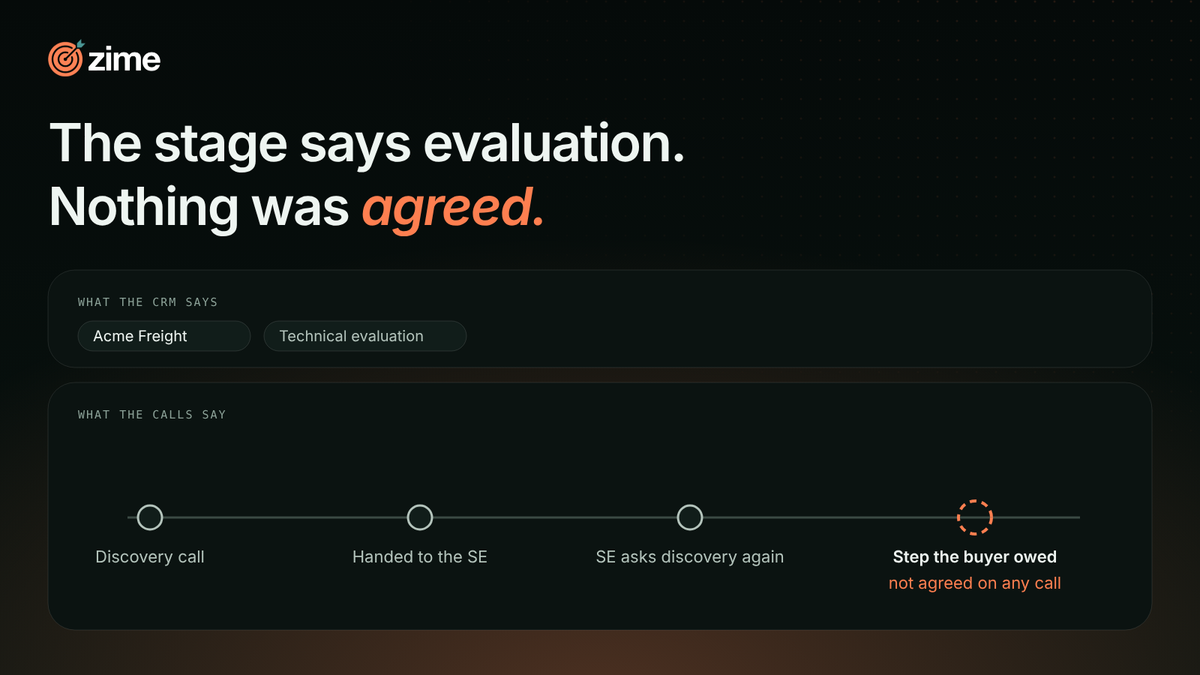
- But the stage is not where the deal stopped. What you cannot see is the exact step the buyer was to take after discovery and did not. The CRM holds what was typed. The call holds the buyer's word.
- And a template or more SE time will not show you that step. An SE who re-asks discovery is one sign it was never agreed. Read the call instead. Check each deal against one list of what must be true before evaluation starts.
- That list is your own standard, and it has to be taught, not mined. The Behavior Graph is Zime's model of how your best SEs decide a deal is ready. It is elicited from your best people through FDE-run interviews and RLHF, including what never shows up in a transcript. In plain terms, Zime's engineers interview them, then score the moves until they would run them.
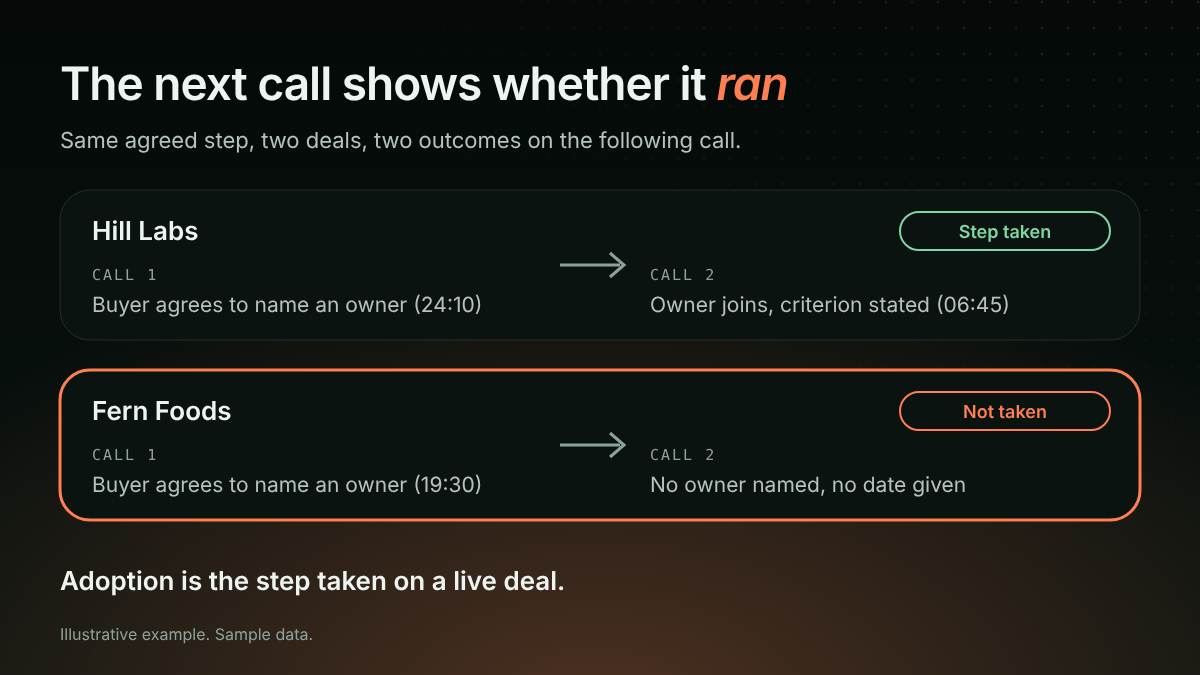
- So check one deal on Monday, and keep everything you bought. Find the step the buyer agreed to, on a named call and minute. Read the next call: did the buyer take it? That is adoption: the step run on a live deal, not a login.
Dana, a VP Sales, opens Thursday’s pipeline review with fourteen deals in Technical Evaluation. Every deal has an owner and a reason for waiting.
The AE says the buyer is thinking it over. The SE says nobody briefed her. The CRM says the deal has sat there for weeks, and that is all it says.
Her tools work. The stage report is accurate, the handoff template is filled in, and every call is recorded. Challenger says its research found that 40 to 60 percent of lost deals ended in no decision. She knows where this column ends if nothing moves.
What she cannot see is where each deal stopped. She wants one fact per deal: what the buyer was to do after discovery, and whether the buyer did it. Where exactly did this deal stop moving, and what was the buyer supposed to do next?
The usual fixes fall short
Four fixes come first. Each is worth keeping, and each stops one step short.
1. A stage report finds the column.
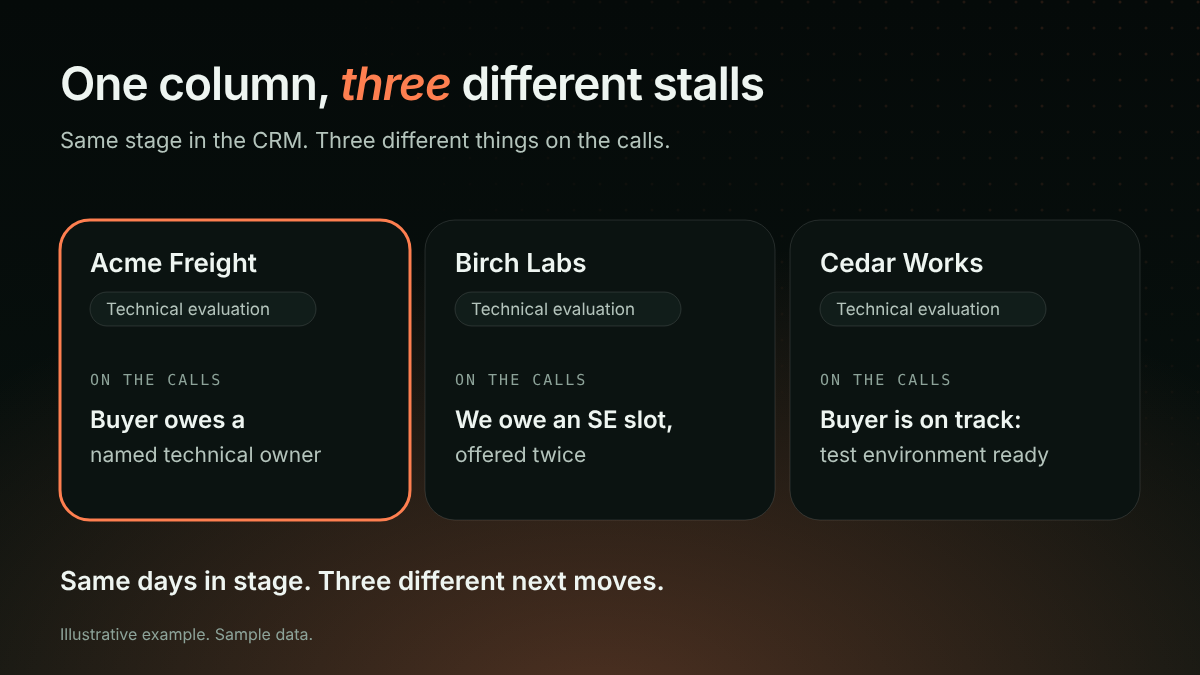
It shows which column a deal sits in, and for how long. It cannot tell apart three deals with the same days in stage. Chitresh Yadav runs SEs across four regions at Versa Networks. His dashboards showed him everything.
"When I go to my org level, I'm drowning because it shows everything."
Chitresh Yadav, VP and Global Head of Sales Engineering, Versa Networks
That is visibility with no next move.
2. A handoff template holds what the AE passed on.
Its tell is an SE who re-asks discovery on the first technical call.
3. More SE time helps when the SE is the wait.
Its tell is who owed the next step at the last contact.
4. Conversation intelligence ranks what correlated with wins.
It reads every call, and both systems recommend. Its tell is a deal with a strong call and no agreed success criterion.
The table below sets what each approach shows about one deal. The lines on what the buyer agreed and on your own standard are the ones that separate them.
| What it shows about a deal | Stage report | Handoff template | Call analytics | Zime |
|---|---|---|---|---|
| Which stage, and for how long | ✓ | ✗ | ✓ | ✓ |
| What the AE passed on | Partial | ✓ | ✓ | ✓ |
| What the buyer agreed on a call | ✗ | Partial | ✓ | ✓ |
| Whether the buyer took the step by the next call | ✗ | ✗ | Partial | ✓ |
| The call checked against your own standard for evaluation | ✗ | ✗ | Partial | ✓ |
The line on checking the call against your own standard carries the argument. Only a standard written from your own best SEs tells a call what it is checked against.
If the column is not where the deal stopped, the step is. So what counts as a step?
Find the step, not the stage
Nobody wrote down what must be true before a deal enters technical evaluation. The AE has a feeling. The SE has another. The stage has no definition, so the call has nothing to be measured against.
A step is something the buyer says out loud: a named owner, a criterion or a date. Guideflow’s April 2026 guide says the biggest predictor of whether a POC converts is whether success criteria were agreed before the evaluation began. It is a vendor guide with no data behind that line.
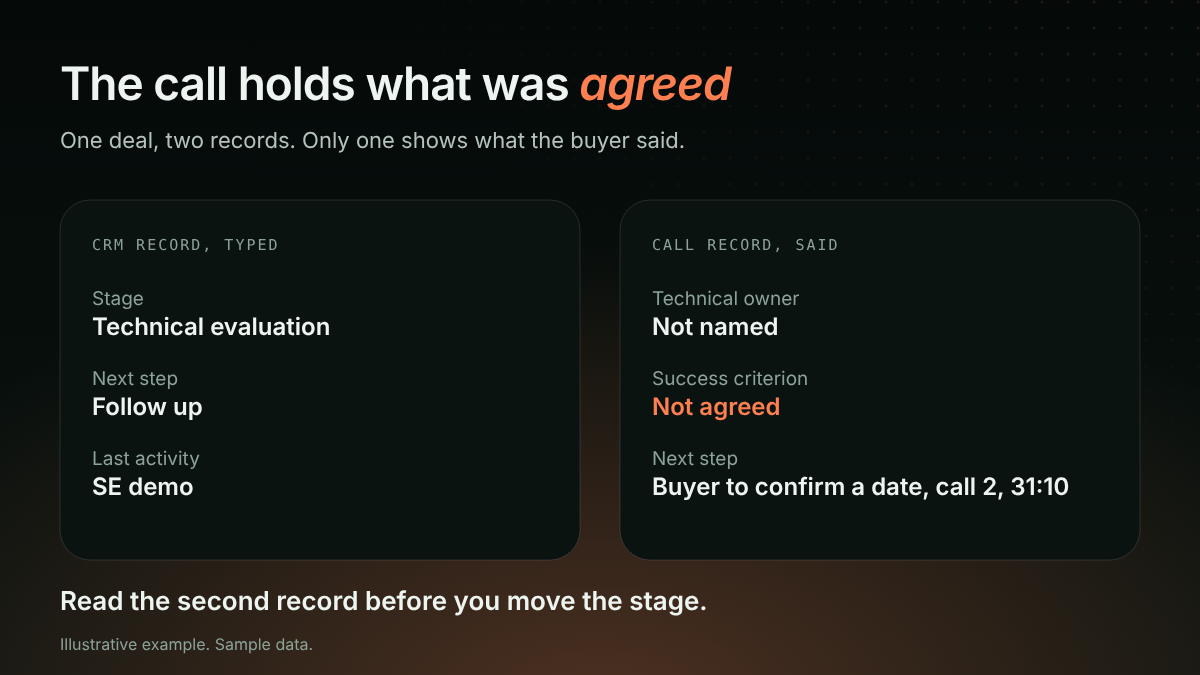
You can test it without any product. Pull the last two calls on ten deals in evaluation. Give each deal twenty minutes. Write two columns: what the CRM says, and what the buyer agreed to do next, with the call and the minute.
Two tests turn that into a verdict. First, name the buyer’s step. Pass: a person, a criterion or a date for most deals. Fail: the notes say “will circle back”. Second, ask who owed the next step at the last contact. Pass: the call shows an owner and a date. Fail: nobody owed anything. If your SE was booked, the step is yours. If the stall looks like a late security review, check whether that reviewer was named on a call before evaluation began. A quiet deal with an agreed step is a slow buyer. A manager can coach to the one moment that decides it. None of this needs a manager on the call, because the recording holds the buyer’s words.
The table below runs both tests on five sample deals. The names and numbers are illustrative.
| Deal | Days in stage (CRM) | What the buyer agreed (call, minute) | Who owes the next step | Verdict |
|---|---|---|---|---|
| Acme Freight | 31 | No technical owner named (call 1) | Buyer | Stalled: no owner |
| Birch Labs | 31 | Criterion agreed (call 2, 18:20) | Us, SE slot offered twice | Stalled on our side |
| Cedar Works | 31 | Environment ready (call 3, 22:05) | Buyer, due Friday | On track |
| Dover Health | 29 | Date agreed, no criterion (call 2, 09:40) | Buyer | Stalled: no criterion |
| Grove Systems | 30 | Nothing agreed after discovery (call 1) | Nobody | Stalled: no step agreed |
Five deals look alike in the CRM and split three ways on the calls. Three wait on a buyer step nobody agreed, one waits on you, and one is fine. Three different fixes sit behind one stage.
By hand, this stops scaling when the column holds more deals than one person can read in a week.
Make the agreed step run
Reading calls once finds today’s stalls. Stopping new ones needs a standard every AE runs before an SE is booked.
Zime’s Behavior Graph is the model that holds how your best SEs decide a deal is ready for evaluation. It also holds your CRO strategy and your past deals. It is elicited from your best people through FDE-run interviews and RLHF, including what never shows up in a transcript. In plain terms, Zime’s engineers interview your best SEs, then score the moves until they would run them. The output is a Behavior: the specific move for this deal. Here it is short. Before an SE is booked, get one named technical owner, one success criterion and one date. Otherwise record a named exception with an owner.
At Versa Networks almost every deal turns on a technical evaluation. In a weekly check-in with Zime, Mickey Singh listed what he wanted checked on each one.
"Have we agreed on what will be success criteria ... are we keeping a tab on it on a regular basis"
Mickey Singh, Versa Networks
That is your standard, written by the person who owns it. Versa reports 79% of its SEs running the right technical discovery within three months, up from 20% at the start. The figure counts behaviors run on live deals. Separately, Versa reports 12% more technical wins. Brent Bair leads a region there.
"As I look at my team, the adoption rate has improved."
Brent Bair, Regional Sales Leader, Versa Networks
That is adoption a leader can see in his own team.
You know it ran when the buyer confirms the step on a named call and minute, and the next call shows the buyer took it. That is adoption: the step run on a live deal. Kapil Bhagat at Bureau described the check on discovery.
"Having a dashboard where non adherence is called out improves execution."
Kapil Bhagat, AVP, Sales Strategy, Bureau Inc.
That is the check: the miss is called out in the open.
Zime has not published a figure for how much faster a leader finds a stall. It has published the adoption and technical-win results above.
Now Thursday again. Dana opens the column and each deal carries one line: the step, the call, the minute. The AE walks into the next call with a named owner and a date to ask for. The SE’s first call starts at the criterion, not at discovery. Dana knows which deals to chase and which to unblock.
With one product and a handful of SEs, the by-hand read may be all you need. Healthy coverage can hide the same gap.
Check one deal this week.
Keep your CRM, your template and your recorder. Zime adds the standard your best SEs would apply, so each call can be checked against it. Bring ten deals sitting in technical evaluation and see the step the buyer owed on each. Book a demo →
FAQ
Deals stall between discovery and technical evaluation. How do you find exactly where?
Read the last two calls on each deal. Write down what the buyer agreed to do next, with the call and the minute, and who owed it at the last contact. Check each deal against one list of what must be true before evaluation. Zime builds that list with your best SEs.
Isn’t days in stage in my CRM enough?
Days in stage tells you which column a deal sits in. It does not tell you what the buyer was to do next. Zime reads from the CRM and recorder you already have.
What if the stall is SE capacity, not the buyer?
At the last contact, who owed the next step? If your SE was booked, the call shows a slot you offered. If the buyer owes it, the call shows a step the buyer agreed and did not take.
Will reps feel policed, and will alerts add noise?
Ask any vendor, including us, two questions. Does the AE see the same evidence the leader sees? What share of flagged deals did managers act on, and how was a flag judged right or wrong?
How many deals do I need before the pattern means anything?
Read it AE by AE, never pooled. Count how many AEs show the same gap. Treat an AE with fewer than three deals on either side as direction only. To test a fix, stagger the start so a random half of AEs go first.