How do you measure whether reps are actually adopting your sales process?

- Measure adoption on the call itself. Count how often each step ran on calls where its moment came up, per rep and per step.
- The hard part: your reports never hear the call. Training, logins and CRM fields show reps received the process, not that they ran it with a buyer.
- Break each stage into moves you can check. "Run discovery" cannot be checked. "Agreed on POC success criteria before the POC" can.
- Zime counts which behaviors ran, per rep, on every call. A behavior is the specific move your best reps make at that moment; Zime encodes, delivers and measures them.
- Customers see the number and see it move. Versa Networks: 20% to 79% of SEs in three months. MyAdvice: checklist adoption from 66% to 87%.
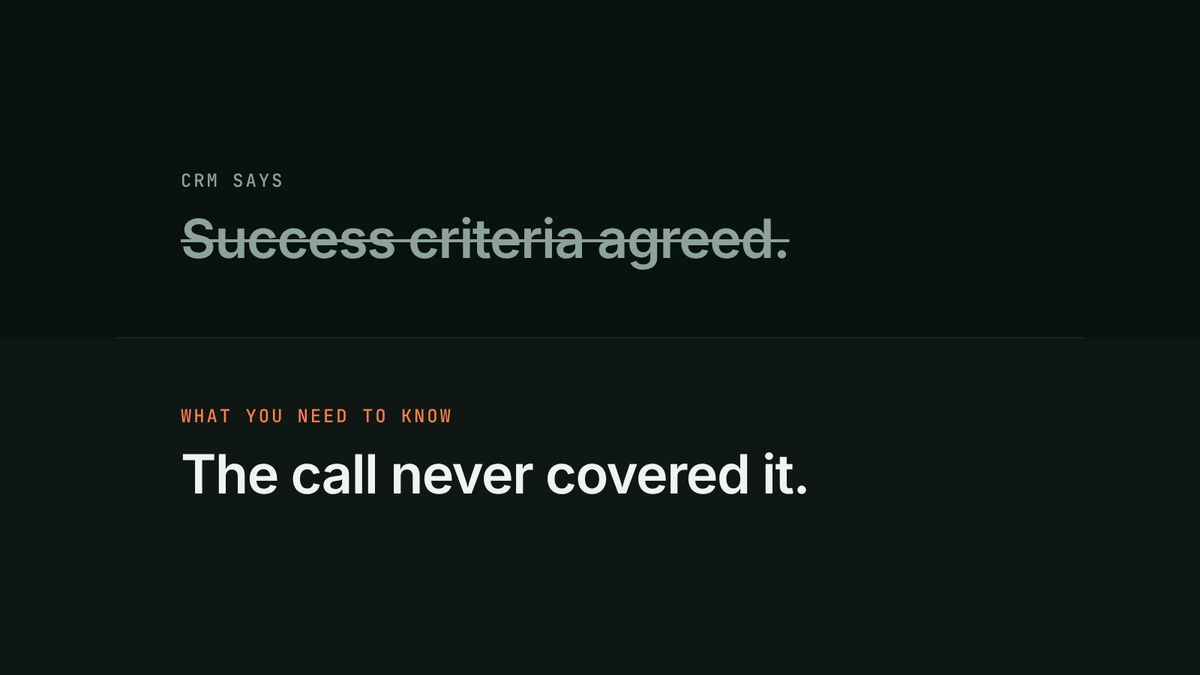
It is Thursday of week six. At kickoff, you set one new rule for the quarter: no POC starts without written success criteria. Enablement certified every rep on it. In the CRM, the field reads "agreed" on almost every open deal.
Then a POC stalls in its third week. You play the technical call. The SE ran a strong demo, and nobody asked the buyer what success would look like. The CRM says agreed. The call never covered it.
Now the question is bigger than one deal. How many other open deals look the same, and which reps are running the rule at all?
Here is how to find out. Measure it on the call. Break each stage of your process into the moves your best reps make there. Check every call for whether each move ran when its moment came up. Divide by the calls where it could have. That number, per rep and per move, is adoption. Training scores, logins and CRM fields cannot give it to you, because none of them hears the call.
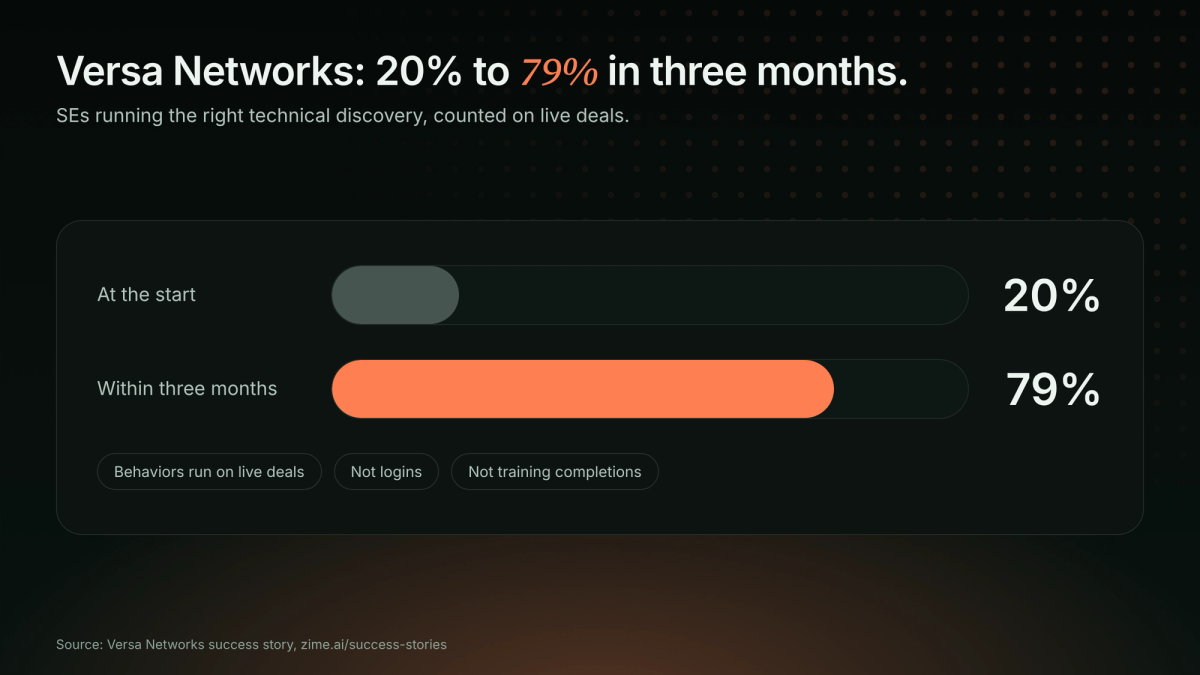
Teams that measure it this way see the number move. At MyAdvice, call checklist adoption rose from 66% to 87% between September and October. At Versa Networks, SEs running the right technical discovery went from 20% to 79% within three months (Versa case study).
Mickey Singh runs sales enablement at Versa Networks, which sells several product lines against ten named competitors. On an August 2026 call, he asked it plainly:
"...any methodology they look very attractive? But in reality, how much of them are executed in the real customer calls?"
Mickey Singh, Global Head, Sales Enablement, Versa Networks
Zime, Behavioral AI for Sales Execution, is built to answer it on every call.
Why your adoption report can't answer it
Each signal on a typical report answers a different question. Training says the rep heard the process. Logins say the tool is open. CRM fields say the record is kept. Trackers say a word was spoken. Gartner notes that sales operations leaders often measure sales technology adoption through "usage metrics that reveal activity but not business value" (Gartner). Forrester evaluated pipelines across a range of companies and describes a gap between the methodologies companies roll out and what reps execute at each stage (Forrester).
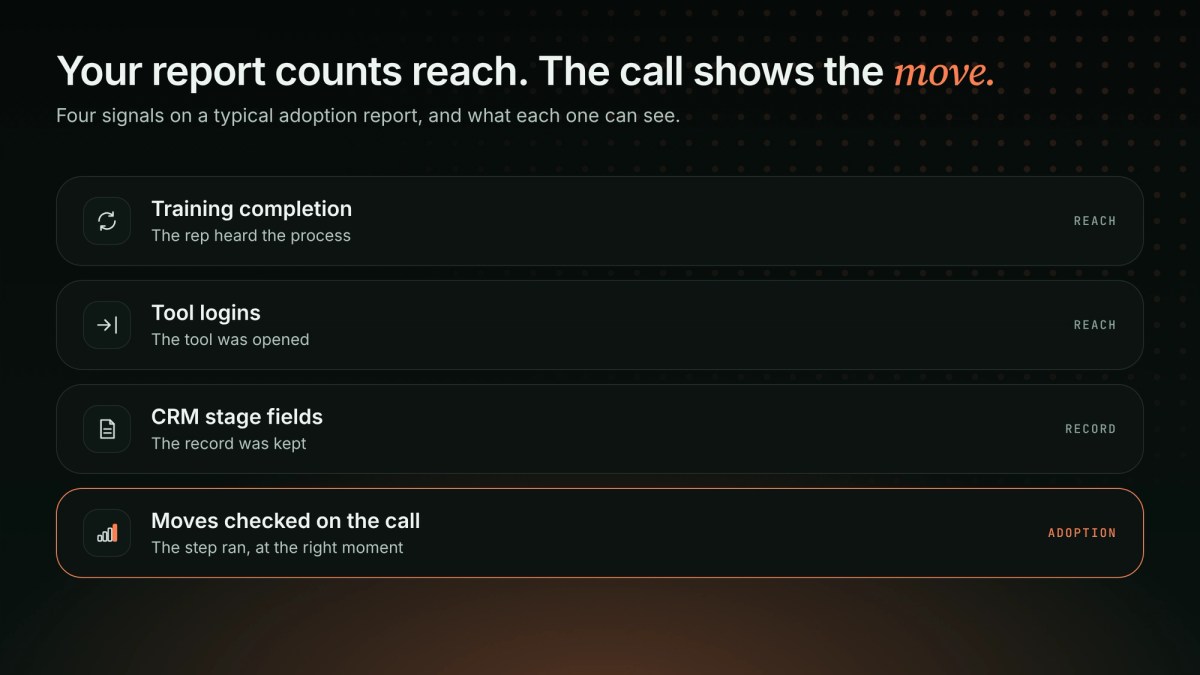
The table below sets the common signals against the question each can answer.
| What it can show | Training completion | Tool logins | CRM stage fields | Call keyword trackers | Moves checked on the call |
|---|---|---|---|---|---|
| The rep was trained on the process | ✓ | ✗ | ✗ | ✗ | ✗ |
| The record was kept | ✗ | ✗ | ✓ | ✗ | Partial |
| The step was done the way your best reps do it, at that stage | ✗ | ✗ | ✗ | Partial | ✓ |
| The step is tied to whether the deal moved | ✗ | ✗ | Partial | Partial | ✓ |
Read across: only the last column answers both questions that matter, whether the step ran and whether the deal moved.
Kenny Cao leads GTM strategy and operations at Skan AI. Describing a new deck and value proposition, he named the same gap:
"I want to understand how the team is delivering against the deck and against the new value proposition, right? It is more of an enablement understanding versus whether they've done it."
Kenny Cao, Senior Director, Head of Go-To-Market Strategy and Operations, Skan AI
Break the process into moves you can check
A process is written as stages and exit fields, like "run technical discovery." On a live call, each line breaks into specific moves that change by role, product, buyer and stage. Zime calls each of these moves a behavior. Your strategy runs on 1,000+ behaviors. Nobody has written them down, tested them or kept them current.
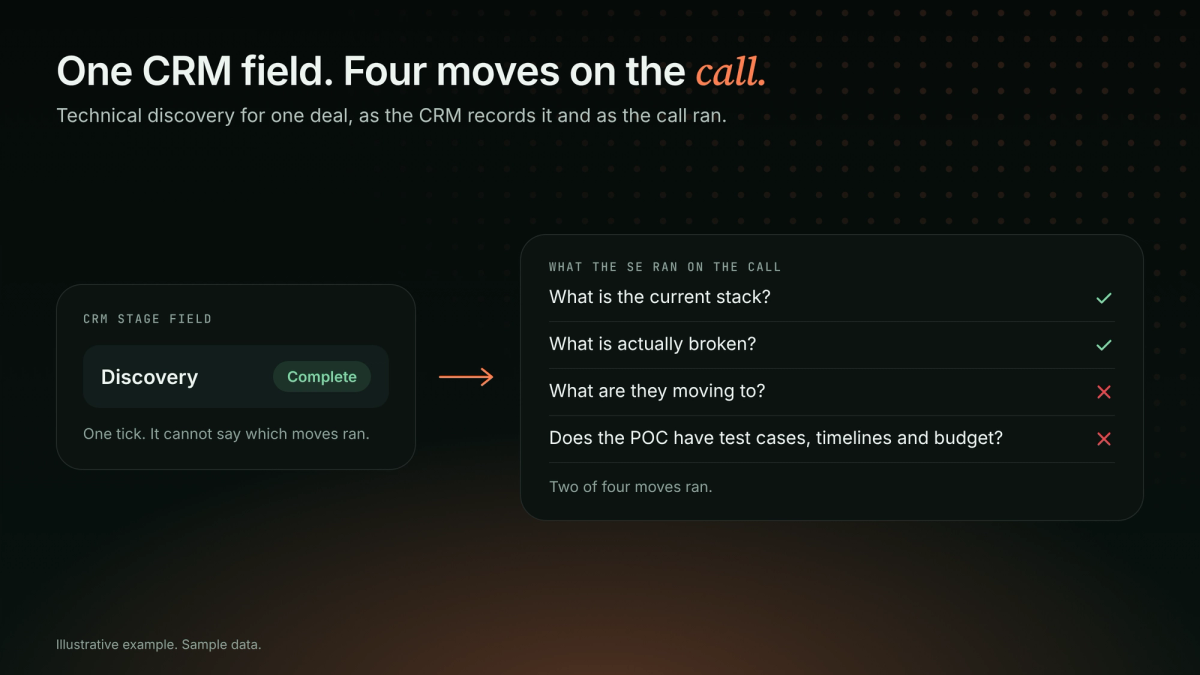
Versa's technical evaluation shows the scale. Before a POC, an SE has to establish four things. What is the current stack? What is actually broken? What are they moving to? Does the POC have real test cases, timelines and budget behind it? A CRM field can say "discovery complete" when only one of the four was asked.
And nobody can check by sitting in. John Volkering ran Versa's European SE team, where technical deep dives decide the largest deals:
"My team doesn't like their managers to be on their calls and get micromanaged."
John Volkering, Director of Systems Engineering, Versa Networks
So the measure has to come from the call itself, move by move, without a manager in the room.
Measure each move on every call
You can try this without buying anything. Pick one stage, one team and the last 30 calls at that stage.
- Write the stage as moves. Three to five lines a listener can mark yes or no, taken from what your best reps do.
- Mark each call. Did the moment come up? Did the rep run the move?
- Count adoption per rep. Runs divided by eligible calls, where eligible means the moment came up.
- Tie each move to the next stage. Did the deal advance within 30 days? Compare within one team so warmer deals do not flatter the move, or stagger the rollout: half the team first, everyone by quarter end.
- Bring the gaps to pipeline review and the 1:1. One skipped move, one deal, one rep.
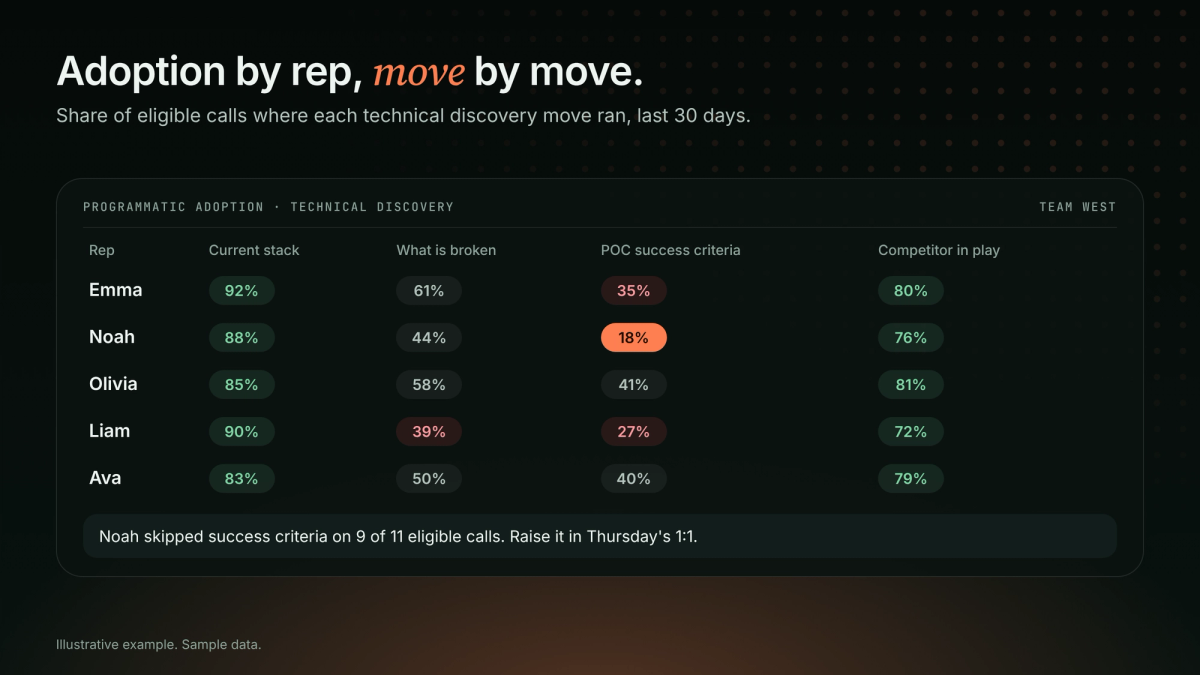
The table below runs that method on one sample stage. Illustrative example. Sample data.
| Technical discovery move | Eligible calls | Ran | Adoption | Advanced when run | Advanced when skipped | Read |
|---|---|---|---|---|---|---|
| Confirm the current stack | 30 | 26 | 87% | 58% | 50% | Running; small lift |
| Ask what is actually broken | 30 | 15 | 50% | 67% | 33% | Coach it; it moves deals |
| Agree POC success criteria before the POC | 22 | 7 | 32% | 71% | 20% | Biggest gap; fix first |
| Name the competitor in play | 18 | 14 | 78% | 50% | 50% | No lift; rework the move |
Coach the success-criteria move first: it is rarely run, and deals advance far more often when it is. The competitor move runs often and changes nothing, so rework the move itself.
Once adoption is a number, leaders track it like pipeline. At Versa, Mickey Singh reviews the AE methodology checklist report every month. Reading it on a June 2026 call, with adoption above 70%, he said:
"Last month was 74%. So it's it's going right direction."
Mickey Singh, Global Head, Sales Enablement, Versa Networks
Bureau did the same for discovery after its founder saw that too little of it was being done to show buyers clear impact. Checklist adherence was tracked automatically, with dashboards for sales managers. Kapil Bhagat, AVP of Sales Strategy at Bureau, described the effect:
"So this monitoring led to execution ... Having a dashboard where non adherence is called out improves execution."
Kapil Bhagat, AVP, Sales Strategy, Bureau
Calling out the skipped step is what moved execution.
Two tests you can run this week:
- The closed-lost test. Listen to a lost deal with every field filled. Pass: the call shows each move. Fail: the field is ticked, the call is silent.
- The one-question test. Ask your report which rep skipped the success-criteria move last week. Pass: it names them. Fail: it shows logins.
By hand, this stops scaling. Thirty calls and four moves is a day of listening for one stage, and a full process is hundreds of moves that change with the strategy.
How Zime measures adoption on every call
Zime solves this by turning your process into the moves your best reps make, delivering them on each call, and counting which ones ran.
- Encode. Zime's engineers interview your best reps and your CRO. The Behavior Graph holds what they know, this quarter's strategy and your past deals, and produces behaviors: the move for this deal, with the winning deal behind it.
- Deliver. Each behavior reaches the rep in the prep note before the call and as a live prompt during it, keyed to the CRM stage.
- Measure. Programmatic Adoption checks every call for which behaviors ran, per rep and per stage. Gaps show up in pipeline review.
- Prove. Strategy Studio tests behaviors against won and lost deals, to show which ones win.
- Update. When the strategy changes, Zime's engineers update the behaviors. Nobody rewrites the process doc.
What four companies measured, and what moved
The table below lists the step each company measured on its calls and the result it published.
| Company | Step measured on calls | Result | Source |
|---|---|---|---|
| Versa Networks | Right technical discovery by SEs, including POC success criteria set upfront | 79% of SEs within three months, up from 20%; 12% more technical wins; 24% less leakage in the committed pipeline | Versa success story; HFS Research |
| MyAdvice | Sales call checklist | Checklist adoption 66% to 87% (Sep to Oct); fatal objections 38% to 4%; win rate 15% to 17% | MyAdvice success story |
| SonicWall | A clear end-of-call ask | 30-40% increase in reps making clear end-of-call asks | SonicWall success story; HFS Research |
| Bureau | Discovery checklist | 30% increase in deal conversions; average deal size up 30% | Bureau success story |
In every case, the result followed a step that was counted on live calls.
Versa Networks: the full case. Versa sells SASE across several product lines against ten named competitors, with 100+ SEs running technical evaluations in deals from $100K to $3M. Leaders could not sit in on SE calls, so technical discovery happened once, in one call, and then vanished. Versa used Zime to encode how its best SEs run a technical evaluation. The four discovery questions became a checklist that fires off the Salesforce stage, prep notes carried the competitor move, and pipeline review flagged each skipped step. Within three months, 79% of SEs were running the right technical discovery, up from 20% at the start. That counts behaviors run on live deals, not logins or training. Technical wins rose 12%, validated by HFS Research, and leakage in the committed pipeline fell 24%. Read the Versa Networks case study, or hear Versa's CRO Martin Mackay and enablement head Mickey Singh talk through the rollout in this conversation (watch on YouTube).
Brent Bair, a regional sales leader at Versa, saw it from the field:
"As I look at my team, the adoption rate has improved. I think it's become ingrained in our sales DNA now that this is incredibly valuable as we're progressing through deals."
Brent Bair, Regional Sales Leader, Versa Networks
MyAdvice. MyAdvice sells to law firms and healthcare practices. Checklist adoption rose across the cohort, not just among champions, because the checklist surfaced inside live calls (MyAdvice success story). Chad Erickson, VP of Sales and Strategy, described Zime catching a problem on one call:
"Incredibly encouraging to me is that the Zime technology picked up on it… a needle in a haystack… it recognized there's something weird going on here."
Chad Erickson, VP of Sales & Strategy, MyAdvice
Bureau. With discovery adherence tracked per rep, Bureau reported a 30% increase in deal conversions and a 30% rise in average deal size.
Now replay Thursday of week six. The report names the three reps who skipped the success-criteria move, and on which calls. You coach those three before their next technical call, and the SE walks into the next POC with criteria agreed.
Book a demo to see adoption counted on your own calls.
FAQ
How do you measure whether reps are actually adopting your sales process?
Measure it on the call. Break each stage into the moves your best reps make, check every call for whether each move ran when its moment came up, and divide by the calls where it could have. Zime does this per rep and per stage, and ties each move to whether the deal advanced.
What is sales process adoption?
Sales process adoption is the share of eligible calls where reps ran the steps your process asks for, at the moment it asks for them. It is measured on live deals, not in training or the CRM.
Which sales tools measure real adoption instead of logins?
Training platforms measure completion, CRMs measure fields, and call recorders track keywords. Measuring adoption means checking each step on the call and tying it to whether the deal moved. Zime does this per rep and per stage.
How long does it take to see adoption move?
Versa Networks went from 20% to 79% of SEs running the right technical discovery within three months. MyAdvice moved checklist adoption from 66% to 87% between September and October.